Image to help understand the article
One ship moves. A global supply question remains.
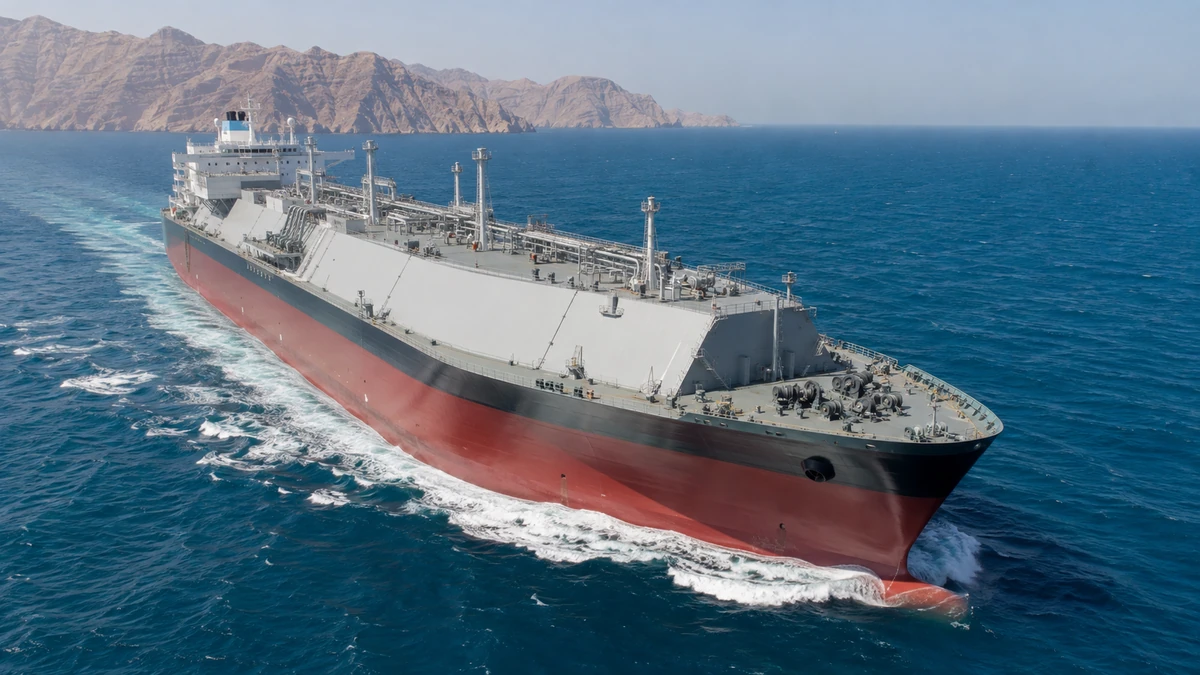
A tanker carrying liquefied natural gas from Qatar has passed through the Strait of Hormuz, offering evidence that a loaded vessel can leave the Persian Gulf — but not yet that one of the world's most consequential energy routes is returning to reliable service.
The Al Maruna was sailing in the Gulf of Oman on the morning of the 8th, according to ship-tracking data reviewed by Bloomberg and cited in the Korean news account. Its listed destination was Pakistan's Port Qasim, with arrival expected on the 10th. That schedule describes an intended voyage, not a confirmed arrival or completed delivery.
For Americans, the significance extends beyond a distant waterway. The United States is a major LNG exporter, and disruptions to competing supplies can change the choices facing U.S. energy companies and their overseas customers. For South Korea, a U.S. ally that relies heavily on imported energy, dependable maritime deliveries are an economic necessity.
The key distinction is between movement and reliability. A ship clearing a chokepoint is a measurable development. Restoring a supply system requires repeated departures, dependable passage, completed deliveries and greater clarity about sellers' contractual obligations. The Al Maruna's voyage establishes only part of that picture.
Why this narrow passage matters far beyond the Gulf
The Strait of Hormuz connects the Persian Gulf with the Gulf of Oman and the wider ocean. Qatar's LNG shipments must pass through it to reach overseas markets. That geography concentrates a global energy concern in a relatively narrow stretch of water: Gas can be produced and loaded, yet still fail to reach customers reliably if maritime access becomes uncertain.
LNG is natural gas chilled into liquid form so it can travel aboard specialized tankers rather than through pipelines. At the receiving end, import terminals typically turn it back into gas for power generation, industry and other uses. The process links production plants, loading terminals, ships, waterways and receiving facilities. A disruption at any one of those points can complicate delivery.
For an American reference point, think of a major freight bottleneck rather than simply an oil well going offline. Reopening a bridge to one truck would show that a crossing is possible. It would not establish that the full distribution network can operate on a predictable schedule. LNG adds further complexity because the cargo requires specialized infrastructure and shipping capacity.
The Al Maruna had loaded its cargo early in the previous month, according to the account. The gap between loading and passage matters, but the available information does not establish where the vessel spent that time or what procedures preceded its transit. It would be speculative to describe a particular holding location, escort arrangement or negotiated permission as the explanation.
Loaded departures tell more than empty arrivals
Several empty Qatari LNG carriers had been observed returning to the Persian Gulf in recent weeks. Those movements suggested that ships needed for exports were heading back toward the loading region. The Al Maruna's outward passage adds a different and more concrete signal: A vessel carrying gas has moved beyond the strait.
The difference is operational, not merely semantic. An empty tanker returning to a producing region may be preparing for a future assignment. A loaded tanker leaving that region is transporting an actual cargo toward a customer. Neither observation, by itself, reveals the schedule or prospects for the rest of the fleet.
There is no confirmation in the available account that the returning empty ships and the Al Maruna were moving under a single, established export plan. Nor does it provide loading dates or destinations for those other carriers. Treating all the movements as proof of a coordinated restart would go beyond the evidence.
Even a successful delivery at Port Qasim would answer a limited question: whether this cargo completed its journey to its intended destination. It would not establish that buyers in Europe or elsewhere in Asia could receive supplies on equivalent terms. The more useful test is whether additional loaded departures follow and whether deliveries become routine rather than exceptional.
What this means for the United States
America's role in this story is different from that of a country primarily dependent on imported LNG. U.S. export terminals, particularly along the Gulf Coast, sell gas into overseas markets. When buyers cannot count on Qatari cargoes, they may look for alternatives, including American supplies. That creates a potential commercial opening, but not an automatic ability to fill every shortfall.
Export facilities have finite processing capacity. Tankers must be available, buyers need access to receiving terminals, and existing contracts can limit which cargoes are available for new transactions. A higher overseas price cannot instantly produce an additional liquefaction plant or free a ship already committed to another voyage.
There is also a domestic dimension. U.S. LNG plants draw from the American natural gas system, connecting overseas demand with domestic production and consumption. Stronger export demand can add pressure to that balance, although the effect depends on production, weather, storage and pipeline constraints. The Al Maruna's transit alone provides no basis for predicting a change in Americans' heating bills or electricity rates.
A useful U.S. industry comparison is the restart of an export terminal after an outage. The first departing cargo may demonstrate that operations have resumed in some form. Customers and traders still need to know whether the plant can sustain output and meet delivery schedules. At Hormuz, the unresolved issue includes access to a shipping route, not just the operating condition of a single facility.
Washington also faces a strategic question. The account identifies uncertainty about how the United States will respond to a proposed Iran-Oman arrangement for managing passage through the strait. It reports no new U.S. decision. For American companies, the practical concern is not only whether vessels can pass today, but whether future rules and their enforcement will allow predictable trade.
South Korea's exposure connects energy security with U.S. ties
South Korea's internationally familiar exports — smartphones, cars and increasingly entertainment — can obscure how much its economy depends on energy arriving from abroad. Unlike the United States, it does not have a comparable domestic natural gas production base. LNG delivered by sea helps supply the energy system behind factories, businesses and homes.
Natural gas also has an everyday cultural connection. Many Korean homes use gas-fired boilers for hot water and modern versions of ondol, the underfloor heating associated with Korean domestic life. Historically, ondol used heat from a fire beneath the floor; modern systems commonly circulate heated water. For readers more familiar with American furnaces and air ducts, that is one way to understand how an international gas supply issue can reach the household level.
That does not mean this particular ship was carrying gas for South Korea. Its listed destination was Pakistan, and the account identifies no Korean buyer for its cargo. Korea's relevance lies in the wider market: If multiple importers seek replacement supplies at the same time, their purchasing decisions can affect one another even when their cargoes originate in different countries.
The U.S.-South Korea connection is therefore commercial as well as strategic. American LNG can serve as one source in a diversified Korean supply portfolio. But diversification is not the same as complete protection. Additional purchases depend on available cargoes, shipping capacity, prices and contract terms. Nothing in this voyage establishes a new bilateral supply agreement or a specific change in Korean procurement.
For both countries, the broader lesson is that energy security involves more than choosing a supplier. It also requires examining the route a cargo takes and whether alternative supplies can arrive when needed. A strong diplomatic relationship cannot, on its own, eliminate physical transportation constraints.
Iran-Oman talks raise separate questions about access and control
Iran said on the 7th that an agreement with Oman to manage transit through the Strait of Hormuz was close to being concluded. That statement is important, but its status needs to remain clear: An announcement that an agreement is near is not confirmation that it has been signed, implemented or accepted by all affected parties.
The available account does not spell out proposed passage conditions or explain how they would be applied. It also does not establish that the Al Maruna's voyage resulted from the talks. The diplomatic announcement and the ship's movement occurred close together, but timing alone cannot demonstrate a causal connection.
A transit arrangement could potentially reduce uncertainty by making procedures clearer. It could also raise concerns about Iran consolidating its influence over passage. Those possibilities are not mutually exclusive. A system might permit more ships to move while introducing new questions about who decides the conditions under which they travel.
For Washington and Seoul, that distinction matters. Physical access is an immediate commercial concern; the durability and governance of that access are longer-term strategic concerns. Without published terms and evidence of implementation, however, it is too early to assert that the proposed arrangement imposes particular fees, restrictions or security requirements.
A moving cargo does not settle a contract dispute
A separate obstacle to declaring normal service lies in the supply contracts. Qatar notified European and Asian buyers in the previous month that the application of force majeure provisions to LNG supplies would be extended through October, according to the account.
Force majeure is a contractual mechanism addressing circumstances beyond a party's control that interfere with performance. American readers may have encountered the term in coverage of hurricanes, industrial outages or pandemic-era business disputes. Its consequences depend on the contract and applicable law; it is not a universal declaration that every obligation disappears.
The underlying contract language and the treatment of individual buyers are not available here. The notification therefore should not be read as proof that every Qatari LNG contract was suspended in precisely the same way. Equally, one cargo moving through Hormuz does not show that the notification has been withdrawn or that all affected delivery commitments have been restored.
That leaves buyers evaluating two distinct kinds of evidence. Ship locations help show what is happening physically. Supplier notices and delivery commitments help show what customers can expect contractually. A dependable recovery would require greater confidence in both, rather than an encouraging shipping observation being used as a substitute for a firm supply schedule.
Why price relief needs more than an encouraging signal
The Korean account describes LNG prices as remaining elevated because of supply uncertainty. It supplies no benchmark prices, trading figures or measured price response following the Al Maruna's passage. There is therefore no basis for claiming that the voyage has already brought prices down.
Energy markets consider expectations as well as cargoes currently at sea. A succession of completed deliveries could give buyers more confidence that supplies will be available when required. A lone transit, without follow-up shipments or clearer operating conditions, offers less assurance.
For consumers, wholesale LNG developments are also several steps removed from a utility bill. Fuel purchasing arrangements, regulation, electricity generation sources and the timing of cost recovery all influence how market changes reach households. That is true in different ways in the United States and South Korea. Neither immediate savings nor an immediate increase in household costs can be inferred from this ship's position.
The same caution applies to businesses. An American exporter might see greater interest from overseas buyers during a disruption, while a Korean importer might prioritize securing replacement supplies. But the account identifies no resulting sales, company earnings changes or procurement decisions. Those remain possible market responses, not reported outcomes.
What would make this the start of a recovery?
The next meaningful milestones are observable. First is whether the Al Maruna reaches Port Qasim and completes delivery. An estimated arrival is useful for tracking the voyage, but confirmation of discharge would establish that the cargo actually reached its customer.
Second is whether more loaded LNG carriers leave the Persian Gulf, and whether those movements continue over time. Repetition would provide stronger evidence of a functioning export route than either empty ships returning or one loaded vessel departing. Buyers would also need to assess whether departures translate into dependable delivery schedules.
Third is clarity about the proposed Iran-Oman agreement: whether it is finalized, what it says and how it operates in practice. Any U.S. response would need to be evaluated on the basis of an actual announcement or action, not an assumed confrontation or accommodation. Changes to force majeure notices would provide another important indication of suppliers' confidence.
The Al Maruna's passage is thus a concrete development with a limited conclusion. A Qatari LNG cargo has cleared Hormuz and is listed as heading toward Pakistan. For American exporters, Korean importers and other participants in the global gas market, the larger question remains unanswered: Can that voyage become a repeatable service on which customers can rely?
Comments
Post a Comment