As K-pop Becomes a Tool of Statecraft, South Korea Faces a Familiar Question: Where Does Public Duty End and Private Business Begin?
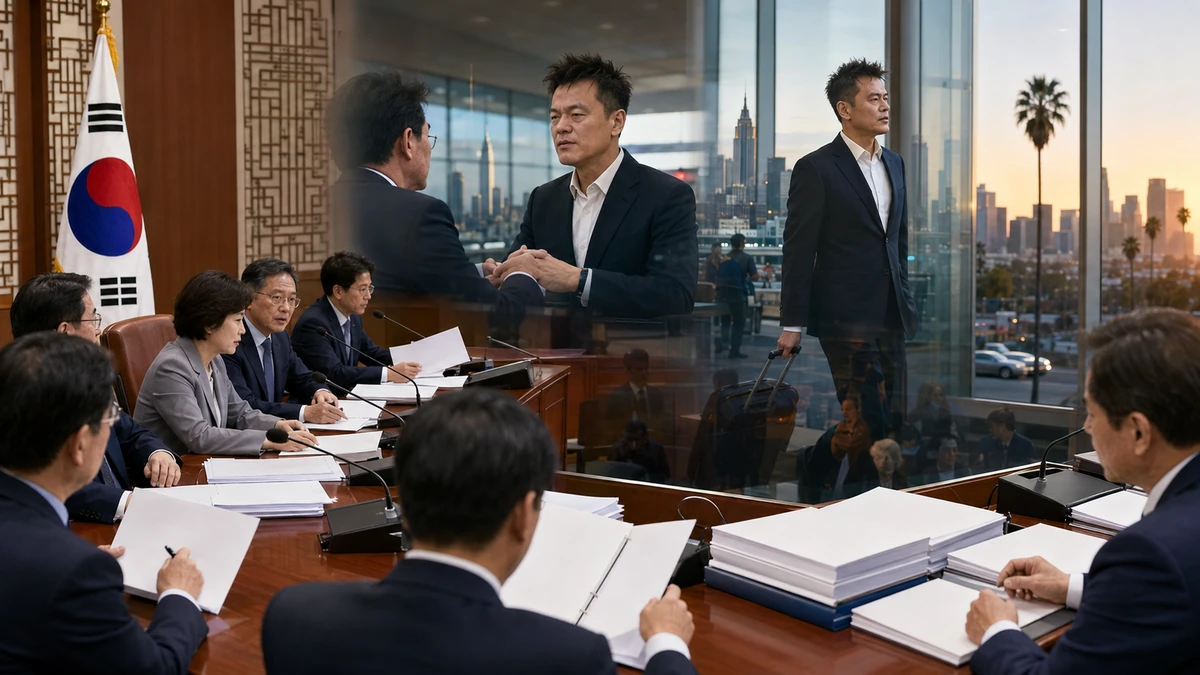
Image to help understand the article
K-pop’s global rise has made even travel schedules politically sensitive
South Korea’s National Assembly has issued a formal caution over a trip to the United States by Park Jin-young, the chair of a government-affiliated committee focused on international exchange in popular culture, after lawmakers said official and personal activities should have been more clearly separated and explained to the public. The issue is not that Park, a prominent music industry figure, stayed in the United States after his formal government itinerary ended. By the account provided by the support team for the Popular Culture Exchange Committee, that later portion was paid for privately and handled within existing rules. The problem, lawmakers signaled, is one of public transparency: When someone in a visible public role travels abroad on official business, the public should be able to tell, clearly and immediately, which meetings are state-related, which are private, and who is paying for what.
That may sound like a narrow administrative dispute, but it points to a much bigger development in South Korea and beyond. K-pop is no longer just an entertainment export. It is also part of the machinery of cultural diplomacy, economic strategy and national branding. As that machinery grows more influential, the standards around ethics, disclosure and public accountability are rising with it. In other words, the more seriously governments treat pop culture as a strategic asset, the more seriously they have to treat the governance surrounding it.
According to the Korean news summary, Park traveled to New York and Los Angeles for 8 nights and 11 days in November. Of that period, the official government-funded portion lasted 5 nights and 6 days, from Nov. 13 to Nov. 18, and included meetings tied to a large K-pop-centered festival known as “Phenomenon.” After that, he remained in the United States for personal activities. The committee’s support team said there was no violation of law or budget rules, and that no public funds were used after the official trip ended. It also said Park personally covered later expenses, including his return flight, and noted that because he serves in a non-full-time position, extending a stay for private reasons after official duties end does not require separate prior approval under current rules.
The Assembly’s intervention therefore appears less like an accusation of corruption than a warning about optics and trust. In a democracy, that distinction matters, but it does not make the matter trivial. Public confidence often turns not on whether an act was technically legal, but on whether the process was easy for ordinary citizens to understand. If a taxpayer-supported trip blends into private or company-related meetings in the same cities, over the same travel period, the burden shifts to public officials and public bodies to make the boundaries obvious.
That is a lesson Americans know well. In Washington, state capitals and city halls, public officials are regularly scrutinized not only for misuse of funds but for the appearance of blurred lines between public responsibilities and private benefit. South Korea is now confronting a version of that same question in an area where the stakes are increasingly international: the global business of Korean culture.
Why this matters beyond one trip
It would be easy to dismiss this as a bureaucratic footnote attached to a celebrity-adjacent official. That would miss the larger point. South Korea has spent years turning its cultural reach into a form of soft power, the kind of influence that does not come from military force or formal diplomacy alone but from attraction, visibility and reputation. K-pop, Korean dramas, film, beauty products and food have all become part of that ecosystem. They help sell concert tickets and cosmetics, but they also shape perceptions of South Korea as modern, dynamic and globally connected.
In that context, bodies that oversee or facilitate cultural exchange are not merely ceremonial. They sit at the intersection of government goals and private-sector expertise. That is especially true in Korea, where entertainment companies, producers, executives and artists often move through spaces that are partly commercial and partly public-facing. The state wants industry knowledge because industry figures know the networks, the market realities and the global players. But once private expertise is brought into a public mission, the line-drawing becomes much more important.
The National Assembly’s caution reflects that tension. Lawmakers did not appear to argue that private-sector professionals should be excluded from cultural diplomacy. In fact, the Korean summary suggests the opposite: the concern is not about using private expertise, but about preventing misunderstandings when public roles overlap with private calendars and corporate affiliations. If official meetings and personal meetings can look similar from the outside, then disclosure has to do more than satisfy paperwork requirements. It has to make the story legible to the public.
That is a governance issue, not just a public relations issue. Once a country begins to use pop culture as an instrument of national strategy, processes that once seemed informal begin to look like matters of institutional integrity. Who attended a meeting? In what capacity? Which portion of the trip was funded by taxpayers? When did the public assignment end? These questions are not glamorous, but they are central to whether cultural diplomacy keeps public legitimacy as it scales up.
The Korean support team’s response is also revealing. It did not merely say that the rules were followed. It also indicated that future administrative and budget management would be handled more strictly and transparently, acknowledging heightened public attention and the economic impact of the committee’s work. That is an important shift in tone. It suggests an understanding that rule compliance may no longer be enough when the public role itself carries symbolic weight.
A familiar issue in an unfamiliar setting for many American readers
For American audiences, the cultural setting may be distinct, but the underlying issue is deeply familiar. The United States has its own long-running debates over official travel, ethics disclosures, outside business interests and the difference between what is permissible and what appears appropriate. Federal and state ethics regimes are built around the idea that trust depends on both legality and clarity. Even when no law has been broken, watchdogs and lawmakers often ask whether an arrangement invites confusion about who is acting for the public and who is acting for private gain.
What may be less familiar to U.S. readers is the way Korea’s entertainment sector is woven into national identity and state strategy. Americans certainly understand Hollywood as a cultural export, and Washington has long appreciated the diplomatic value of American music, film and television. But the Korean Wave, often referred to by the Korean term “Hallyu,” has developed in a more concentrated and state-aware way. “Hallyu” refers to the global popularity of South Korean culture, from BTS and Blackpink to “Parasite,” “Squid Game,” Korean skin care and Korean cuisine. It is both a market phenomenon and, increasingly, a policy framework.
That does not mean the Korean government directs pop culture in some simplistic top-down way. The industry remains driven by private companies, talent agencies, producers, platforms and fans. But officials have recognized that Korean entertainment can generate tourism, exports, prestige and geopolitical visibility. In practical terms, that means public institutions may sponsor exchanges, support events, organize overseas meetings and cultivate partnerships. It also means well-known industry figures may take on quasi-public roles that would draw scrutiny anywhere, but perhaps especially in a field where celebrity, commerce and diplomacy overlap.
For Americans, a rough analogy might be if a major music executive or film producer were appointed to a visible government advisory role promoting American cultural exports abroad, then took an official trip to Los Angeles, London or Seoul that included public meetings, followed by private meetings in the same city. Even if all costs were properly separated, Congress and the press would likely want the itinerary and funding breakdown to be crystal clear. That, in essence, is the issue now surfacing in Seoul.
The Korean case therefore offers a window into a maturing phase of the Korean Wave. This is not just about whether Korean culture can travel. It already has. It is about whether the institutions built around that success are keeping pace with the visibility and scrutiny that success brings.
What this means for the United States
This story matters in the United States because America is not a distant observer of the Korean Wave. It is one of its biggest stages, its biggest markets and one of its most important testing grounds. New York and Los Angeles are not incidental destinations in this story; they are central nodes in the business of global entertainment. Korean companies seek U.S. distribution, touring revenue, media exposure, brand partnerships and legitimacy in the world’s most competitive pop market. American streamers, labels, promoters, advertisers and investors, in turn, increasingly view Korean content not as niche import but as mainstream business.
That makes governance questions in Seoul relevant to U.S. companies and audiences. If South Korea is using public-facing institutions to expand cultural exchange in America, U.S. partners will want confidence that these engagements are transparent and professionally managed. American businesses are accustomed to compliance conversations, conflicts-of-interest policies and disclosure expectations, especially when public entities are involved. The clearer South Korea can make the boundary between official cultural diplomacy and private industry activity, the easier it becomes for U.S. companies to engage without second-guessing the nature of a meeting or partnership.
There is also a fan dimension. American audiences have helped turn K-pop into a durable commercial force, not just a viral curiosity. Stadium tours, album sales, festival appearances, fan conventions, cosmetics tie-ins and streaming numbers all reflect a level of engagement that has moved beyond early-adopter enthusiasm. As K-pop deepens its American footprint, some of the questions once treated as domestic Korean administrative matters begin to matter more internationally. Fans who support artists and events across borders increasingly expect the same transparency from cultural institutions that they expect from government bodies or major corporations at home.
For Washington, the issue is subtler but still real. U.S.-South Korea ties are no longer defined only by security cooperation and semiconductors. Culture has become part of the alliance’s public face. Korean music and media shape how younger Americans understand South Korea, often more directly than diplomatic communiques do. That means the credibility of Korea’s cultural outreach apparatus can have ripple effects, however modest, on the broader relationship. Clean processes may not make headlines every day, but messy ones can quickly undermine trust.
In that sense, the Assembly’s caution could be read positively from an American perspective. It suggests that South Korea’s democratic institutions are applying greater scrutiny as cultural diplomacy becomes more valuable. That is the kind of institutional maturation U.S. counterparts generally prefer to see in a partner country. Stronger rules and clearer public disclosures do not weaken the Korean Wave; they make it more sustainable in high-visibility markets like the United States.
The bigger trend: K-pop diplomacy is getting institutional, and that changes the rules
The most important development here may be structural rather than personal. As long as Korean popular culture was seen primarily as entertainment, the industry could operate with a degree of flexibility that suited fast-moving private business. But once it became a tool of diplomacy and a symbol of national competitiveness, the expectations changed. Institutionalization brings resources and reach, but it also brings audits, oversight hearings and demands for documentation.
This is a natural progression for any successful cultural industry that becomes entangled with public policy. The same thing happens in other sectors when governments decide an industry is strategic. Tech, defense, higher education and sports all offer examples in which private actors are asked to serve public aims, only to discover that the public side carries different standards of reporting and accountability.
For Korea, the challenge is sharper because the comparative advantage of K-pop often lies in speed, personal networks and hybrid roles. Executives may be entrepreneurs, tastemakers and public ambassadors at once. Advisory bodies may rely on non-career officials precisely because they understand the industry better than a traditional bureaucracy does. That can be a strength. But it also creates gray areas when those same people travel, meet partners, or extend trips in major industry hubs like Los Angeles and New York.
The Assembly’s demand for clearer distinctions suggests that the old informal understandings are becoming less acceptable. Separating expenses is necessary, but not sufficient. The public increasingly wants a transparent narrative, not just a compliant spreadsheet. That means future trips may need cleaner itinerary disclosures, clearer statements of role, perhaps even more standardized reporting on when a public mission starts and ends. In practical terms, the committee and the ministry may need to behave less like a flexible cultural network and more like a public institution under constant public inspection.
That is not unique to Korea. It is what happens when soft power becomes serious business. A nation can celebrate the global spread of its culture, but once that spread is partly managed through public structures, governance stops being backstage work. It becomes part of the performance.
What to watch next in Korea and in cross-Pacific entertainment ties
The immediate fallout from this case may be limited. Based on the summary, there was no finding of illegality, no evidence presented that public funds were used for personal activities after the official trip, and no indication of a punitive sanction beyond a caution and a request for clearer distinction. But the longer-term implications could be significant if this becomes the basis for tighter administrative standards.
One likely next step is procedural refinement. The Korean government and affiliated bodies may move toward more explicit trip documentation: clearer public schedules, more formal demarcation of official and private segments, and more consistent disclosure of who bears which costs. That would align with what the support team has already signaled — a commitment to stronger and more transparent management, even beyond the bare minimum required by law.
Another thing to watch is whether similar scrutiny expands to other cultural and quasi-cultural appointments. As Korean content companies deepen their ties with U.S. studios, streamers, live-event promoters and technology platforms, public-private overlap is only going to increase. The more value attached to those relationships, the more likely lawmakers and the public are to ask detailed questions about roles, incentives and funding.
For American observers, the takeaway is not that Korea’s cultural diplomacy is troubled. It is that it is entering a more mature and politically accountable phase. That is often a sign of success. Institutions typically face this level of scrutiny when they have become important enough to warrant it. In Korea’s case, the very fact that a trip linked to K-pop-related exchange in New York and Los Angeles can trigger parliamentary concern says something about the stature Korean culture now holds at home and abroad.
It also points to a deeper truth about global influence in the 21st century. Cultural power is no longer separate from governance. A hit song, a streaming sensation or a sold-out stadium tour may begin as entertainment, but once governments incorporate that success into national strategy, questions of transparency follow close behind. South Korea’s lawmakers are now pressing that point. For the United States, where Korean culture is no longer fringe but firmly embedded in the mainstream entertainment economy, that evolution is worth watching carefully.
Because in the long run, the strength of cultural diplomacy is not measured only by how far it travels. It is also measured by how credibly it is managed.
Comments
Post a Comment