Image to help understand the article
Bank of Japan Moves Rates to a Three-Decade High
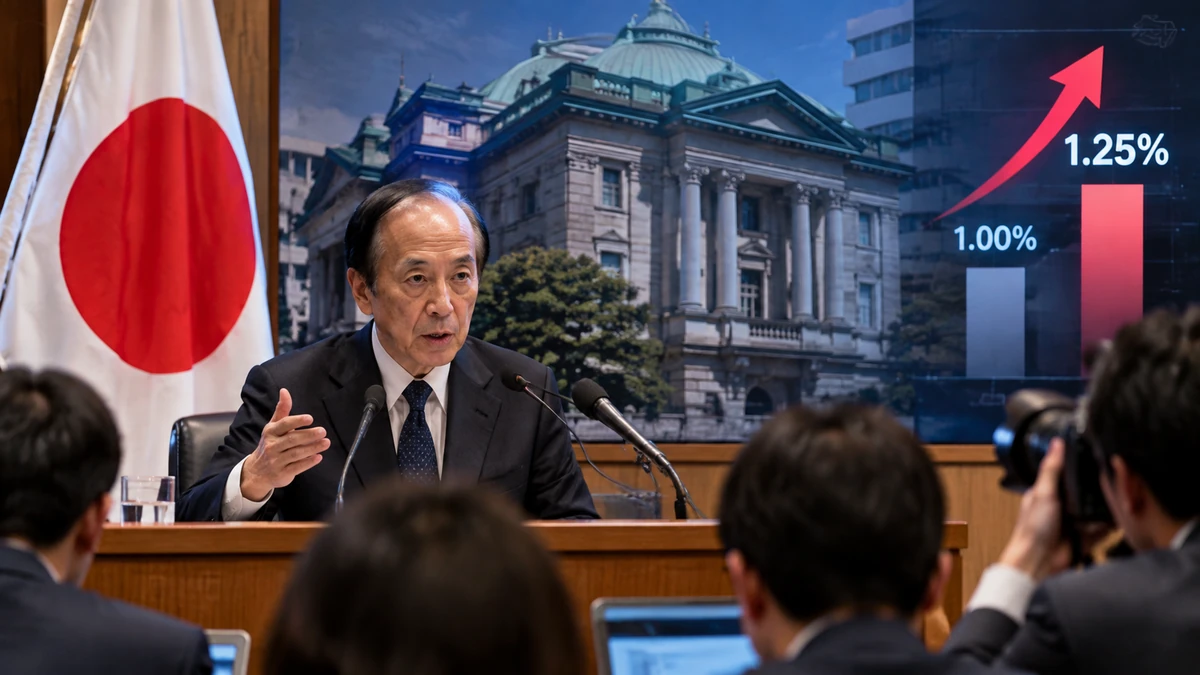
The Bank of Japan has raised its short-term policy interest rate to about 1.25%, marking the highest level for Japan’s benchmark rate since 1995. The decision, announced after a two-day meeting of the central bank’s Policy Board, represents another step in Japan’s gradual shift away from years of ultra-low interest rates.
For many Americans, Japan’s monetary policy may seem unusual because the country spent decades with interest rates near zero. While the U.S. Federal Reserve has historically adjusted rates more aggressively to manage inflation and employment, Japan maintained extremely loose monetary conditions for much of the past generation in an effort to overcome persistent deflation and weak economic growth.
The latest increase follows a previous move in June, when the Bank of Japan raised its policy rate from around 0.75% to around 1%. The three-month gap between the two increases represents the fastest pace of tightening since Kazuo Ueda became governor of the central bank.
The decision signals that Japanese policymakers believe inflation pressures have become more durable. However, it also reflects the challenges facing an economy that has long depended on low borrowing costs to support businesses, consumers and financial markets.
Why the Yen and Inflation Are Driving Japan’s Policy Shift
A major factor behind Japan’s recent monetary changes has been the weakness of the Japanese yen. A weaker currency can make exports more competitive, but it also raises the cost of imported goods, including energy and food.
Japan relies heavily on imported energy resources, making exchange-rate movements especially important for households and companies. When the yen loses value against currencies such as the U.S. dollar, Japanese consumers can face higher prices for fuel, electricity and imported products.
The Bank of Japan’s latest move came amid expectations that rising international oil prices and yen depreciation could push inflation higher than previously forecast. Officials have been watching whether price increases are becoming embedded in the economy rather than being caused only by temporary factors.
The yen’s weakness has also attracted attention from U.S. officials. U.S. Treasury Secretary Scott Bessent has repeatedly called for measures to address excessive yen depreciation, according to reports. One reason analysts cite for the yen’s decline is the difference between interest rates in Japan and the United States. Higher U.S. rates have generally made dollar-denominated assets more attractive, contributing to pressure on the yen.
In late July, Japanese and U.S. monetary authorities reportedly participated in coordinated action involving yen purchases. Currency intervention is a sensitive tool because governments must balance exchange-rate stability with broader economic goals.
Japan’s Long Journey Away From Negative and Near-Zero Rates
The Bank of Japan’s rate increase is significant because it represents a continuation of a historic policy transformation. For years, Japan struggled with deflation, a condition in which falling prices can discourage spending and investment. In response, policymakers maintained exceptionally low interest rates and introduced unconventional monetary policies designed to stimulate economic activity.
The situation began changing as inflation returned. Japan experienced stronger price increases after global supply chain disruptions, higher energy costs and currency pressures affected the economy. Unlike previous periods when inflation was considered too weak, policymakers have increasingly focused on preventing prices from rising too quickly.
Japan’s central bank has also been closely watching wage growth. A key question for economists is whether companies will continue raising wages enough to support consumer spending and create a sustainable cycle of income growth and demand.
The latest rate increase does not mean Japan has adopted a high-rate environment similar to the United States. Even at 1.25%, Japanese borrowing costs remain relatively low compared with many major economies. Instead, the move represents normalization after an unusually long period of monetary support.
What Japan’s Rate Decision Means for the United States
For American consumers, investors and companies, Japan’s interest-rate changes matter because the two economies are deeply connected through trade, investment and financial markets.
Japan is one of the world’s largest economies and a major investor in the United States. Japanese automakers, technology companies and manufacturers operate large facilities across America, while U.S. companies rely on Japan as an important market for products and services.
Exchange rates are one of the most immediate connections. A stronger yen can influence the competitiveness of Japanese exports, including automobiles, electronics and industrial equipment. It can also affect American companies competing with Japanese firms in global markets.
For investors, the Bank of Japan’s policy shift is important because Japanese institutions hold significant overseas assets, including U.S. government bonds. Changes in Japanese interest rates can influence decisions by global investors about where to allocate capital.
The move also highlights a broader global trend: major economies are adjusting monetary policy after years of emergency measures introduced during periods of economic weakness. While the Federal Reserve, European Central Bank and Bank of Japan operate independently, their decisions often interact through currency markets and international financial flows.
Implications for Korea and East Asia’s Economic Landscape
Japan’s rate increase is also closely watched in South Korea and other Asian economies. The two countries are major trading partners and compete in industries including automobiles, electronics, advanced manufacturing and technology.
A changing yen exchange rate can affect regional competitiveness. Korean companies often monitor movements in the yen because currency shifts can influence export prices and overseas earnings. However, the impact depends on many factors, including production locations, supply chains and global demand.
Japan and South Korea have also been strengthening economic cooperation in recent years after a period of diplomatic tension. Both countries face similar challenges, including aging populations, energy dependence and the need to remain competitive in advanced industries.
The Bank of Japan’s policy normalization may therefore be viewed not only as a domestic financial decision but also as part of a wider adjustment occurring across East Asia. Governments and businesses throughout the region are reassessing how they operate in an environment of higher borrowing costs and changing currency conditions.
What Markets Will Watch Next
Financial markets are likely to focus on whether the Bank of Japan continues raising rates or pauses to evaluate the effects of its recent moves. Future decisions will depend on inflation trends, wage growth, consumer spending and currency movements.
The central bank faces a delicate balancing act. Raising rates too quickly could slow economic activity by increasing borrowing costs for households and businesses. Moving too slowly could allow inflation pressures or currency weakness to continue creating financial strain.
Investors will also watch the relationship between Japanese monetary policy and U.S. interest-rate expectations. Differences between the Federal Reserve and Bank of Japan can influence currency markets, investment flows and global financial conditions.
Japan’s latest rate increase is therefore more than a domestic policy adjustment. It marks another chapter in one of the most closely watched economic transformations in the world: the return of interest rates to a country that spent decades fighting against falling prices and stagnant growth.
Comments
Post a Comment