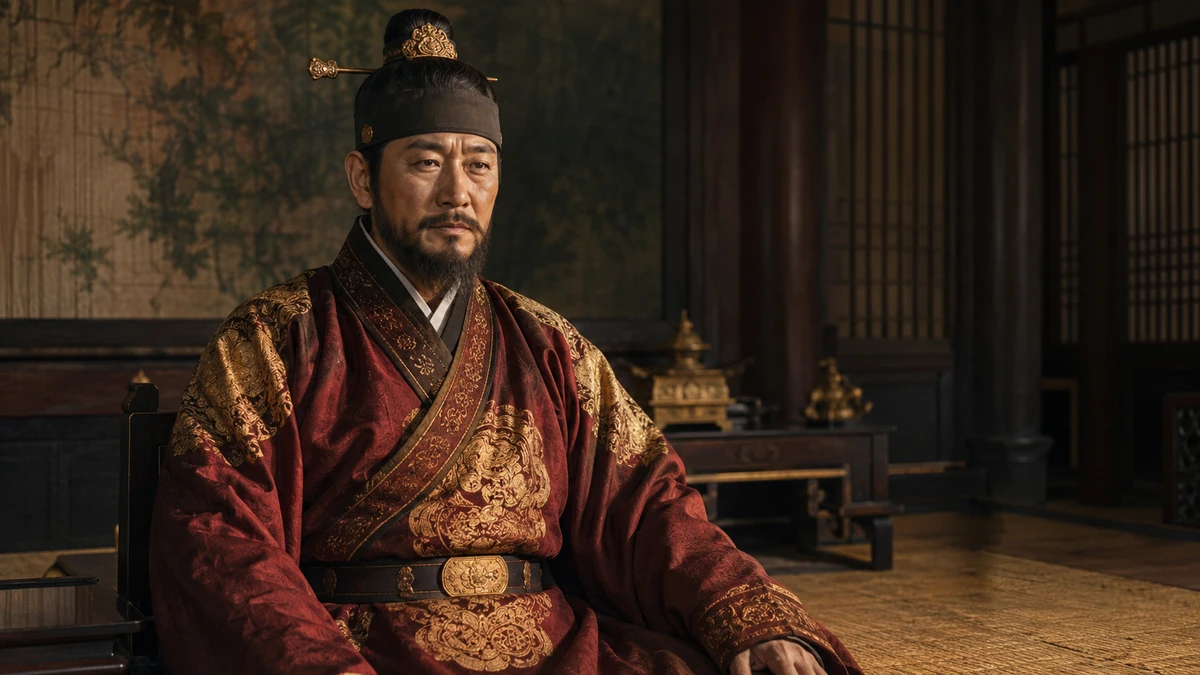
Image to help understand the article
A Founder at the Crossroads of History and Legend
More than a millennium before South Korea became an American ally and Korean popular culture found a global audience, a regional military commander named Wang Geon helped create a political order whose name would eventually become the English word “Korea.” Known after his death as Taejo, a title commonly given to the founder of a Korean dynasty, Wang established the Goryeo kingdom in 918 and emerged as the central figure in the reunification of the peninsula after decades of fragmentation.
Wang was born in 877 in Songak, a commercially and strategically important area that later became the city of Kaesong. Kaesong now lies in North Korea, just north of the Demilitarized Zone separating the two Koreas. That geography gives Wang’s story a resonance that extends beyond medieval history. His home region sits inside a modern political division that would have been unimaginable in his time, when competing rulers sought control over the peninsula but still operated within a shared cultural world.
Even Wang’s birth date illustrates the difficulty of presenting early Korean history to modern readers. Traditional sources place it on the 14th day of the first lunar month in 877. Depending on how historians convert the date from older calendars, it may be rendered as Jan. 31 or Feb. 4. Such discrepancies are common when events recorded according to lunar calendars are translated into modern Western dating systems.
Wang was the eldest son of Wang Ryung, a powerful local leader, and a woman from the Han family. In the unsettled politics of the late ninth century, families like theirs mattered enormously. Korean historians often describe them as “hojok,” a term referring to locally based elites who controlled land, trade, fortified settlements and armed followers as royal authority weakened. An American comparison might combine elements of a political dynasty, a wealthy regional business family and a frontier militia commander. They were not simply provincial officials; they could negotiate with kings, switch allegiances and determine which emerging regime survived.
Later court histories portrayed the young Wang as intelligent, commanding and physically impressive. They also surrounded his ancestry with claims of divine favor and prestigious descent. Those accounts are valuable, but they require caution. Like stories told about Rome’s legendary founders or the heroic biographies attached to American political figures, royal genealogies often reveal what later generations wanted to believe as much as what can be verified.
Why Korea Was Divided Again
To understand Wang’s rise, American readers need to look beyond the familiar Three Kingdoms era of Goguryeo, Baekje and Silla. By the late seventh century, Silla had defeated its rivals and controlled most of the peninsula. But by the late ninth century, the Silla monarchy had lost much of its authority. Rebellions spread, taxes became harder to collect and regional strongmen built independent power bases.
The resulting period is known as the Later Three Kingdoms. The name deliberately echoed the earlier age, but these were new political movements claiming the prestige of older states. Gyeon Hwon founded Later Baekje in the southwest. Gung Ye established a northern and central regime that was eventually called Taebong. A weakened Silla remained in the southeast. Wang Geon first rose not as an independent monarch but as one of Gung Ye’s commanders.
Wang and his father entered Gung Ye’s service in 896, surrendering Songak and placing their resources behind the expanding regime. That decision was typical of the period’s politics. Local elites constantly calculated which leader could protect their communities and offer them influence in a new order. Wang’s family brought more than land. Its position near the western coast gave it experience with maritime commerce, shipping and naval power.
By 898, Wang was leading elite cavalry. His early campaigns were not an uninterrupted series of victories, despite the triumphant image promoted by later Goryeo accounts. Records suggest that some initial operations produced limited results. Over time, however, Wang helped extend Taebong’s authority through parts of what are now the central and southern regions of South Korea. His importance came from persistence, coalition-building and the ability to operate across both land and sea.
This distinction matters because founder stories tend to compress complicated struggles into the biography of one exceptional man. Wang was unquestionably a capable commander, but he depended on sailors, generals, monks, local elites and communities that supplied food, intelligence and troops. He also benefited from Gung Ye’s political structure before eventually replacing him. Reading the period as a contest among networks, rather than a duel among three kings, provides a clearer explanation of how Goryeo was built.
The Maritime Campaign That Made Wang Geon
Wang’s most consequential military work took place along Korea’s southwestern coast, particularly around Naju. For readers accustomed to maps that emphasize Seoul and the heavily fortified land border with North Korea, the maritime nature of early Korean state-building can be easy to overlook. The peninsula’s western and southern coasts contain islands, tidal flats, river mouths and sea lanes that connected inland agricultural centers with China and other parts of East Asia.
Beginning around 900, Wang fought forces loyal to Gyeon Hwon and Later Baekje in the Yellow Sea and along the southwest. In 903, he pushed into the Naju area, threatening Later Baekje from behind. Control of Naju offered strategic leverage because it could disrupt the rival kingdom’s access to maritime routes and place pressure on its core territory.
The struggle lasted decades and changed hands repeatedly. Wang attacked islands near Jindo, seized key positions and fought naval engagements in which fire was reportedly used against larger enemy fleets. He also suffered reversals. Later Baekje counterattacked, and different sources disagree about the timing and leadership of some victories. Inscriptions associated with Buddhist monks indicate that Gung Ye personally took part in major southwestern campaigns, complicating later narratives that gave Wang most of the credit.
That disagreement is more than a footnote. After Wang founded his own dynasty, Goryeo historians had political reasons to present him as the indispensable architect of victory and Gung Ye as a failed tyrant. Modern historians therefore compare official chronicles with inscriptions, local traditions and surviving geographical evidence. The process resembles the way American scholars reassess Civil War memoirs or presidential biographies, asking not only what an account says but who wrote it, when and for what purpose.
Wang’s reputation nevertheless grew because he paired military action with efforts to win local support. Traditional accounts emphasize that he provided relief to residents of conquered areas instead of treating them solely as enemy subjects. Whether every episode occurred exactly as later writers described it, the political strategy is plausible and consistent with his broader career. Wang understood that occupying a fortress was not the same as governing the surrounding population.
His campaigns eventually linked strategically important areas in central Korea with Naju in the southwest. By controlling or contesting this corridor, Taebong could pressure Later Baekje’s trade and military communications. In 913, Wang was appointed sijung, the highest-ranking official in Gung Ye’s government. Before turning 40, he had become the regime’s clear second-in-command.
Marriage, Alliances and the Willow-Leaf Legend
Wang’s political network was reinforced through marriage. During operations in the southwest, he formed an alliance with a prominent Naju leader named O Da-ryeon and married his daughter. She later became known as Queen Janghwa. Their son, Mu, succeeded Wang as Goryeo’s second king, Hyejong.
In premodern Korea, royal marriage was rarely just a private relationship. It tied the court to regional families that could provide ships, soldiers, grain and political recognition. Wang would become especially associated with a marriage strategy designed to bind powerful local groups to the new dynasty. In a country fragmented among competing military and commercial networks, family relationships could function as instruments of national integration.
A famous legend says Wang met the young woman near a well south of Mount Geumseong in Naju. When he asked for water, she floated a willow leaf in the dipper so that he would have to drink slowly and would not become sick. Impressed by her thoughtfulness, Wang sought permission to marry her. Another story says she had dreamed of a golden dragon entering her body before meeting him.
Such stories should not be treated as straightforward eyewitness reporting. They belong to a broader tradition in which the births and marriages of rulers are marked by prophetic dreams, unusual light, dragons or auspicious landscapes. Their function was political as well as entertaining: They suggested that a dynasty’s rise had been recognized by heaven and nature.
The willow-leaf tale also reflects values that remained influential in Korean storytelling — restraint, practical intelligence, concern for another person and the idea that character can be revealed through a small act. Similar motifs appear in folktales elsewhere, including American stories that turn an ordinary encounter into proof of a future leader’s virtue. The historical marriage mattered because it cemented a regional alliance; the legend made that alliance emotionally memorable.
Prophecy and the Politics of Sacred Geography
Accounts of Wang’s birth are closely connected to pungsu-jiri, Korea’s tradition of reading the relationship among mountains, waterways, settlements and human fortune. It is often compared with Chinese feng shui, from which it drew important influences, though the Korean tradition developed its own geography and political significance.
One narrative says an earlier ancestor was advised to settle south of Mount Buso because a future ruler would be born there. Another centers on Doseon, a monk later celebrated for his knowledge of geography and geomancy. According to the official Goryeo history, Doseon examined the site where Wang’s father planned to build a house and offered cryptic instructions. He reportedly said the home should be constructed in 36 sections because the family’s destiny was linked to water. He also predicted the birth of a son who would unite Samhan, an old term used broadly in later periods to evoke the Korean lands.
Traditional records say the house was built according to those directions, Wang was born the following year and a mysterious light and purple energy filled the home. Doseon was also said to have returned when Wang was 17 to teach him military knowledge, astronomy and ritual practice.
These claims cannot be verified as conventional biography. Their importance lies in how they authorized Wang’s rule. A founder who removed his former sovereign needed more than battlefield success. He needed a narrative explaining why his takeover represented the restoration of order rather than simple betrayal. Prophecy supplied that justification retroactively.
Genealogy served a similar purpose. One tradition linked Wang’s paternal line to an emperor of China’s Tang dynasty, though scholars generally regard the story as heavily legendary. Other accounts emphasized ancestry connected to Goguryeo, the northern kingdom whose legacy Goryeo claimed. Even the dynasty’s name made that connection explicit: Goryeo was derived from Goguryeo, and “Korea” later entered Western languages through forms of the word Goryeo.
Official family records themselves acknowledged uncertainty about Wang’s earlier paternal ancestry. That tension — between documentary gaps and elaborate legends — is central to understanding medieval kingship. Myth was not necessarily a careless substitute for history. It was a form of political communication, telling subjects that the founder’s authority was embedded in bloodline, landscape and cosmic order.
The 918 Revolution and a New Political Order
By 918, Gung Ye’s rule had alienated important commanders and regional leaders. Korean sources describe growing autocracy, arbitrary punishment and suspicion within the Taebong court. Four military figures — Shin Sung-gyeom, Bok Ji-gyeom, Bae Hyeon-gyeong and Hong Yu — became prominent supporters of a movement to replace him with Wang.
Wang initially presented himself as reluctant, a common theme in accounts of regime change that sought to demonstrate a new ruler had accepted power out of public duty rather than personal ambition. Whatever his private intentions, the political result was clear: Gung Ye was removed, Taebong collapsed and Wang founded Goryeo in 918.
The transition was not yet the reunification of Korea. Silla and Later Baekje still existed, and military rivalry continued. But the founding marked a change in governing style and political strategy. Wang’s strength came partly from his ability to work with the same regional elites whose independence had helped break the old Silla order. Rather than attempting to eliminate every local power center at once, he incorporated influential families through appointments, alliances and marriages.
That approach did not create a modern nation-state, and “unification” should not be confused with the centralized national governments Americans know today. Medieval authority was layered and personal. A king’s power depended on negotiated relationships with aristocrats, military leaders, temples and local communities. Wang’s achievement was to build a durable coalition broad enough to outlast the immediate war.
His career also challenges the clean moral divisions found in patriotic retellings. He rose because Gung Ye trusted him with troops and high office, then benefited from the revolt that destroyed Gung Ye’s regime. He fought Gyeon Hwon for years but could not secure every region permanently. His record included both naval victories and defeats. The durability of his legacy came not from invincibility but from adaptation.
What Wang Geon’s Story Means in the United States
For Americans, Wang Geon is not a household name. Yet the world he helped create has direct relevance to how the United States encounters Korea today. The name Goryeo eventually became “Korea,” and the dynasty established in 918 helped shape the historical identity invoked on both sides of the modern Korean border. Understanding that deeper past makes it easier to see Korea as more than the product of the Korean War, Cold War alliances or the recent global success of K-pop.
This matters at a time when many Americans first approach Korean history through entertainment. Streaming platforms have made Korean historical dramas, often called sageuk, accessible to viewers who may know little about royal titles, dynastic politics or regional geography. The genre can be compared with American prestige dramas about the Revolution, the Civil War or political dynasties: It uses the past to examine power, loyalty and national identity, but it also takes dramatic liberties.
Wang’s life offers precisely the kind of material that travels well across cultures — a general rising during state collapse, a ruler surrounded by prophecy, a strategic marriage, naval warfare and a revolt against an increasingly distrusted leader. For American media companies distributing Korean content, the opportunity is not merely to sell an exotic costume epic. It is to give viewers enough context to understand why local clans, Buddhist figures, ancestral claims and geomancy carried political weight.
The comparison with American founder narratives is especially useful. The United States has long debated how to separate civic mythology from the more complicated lives of George Washington, Thomas Jefferson and other founders. Korea faces a different historical record and political tradition, but the underlying question is recognizable: How should a society honor a foundational figure without turning later propaganda into unquestioned fact?
Wang’s connection to Kaesong also adds significance for the U.S.-Korea relationship. The United States is bound to South Korea through a security alliance created in the aftermath of the Korean War, while North Korea remains one of Washington’s most difficult foreign policy challenges. Kaesong’s place in Goryeo history is a reminder that the peninsula’s division is modern, even though the cultures and historical claims on both sides reach back centuries.
For Korean American audiences, these stories can provide a historical frame broader than immigration, war and contemporary pop culture. For other American readers, they offer a way to understand why debates about historical territory, dynastic heritage and cultural ownership can carry emotional force in East Asia. The past is not simply ceremonial background; it remains part of how countries explain who they are.
What to Watch as Korea’s Past Goes Global
The growing international interest in Korean culture is expanding from pop music and contemporary television into food, language, literature and history. As that shift continues, figures such as Wang Geon are likely to become more visible outside Korea. The challenge will be presenting them without flattening a contested era into either nationalist celebration or fantasy.
Three issues deserve attention. The first is evidence. Official chronicles were written within political systems that had reasons to glorify founders and discredit rivals. The second is geography. Coastal trade routes, regional power bases and cities such as Naju and Kaesong were not side details; they were essential to the creation of Goryeo. The third is coalition politics. Wang succeeded not because he stood outside the social order, but because he understood how to connect military command, maritime resources, family alliances and local legitimacy.
That combination makes his career relevant beyond Korea. Periods of political fragmentation often reward leaders who can turn military success into a broad governing bargain. Wang’s story shows that conquest alone rarely produces a durable state. A founder must persuade competing groups that the new system offers more security and opportunity than the old one.
It also shows why historical legends endure. Predictions by monks, royal dreams and miraculous lights may not satisfy modern standards of proof, but they helped medieval audiences make sense of rapid political change. Today, they continue to shape popular memory, tourism and screen storytelling.
The lasting importance of Wang Geon lies less in any single battle or birth legend than in the order that followed his rise. He emerged from a regional elite, mastered the politics of a fragmented peninsula and turned service under one ruler into the foundation of a new dynasty. For American audiences discovering Korea through music, television and an increasingly important Pacific alliance, his life opens a door onto a much longer story — one in which trade, war, family and myth combined to create the kingdom that gave Korea its name.
Comments
Post a Comment