Image to help understand the article
Two engineering awards, one practical test for AI
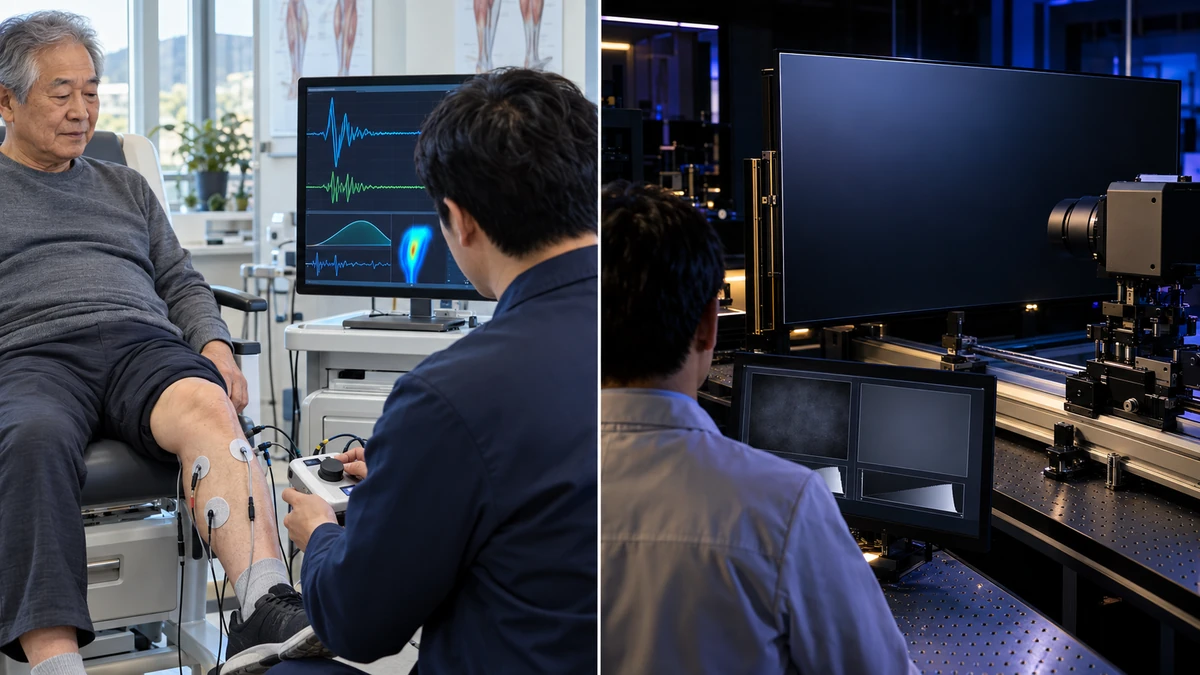
One technology analyzes how muscles respond to stimulation. The other corrects uneven image quality in the panels that power modern screens. Together, two engineering achievements recognized in South Korea offer a useful counterpoint to the American conversation about artificial intelligence: Some of AI’s consequential applications may involve neither a chatbot nor a computer-generated image, but a more useful clinical measurement or a more consistent factory product.
South Korea’s Ministry of Science and ICT and the Korea Industrial Technology Association announced on the 14th that Exosystems CEO Lee Hoo-man and LG Display engineer Jeon Chang-hoon were selected as September recipients of the Korea Engineer Award. Lee was recognized for technology that quantifies neuromuscular function to assist assessments of muscle decline. Jeon developed AI-based image correction for organic light-emitting diode, or OLED, panels at LG Display’s research center in Paju, northwest of Seoul.
The announcement does not establish that either advance is available in the United States, and an engineering prize is not independent proof of clinical effectiveness or commercial performance. But the pairing highlights an important direction for Korean technology: applying AI to specialized problems in health care and advanced manufacturing. For American patients, electronics buyers and companies connected to Korea’s technology sector, the relevant question is what these systems can reliably improve — and what evidence will be needed before those improvements reach everyday life.
Why muscle decline needs better measurement
Lee’s work addresses the assessment of sarcopenia, a condition involving the loss of muscle strength and muscle mass that often accompanies aging. For readers more accustomed to hearing about osteoporosis, which weakens bones, sarcopenia concerns another foundation of physical independence: the muscles people need to rise from a chair, climb stairs and recover after illness. The conditions are different, but both can matter greatly to an older person’s mobility.
Evaluating muscle decline can require several kinds of information. The Korean announcement describes an existing process that examines muscle mass, strength and walking speed in sequence. Those measurements capture different aspects of a patient’s condition rather than providing interchangeable answers. A person’s amount of muscle tissue, for example, is not the same thing as how effectively that person can use it.
The practical difficulty is that some patients who most need assessment have trouble completing movement-based tests. Someone with limited mobility may struggle with a walking assessment, complicating the effort to understand that person’s muscle function. This is a familiar challenge for American rehabilitation practices and facilities serving older adults: The test must be useful without demanding more than the patient can safely manage.
Exosystems’ approach analyzes muscle signals produced in response to stimulation at particular frequencies. AI turns those responses into numerical indicators intended to support diagnosis. The award recognizes the potential to make evaluation more convenient, especially when conventional assessment is cumbersome. It does not establish that the technology replaces every existing measure of muscle health.
What an AI-generated muscle indicator can — and cannot — tell a clinician
The distinction between a diagnostic aid and an autonomous diagnosis is central to understanding Lee’s achievement. As described in the announcement, the system interprets physiological signals and produces indicators for use in assessment. It is not described as independently deciding whether a patient has sarcopenia, identifying every cause of weakness or choosing a rehabilitation plan.
Neuromuscular function refers to the way nerves and muscles work together to produce movement. Measuring a muscle’s response to stimulation can provide a different view from observing a person walking across a room. The engineering challenge is to convert that response into information that is consistent, understandable and useful to a health professional.
For clinicians, the next questions go beyond whether an algorithm can detect a pattern. Does its output agree with established assessments? Does it remain reliable across patients with different ages, medical conditions and levels of mobility? Can it detect changes that matter during recovery? And does adding the measurement help professionals make better decisions?
The supplied announcement does not provide clinical trial results, diagnostic accuracy figures or details about regulatory authorization. Those gaps limit what can be concluded about readiness for broader medical use. They also identify the evidence that would matter to a hospital or rehabilitation provider considering the technology.
Lee said he hopes easier, more objective measurement of neuromuscular function will provide practical help in rehabilitation settings. He also described further development as a way to strengthen South Korea’s digital health industry. That ambition links the project to a wider commercial challenge: turning a technically promising measurement into a tool that fits real clinical work.
The screen problem hiding in a dark scene
Jeon’s work concerns a different kind of signal: the electrical control of an OLED display. Unlike a conventional liquid crystal display that relies on a backlight, an OLED screen uses light-emitting elements to create the picture. That design supports deep blacks and strong contrast, qualities familiar to Americans shopping for premium televisions or watching movies on high-end mobile devices.
Those advantages depend on precise control. During production, variations in the performance of the tiny electrical switches that drive a panel can cause image quality to become uneven. The result is a manufacturing problem, not necessarily a flaw in the movie, game or photograph being displayed. Sending the same intended visual information across a panel does not guarantee that every part will reproduce it uniformly.
The correction technology developed at LG Display’s Paju research center uses AI to predict an original image and correct image quality on that basis, according to the award announcement. The description does not provide enough technical detail to reconstruct the process or determine exactly how it compares with other correction methods.
Its purpose, however, is clear: reduce the visible consequences of electrical variation in OLED production. An American viewer’s reference point might be a dimly lit scene in a streaming drama or the shadowed background of a video game. When an image is close to black, unwanted differences across a screen can interfere with the intended picture. Jeon’s work targets consistency in the panel itself, rather than adding new creative content or simply increasing video resolution.
Big performance claims need a defined baseline
According to the achievements cited by the ministry and the industry association, Jeon’s technology improved image uniformity by 100% and reduced correction time by 75% under extremely low-luminance conditions. Those are substantial reported gains, but neither percentage should be treated as a complete description of performance.
A 100% improvement in uniformity does not necessarily mean a perfectly uniform screen. Its meaning depends on the measure being used, the initial performance and the conditions under which the comparison was made. The supplied summary does not identify that measure or provide the underlying test data. The figure is therefore best understood as a performance claim attributed to the award announcement, not an independently verified judgment about finished televisions.
The time reduction also has a specific scope. It concerns correction in very low-brightness conditions, not a claim that an entire OLED factory can make panels 75% faster. Nor does the announcement say that retail prices will fall by a corresponding amount.
Even with those qualifications, the manufacturing logic is important. If a correction step becomes faster while delivering more consistent results, it could ease a production bottleneck. Whether that produces a meaningful commercial benefit depends on how the step fits into the larger process, its cost and its performance at scale.
Jeon said he intends to draw on accumulated engineering experience to strengthen South Korea’s position in the global OLED industry. The award recognizes a targeted process improvement within that effort, not proof that the competitive outcome is settled.
What this means for the United States
For the United States, these projects point to two distinct areas of potential relevance: tools for an aging population and improvements in the international electronics supply chain. Neither requires American consumers to become familiar with the Korean award itself. The connection would emerge through the care they receive, the devices they buy and the technology their employers evaluate.
In health care, a convenient way to assess neuromuscular function could interest rehabilitation providers and organizations caring for people with limited mobility. But a Korean engineering honor does not grant access to the American medical market. Depending on a product’s intended use and regulatory classification, U.S. Food and Drug Administration requirements could apply. Providers would also need to examine clinical evidence, staff training, compatibility with existing workflows and how the service would be paid for.
The announcement identifies no U.S. authorization, American clinical partner or reimbursement arrangement for Exosystems’ technology. Its relevance to American care is therefore prospective, not an established market development. That distinction matters particularly in medical AI, where promising technical demonstrations do not automatically translate into better patient outcomes.
On the display side, LG Display operates in an international industry whose products reach consumers through electronics brands and device manufacturers. It should not be confused with LG Electronics: A panel supplier’s manufacturing advance is not itself an announcement of a new LG-branded television. The source does not identify an American customer, a particular consumer device or a U.S. release schedule incorporating Jeon’s method.
Still, American electronics companies have reason to follow improvements in panel consistency and production efficiency. Better components can support more dependable finished products, although buyers would need product-specific evidence before expecting a visible upgrade. For U.S.-Korea economic ties, the awards illustrate the value of technical expertise embedded in supply chains and specialized products. They do not announce a new bilateral agreement, but they show why Korea’s engineering capacity matters beyond its domestic market.
A different AI story from the one dominating Silicon Valley
Much of the public-facing American AI debate centers on systems that generate text, images, audio or software code. The Korean award recipients represent a different model: AI used to interpret a constrained set of signals or correct a defined technical problem. Success is less about appearing conversational or creative than about producing a measurement or adjustment that can withstand scrutiny.
There are useful American industry parallels at the level of application. AI-assisted interpretation of medical images and automated visual inspection in factories similarly use pattern recognition to support specialized tasks. Those comparisons help explain the category, but they do not establish that Exosystems’ system has the same evidence base as an authorized medical product or that LG Display’s process matches any particular American manufacturer’s approach.
In both award-winning projects, domain knowledge remains central. Understanding nerves and muscles is necessary to decide whether a physiological indicator has clinical meaning. Understanding display electronics is necessary to decide whether a correction improves the actual panel. An algorithm’s output is valuable only in relation to the physical system it is meant to describe or control.
That is the broader trend these awards illustrate, rather than prove on their own: AI becoming part of specialized engineering tools, often out of consumers’ sight. The economic value may come from reducing friction in an existing process instead of creating a stand-alone consumer app. For American businesses considering AI investments, that is a useful distinction between a compelling demonstration and a measurable operational benefit.
What to watch after the awards
The Korea Engineer Award recognizes engineers who contribute to technological innovation in industry. Recipients receive a ministerial award and 5 million won in prize money. It is recognition of engineering achievement, not a substitute for medical regulation, independent testing or commercial adoption.
For Lee’s technology, meaningful next developments would include published validation, clearer information about intended clinical use and evidence showing how the measurements affect rehabilitation decisions. Assessing convenience also requires attention to the patient: how testing feels, how long it takes and whether it works reliably for the people who struggle with conventional evaluations.
For Jeon’s work, the most useful disclosures would define the uniformity metric, explain the comparison behind the reported gains and show how the method performs in routine production. Evidence connecting the process to identifiable finished products would help consumers and business customers distinguish an engineering accomplishment from a market-ready benefit.
For American audiences accustomed to seeing South Korea through K-pop, television dramas and consumer gadgets, the awards provide a view further upstream — into the technical work behind health tools and display components. The story is not that two prizes herald an immediate transformation of U.S. hospitals or living rooms. It is that AI’s next useful contributions may arrive as quieter improvements: a muscle assessment that is easier to administer, or a screen that reproduces a dark scene more consistently. Whether those contributions travel from Korean research and development into American daily life will depend on evidence, execution and adoption.
Comments
Post a Comment