Image to help understand the article
A different window into South Korea
A ship taking an Arctic route to Europe, the direction of U.S. interest rates and a baseball team's fading playoff hopes might seem like unrelated stories. In a South Korean search roundup dated Sept. 13, 2026, they sit alongside one another — a reminder that the country's digital conversation extends well beyond the entertainment exports that often dominate its image in the United States.
The roundup, which attributes its figures to Google Trends, brings together shipping, finance, video games, labor disputes, television and artificial intelligence. Several subjects have direct American connections: Federal Reserve policy, Starbucks and the debate over the safety of AI systems developed by U.S. companies. Others, including Arctic shipping and investment in Korean gaming intellectual property, touch industries in which American businesses have substantial interests.
This is not a survey of what all South Koreans consider important. Nor can one search snapshot establish a lasting shift in public opinion. It does, however, offer a useful starting point for examining how Korean domestic concerns intersect with American economic power, corporate brands and technology. For U.S. readers accustomed to encountering Korea through K-pop, streaming dramas or security headlines, the picture is broader and more familiar: families under strain, workers confronting employers, fans worrying about their teams and investors watching Washington.
What the rankings actually measure
The most important qualification comes before any interpretation. The supplied roundup says its numbered entries follow the order of Google's trending-search list, not a ranking from the largest estimated search volume to the smallest. The figures are approximate indicators supplied by Google, not verified counts of individual people.
That distinction explains an apparent inconsistency. The Korean term for ships leads the list with an estimate of 1,000-plus searches, while Lotte versus KT appears seventh with 2,000-plus. Bonds place second with 200-plus. Those numbers do not support a claim that shipping attracted more searches than baseball, or that bonds were the country's second-most-searched subject overall.
Broad keywords also create ambiguity. Searches for ships were linked to coverage of an Arctic voyage, a fire aboard an aquaculture support vessel and an attack on a merchant ship near the Strait of Hormuz. A single label can therefore collect people pursuing very different stories. Similarly, a search for strikes does not establish support for organized labor, and a search for Starbucks does not reveal whether the user is a customer, a critic or simply curious.
The analysis here rests on the supplied roundup and its descriptions of linked coverage, rather than independently verified Google data or a review of every underlying article. It also captures Google activity, not the entire Korean internet, where domestic services such as Naver are important gateways to information. These limitations make the list a collection of reporting leads, not a national opinion poll.
An Arctic voyage raises questions beyond Korea
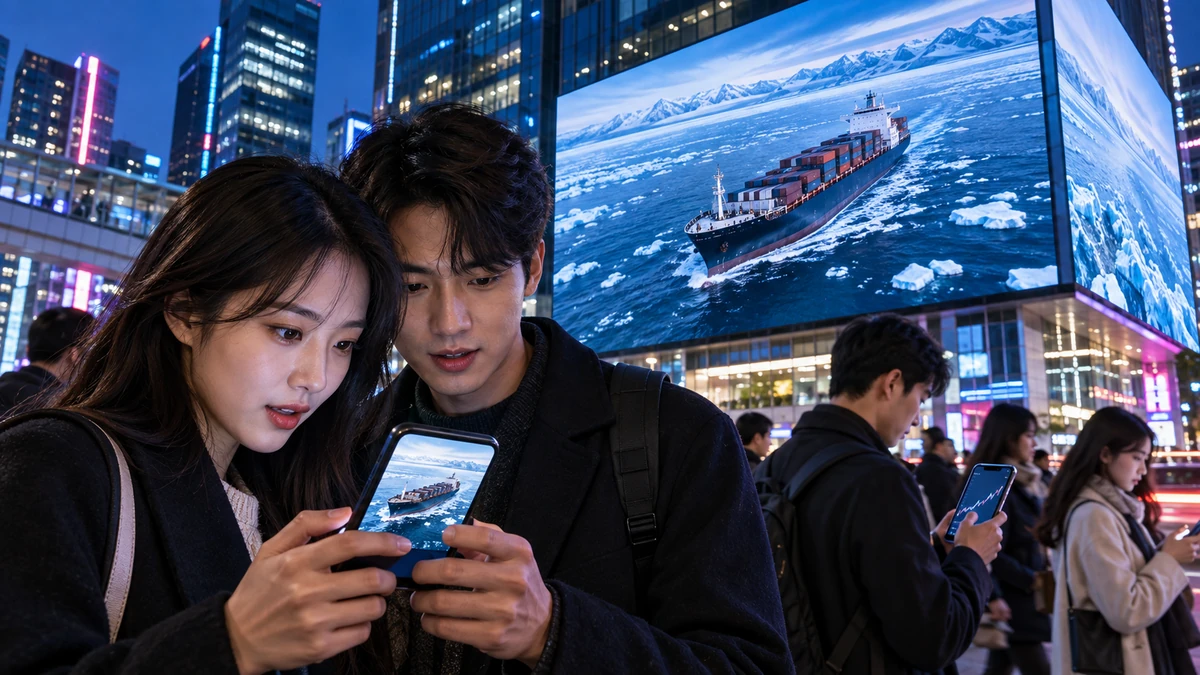
Shipping provides the roundup's most expansive international story. According to the coverage it summarizes, a trial vessel reached the Netherlands 22 days after leaving Busan, South Korea's major port city. Another linked report said the ship traveled about 6,400 kilometers — roughly 4,000 miles — through Arctic waters without an icebreaker.
For an American audience, the significance is not simply that a ship reached Europe. It is the possibility of changing how goods move between East Asian manufacturing centers and European customers. An Arctic passage can offer a geographically shorter alternative to some established routes, but a shorter line on a map does not automatically produce a cheaper, safer or dependable commercial service.
Seasonal ice, weather, insurance, rescue capacity and geopolitical restrictions can all affect whether a voyage is practical. Arctic shipping also raises environmental concerns in a region already undergoing profound climate-related change. A successful passage without icebreaker assistance does not demonstrate that the same route would be available throughout the year or suitable for a regular schedule.
For the United States, an Arctic nation through Alaska, these are commercial and strategic questions as well as environmental ones. American importers, insurers and logistics companies have reasons to monitor changes in global shipping routes. Still, the supplied account gives no cargo economics, repeat-voyage results or contractual commitments. The next meaningful evidence would be whether operators can reproduce the trip reliably and show that its total costs make business sense.
Why Korean investors watch the Federal Reserve
The bonds entry offers the clearest connection to everyday American financial life. The roundup identifies U.S. bond markets and the direction of interest rates — not debt collection, another possible meaning of the Korean search term — as the focus of associated coverage. It describes reports examining possible additional rate increases and the reaction of longer-term yields.
Americans encounter those same forces through mortgage rates, retirement portfolios and business borrowing costs. Korean investors and companies watch them because U.S. financial conditions do not stop at the American border. Treasury yields provide a reference point for assets around the world, while changes in expectations for U.S. rates can influence exchange rates and international capital flows.
For a Korean business importing dollar-priced materials or selling goods overseas, currency movements can alter costs and revenues. For investors, changing returns on U.S. debt can affect the appeal of other holdings. The consequences depend on many factors, including hedging and domestic policy, but the reason for paying attention is straightforward: Decisions and expectations centered in Washington can reshape financial calculations in Seoul.
The roundup also references commentary attributed to Kevin Warsh about rate increases. Its brief excerpts do not establish a complete policy position or the circumstances of the remarks, and they should not be treated as an independently verified Federal Reserve announcement. The more defensible observation is that U.S. monetary policy was a subject of Korean search interest — an illustration of the shared financial environment, not proof of what investors expected to happen next.
For the United States, Korea is more than an export audience
The American takeaway is that South Korea is not simply a destination for U.S. products or a source of entertainment for American fans. It is also a market in which American institutions and companies become subjects of local scrutiny. Federal Reserve policy is assessed for its financial consequences. Starbucks is examined through a controversy involving public purchases. AI executives appear in coverage about risks that reach beyond their home market.
That distinction matters for U.S. businesses. Recognition does not guarantee approval, and global branding does not erase local political or cultural expectations. A company can be familiar enough to attract customers while also becoming a symbol in an argument about government spending or corporate responsibility. American companies operating internationally need to understand that local debate, rather than assume the brand carries the same meaning everywhere.
For American audiences drawn to Korea by music, television or film, the list offers another useful correction. Korean public attention includes the same kinds of unresolved questions that fill American news coverage: Who benefits from economic change? How should families be represented on television? What does an employer owe its workers? How much confidence should the public place in new technology?
For U.S.-Korea relations, the significance is less an immediate diplomatic development than the depth of the economic and cultural connections already in place. This snapshot cannot show whether bilateral ties are improving or deteriorating. It does show why understanding the relationship requires looking beyond military cooperation and entertainment sales to the daily decisions of consumers, investors, employees and technology users.
Starbucks and the politics of public purchases
Starbucks appeared in the roundup through reports about declining gift certificate purchases by Korean local governments following a controversy described as Tank Day. The supplied material does not explain the disputed promotion in sufficient detail to establish its meaning or fairly reconstruct the controversy. What it does identify is a public-spending question involving an internationally recognizable American brand.
One linked report cited purchases totaling 1.7 billion won over three years across 17 provincial-level jurisdictions. It also described a sharp decline in purchases during the first half of the year. Another headline contrasted Starbucks gift certificate spending with official encouragement to use local currency programs — initiatives broadly comparable to geographically restricted shopping vouchers intended to support participating local businesses.
American readers may recognize the underlying argument from debates over whether public institutions should direct spending toward neighborhood businesses or national chains. The presence of a famous brand makes the issue more visible, but the accountability question concerns how officials spend public funds and whether those choices align with their stated economic priorities.
The figures do not establish a nationwide consumer boycott, a fall in Starbucks' overall Korean sales or a financial impact on its U.S. business. Public-sector gift certificate purchases are only one category of spending. Nor does a decline following a controversy, by itself, prove that the controversy caused it. Budgets, purchasing rules and comparable periods would all matter in a fuller assessment.
A gaming dispute points to the value of intellectual property
Wemade, a Korean game company, entered the list through reports that China's Kingnet, previously an opponent in an intellectual property dispute involving The Legend of Mir 2, was participating as an investor in an acquisition of Wemade. The apparent shift from legal adversary to financial participant is the central business development described in the roundup.
The reported investment amount is less settled. The supplied headlines cite both 400 billion won and 460 billion won. That discrepancy should remain visible rather than be converted into a single authoritative figure. The summary also does not provide enough documentation to establish the final transaction structure or whether the proposed investment had closed.
For Americans, a useful comparison is the role of established franchises in major gaming acquisitions, such as Microsoft's purchase of Activision Blizzard. The transactions are not equivalent, but they illuminate a shared principle: Familiar game worlds, characters and player communities can carry value far beyond the original release of a title.
The Korean case also illustrates why entertainment coverage cannot stop at performers and screen appearances. Rights ownership, licensing and investment determine who can develop and profit from creative properties. A former opponent may see commercial value in an asset it once contested. Whether that resolves old disputes or creates new questions depends on the contracts and ownership arrangements, not the search ranking.
Baseball and family television supply the familiar human stakes
Two entries concern Korean professional baseball: catcher Son Seong-bin and a matchup between the Lotte Giants and KT Wiz. Lotte is based in Busan, while KT plays in Suwon, south of Seoul. Both compete in the Korea Baseball Organization, whose teams commonly carry corporate names — a naming convention that differs from the city-and-mascot pattern familiar to most Major League Baseball fans.
The associated coverage examined uncertainty around Son's return and Lotte's diminishing postseason prospects. The summary does not confirm that Son was out for the season; it notes that some headlines raised that possibility as a question. Other reports considered how catching options might affect pitcher Park Se-woong, including a possible pairing with Yoo Kang-nam.
The American parallel is immediate: a late-season roster problem becomes inseparable from the standings. Fans are not merely searching for a final score. They want to know whether the available catcher can help a struggling pitcher, whether a veteran has another opportunity and whether postseason hopes remain realistic. Korean coverage often calls the playoffs fall baseball, much as American coverage invokes October.
The television entry concerns Oh Eun-young Report — Marriage Hell, a program centered on troubled relationships and family counseling. Coverage summarized in the roundup focused on a family's account of its 17-year-old son's isolation and difficulties in a blended household. Oh is a psychiatrist widely known in South Korea for parenting and family advice.
American readers may recognize elements of daytime relationship television, though that comparison does not make the formats or clinical practices identical. The reporting challenge is familiar in both countries: A televised account of family distress is not a complete clinical record. Search interest does not justify diagnosing a teenager, assigning blame from selected scenes or treating a family's most vulnerable moments solely as entertainment.
AI, labor and investigations require different kinds of caution
Dario Amodei, the head of U.S.-based AI company Anthropic, appeared in a cluster of coverage about AI safety and arguments for slowing development. The roundup also includes a separate headline attributing comments about an OpenAI initial public offering to Sam Altman. Those are distinct people, companies and subjects; their appearance in one search cluster does not establish a shared position.
For U.S. technology companies, the Korean attention underscores the international reach of American AI debates. Questions about reliability, dangerous capabilities and corporate incentives become relevant wherever the systems are used. But dramatic headlines about catastrophic outcomes are not evidence that a particular outcome is imminent, and the supplied summaries do not establish a coordinated industry decision to slow development.
The labor entry concerns a four-hour partial strike at HD Hyundai Heavy Industries and reports of plans to expand action beginning Sept. 16. Shipbuilding is a major Korean industry, making workplace negotiations relevant beyond an individual factory. Still, the roundup supplies neither the full bargaining demands nor measured production losses. It cannot establish consequences for American customers or any specific ship delivery.
The final entry involves a father's request for review after authorities closed a preliminary inquiry into his young daughter's death. That is a serious accountability story, but the supplied descriptions do not establish criminal responsibility. A request for further review, reported suspicions and a legal finding must remain clearly distinguished.
What to watch after the searches fade
The common thread is not a single change in Korean opinion. It is the overlap between local concerns and systems that cross borders: shipping networks, dollar financing, entertainment rights, consumer brands and AI development. The American connection is strongest where those systems involve U.S. institutions and companies, but it also runs through recognizable experiences, from labor bargaining to baseball anxiety.
The next useful developments would be concrete rather than algorithmic: repeat Arctic voyages with disclosed costs, formal documentation of the gaming investment, clearer public purchasing data, verified policy statements and reported outcomes in the labor dispute. For the family and death-investigation stories, responsible follow-up would prioritize evidence, privacy and procedural accuracy over sensational details.
A trending-search list can show where curiosity briefly gathers. It cannot establish why every person searched, what the public believes or which headline will have lasting consequences. Read with those limits in mind, this Korean snapshot offers American readers something valuable: a view of a closely connected country as a complex society, not simply a cultural phenomenon or a foreign-policy headline.
Comments
Post a Comment