Image to help understand the article
A Korean approach to the American side dish
Strawberry salad, mashed potatoes and mushrooms with tartar sauce might sound more like an American potluck lineup than an introduction to Korean cooking. But a Korean recipe feature groups versions of all three under a different organizing idea: banchan, the accompanying dishes that help turn rice and other foods into a meal.
The recipes — strawberry salad with yogurt, green mashed potatoes with spinach-milk sauce, and roasted mushrooms with tofu tartar sauce — offer an accessible way for American cooks to explore that approach. Their ingredients are largely recognizable, their preparations cross culinary boundaries, and their nutritional notes raise a question relevant on both sides of the Pacific: How can a cook build an interesting plate without relying mainly on salt?
These are not evidence of a sweeping new food trend, nor does the feature establish that Korean households are abandoning familiar dishes for yogurt-dressed fruit. What they illustrate is more modest and useful: Korean meal planning can accommodate ingredients and preparations that Americans already know. Understanding the structure of a meal can be as valuable as learning a signature recipe.
For readers whose reference points for Korean food are barbecue, kimchi or a restaurant bibimbap bowl, this lineup broadens the picture. The connection is not that strawberries or mashed potatoes are uniquely Korean. It is that they can occupy a place at a Korean table — and offer ideas for an American one.
What banchan means, beyond the little restaurant plates
Banchan is commonly translated as side dishes. At a Korean restaurant in the United States, it often means the small plates arriving around the main order: perhaps kimchi, seasoned vegetables or another preparation selected by the kitchen. These dishes generally accompany the meal rather than function as an appetizer course to be finished before everything else arrives.
The comparison with American sides is helpful but incomplete. At a steakhouse, a diner may choose potatoes or spinach to accompany an individually ordered entree. A Korean meal often places several accompanying dishes within reach of the table, allowing diners to alternate among rice, vegetables and other foods. The side dishes contribute to the meal's variety rather than merely decorate its central protein.
That does not mean every home dinner requires an elaborate spread. The recipe feature explicitly presents its three dishes as alternatives to consider, not a checklist that must be completed. A cook looking for something different after work could choose one rather than prepare all three.
The category also should not be mistaken for a certification of antiquity. Calling a preparation banchan describes its role in a meal; it does not necessarily mean the recipe is centuries old. Yogurt, a milk-based spinach sauce and tofu tartar sauce make this selection especially useful for understanding how flexible that role can be. For an American household, the practical lesson is permission to rethink an accompaniment without rebuilding dinner around an unfamiliar cuisine.
Strawberries move from breakfast bowl to dinner table
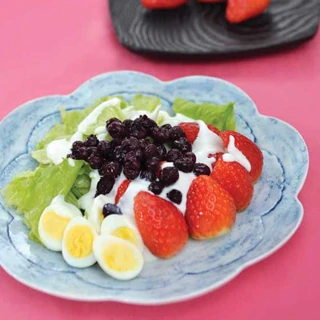
The strawberry salad bridges familiar American food categories. Berries and plain yogurt suggest breakfast; lettuce points toward a dinner salad; boiled quail eggs make the combination more substantial than a bowl of fruit. Together, they become a composed side dish rather than a dessert.
The detailed recipe lists 70 grams of strawberries, 85 grams of plain yogurt, 70 grams of lettuce, 30 grams of quail eggs and 15 grams of blueberries, along with small amounts of vinegar and salt for boiling the eggs. Its directions call for halved, peeled eggs and halved strawberries arranged with torn lettuce and blueberries, with the yogurt poured over the assembled ingredients.
That last detail resolves an ambiguity in the feature's introductory discussion. While the overview treats yogurt as a suggested pairing, the accompanying recipe explicitly uses it as the topping. American readers can think of the preparation as a fruit-and-greens salad with a plain yogurt dressing, although the source does not provide a tasting assessment or establish how sweet or tart the finished dish will be.
Quail eggs may be the least familiar ingredient for many U.S. shoppers. They are much smaller than chicken eggs and may require a trip to an Asian grocery or specialty market. The recipe's weights are more useful shopping guides than its item counts because egg and berry sizes vary.
The feature emphasizes pairing fruit with a calcium-containing food. Plain yogurt can contribute calcium and protein, but the broader point is food variety, not a special protective interaction between strawberries and dairy. The recipe card reports 195 calories, 30 grams of carbohydrates, 7 grams of protein, 5 grams of fat and 138 milligrams of sodium per serving. Those figures are supplied by the source, not independently verified.
Mashed potatoes, with a different supporting cast
The potato dish offers perhaps the easiest American point of entry. Mashed potatoes already have a dependable place at Thanksgiving and weeknight dinners. Here, the familiar base is combined with a sauce made from spinach and milk, then accompanied by almonds, cranberries and chicory.
The method starts by blanching spinach in salted boiling water, rinsing it in cold water and squeezing out moisture. The spinach is blended with milk and strained. Separately, peeled potatoes are steamed for about 20 minutes and mashed. The potatoes are then mixed with chopped chicory, some spinach-milk sauce and sugar, with chopped almonds and cranberries added on top and more sauce served alongside.
This is not simply an American butter-and-cream mash colored green. The listed preparation uses a small quantity of milk in the sauce and includes no butter. Its combination of potatoes, greens, fruit and nuts also gives it a different ingredient profile from a plain potato side. The source does not specify whether the cranberries are fresh or dried, however, a distinction American cooks should resolve before attempting a precise reproduction.
The recipe card reports 155 calories, 32 grams of carbohydrates, 5 grams of protein, 1 gram of fat and 24 milligrams of sodium per serving. That is the lowest listed sodium figure among the three dishes. But the recipe uses salted blanching water without specifying an amount of salt, one reason to treat the nutrition data as a guide rather than a laboratory result that every home preparation will reproduce.
For American cooks, the transferable idea is the sauce: Vegetables and milk can become part of the potato preparation itself, rather than remain separate components elsewhere on the plate. It is an approach to consider, not proof that this particular mash is nutritionally superior to every alternative.
Tofu tartar sauce turns attention to the condiment
The mushroom dish makes its strongest cross-cultural connection through tartar sauce. Americans commonly encounter the condiment alongside fried fish or seafood sandwiches, usually in a mayonnaise-based version. This preparation instead lists soft tofu with chopped onion, chopped cucumber pickles, olive oil, vinegar, lemon juice, mustard, honey and white pepper.
The accompanying mushrooms are king oyster mushrooms, called saesongi in Korean. Their thick stems distinguish them from the small button mushrooms familiar in many American supermarkets. The recipe lists olive oil for the mushroom component and chicory as an accompaniment.
There is an important limitation for anyone hoping to cook directly from the supplied material: The mushroom instructions stop during preparation of the tofu sauce. They direct the cook to squeeze moisture from the chopped onion and pickles and begin combining the sauce ingredients, but they do not provide the complete mushroom-cooking procedure. An oven temperature, cooking time or detailed grilling method cannot responsibly be presented as part of this recipe.
Even without those missing steps, the ingredient strategy is clear. The feature encourages cooks to consider mustard and lemon instead of leaning exclusively on soy sauce or salt for seasoning. Acidity and pungency give a sauce dimensions that salt alone cannot supply. Soft tofu provides a different base for a condiment Americans already recognize.
That does not make the sauce sodium-free. Prepared mustard and pickles can contain substantial sodium, with amounts varying by brand and quantity. Nor should the dish automatically be described as vegan: The listed sauce includes honey. Its recipe card reports 150 calories, 18 grams of carbohydrates, 8 grams of protein, 5 grams of fat and 133 milligrams of sodium per serving, although those numbers warrant particular caution given the listed oil quantities.
What the sodium advice can — and cannot — establish
The feature links its ingredient pairings to lower-sodium eating, including discussion of potassium in produce and calcium in dairy. Those explanations need some separation. Adding a potassium-containing vegetable or calcium-containing dairy product does not remove sodium from a recipe. Reducing the amount of sodium added, or choosing ingredients with less sodium, directly changes its sodium content.
Potassium plays a role in blood pressure regulation and the body's handling of sodium. That is not the same as saying a serving of strawberries cancels out a salty meal. Likewise, milk and yogurt can contribute calcium, but they should not be understood as a way to flush away whatever salt a diner consumes. People with kidney disease or other conditions requiring potassium restrictions need individualized advice rather than a general instruction to eat more potassium.
The data themselves also deserve scrutiny. Although the feature's introductory text says serving information is unavailable, the detailed recipe cards explicitly label the nutrition figures as per serving. That is the basis for the figures reported here. The material still does not explain its nutrient-calculation methods or provide enough detail to establish what every cook will actually consume.
In the mushroom recipe, the listed olive oil totals 12 grams before accounting for any other source of fat, yet the nutrition panel reports only 5 grams of total fat. Some cooking oil may remain behind, but the supplied information does not explain the discrepancy. It would therefore be inappropriate to present the panel as a verified nutritional analysis.
For a U.S. reference point, the Food and Drug Administration uses a daily value of less than 2,300 milligrams of sodium for adults and children age 14 and older. A single side dish is only part of that daily total. Bread, soup, sauces, packaged foods and the rest of dinner still count.
What this means for American kitchens and food companies
For American audiences, these dishes suggest a way to engage with Korean food beyond purchasing one signature sauce or ordering one famous entree. Strawberries, yogurt, potatoes, spinach and tofu provide familiar ingredients through which to explore a different style of meal organization. A household can try one accompanying dish while keeping the rest of dinner unchanged.
For fans drawn to Korean culture through music, television or film, that distinction matters. Food is not only a collection of visually recognizable dishes. It also involves routines: how dishes are grouped, how people share them and how a cook adds variety to an everyday meal. This recipe feature offers a small window into those choices without establishing that its particular combinations are universal in Korea.
The comparable American industry practice is the adaptation of a familiar format with a different ingredient base — a yogurt dressing instead of a richer dressing, for example, or a plant-based spread in place of a conventional condiment. The tofu tartar sauce fits that kind of product-development thinking. But there are no U.S. sales figures, company announcements or consumer surveys in the source showing commercial demand for this specific preparation.
For American restaurants, recipe publishers and food brands considering similar ideas, the practical requirements are straightforward: explain unfamiliar ingredients, provide workable measurements, identify allergens and support nutrition claims. This lineup includes dairy, eggs, almonds and soy across its three recipes. A Korean-inspired label does not replace clear ingredient information, and a lower-sodium pitch requires more than the presence of vegetables.
The U.S.-Korea connection here is cultural rather than diplomatic or transactional. The material documents no trade agreement, export initiative or corporate partnership. Its significance for American readers lies in how easily a Korean meal-planning concept can be understood through foods already present in U.S. kitchens, without pretending the two food cultures are interchangeable.
What to take to the table next
The strongest lesson from this collection is not that three dishes constitute a complete diet, or that every conventional seasoning needs replacing. It is that choosing an accompaniment can begin with a pairing: fruit and yogurt, potatoes and a vegetable-milk sauce, mushrooms and a tofu-based condiment.
For home cooks, the next step is to select one idea that fits the meal and use complete, reliable instructions. The salad and potato preparations offer more procedural detail than the truncated mushroom recipe. Anyone seeking a precise sodium target should also check ingredient labels and measured amounts rather than rely solely on the supplied panels.
For publishers and businesses connecting Korean food with American audiences, what to watch is the quality of that explanation. More useful than declaring every hybrid dish a new trend is showing readers how it works, where its ingredients come from and what the available evidence actually supports. These three sides make a persuasive case for curiosity at dinner — with familiar groceries, a broader understanding of banchan and appropriately modest nutritional claims.
Comments
Post a Comment