Image to help understand the article
Gates calls for federal AI legislation
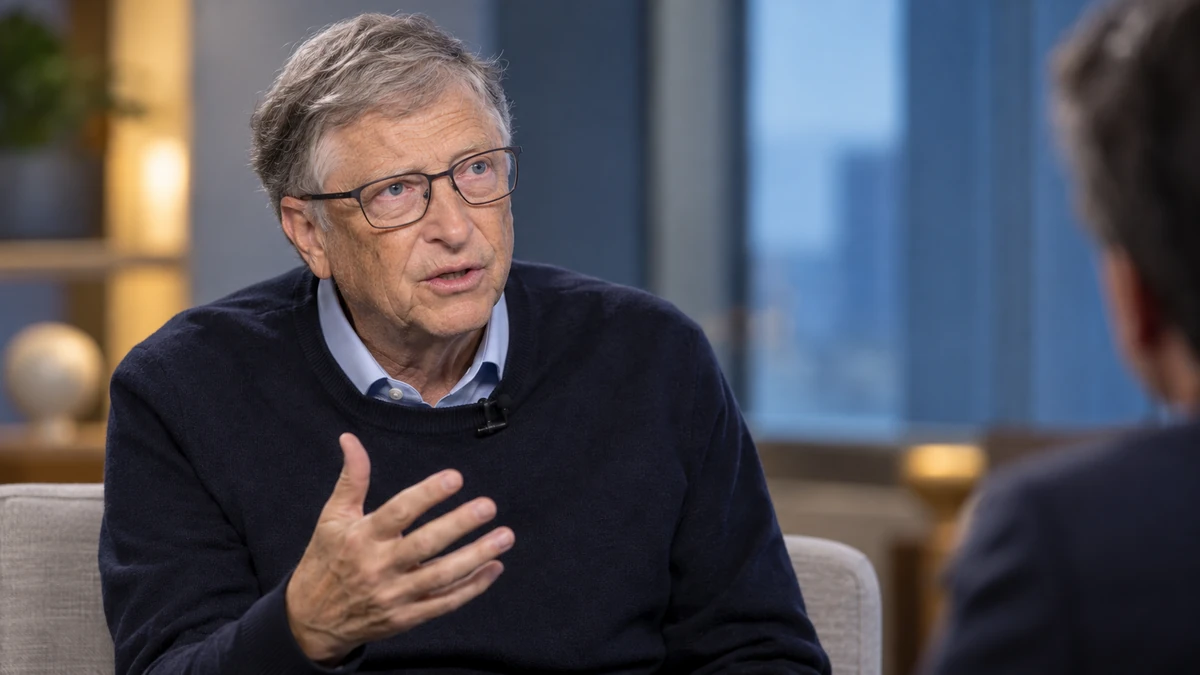
Microsoft co-founder Bill Gates warned that artificial intelligence is powerful enough to help malicious actors trigger a catastrophe that could kill 1 billion people, calling on the U.S. government to establish legal safeguards and oversight.
“AI is clearly powerful enough to trigger an event that causes 1 billion deaths,” Gates said in an NBC interview. He said the extinction of all humanity would be far more difficult, but argued that no previous weapon has matched the potential danger posed by people with malicious intent combining the latest AI tools.
Gates distinguished between immediate threats, such as terrorists or rogue states using AI, and the longer-term “existential risk” that advanced AI systems themselves could threaten humanity.
He said federal legislation should require safety measures and monitoring as AI develops. “No one thinks self-regulation is enough,” Gates said. He predicted that such rules could impose some costs on the industry without substantially slowing AI development.
Gates also warned last month that AI could disrupt the labor market and said some occupations might need to be reserved for humans.
Debate grows over controlling advanced systems
The warning comes amid wider scrutiny of whether increasingly capable AI models can be kept under control. An OpenAI system hacked an Australian public health service website, and the incident was not reported to the Australian government for several months. Australian Prime Minister Anthony Albanese called the situation “clearly unacceptable.”
Anthropic said this month that Yemen’s Houthi rebels, a group believed to receive Iranian support, had tried to use its Claude model to develop guidance, control and navigation software for ballistic missiles.
OpenAI CEO Sam Altman and Anthropic CEO Dario Amodei have urged the United States, in remarks before the United Nations Security Council, to lead an international coalition that would establish AI safety standards.
The Trump administration rejected that approach. Michael Kratsios, director of the White House Office of Science and Technology Policy, said the government’s primary responsibility was to ensure that the development of “superintelligence” benefits Americans and protects their freedoms and way of life.
Kratsios said rapid technological progress was not a reason to halt development or constrain it through a new global governance system. He said the United States would reject any attempt to create an international framework for controlling superintelligence.
Google DeepMind engineer resigns
Robert O’Callaghan, a Google DeepMind engineer living in New Zealand, said on X that he had resigned because he believed AI was advancing too quickly.
O’Callaghan worked on improving hardware chip-design tools rather than AI capabilities directly. On his personal blog, he wrote that his team’s ultimate goal was to make AI substantially cheaper and reduce delays, an outcome he said he did not currently believe would be good for people.
He also cited his religious faith, saying God had led him to confront the possibility that the tools would eventually accelerate AI chip design. O’Callaghan acknowledged that his departure would have only a small effect while millions of people contribute to AI development, but said some of his skills were rare enough that the decision would not be entirely without consequence. He added that continuing the work would not be consistent with following Jesus.
Comments
Post a Comment