Image to help understand the article
A Hollywood Epic Reaches a Rare Korean Milestone
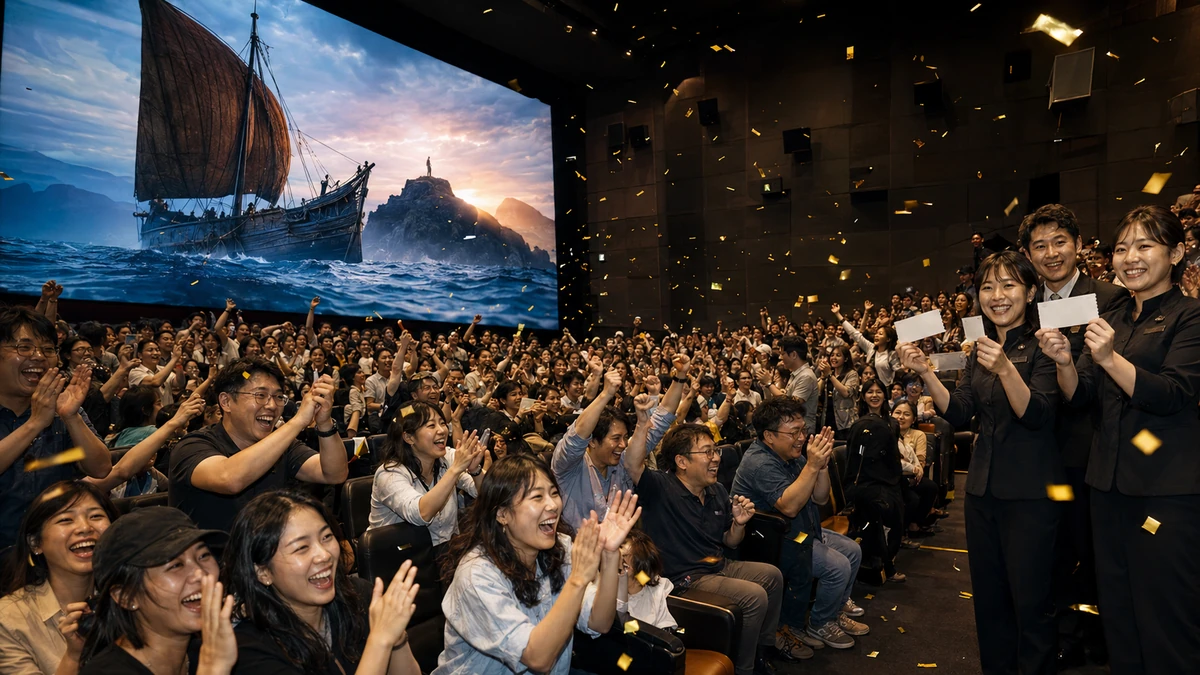
Christopher Nolan’s “The Odyssey” has crossed 10 million admissions in South Korea, turning a nearly three-hour adaptation of an ancient Greek poem into one of the country’s biggest theatrical events of the year. Universal Pictures, the film’s distributor, said the movie passed the threshold at about 4 p.m. on the 6th, 33 days after opening in Korean theaters on the 5th of the previous month.
For American readers, the significance of 10 million is easy to miss because the U.S. film industry generally measures success in dollars. South Korea, by contrast, often discusses box-office performance in admissions, emphasizing how many tickets were sold rather than only how much revenue a title generated. A “10 million movie” is not simply a hit. It is a widely recognized cultural category, comparable to a film becoming a national conversation in the United States while also reaching the upper ranks of the annual box office.
South Korea has a population of roughly 51 million, so 10 million admissions represent ticket sales equal to nearly one-fifth of the country’s population. That does not mean one in five Koreans necessarily saw the movie, because repeat viewings are included. Still, the scale explains why the milestone carries so much symbolic weight. It suggests that a film has moved beyond dedicated fans and reached families, casual moviegoers and audiences across generations.
“The Odyssey” is the second release of the year to reach 10 million admissions, following Korean director Jang Hang-jun’s “The Man Who Lives With the King.” Counting both domestic and international productions, it is the 35th film in Korean box-office history to enter the 10 million club, according to the figures cited by the distributor.
Its performance is especially notable among imported movies. “The Odyssey” is the first foreign film to reach 10 million admissions in Korea since James Cameron’s “Avatar: The Way of Water,” released in 2022, and only the 10th international title to do so. The small group includes “Avatar,” Nolan’s “Interstellar,” “Bohemian Rhapsody,” “Aladdin” and “Frozen II.” Those films differ dramatically in genre, but all offered a combination of spectacle, emotional accessibility and a reason to experience them with an audience.
A Month at No. 1, Not Just a Blockbuster Opening
The film’s trajectory points to something more durable than opening-weekend excitement. “The Odyssey” remained No. 1 at the Korean box office every day from its release through the 6th, an unusually sustained run in a market where new titles can quickly displace even heavily promoted releases.
The movie reached 1 million admissions on its fourth day and passed 5 million on its 13th. By its 24th day, it had sold more than 8 million tickets, the fastest audience growth among films released in Korea this year. Those figures suggest that initial curiosity did not collapse after Nolan’s core following rushed to theaters. Instead, the audience expanded over several weeks.
That distinction matters in the streaming era. Hollywood studios have become adept at creating enormous opening weekends through franchise recognition, global marketing and presales. The harder task is persuading people to keep buying tickets after the most committed fans have already attended. In Korea, “The Odyssey” appears to have done that by functioning not only as a movie but as an event — the kind of release viewers felt should be seen on the biggest screen available.
The pattern also reflects the structure of South Korea’s highly developed theatrical market. Major multiplex operators, including CGV, Lotte Cinema and Megabox, have invested heavily in premium auditoriums, large-format screens and enhanced sound systems. Korean moviegoers are accustomed to selecting not just a title and showtime but a particular viewing format. For a director such as Nolan, whose marketing routinely emphasizes film projection, practical production methods and theatrical scale, that culture provides unusually fertile ground.
The film’s 172-minute running time might ordinarily limit screenings and discourage casual viewers. Instead, length became part of the promise: Audiences were being offered a substantial, immersive experience rather than a story designed to be consumed in fragments. The result challenges the assumption that contemporary viewers have lost patience for long, demanding movies. They may be selective, but they will still commit when the production appears to justify the time.
Nolan Becomes a Two-Time 10 Million Director
The milestone gives Nolan his second 10 million-admission film in South Korea after “Interstellar.” He is the fourth foreign filmmaker, or filmmaking team, to have at least two movies reach that level in the country, joining Anthony and Joe Russo, James Cameron, and “Frozen” directors Chris Buck and Jennifer Lee.
Nolan’s distinction is that his two films are unrelated stories rather than installments in the same series. According to the Korean report, he is the first foreign director to reach 10 million admissions twice with nonfranchise films. That detail helps explain his unusual position in the Korean market. He is effectively marketed like a franchise unto himself.
In the United States, the closest comparison may be the small group of directors whose names can sell an original or historically based film without dependence on a familiar superhero, sequel number or cinematic universe. Steven Spielberg once occupied that position almost alone. More recently, filmmakers including Jordan Peele, Quentin Tarantino and Nolan have shown varying degrees of director-driven commercial power. Nolan’s Korean following demonstrates how that form of authorship can travel internationally.
Neither “Interstellar” nor “The Odyssey” fits the conventional model of easy, short-form entertainment. “Interstellar” combined theoretical physics, ecological collapse, family separation and questions about time. “The Odyssey” reaches back about 3,000 years to a poem attributed to Homer and turns the hero’s long journey home into a 172-minute production. Korean audiences have treated that complexity not as an obstacle but as part of the attraction.
That response is tied to Nolan’s reputation for making intellectual ambition feel like spectacle. His movies invite audiences to debate time, memory, morality and human survival while also delivering images and sound designed for premium theaters. In Korea, where film culture includes active online discussion, repeat viewing and close attention to directors, that combination can sustain a movie long after its first wave of publicity.
The cast also lowers the barrier to an ancient story. Matt Damon plays Odysseus, the king of Ithaca who spends 10 years trying to return home after the decade-long Trojan War. Anne Hathaway, Tom Holland, Charlize Theron, Robert Pattinson and Zendaya are also featured. Their global familiarity gives viewers multiple points of entry into material that might otherwise sound like a classroom assignment.
Why Greek Mythology Feels Familiar in South Korea
Although “The Odyssey” comes from the Western classical tradition, its world is not entirely foreign to Korean audiences. The Trojan horse, the goddess Athena, the seductive Sirens and other Greek mythological figures have circulated for decades through translated books, comics, animation, school materials and popular entertainment.
One particularly important bridge was “Greek and Roman Mythology in Comics,” an educational comic series first published in South Korea in November 2000. The series surpassed 10 million copies in cumulative sales, according to the Korean report. Many Koreans who encountered the gods and heroes through those books as children or teenagers are now in their 20s and 30s, a central demographic for theatrical moviegoing.
CGV data showed that the audience for “The Odyssey” was distributed relatively evenly by age, with viewers in their 20s and 30s accounting for half of admissions. The distributor connected the film’s appeal among people born in the 1990s to their childhood familiarity with Greek mythology. In that sense, the movie benefits from nostalgia, but not nostalgia for an earlier screen franchise. It draws on memories of reading, studying and imagining the myths.
American audiences may recognize a parallel in the enduring popularity of mythology-based books and adaptations, from school editions of Homer to Rick Riordan’s “Percy Jackson” series. Stories about gods, monsters and heroic quests often enter popular culture long before viewers encounter the original texts. By the time a prestige filmmaker revisits the source, audiences already know the broad outlines and can focus on interpretation and execution.
Familiarity with the ending may even strengthen the theatrical appeal. “The Odyssey” is not built around whether Odysseus will encounter the Cyclops Polyphemus, the Sirens or the sorceress Circe. Many viewers already know those episodes. The selling point is seeing how Nolan gives physical form to images that have existed in books, paintings, cartoons and the imagination.
The production reportedly minimized computer-generated imagery in major sequences involving sea voyages, the Trojan War and confrontations between humans and mythical beings. That emphasis on physical texture fits Nolan’s established brand. It also transforms an ancient narrative into a demonstration of contemporary filmmaking craft. The story may be old, but the experience of seeing it staged at this scale is presented as new.
IMAX Turns the Movie Into a Repeat-Viewing Event
The clearest evidence that format mattered is the film’s record-setting IMAX attendance. “The Odyssey” was shot entirely with IMAX film cameras, a first for a 172-minute feature, according to the Korean account. Through the 5th, more than 1.1 million people in South Korea had seen it in IMAX.
That total surpassed the previous Korean IMAX attendance record of about 929,000, held by “Avatar: The Way of Water.” At the time of the calculation, “The Odyssey” had recorded approximately 9.77 million overall admissions, putting IMAX’s share at 11.3%. For a premium format available on only a fraction of the country’s screens, that is a substantial portion of the audience.
Demand for premium screenings also appears to have encouraged repeat business. The reported share of viewers who saw “The Odyssey” at least twice was 6.3%, compared with 4.8% for “Spider-Man: Brand New Day” and 4.6% for “Hope.” Advance ticket sales, which stood in the 500,000 range on opening morning, rose above 1 million in the second week and remained above 700,000 in the third.
Those numbers indicate that some viewers may have started in a conventional auditorium and later upgraded to IMAX, while others returned to compare formats or revisit major sequences. The premium ticket was not merely an add-on purchased by opening-night enthusiasts. It became part of the movie’s longer commercial life.
This is an increasingly important theatrical formula: Give audiences a film that changes meaningfully when presented on a larger screen with more powerful sound. Streaming services can compete on convenience, price and vast libraries. They cannot fully replicate the physical dimensions of an IMAX auditorium or the social experience of a sold-out screening. “The Odyssey” suggests that theaters can still win when they offer something clearly differentiated from home viewing.
What the Korean Success Means for the United States
For the American film business, South Korea’s response offers both an opportunity and a warning. The opportunity is that ambitious, nonfranchise filmmaking can still generate mass attendance overseas when a trusted director, recognizable cast and premium visual format come together. The warning is that audiences increasingly need a persuasive reason to leave home, and ordinary theatrical presentation may not be enough.
Universal Pictures, an American studio, is the direct commercial beneficiary of the Korean performance. A 10 million-ticket run in one of Asia’s most influential entertainment markets strengthens the international case for large-scale projects that are not conventional sequels. It also gives American studios another example of South Korea’s importance as more than a secondary release territory. Korean audiences can validate a Hollywood film’s global-event status and generate enthusiasm that circulates through fan communities well beyond the country.
The result should be especially relevant to U.S. theater chains and premium-format operators. American moviegoers have also shown that they will seek out IMAX and other large-format presentations for films promoted as visually distinctive. Nolan’s work has repeatedly placed projection technology at the center of release campaigns, encouraging audiences to research screen size, aspect ratio and film formats in a way once associated mainly with cinephiles.
Korea’s numbers suggest that this behavior can move from a niche concern to a mainstream purchasing decision. If viewers believe one auditorium offers a substantially better experience than another, theaters can create urgency and repeat attendance even for a movie with a long running time. For U.S. exhibitors, that supports continued investment in premium screens — but it also raises questions about access, because the highest-demand formats are concentrated in major cities and carry higher ticket prices.
American audiences may also find the Korean embrace of “The Odyssey” notable because it reverses the familiar direction of cultural discussion. In recent years, U.S. coverage of Korean entertainment has focused on Korean works traveling outward: BTS and other K-pop acts filling American stadiums, “Parasite” winning the Academy Award for best picture, “Squid Game” becoming a Netflix phenomenon and Korean production companies pursuing Hollywood partnerships. Here, an American studio’s adaptation of a foundational European text becomes a major cultural event in Korea.
That two-way movement is a more accurate picture of U.S.-Korea entertainment ties than a simple story of Korean content “arriving” in America. Korean audiences have long been sophisticated consumers of Hollywood movies, while Korean films, television dramas and music now influence American tastes and business strategies. Success moves in both directions, and companies increasingly plan releases around globally connected fan cultures rather than isolated national markets.
There is also a lesson for American filmmakers adapting familiar intellectual property. Recognition alone does not guarantee urgency. “The Odyssey” is among the oldest well-known stories in Western literature, but its Korean success appears to rest on making the material feel physically immediate and technologically current. The source does not need to be new if the method of presentation feels new.
A Broader Shift in What Counts as Theatrical Entertainment
The Korean run of “The Odyssey” fits a wider shift in the movie business. Theaters are increasingly strongest when a film can be sold as a communal occasion rather than simply the first place a story becomes available. Concert films, animation, effects-heavy science fiction and filmmaker-driven epics can all benefit from that logic, though they reach different audiences.
This does not mean every long film or literary adaptation can reproduce Nolan’s success. His name carries unusual weight, the cast includes some of the world’s most recognizable actors, and Universal has the resources to mount a global campaign. South Korea’s dense network of modern multiplexes also makes premium theatrical attendance easier than it would be in markets with fewer screens.
Nor does the milestone erase the pressures facing theaters. Streaming habits remain deeply established, younger viewers have endless entertainment choices, and premium tickets can make frequent moviegoing expensive. Event films may strengthen the biggest releases while leaving smaller dramas, comedies and independent productions with less room to attract attention.
Still, the achievement complicates predictions of theatrical decline. Korean audiences committed nearly three hours to a story originating in the eighth century B.C., then helped push it past 10 million admissions in barely more than a month. Many did so not despite the movie’s scale and complexity, but because of them.
The next question is whether studios will draw the right conclusion. The lesson is not simply to make everything longer, louder or more expensive. It is to align story, filmmaker and format so that audiences understand why a movie belongs in a theater. “The Odyssey” offered mythology familiar enough to be accessible, stars recognizable across borders and images marketed as impossible to appreciate fully on a phone or television.
For Hollywood, Korean exhibitors and audiences on both sides of the Pacific, that combination is worth watching. A 3,000-year-old journey has become evidence that theatrical novelty does not always require a new universe. Sometimes it requires taking an old story seriously, giving it contemporary scale and convincing viewers that the voyage itself is worth leaving home for.
Comments
Post a Comment