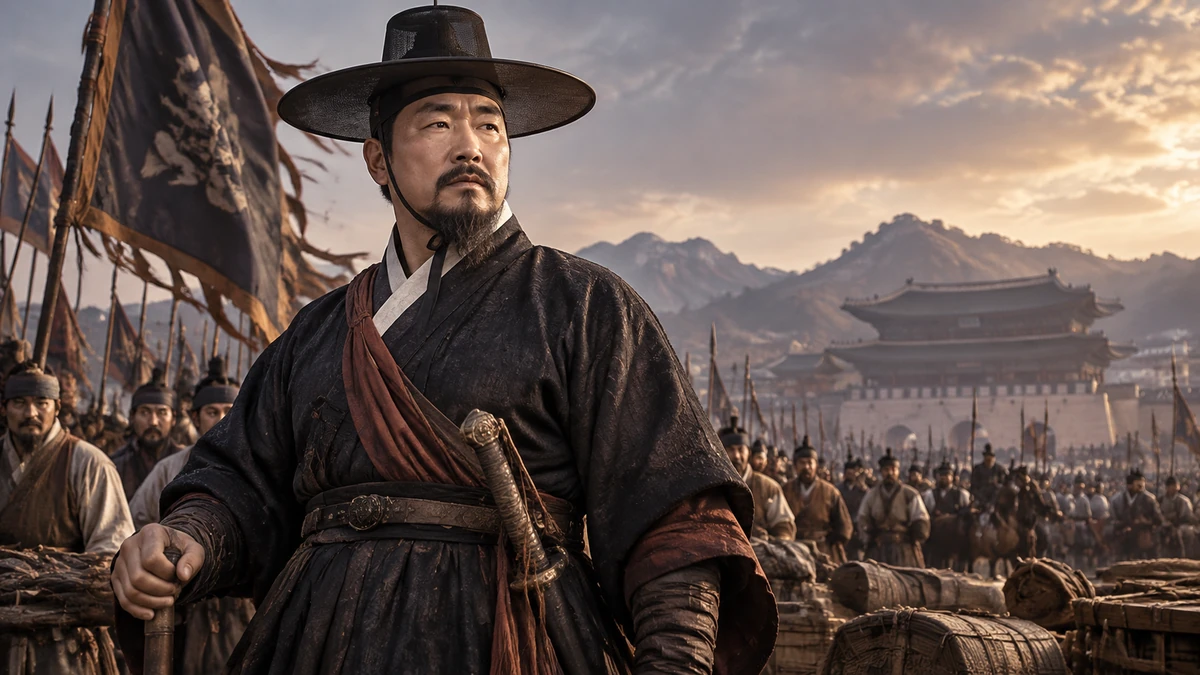
Image to help understand the article
A Scholar Who Took Up Arms at the End of Korea’s Empire
Long before South Korea became a modern democracy with a globally recognized economy and culture industry, the Korean Peninsula experienced one of the most turbulent periods in its history. During the final years of the Korean Empire, a number of activists and military leaders organized armed resistance against growing Japanese influence. Among them was Heo Wi, a scholar-official who became one of the most prominent leaders of Korea’s anti-Japanese righteous armies, known in Korean history as the uibyeong.
For many American readers, the term righteous army may require some explanation. These were not a formal national military like the U.S. Army or a government-recognized force. Instead, they were civilian-led armed groups made up of scholars, farmers, former soldiers and local residents who organized resistance movements during periods of foreign pressure and occupation. Their motivations combined political opposition, defense of national sovereignty and traditional Confucian ideals of loyalty and duty.
Heo Wi was born in 1855 in Seonsan, in what is now South Korea’s North Gyeongsang Province. His pen name was Wangsan, a name that remains familiar today through streets and memorial sites. Raised in a family deeply connected to Confucian learning, Heo initially followed the path of a scholar rather than a warrior. However, the political crisis of late 19th-century Korea changed his direction.
In 1895, the assassination of Empress Myeongseong, an event widely viewed in Korea as a symbol of increasing Japanese interference, and the enforcement of a government order requiring Korean men to cut their traditional topknots sparked widespread anger. Heo joined the first wave of resistance movements, helping organize an armed group in 1896. The movement attempted to establish a base in areas including Gimcheon and Seongju and prepared to challenge government forces aligned with the existing political order.
The uprising was eventually defeated after government troops and reinforcements attacked the movement. Heo temporarily withdrew from armed activity after receiving a secret order from Emperor Gojong asking some resistance groups to disband. He returned to study, but his withdrawal from battle did not mean an end to his opposition to Japanese expansion.
From Government Official to Political Dissident
Heo Wi’s life was unusual because he was not originally an outsider challenging the Korean state. He had served within the imperial government itself. In 1899, he returned to official service, holding positions connected to institutions such as the Seonggyungwan academy, the Korean judiciary and the central administration. His career reflected the complex choices faced by Korean elites during a period when the country’s sovereignty was increasingly threatened.
As Japan expanded its influence over Korean affairs, Heo became more openly critical. After the signing of agreements that increased Japanese control over Korean diplomacy and administration, he participated in distributing statements criticizing Japan’s actions. Authorities arrested him along with other prominent figures, including Choe Ik-hyeon and Kim Hak-jin, and imprisoned him for several months.
After his release, Japanese officials attempted to persuade him to accept a senior government position under the new political environment. He refused and left government service, choosing retirement and resistance over cooperation with a system he believed undermined Korea’s independence.
This transition from official to resistance leader is one reason Heo remains an important historical figure in Korea. His story reflects a broader pattern seen during the final years of the Korean Empire: individuals who had worked inside government institutions later became opponents of foreign domination when they concluded that existing political structures could no longer protect national sovereignty.
The 13 Provinces Army and the Attempt to March on Seoul
Heo Wi’s most famous military role came in 1907, after Emperor Gojong was forced to leave the throne and the Korean imperial army was disbanded. The loss of the official military pushed many former soldiers into resistance movements. Heo organized a new force in Gyeonggi Province and joined efforts to unite regional resistance groups.
That year, thousands of fighters gathered in Yangju to create the 13 Provinces Army, an alliance representing resistance forces from across the Korean Peninsula. The organization was led by Yi In-yeong as commander-in-chief, while Heo Wi served as military commander and leader of forces from Gyeonggi Province.
The alliance planned what became known as the Seoul advance, an attempt to attack Japan’s main colonial administrative center in Korea. Heo led an advance unit of roughly 300 elite fighters toward the area outside Seoul’s eastern gate. The operation, however, faced serious logistical problems. Communication between units broke down, reinforcements failed to arrive, and Japanese forces attacked different groups separately.
The campaign ended without achieving its objective, and the resistance forces were forced to retreat. Despite the defeat, the operation became one of the most significant examples of coordinated Korean resistance before Japan formally annexed Korea in 1910.
For historians, the Seoul advance also demonstrates the challenges faced by irregular movements. The fighters often had strong local support and determination, but they lacked the centralized command structure, modern equipment and resources available to Japanese forces.
Guerrilla Warfare Along the Imjin River
After the failure of the Seoul campaign, Heo Wi continued organizing resistance. He joined forces with several other commanders to establish the Imjin River United Righteous Army, taking the position of overall leader. Rather than attempting another direct assault against stronger Japanese forces, Heo adopted guerrilla tactics.
His leadership emphasized discipline and maintaining public support. He instructed his forces not to harm civilians and used military certificates to obtain supplies rather than allowing uncontrolled confiscation. These efforts reflected an attempt to present the resistance movement as a legitimate national struggle rather than a group of armed rebels.
In early 1908, Heo helped organize thousands of fighters in areas including Gapyeong and Jeokseong. His forces trained troops, produced weapons and coordinated with other resistance leaders. He also sent messages to other groups calling for continued opposition to Japanese rule.
Japanese authorities and Korean collaborators attempted to weaken his movement through political offers. According to Korean historical accounts, officials including Prime Minister Yi Wan-yong offered Heo government positions in an effort to persuade him to stop fighting. He rejected these proposals and continued resistance efforts.
Execution, Family Sacrifice and Korea’s Memory of Independence Activists
Heo Wi was captured by Japanese military police on June 11, 1908, in Yudong village in Yangpyeong, a mountainous area east of Seoul. He was imprisoned at Seodaemun Prison, a facility later remembered in Korea as a major symbol of colonial-era repression. On Oct. 21, 1908, he was executed at the age of 51.
His resistance came with a heavy cost for his family. His older brother Heo Hun reportedly sold thousands of fields of farmland to help finance the movement, while another brother, Heo Gyeom, participated directly in armed resistance. After Heo Wi’s death, members of the family eventually moved to Manchuria, then part of a major migration route for Korean independence activists seeking to continue their struggle abroad.
Several relatives and descendants later participated in independence activities. Their experiences reflected a broader reality for many Korean families involved in anti-colonial movements: exile, financial hardship and separation from their homeland.
The South Korean government awarded Heo Wi the Order of Merit for National Foundation, Republic of Korea Medal, in 1962. Today, his legacy is preserved through memorial sites, including Wangsan Heo Wi Memorial Park in Gumi, and through Wangsan-ro, a street in Seoul named after his pen name.
Why Heo Wi’s Story Matters to American Audiences
For Americans, Heo Wi’s story provides historical context for understanding modern South Korea’s relationship with independence, national identity and remembrance. South Korea’s contemporary global influence through technology, entertainment and trade developed after decades of political upheaval, including the Japanese colonial period from 1910 to 1945 and the Korean War from 1950 to 1953.
American audiences often encounter Korea through cultural exports such as K-pop, Korean films, television dramas and consumer brands. However, many of these global successes are connected to a longer historical narrative about sovereignty and national rebuilding. Stories of independence activists like Heo Wi remain central to how many Koreans understand the sacrifices made before the country’s modern transformation.
In the United States, historical memory also plays an important role in national identity. Similar discussions can be found around figures from the American Revolution, civil rights movement and other periods when individuals challenged powerful political systems. The comparison is not exact, but it helps explain why figures like Heo Wi continue to receive public attention more than a century after their deaths.
For Korean communities in the United States, including Korean American families and cultural organizations, independence-era history remains an important part of heritage education. Museums, schools and community events often explore the experiences of Koreans who fought for self-determination during the early 20th century.
A Historical Figure Between Scholarship and Resistance
Heo Wi’s legacy is built around a contradiction that defines many figures from periods of national crisis. He was a Confucian scholar and government official who ultimately became an armed resistance commander. His life shows how political circumstances forced individuals to make choices between accommodation, reform and confrontation.
His military campaigns did not defeat Japan, and the broader independence movement would continue for decades after his death. Yet his role in organizing the 13 Provinces Army and the Imjin River resistance movement made him one of the most recognized leaders of Korea’s righteous army tradition.
Today, Heo Wi is remembered not only as a fighter but also as a symbol of personal conviction during a period when Korea faced the loss of its sovereignty. For international audiences seeking to understand Korea beyond its modern economic and cultural achievements, his story offers a window into the historical experiences that shaped the nation’s identity.
Comments
Post a Comment