How a 14th-Century Korean Scholar Turned Cotton Into a Social Revolution — and Why It Still Matters in a U.S.-Korea Economy
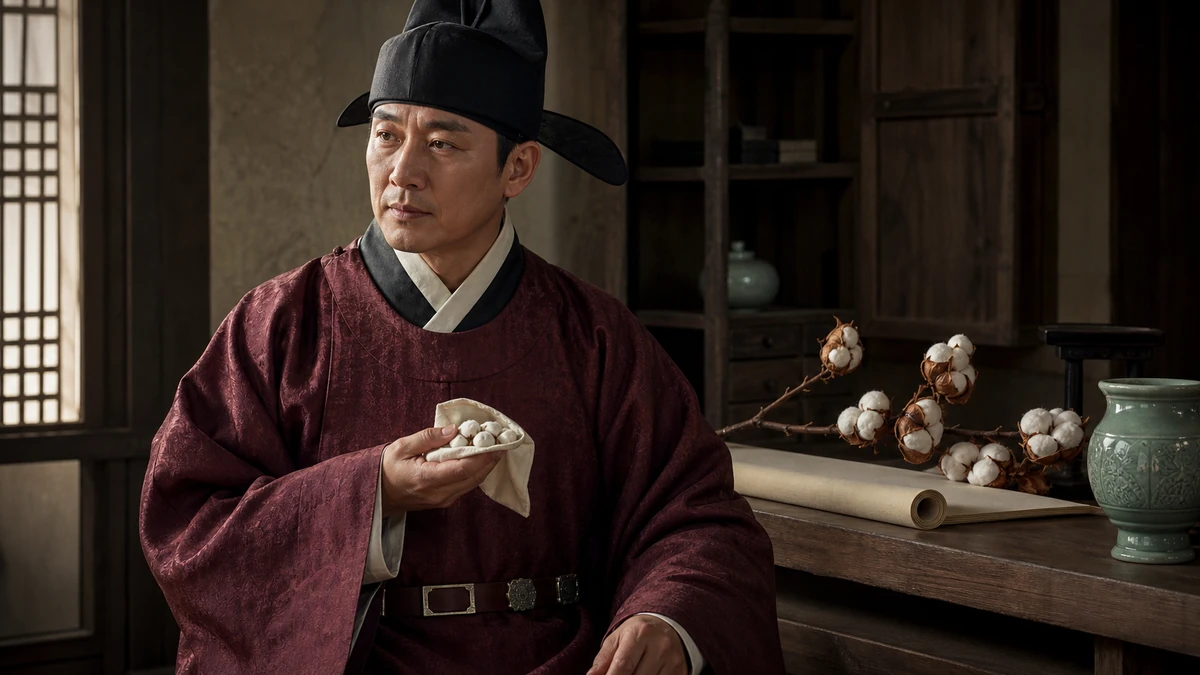
Image to help understand the article
A statesman remembered not for a court title, but for a fabric revolution
In Korean historical memory, Moon Ik-jeom occupies a place that may seem unusual to Americans at first glance. He was a scholar-official, diplomat and political figure in the waning years of the Goryeo dynasty, the medieval Korean kingdom that ruled from 918 to 1392. Yet he is remembered less for a single law, battle or royal decree than for helping spread cotton cultivation and cotton processing in Korea — a change that transformed what ordinary people could wear, sleep under and afford.
That may sound small until you place it in human terms. Before cotton became more widely available, clothing and bedding for commoners were far more limited. The Korean source material describes a society in which hemp cloth had long been standard for ordinary people, while padded cotton garments and cotton-filled bedding were much more closely associated with elites. Moon’s legacy, then, is not simply agricultural. It is about daily life. It is about warmth in winter, softer clothes against the skin and the democratization of a material once scarce or inaccessible.
For American readers, there is a useful comparison here. U.S. history often celebrates inventors, industrialists and political leaders who changed everyday life by making once-rare goods widely available: the spread of affordable steel, the assembly line for consumer goods, rural electrification, refrigeration or mass-market denim. Moon’s story belongs to that same broad category of historical change. He did not merely encounter a useful commodity. According to the Korean account, he helped turn a fragile introduction — just a few seeds and a great deal of trial and error — into a practical system that ordinary people could use.
That helps explain why Moon remains such a durable figure in Korea’s historical imagination. He stands at the intersection of statecraft, technology transfer and social welfare, even if those modern terms would have been foreign to his time. He also embodies a recurring theme in Korean history: the idea that scholarship should not be detached from the material needs of the people. In an era of dynastic instability, diplomatic pressure and ideological conflict, one of the most consequential acts attributed to him involved not a throne room but a field.
What changed in late Goryeo: from rare seeds to everyday cloth
The broad outline of Moon Ik-jeom’s life is rooted in elite education and public service. Born in what is now Sancheong in South Gyeongsang province, he was trained from childhood in classical learning and later studied in the orbit of major scholars such as Yi Gok, sharing intellectual ties with figures including Yi Saek and Jeong Mong-ju. He passed state examinations, entered officialdom and built a career that included local administration, scholarship and advisory roles at court.
But the turning point in the story came during a diplomatic mission to the Yuan dynasty, the Mongol-ruled empire in China. The period was politically volatile. Goryeo’s King Gongmin was trying to reduce the kingdom’s dependence on Yuan influence, while rival political forces sought to unseat him. The Korean source notes conflicting accounts about Moon’s exact role and subsequent punishment. What appears consistent is that the political turmoil surrounding the mission damaged his official career.
Out of that turbulence came the episode that secured his place in history. According to traditional accounts cited in the Korean summary, Moon brought a few cotton seeds back to Goryeo, allegedly hidden inside a writing brush case. Whether one emphasizes the drama of the smuggling detail or the broader historical process, the more important point is what happened next: bringing in seeds did not automatically create a textile economy.
The source is explicit on that point. Moon and his father-in-law, Jeong Cheon-ik, planted the seeds in Sancheong but initially failed. Most attempts did not take. Only one plant reportedly flowered. From that single success, they harvested more than 100 seeds and planted again. Over roughly three years, cultivation improved. Moon also distributed seeds free of charge to local residents and encouraged them to grow cotton themselves. In other words, this was not just an act of importation. It was a campaign of adaptation, teaching and local diffusion.
That distinction matters historically. Many societies have stories about the first arrival of a crop or technology, but the more consequential question is whether the new thing can be reproduced, taught, maintained and integrated into daily life. Cotton needed not just soil and climate, but know-how. The Korean account says there was still a major technical obstacle even after cultivation began to succeed: the cotton had to be processed. Seeds had to be separated from fiber, and fiber had to be spun into thread before cloth and quilts could be made.
Here again, Moon’s achievement is described as systemic rather than symbolic. He and his associates are said to have learned methods for ginning and spinning, including how to make simple devices used to remove seeds and draw thread. Later descendants improved some of these tools. What started as a botanical introduction grew into a practical chain: seed multiplication, cultivation, ginning, spinning and weaving. Only then could cotton become fabric, and only then could fabric become social change.
For historians, that makes the story especially valuable. It is not really a tale about a lone genius conjuring a miracle. It is a case study in how innovation actually spreads: unevenly, experimentally and through networks of family, local communities and toolmaking. Americans familiar with the history of industrial adoption — from the cotton gin to mechanized farming to semiconductor manufacturing — will recognize the pattern. Breakthroughs matter. So do systems.
Why cotton mattered so much in Korea
To understand Moon’s importance, it helps to understand the material world of premodern Korea. Clothing in many societies has carried not just practical value but social meaning. Fabric could signal class, office, ritual role and access to resources. In late Goryeo, as the Korean source frames it, cotton’s wider availability gradually shifted the material basis of ordinary dress from hemp cloth toward cotton cloth. That change would have affected comfort, warmth and everyday dignity as much as fashion.
Americans may think of cotton through the lens of the U.S. South, plantation agriculture, slavery and the Industrial Revolution. That history is essential and morally unavoidable in the American context. But cotton’s significance globally is broader. Across many parts of the world, cotton became transformative because it was versatile, wearable and scalable. It could be woven for garments, used in bedding and integrated into domestic production. In climates with harsh winters or sharp seasonal variation, the difference between coarse hemp and cotton padding was not trivial. It was intimate and physical.
That is why Moon’s reputation in Korea belongs partly to social history rather than just political history. The source says cotton’s spread helped move padded clothing and cotton quilts beyond royalty and aristocratic families into wider circulation. For common people, that would have meant not simply nicer textiles but warmer nights and more practical daily wear. In a premodern agrarian society, those gains were significant enough to echo across generations.
The story also reveals something about Korean historical values. Moon is not remembered only as a man who introduced a crop, but as someone who shared seeds freely and taught cultivation methods. That fits a familiar East Asian ideal of the scholar-official as a moral actor responsible for the people’s welfare, not merely a court insider. The Korean account also situates him among early neo-Confucian intellectual circles, and later episodes in his life reflect ideals of loyalty, moral conviction and filial piety.
Those details matter because they explain why Moon’s story persisted so strongly in Korea. He was not merely useful; he was legible within a moral framework that later generations admired. A diplomat caught in dynastic turmoil, a scholar tied to major intellectual lineages and a public figure associated with relieving material hardship — that combination gave his legacy unusual staying power.
The source also notes a modern scholarly wrinkle: recent discoveries of cotton textiles from the Baekje period have raised the possibility that cotton existed on the Korean Peninsula much earlier, perhaps having been introduced and then lost or failing to continue in sustained cultivation. If that interpretation is correct, Moon’s achievement would not necessarily be the absolute first introduction of cotton to Korea. Instead, it would be the successful reintroduction or redistribution of cotton after a long interruption or period of scarcity.
That nuance does not diminish the historical weight of the story. In fact, it sharpens it. History often celebrates firsts, but social transformation is usually driven by durable adoption, not by isolated appearances. If cotton had existed earlier but did not remain embedded in everyday life, then Moon’s role in reestablishing it at scale may be even more historically meaningful than a simple origin myth.
The political turmoil behind the legend
There is a temptation, when telling a story like Moon’s, to reduce him to a kind of medieval agrarian hero. But the Korean account makes clear that his life was deeply political. He operated in the final century of Goryeo, when factional struggle, diplomatic pressure and institutional change were remaking the peninsula. That context is not background noise. It is part of the point.
His journey to Yuan China took place as Goryeo tried to loosen the grip of a once-dominant imperial power. The mission became entangled in a succession struggle involving a rival claimant backed by forces in Yuan territory. Moon was later said to have been implicated, perhaps unfairly, in support for that claimant. Sources differ on whether he was forcibly sent back, stripped of office or experienced exile and later rehabilitation. Such inconsistencies are normal in premodern biography, especially when later generations build commemorative narratives around a figure.
What does seem clear is that political shocks redirected his life. That matters because the cotton story is not separate from state instability; it emerged partly because of it. In many countries, technological or agricultural transfers happen along diplomatic, military or imperial routes. Goods, seeds and ideas often travel through moments of coercion or crisis rather than through calm peacetime exchange. In Moon’s case, a diplomatic mission shaped by imperial politics became the channel through which a society-changing crop was more successfully propagated at home.
The later chapters of his life reinforce how closely moral reputation and political conflict were intertwined in late Goryeo. The Korean summary describes him as a man of principle who participated in debates over policy and served in high educational office, but also one who suffered demotion, left office, returned and ultimately opposed major land reforms backed by rising political forces, including the camp associated with Yi Seong-gye, the founder of the Joseon dynasty.
That places Moon at a historical hinge point. He is remembered for advancing one major social transformation — cotton diffusion — while living through another far larger one: the end of Goryeo and the birth of Joseon. To American readers, the closest analogy may be a statesman whose legacy in agriculture or infrastructure outlasts the political order he served. His contribution becomes national rather than merely dynastic.
Even the moral language attached to him tells us something about how Korea later interpreted its past. The source emphasizes his filial devotion, including periods of mourning in accordance with Confucian rites and an account of him guarding his mother’s grave despite danger from raiders. Such episodes reinforced his image as a righteous scholar-official. Whether one reads every detail literally or sees some of it through the lens of later reverence, the broader point remains: Koreans did not preserve Moon merely as a technician. They preserved him as a moral exemplar whose practical work benefited society.
What this story means in the United States
For Americans, Moon Ik-jeom’s story resonates on several levels that go beyond historical curiosity. First, it offers a reminder that Korea’s global influence did not begin with K-pop, Korean film, beauty products or high-end consumer electronics. Long before the Korean Wave, Korea had its own internal stories of technological adaptation, material innovation and social change — stories that help explain why the country today is so often adept at turning imported inputs into widely adopted systems.
That matters in a U.S.-Korea relationship increasingly defined not just by security ties but by supply chains, manufacturing and cultural reach. Americans tend to encounter South Korea through brands like Samsung, Hyundai, LG or through cultural exports such as BTS, "Parasite" and Netflix dramas. But beneath those contemporary reference points lies a much older historical pattern: the prestige attached to practical knowledge that can be localized, scaled and shared.
Moon’s cotton story also speaks to a very American way of thinking about innovation. In the United States, there is long-standing admiration for people who solve bottlenecks rather than simply identify opportunities. The Korean source says Moon did not stop at obtaining seeds. He and his collaborators struggled with failed plantings, distributed seeds to others and helped spread the know-how needed to process cotton into usable thread and cloth. That is exactly the kind of innovation story American business readers would recognize today. It is about implementation.
There is also a deeper economic parallel. The U.S. and South Korea are tightly linked through advanced manufacturing, trade and technology strategy. In sectors from semiconductors to batteries to autos, the central question is often not whether a breakthrough exists somewhere in the world, but who can adapt it, produce it reliably and integrate it into a broader industrial ecosystem. Moon’s world was agricultural, not digital, but the logic is surprisingly familiar. A seed by itself is not an industry. A tool by itself is not a supply chain. A good idea by itself does not change society.
For American audiences interested in culture, the story provides another useful bridge. Korea’s cultural exports often excel in the United States because they package local specificity in a form that travels well. Moon’s legacy is an example of the reverse: an imported material turned into a deeply Korean social transformation. That dynamic — absorbing something external, refining it and embedding it in local life — remains central to how South Korea has built both industrial capacity and cultural influence.
U.S. readers should also note the caution in the Korean source regarding claims of absolute origin. If cotton may have appeared on the peninsula earlier and then faded, Moon’s significance lies in restoration and diffusion rather than pristine invention. That distinction should feel familiar in an American economy that often over-romanticizes lone inventors. Many of the most important U.S. innovations have depended on adaptation, process improvement and mass access. Moon’s story fits that more realistic model of historical change.
Finally, this story helps American readers understand why historical figures tied to daily life remain powerful in Korea. Just as Americans remember figures associated with electrification, public education, vaccines or transformative infrastructure, Koreans remember people whose actions changed how ordinary households lived. That memory becomes part of national identity. In an era when U.S.-Korea ties increasingly include media, education, tourism and consumer culture, that kind of historical literacy matters.
From origin myth to modern trend: why Moon Ik-jeom still matters now
The reason to revisit Moon Ik-jeom today is not simply to admire a medieval anecdote. It is to recognize a broader trend in how societies tell stories about themselves. Korea’s modern identity has often been explained through compressed industrialization, export growth and democratic transformation in the 20th century. But stories like Moon’s show that Koreans also understand national development through a longer timeline of adaptation: the ability to import, modify and disseminate useful knowledge in ways that improve ordinary life.
That may be one reason the story continues to have cultural staying power. It connects elite learning with popular welfare. It links international exchange with local ingenuity. It frames national resilience not as isolation, but as selective absorption. Those are themes that continue to shape South Korea’s image abroad and its policy choices at home.
There is also a modern relevance in the way this story complicates the meaning of innovation. In contemporary discourse, especially in the United States, innovation is often treated as synonymous with novelty, venture capital and disruption. Moon’s legacy points toward a different definition: innovation as diffusion. A technology or material changes society only when someone figures out how to make it usable at scale, accessible beyond elites and sustainable over time.
That is one reason the details in the Korean source are so revealing. The one successful blossom. The harvesting of new seeds. The free distribution to neighbors. The search for mechanical methods to remove seeds and spin thread. These are not ornamental details. They are the anatomy of adoption. They show how a society moves from curiosity to dependence.
In that sense, Moon’s story belongs in a global conversation about resilience and supply. Recent years have made Americans acutely aware of how much everyday life depends on invisible production chains — whether for medical gear, computer chips or basic household goods. Premodern cotton is obviously not the same as 21st-century strategic manufacturing. But the underlying lesson is timeless: societies are vulnerable when essential materials are scarce, controlled by elites or disconnected from local capability. They become stronger when knowledge circulates and production becomes embedded.
What to watch next, for historians and general readers alike, is how Korean scholarship continues to refine the story. The source’s mention of possible earlier cotton use on the peninsula suggests that the older textbook version — Moon as the single and first introducer of cotton to Korea — may continue to evolve. That is not a threat to the story’s importance. It is what mature history looks like. Legends become more precise. Myths become systems. Heroes become participants in larger networks of change.
For American readers, that should make the story more interesting, not less. The most valuable historical figures are often not the ones who did one impossibly singular thing, but the ones who reveal how transformation actually happens. Moon Ik-jeom appears to be one of those figures. In a moment of diplomatic upheaval, he became associated with the successful spread of a crop and a process that altered Korean daily life for generations. That is not just a Korean story. It is a human one — about how materials, knowledge and moral purpose can converge to rewrite the texture of ordinary life.
A Korean historical figure with a very modern message
If Moon Ik-jeom’s legacy endures, it is because cotton in this story is never just cotton. It represents access, adaptation and the transfer of comfort from the privileged few to the broader public. It represents the hard part of innovation: making a useful thing work in real conditions, then teaching others to do the same. And it represents a kind of public-minded intelligence that still carries force in Korea’s national narrative.
For American audiences, the lesson is straightforward. To understand South Korea, it is not enough to know its contemporary exports or security headlines. It also helps to know the older stories Koreans tell about practical change — stories in which scholarship meets production, foreign contact meets local experimentation and social status is measured not just by power but by whether people’s lives improve.
That is why a 14th-century official from Sancheong still matters. In the Korean account, he lived through dynastic turmoil, intellectual struggle and political controversy. Yet what lasted was something far more intimate than court rank: warmer clothes, softer fabric, cotton quilts and a lasting shift in how ordinary people lived. For a man trained in letters and statecraft, that may be the most durable kind of public service there is.
Comments
Post a Comment