
Image to help understand the article
A blockbuster built from a national wound
In the United States, historical dramas about political trauma often face a familiar question: Can a movie about a painful chapter in national life also become a mass-market success? South Korea answered that question emphatically in 2017 with A Taxi Driver, a film that turned one of the country’s darkest modern episodes into a mainstream theatrical phenomenon.
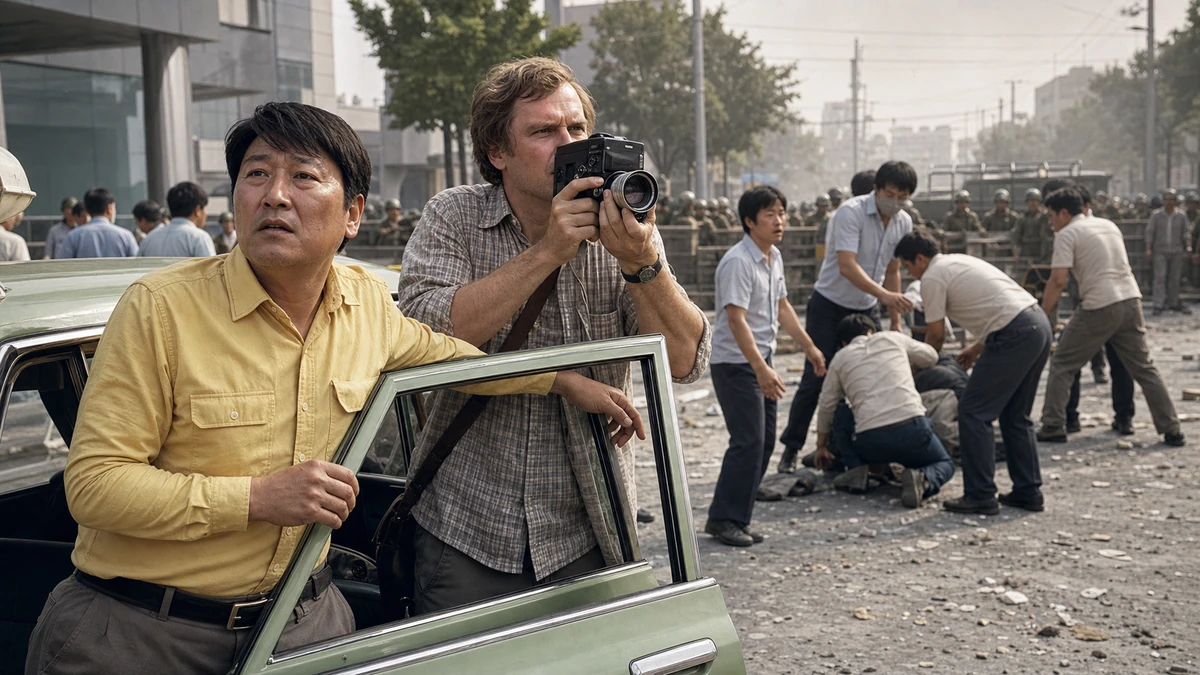
Directed by Jang Hoon and led by one of South Korea’s most recognizable actors, Song Kang Ho, the film is based on the real-life story of a Seoul cab driver who helped German journalist Jürgen Hinzpeter reach the city of Gwangju in May 1980, when a pro-democracy uprising was met with violent military repression. For many international viewers, that setup may sound like a suspense thriller with political stakes. In South Korea, it carries something far deeper: the weight of memory, grief and the long fight over who gets to record the truth.
The movie became what Korea calls a “10 million film,” meaning it drew more than 10 million admissions — a benchmark that, in a country of roughly 50 million people, signals rare, broad-based cultural impact. According to box office figures cited in South Korea at the time, the film drew more than 2.2 million viewers over Aug. 5 and 6 alone across 1,906 screens, passed 4.36 million by Aug. 7 and reached 6 million by the afternoon of Aug. 10. Those numbers matter not simply because they are large, but because they show how a story rooted in state violence and contested memory reached far beyond art-house audiences or older Koreans who personally remember the era.
That is one reason A Taxi Driver matters outside Korea as well. It is not just a successful period drama. It is an example of how Korean cinema has learned to package difficult history in a way that remains emotionally accessible to general audiences without stripping the subject of its moral seriousness. For American viewers who may know South Korea chiefly through K-pop, Oscar-winning films or hit Netflix series, this movie offers another window into how the country tells stories about itself — and how those stories travel.
Why Gwangju still matters in South Korea
To understand the force of A Taxi Driver, it helps to understand what the Gwangju Democratization Movement represents. In May 1980, residents of Gwangju, a city in southwestern South Korea, rose up amid nationwide political turmoil and demands for democracy. The military cracked down violently. For years, the full truth of what happened was difficult for many people outside the region to know, in part because of censorship, intimidation and the suppression of reporting.
For Americans, one rough point of comparison is the way certain defining national tragedies become moral touchstones that later generations revisit through film, journalism and public memorials. But Gwangju also carries a specific Korean meaning. It is not just a tragic event from the past. It is central to South Korea’s democratic identity and to ongoing debates about state power, media credibility, civic responsibility and regional memory.
The source material behind A Taxi Driver highlights that reality through the role of Hinzpeter, a foreign correspondent working for German broadcaster ARD/NDR, who entered Gwangju and documented the violence. In the historical memory surrounding the uprising, the footage he helped bring out became crucial because many South Koreans elsewhere did not understand the scale of what was happening. The article summary notes remarks later attributed to then-President Moon Jae-in after a screening of the film: that people in other regions did not know the truth at the time, and that journalists who tried to report it could face punishment or dismissal.
That context helps explain why this is not merely a movie about one brave reporter. It is a movie about a society in which reality itself had to be smuggled out. In that sense, the camera in A Taxi Driver is not a passive object. It is a political instrument, a moral witness and a threat to official narratives.
An ordinary driver becomes the audience’s guide
One of the film’s most effective choices is that it does not begin with ideology. It begins with a working man trying to pay rent.
Song plays Kim Man Seob, a character modeled on the real taxi driver Kim Sa-bok. He is a widowed father in Seoul raising his young daughter and struggling financially. He is not presented as a dissident or activist. He overhears that a foreign passenger needs a ride to Gwangju and is willing to pay 100,000 won if the trip is completed and the driver returns to Seoul before curfew. For a man behind on rent, that is reason enough to take the fare.
That detail is not incidental. It is what makes the story legible to a wide audience. Instead of asking viewers to enter a politically charged historical event through speeches or policy debates, the film brings them in through a practical, recognizable dilemma: a parent needs money. In American cinema, this is the kind of structural choice that often separates a respected historical film from one that becomes a word-of-mouth hit. The private problem opens the door to the public crisis.
As the summary describes, Man Seob initially does not fully understand who his passenger is or why he wants to go to Gwangju. The passenger — called Peter in the film and played by Thomas Kretschmann — senses that something grave is happening and wants to report it. The gap between the two men is central to the movie’s tension. To one, Gwangju is a job. To the other, it is a story that must be documented before the world looks away.
That setup gives the film a road-movie quality, but it also creates a moral progression. The taxi driver becomes the audience’s surrogate. He is not a heroic figure from the outset. He learns, reacts, doubts and hesitates. The film’s choice to filter national trauma through the limited understanding of one ordinary person is part of what made it commercially accessible. Viewers are not asked to arrive with expertise. They are invited to discover, scene by scene, what he discovers.
The film reportedly opens with the 1980 song “Short Hair” by Cho Yong Pil, grounding the character in everyday life before history interrupts it. That kind of tonal decision matters. It reminds the audience that before a place becomes “history,” it is first just where people live, drive, sing, work and worry about bills.
The power of outsiders, translators and local witnesses
Once the characters reach Gwangju, A Taxi Driver becomes something larger than a two-man story. The article summary emphasizes the widening circle around them: a local university student who can interpret between Korean and English, a Gwangju taxi driver, local journalists and citizens gathered around the wounded. Those additions are more than supporting roles. They show that truth does not emerge from a lone hero narrative. It moves through networks of trust, translation and risk.
That may be one of the most resonant aspects of the film for international audiences. In the American imagination, especially in movies about journalism, there is a strong tradition of celebrating the determined reporter: think of All the President’s Men or Spotlight. A Taxi Driver honors the foreign correspondent’s role, but it also insists that journalism depends on other people — drivers, interpreters, local fixers, witnesses, medics and ordinary residents willing to guide outsiders into danger.
The student character, played by Ryu Jun Yeol, is especially significant in this framework. He does not merely translate language; he translates the crisis itself. He helps bridge geography, class and nationality. Without him, the foreign reporter and the Seoul driver remain partially sealed off from the people whose story is unfolding. That role will be familiar to anyone who has followed conflict reporting around the world. Stories that reach global audiences are often made possible by individuals whose names never become internationally famous, even though they carried much of the risk.
The taxi drivers in the film also carry symbolic weight. A cab is an ordinary vehicle, a piece of urban routine. In this story, it becomes a means of crossing barricades, a witness box on wheels and, ultimately, a mechanism by which history is transported from a blocked-off city to the outside world. That transformation is part of the movie’s emotional logic. It suggests that history is not only made in palaces, newsrooms or military headquarters. It is also made by the people who decide whether to stop, keep driving, turn around or help a stranger.
The summary notes that Man Seob is deeply shaken after seeing the indiscriminate shooting of civilians by soldiers. That moment of recognition is the film’s hinge. He finally understands who Peter is and why the trip matters. Yet the movie does not erase his fears. His cab is damaged. His daughter is back in Seoul. He remains a man with obligations at home. This is precisely what keeps the story grounded. The film’s ethical question is not whether saints exist. It is what ordinary people do when survival and conscience collide.
Why the film connected with younger audiences
Historical films often struggle with younger viewers, especially when they deal with events taught in school as solemn national milestones. A Taxi Driver appears to have cut through that problem by making the story feel lived rather than lectured.
The movie did not attempt to explain the entire chronology of the Gwangju uprising in textbook fashion. Instead, as the summary notes, it restricted the story to what Man Seob and Peter experience directly. That narrative limitation can frustrate some critics who want broader political scope, but it also explains the film’s reach. It gives audiences a manageable point of entry into a complicated and emotionally heavy history.
That strategy has parallels in American filmmaking. Movies about the civil rights movement, political scandal or war often gain wider traction when they focus on a specific relationship or journey rather than trying to summarize an entire era. The emotional engine comes from proximity. Audiences learn because they care what happens to the people in front of them.
The article summary suggests that this was part of the film’s broad appeal in South Korea: it drew not only people who remembered 1980 firsthand, but also generations born long after military rule. That intergenerational reach is important. In democratic societies, civic memory does not automatically reproduce itself. It has to be retold in forms that feel urgent to people who did not live through the original event.
The comments cited from Hinzpeter’s widow underscore that point. She said he often spoke of it as his duty to tell the truth and that she hoped younger people would understand that democracy is not something that arrives by itself. That sentiment could easily resonate in the United States, where democratic norms, media trust and historical literacy are all subjects of intense debate. A movie like A Taxi Driver does not offer a civics lesson in the formal sense. It does something more durable: it dramatizes the cost of not knowing, and the cost paid by those who insist that others know.
What this means in the United States
For American audiences, A Taxi Driver lands at the intersection of several trends: the globalization of Korean popular culture, a growing appetite for non-English-language storytelling and renewed interest in how democracies remember state violence and media suppression.
First, the film broadens the picture of what Korean entertainment means in the United States. Many Americans arrived at Korean culture through K-pop, prestige television or genre films. But A Taxi Driver points to another pillar of the Korean Wave: historical storytelling that is deeply local in subject matter yet legible across borders. In a U.S. market now more open than it once was to subtitled content, that matters. It means Korean exports are not confined to glossy contemporary formats; they also include films that ask foreign viewers to engage with Korean history on Korean terms.
Second, the movie has clear relevance for American media culture. The role of a foreign reporter documenting suppressed violence, aided by local civilians, touches issues U.S. news audiences understand well: the danger of restricted access, the importance of eyewitness documentation and the vulnerability of truth when governments control the flow of information. American readers do not need to know every detail of South Korea’s 1980 political landscape to grasp why that story matters. They have seen analogous arguments play out in debates over war coverage, whistleblowers, protest footage and the authority of documentary evidence.
Third, the film has implications for U.S.-Korea cultural ties. South Korea is not only a treaty ally and major economic partner of the United States. It is also an increasingly influential cultural producer whose films shape how Americans think about the country. A generation ago, many Americans may have associated South Korea mainly with geopolitics: North Korea, military alliances and trade. Today, Korean cinema and television are often the entry point. That shift creates opportunities and responsibilities. When historical films cross borders, they do more than entertain; they become informal ambassadors of national memory.
There is also a commercial angle. U.S. distributors, streaming platforms and exhibitors have spent the past several years learning that American viewers will show up for Korean stories when the storytelling is compelling and the marketing is smart. A film like A Taxi Driver demonstrates that the addressable audience for Korean content is not limited to genre fans or Korean American communities. There is a broader market for politically grounded, emotionally driven stories from South Korea, especially when they connect to universal themes such as family duty, ethical awakening and the struggle to document abuse of power.
Finally, the film invites a comparison with how the United States processes its own historical trauma on screen. American cinema has produced major works about slavery, segregation, labor conflict, war and political corruption. But those films, too, are often judged by whether they make the past newly legible to people born long afterward. A Taxi Driver belongs in that larger conversation. It asks how a commercial film can carry memory without becoming homework and how a national entertainment industry can turn a painful chapter into a work of mass civic reflection.
A trend, not just a single hit
The strongest way to read A Taxi Driver may be not as a one-off success, but as evidence of a broader pattern in South Korean culture: the increasing ability of mainstream entertainment to revisit contested history through intimate, accessible storytelling.
That matters because the article summary makes clear that the film did not receive unanimous praise in exactly the same way. Some critics recognized the power of being swept into the drama of history; others wanted something more than emotional impact and tears. That split is revealing rather than damaging. It suggests that the film occupies an important middle space — between a civic memorial and a commercial crowd-pleaser, between historical overview and subjective experience.
In trend terms, that middle space is where many influential Korean films have thrived. They often use genre, melodrama or tightly framed personal stories to approach subjects that might otherwise feel forbidding. A Taxi Driver does not attempt to be the final or complete cinematic account of the Gwangju uprising. The summary rightly suggests it is better understood as an entry point: a film about what happens when a witness must choose between looking away and helping truth travel.
That framing may also explain why the story resonates beyond South Korea. The questions it raises are global. What happens when a city is sealed off from scrutiny? Who is responsible for telling the outside world what is happening? What obligations do bystanders have when they discover that the official version of events is false or incomplete? Those questions do not belong to one country or one decade.
The international reaction mentioned in the summary underscores that point. In China, the film was reportedly barred from domestic release because scenes of conflict between civilians and the military evoked memories of the 1989 Tiananmen crackdown. Whether viewed from Seoul, Washington or elsewhere, the movie carries political echoes that go well beyond Korean history. It is a reminder that stories about suppressed truth are rarely confined by borders.
Why it still deserves attention now
Years after its release, A Taxi Driver remains relevant because it speaks to two pressures modern audiences feel at once: information overload and historical amnesia. People are surrounded by images, footage and claims, yet they still struggle to know what is real, who can be trusted and how truth survives systems designed to bury it.
The film’s answer is both simple and demanding. Truth survives through chains of human action. A reporter records. A driver agrees to go. A student translates. Local residents guide, shelter and testify. The process is collective, fragile and often dangerous. The movie’s lasting power lies in showing that democratic memory is not self-executing. It depends on people who decide, in ordinary moments, not to look away.
For American readers and viewers, that is the most useful way to approach A Taxi Driver. It is a Korean film about a specifically Korean historical trauma, and it should be respected in that specificity. But it also belongs to a global archive of movies that ask how societies remember violence, how journalists work under pressure and how everyday people become participants in history whether they intended to or not.
Its commercial success in South Korea suggests something important about the state of Korean cinema and, more broadly, about the cultural reach of Korean storytelling. Audiences will show up for difficult history if the story is anchored in recognizable human stakes. A father worried about rent. A foreign reporter chasing evidence. A city whose reality has been blocked off from the nation. A ride that begins as a fare and becomes a moral crossing.
That is the achievement of A Taxi Driver. It turns a taxi — one of the most ordinary spaces in urban life — into a vehicle for democratic memory. And in doing so, it offers international audiences, including Americans, a clearer understanding of how South Korea remembers one of the events that helped shape the country it is today.


0 Comments