Image to help understand the article
A disaster with no clear starting point for rebuilding
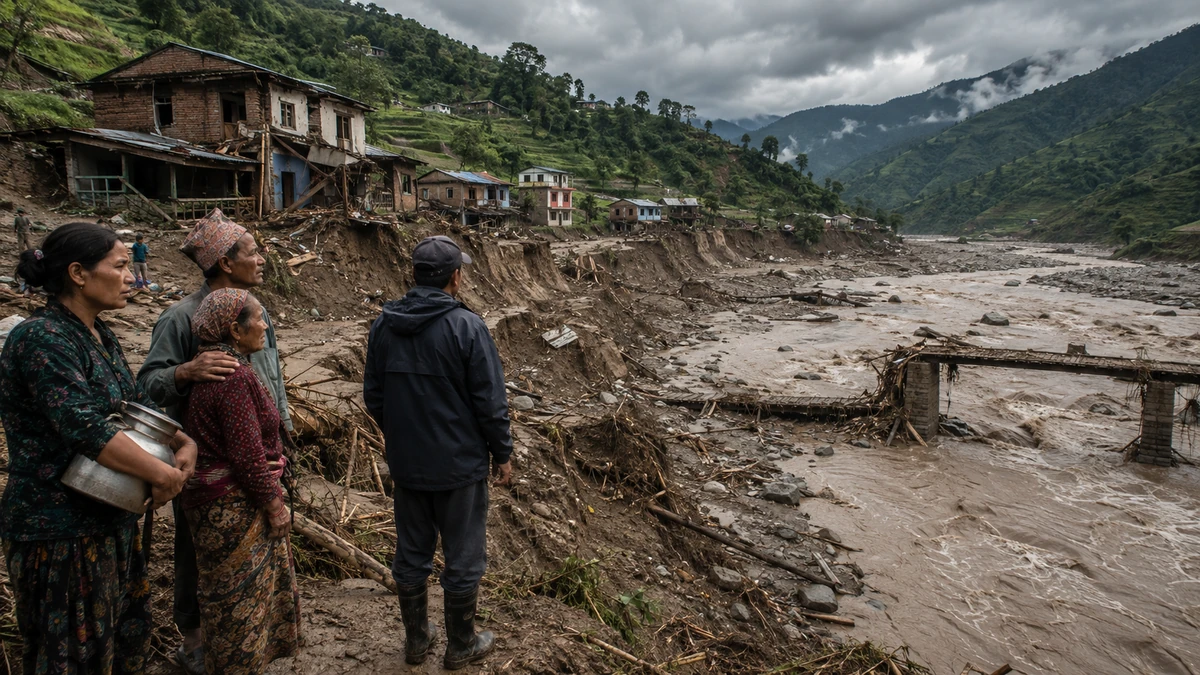
In the aftermath of a major earthquake, recovery often begins with a grim but relatively concrete task: clearing rubble where homes, schools and businesses once stood. After Nepal’s latest catastrophic flooding, some communities face a more fundamental question. There may be no recognizable village to rebuild.
Moon Gwang-jin, a Korean relief worker who has spent more than two decades working in Nepal, said it was impossible to predict how long recovery from the flooding would take. Speaking from Lalitpur in Bagmati Province, Moon contrasted the current emergency with Nepal’s devastating 2015 earthquake, a magnitude 7.8 disaster that killed about 8,900 people and damaged roughly 1 million buildings.
Relief work connected to that earthquake took about three years to approach completion, Moon told South Korea’s Yonhap News Agency. The rebuilding cost was estimated at $9 billion. More than 4 million displaced people spent over a year living in tents or temporary structures, while about 1 million students lost access to classrooms.
Those numbers offer a measure of Nepal’s experience with large-scale catastrophe. Yet Moon said they do not provide a reliable timetable for the latest crisis. In 2015, buildings generally collapsed where they had been standing. Communities could begin again with property lines, roads and village boundaries still identifiable, even when the physical destruction was overwhelming.
This time, floodwaters swept away not only houses and infrastructure but, in some places, the land and economic foundations that made settlement possible. A road can be repaired. A house can be reconstructed. Rebuilding an entire community becomes much harder when residents cannot safely return to the same location, when river channels have shifted or when the routes connecting a village to markets, schools and medical care no longer exist.
That distinction explains why the phrase “long-term recovery” may be inadequate. Nepal is not simply facing a longer version of a familiar rebuilding effort. It may have to determine where some communities can exist at all.
In the Himalayas, distance is measured in days
Current relief operations are centered around Bidur and Trishuli Bazaar in Nepal’s Nuwakot district, part of Bagmati Province. Bidur is near a military base in Trishuli from which helicopters have been taking off daily to search for missing people. Trishuli Bazaar, a commercial center about 4 miles upstream from Bidur along the Trishuli River, has become a gathering point for survivors descending from damaged mountain communities.
Schools and churches around the market town have been converted into temporary shelters. For Americans, the arrangement may recall public schools, churches and recreation centers opening as emergency shelters after hurricanes, wildfires or tornadoes. But Nepal’s terrain makes even basic evacuation far more difficult. Survivors escaping upper-river communities, including areas around Dhunche, reportedly walked 30 to 37 miles along mountain trails. The journey took at least two days and, for some, as long as four.
On an American road map, 35 miles might suggest a short drive. In the Himalayan foothills, that distance can mean steep paths, damaged bridges, unstable slopes and no vehicle access. It can separate a family from food, medical treatment and reliable information for days. It also changes the meaning of a rescue hub. A shelter may appear close to a damaged village when viewed on a map, yet remain nearly unreachable on the ground.
Moon said the flood surged down the Trishuli River from upstream areas. Communities east of the river experienced numerous deaths and disappearances, while more people appear to have survived on the western side near Trishuli Bazaar. That uneven pattern means rescuers cannot assume that the population arriving at shelters reflects the full scope of the disaster.
Daily helicopter searches underscore the lack of dependable road access. Aircraft can locate isolated groups and move quickly over landslides or washed-out crossings, but they cannot replace a functioning transportation network. Flights depend on weather, visibility, fuel, landing space and the availability of trained crews. They can carry only a fraction of what trucks could deliver over an intact road.
The result is a disaster unfolding on two timelines. In accessible towns, relief workers can register survivors and distribute supplies. In isolated mountain areas, officials may still be trying to determine who survived, who is missing and whether entire settlements remain habitable.
Survival is only the first phase
Reaching a shelter does not end a survivor’s emergency. It begins a prolonged process of documenting identity, tracing relatives, assessing medical needs and determining whether there is a home to return to. Relief workers must establish which village each person came from, whether family members remain missing and whether the original settlement can be reached safely.
That work is especially difficult when residents fled without documents, phones, money or time to collect belongings. It becomes more complicated when people from several villages converge on the same school or church, and when local authorities cannot immediately communicate with upstream communities.
Moon relayed an account from survivors near Ramche and Dhunche about a village of 150 households where residents from only 25 households were believed to have survived. The others were reported dead or missing. That account was not presented as a confirmed national statistic, and it should not be treated as one. It is, however, an indication of the potentially extreme losses suffered at the community level — and of how much remains unknown while rescuers struggle to reach remote areas.
Temporary shelters also create secondary pressures. A school used as an evacuation center cannot operate normally as a school. A church serving as sleeping quarters, a supply depot and a family-reunification site has less capacity to perform its regular role in community life. If displacement lasts for months, Nepal could face overlapping crises in housing, education, public health and local commerce.
Children are particularly vulnerable to that disruption. Nepal’s 2015 earthquake left about 1 million students without classrooms, demonstrating how quickly a natural disaster can become an education emergency. When classes stop for an extended period, students lose more than instructional time. Schools often serve as centers for meals, social support, safety monitoring and community information, much as they do in the United States.
Adults face a parallel economic problem. A family may survive and receive food at a shelter but lose farmland, livestock, tools, inventory or access to a local market. If the community’s economic network has disappeared, replacing a roof does not restore a livelihood. Families may remain dependent on outside assistance even after immediate food and medical needs are met.
Why the 2015 earthquake is an imperfect comparison
Nepal’s 2015 earthquake remains the country’s most familiar benchmark for disaster response. It caused immense destruction and required years of national and international assistance. But using that experience as a template for the current flood could lead governments and aid organizations to underestimate the complexity of the new emergency.
Earthquake recovery typically begins with surveys of damaged structures, decisions about which buildings can be repaired and plans to rebuild according to safer construction standards. The process is expensive and politically difficult, but it generally assumes that communities will remain in approximately the same places.
Flood recovery can challenge that assumption. If land has eroded, riverbanks have collapsed or transportation corridors have been permanently altered, rebuilding in place may expose residents to another disaster. Officials may have to consider relocation, a process that can take years because it involves land ownership, compensation, access to jobs and agreement among residents.
Relocation also carries cultural and emotional costs that are difficult to calculate. In Nepal, as in rural communities across the United States, a village is more than a collection of houses. It can include family land, religious sites, burial or memorial traditions, social networks and knowledge tied to a particular landscape. Moving residents to a safer location may reduce physical risk while separating them from the relationships and livelihoods that sustained them.
This is why Moon’s inability to estimate a recovery period should not be read simply as pessimism. Before Nepal can produce a credible timeline, responders need a reliable map of the damage. They must identify survivors, reach communities cut off by terrain, search for missing people and determine which settlements can be restored. In some places, the first major recovery decision may not be how to rebuild but whether to rebuild there at all.
The earthquake’s estimated $9 billion recovery cost offers another warning. Nepal had to absorb that burden while millions of people lived in temporary housing. The present disaster could create a different but equally demanding mix of costs: emergency air operations, road reconstruction, long-term shelter, land acquisition and the establishment of new schools, health facilities and commercial centers for relocated communities.
What this means for the United States
For Americans, the Nepal flood is not only a distant humanitarian story. It is part of a broader challenge confronting U.S. disaster agencies, charities, donors and companies: how to support communities when climate-related or weather-driven disasters destroy the assumptions on which conventional recovery programs are built.
The United States has its own examples of disasters that made a return to normal difficult or impossible. After major hurricanes, coastal communities have debated whether to rebuild in flood-prone areas or move homes away from the water. Western towns threatened by repeated wildfires face similar questions about insurance, infrastructure and managed retreat. In parts of Alaska, erosion and thawing ground have forced Indigenous communities to pursue relocation rather than straightforward reconstruction.
Nepal’s emergency is different in geography, government capacity and scale, but the policy dilemma will be recognizable to American officials and disaster experts. Relief systems are often designed to deliver food, medicine, tents and clean water quickly. Those supplies are essential. They do not answer who will pay for new land, where children will attend school or how a displaced farmer will earn a living if returning home is unsafe.
American audiences also play a role through charitable giving. Large disasters often produce a surge of donations followed by a steep decline in attention. The pattern favors visible emergency needs — rescue operations, bottled water, blankets and temporary shelters — while longer-term work receives less public interest. Nepal’s situation illustrates why that cycle can be damaging. If some villages have effectively vanished, meaningful aid may need to continue long after the flood disappears from international headlines.
U.S.-based nonprofit organizations and philanthropic groups considering support should pay attention to the difference between supplies delivered and communities reached. Aid concentrated in accessible shelters can create an incomplete picture when survivors remain scattered across isolated areas. Effective assistance may require support for mapping, local-language communication, family tracing, transportation and damage assessment before the full scale of housing needs can be known.
American companies involved in satellite imagery, telecommunications, logistics, engineering and emergency mapping may also see lessons in the response, although the Korean report does not identify any specific U.S. corporate involvement. In mountain disasters, information can be as important as physical supplies. Knowing where roads have failed, where survivors are moving and which settlements have gone silent helps responders direct scarce helicopters, medical teams and food deliveries.
The crisis also matters to U.S. relations with South Asia and to America’s partnership with South Korea. Moon’s presence reflects a long-running Korean engagement in international relief and development work. South Korea transformed within living memory from a recipient of postwar assistance into a major economy with its own aid organizations, religious charities and overseas volunteers. That history gives Korean responders a distinctive place in global humanitarian work and creates opportunities for coordination with American agencies and nonprofit groups.
For the United States, cooperation with South Korean partners need not be limited to security concerns on the Korean Peninsula or trade in semiconductors, cars and entertainment. Disaster response is another practical area in which the two allies can combine resources and regional experience. Any such cooperation in Nepal, however, should be led by verified local needs rather than by outside organizations competing for visibility.
The Korean connection beyond K-pop and television
American awareness of South Korea has expanded dramatically through K-pop, television dramas, movies, beauty products and food. That cultural reach can obscure another aspect of Korea’s global presence: decades of work by aid groups, churches, medical teams and individual volunteers in developing countries.
Moon has worked in Nepal for more than 20 years, giving him a frame of reference that extends beyond a single emergency. His comparison with the 2015 earthquake is significant because it comes from direct experience with a previous disaster that tested nearly every part of Nepal’s public infrastructure.
Korean churches are especially active in overseas missionary and humanitarian work, a role that may be unfamiliar to Americans who primarily encounter Korea through pop culture. South Korea has a large and influential Protestant community, and Korean religious organizations have established networks throughout Asia and beyond. Their work can include disaster relief, schools, clinics and community assistance. The report does not specify Moon’s organizational affiliation, but the use of churches as shelters in Nepal highlights how religious spaces often become part of emergency infrastructure, regardless of denomination.
That broader Korean engagement matters because responders with long-standing local relationships may recognize problems that short-term international teams miss. They may know which roads become impassable, which villages are absent from official lists and which local leaders can verify reports about missing families. In a disaster marked by information gaps, trust and local knowledge can determine whether aid reaches beyond the most visible shelters.
For American fans interested in Korea, the story is a reminder that the country’s international influence is not confined to entertainment exports. South Korea’s global identity also includes development assistance, civil society organizations and people who have spent years working in communities far from Seoul.
What to watch as the emergency becomes a recovery crisis
The most important short-term measure will be whether Nepal can close the information gap between crowded shelters and isolated upstream communities. A rising count of registered evacuees does not necessarily mean responders have reached the worst-hit areas. It may only mean that people who were able to walk out have finally arrived.
Search operations and supply distribution must therefore proceed at the same time. Focusing exclusively on shelters risks overlooking survivors who remain cut off. Focusing only on remote searches could leave thousands of displaced people without adequate food, sanitation or medical care. The terrain makes both missions slow and expensive.
A second question is whether authorities determine that some communities cannot safely return. Such decisions will shape nearly every later stage of recovery, from land policy and housing construction to schools and local markets. They will also require consultation with residents whose connection to their home villages cannot be reduced to the value of damaged property.
A third issue is the duration of international attention. The 2015 earthquake showed that even a globally prominent disaster can leave millions in temporary shelter for more than a year. The latest flood may demand an even less visible kind of assistance: surveying lost settlements, restoring transportation links and helping communities rebuild social and economic networks in new locations.
Finally, reliable numbers will matter, but they should be interpreted cautiously. Early accounts from inaccessible regions are often incomplete. Testimony about catastrophic losses in a single village can reveal the severity of the situation without establishing a national total. Responsible reporting and effective relief both require distinguishing confirmed figures from survivor accounts while continuing to investigate both.
Nepal’s flood demonstrates that the scale of a disaster cannot be captured solely by counting deaths or damaged buildings. When roads, neighborhoods and livelihoods disappear together, every later task becomes more difficult: rescue, registration, housing, education and economic recovery. The central question is no longer simply how quickly Nepal can rebuild. It is how the country, with support from international partners, can recreate communities whose physical foundations have been swept away.
Comments
Post a Comment