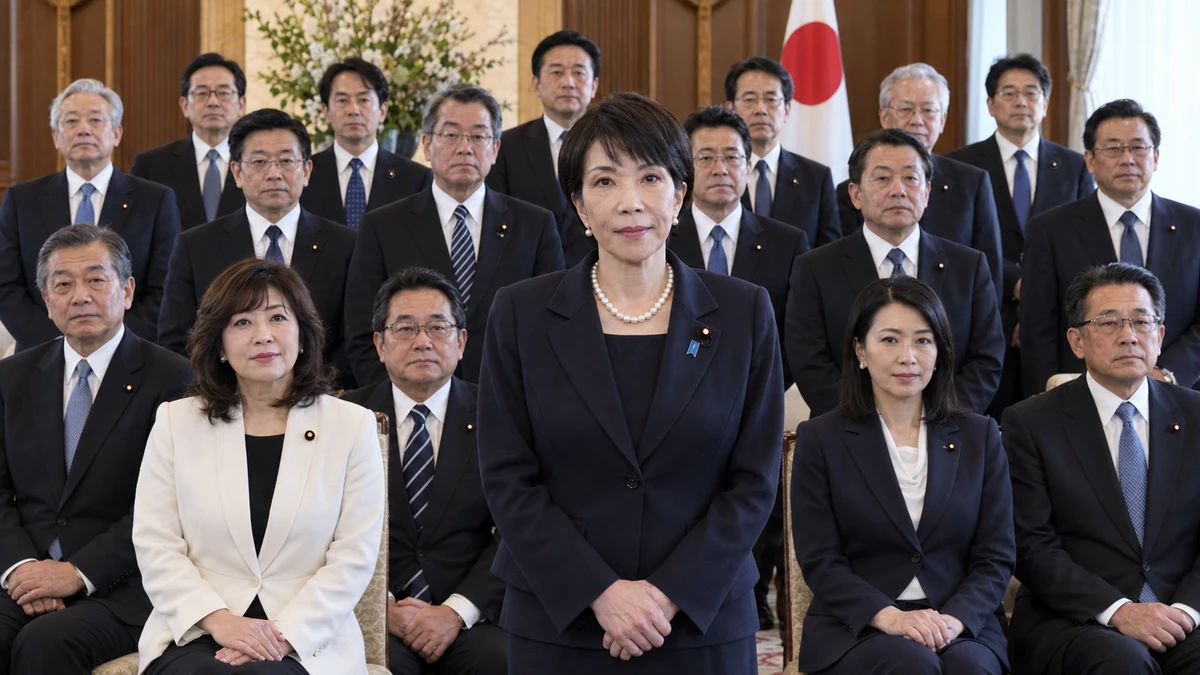
Image to help understand the article
A historic first, but a familiar imbalance
Japan’s first female prime minister has broken a barrier at the top of one of America’s most important allies. The composition of her Cabinet raises a harder question: How much does a breakthrough for one woman change the opportunities available to others?
Just two women serve as ministers alongside Prime Minister Sanae Takaichi, according to a Korean-language news summary citing Yonhap News Agency. They are Finance Minister Satsuki Katayama and Kimi Onoda, the minister responsible for economic security. The rest of the ministerial lineup remains heavily male, prompting criticism ahead of an anticipated Cabinet reshuffle.
The dispute is about more than the optics of a group photograph. Takaichi emphasizes merit and equal opportunity, while critics question whether a government can credibly promote women’s advancement without appointing more women to positions of authority. Behind that disagreement lies a structural problem familiar well beyond Japan: Political leaders choose from a pool of experienced candidates shaped by years of unequal access to office.
For American readers, the story offers both a window into an essential Pacific partner and a recognizable argument about representation. A woman can reach the highest level of an institution without substantially changing how that institution recruits, rewards and promotes everyone else. The coming personnel decisions will provide an early measure of whether Takaichi’s historic premiership produces a broader opening.
Why the two appointments matter — and why critics want more
The women in Takaichi’s Cabinet do not hold marginal assignments. Finance is central to the government’s response to inflation, taxation and currency pressures. Economic security involves the increasingly important intersection of commerce and national security, including questions about strategic technologies and dependence on overseas suppliers.
Those portfolios matter to the United States, whose companies and policymakers work closely with Japan on investment, manufacturing and regional security. Simply counting ministers cannot capture every dimension of influence: A woman directing financial policy may exercise more power than several ministers in less consequential positions.
Still, the prominence of two appointments does not settle the question of access across the government. The criticism described in the source concerns the narrowness of women’s participation, not a claim that Katayama or Onoda lacks responsibility or qualifications.
A former female Cabinet member cited in the summary warned that appointing few women after the arrival of a female prime minister could make the administration appear uncommitted to women’s advancement. That criticism highlights the heightened expectations surrounding a political first. Takaichi’s success is being judged not only as an individual achievement, but also as a possible turning point for other women.
That expectation deserves scrutiny, too. Female leaders are often expected to transform gender relations in ways that male leaders are not. The more useful question is not whether Takaichi owes the public a particular kind of leadership because she is a woman. It is whether her administration’s personnel choices match its stated support for expanding opportunity.
The argument over merit and equal opportunity
Takaichi has acknowledged the need to appoint women more actively while emphasizing merit and equal opportunity, according to the summary. Asked why her administration included relatively few women, she stressed that equal opportunity was her guiding principle. She also remains cautious about quotas that would reserve a share of election candidacies or legislative seats for women.
Chief Cabinet Secretary Minoru Kihara, a senior official who helps coordinate the government and serves as its principal spokesman, offered a particularly direct account of that approach. At a Tokyo speech described in the source, he said previous Cabinets had generally made an effort to include a certain number of women, while Takaichi gave that consideration less weight. He emphasized ability rather than gender as the basis for appointments.
The distinction sounds straightforward: Select the most qualified person, regardless of sex. But it leaves unanswered how political qualifications are accumulated. Seniority, legislative experience, party relationships and previous government service can all strengthen a candidate’s claim to a Cabinet job. Each also depends on getting opportunities earlier in a career.
If men have historically had more access to those opportunities, a selection process centered on established résumés can reproduce the imbalance without explicitly excluding women. That does not prove any particular appointment is unfair. It does mean that evaluating the final choice alone may miss the decisions that determined who could realistically compete.
The American parallel is the long-running debate over diversity in executive hiring, university leadership and political appointments. One side emphasizes uniform standards at the point of selection; another asks whether the route to meeting those standards has been equally accessible. Japan’s Cabinet dispute reflects that same tension, expressed through the institutions of a parliamentary democracy.
The bottleneck begins inside the ruling party
The available figures suggest the problem starts well before the prime minister assembles a Cabinet. Women account for approximately 10% of Liberal Democratic Party lawmakers in Japan’s House of Representatives and about 20% in the House of Councillors, according to the summary.
Those are figures for the ruling party’s lawmakers, not for the entire Japanese legislature. The distinction matters because party representation helps determine the pool of politicians positioned to receive senior government jobs.
Japan’s national legislature, known as the Diet, has two chambers. The House of Representatives is the lower house and has the decisive role in choosing the prime minister when the chambers disagree. Unlike an American president, Japan’s prime minister is chosen by lawmakers rather than through a separate national presidential election. A majority of Cabinet ministers must also be members of the Diet, giving parliamentary careers particular importance in the path to executive power.
The Liberal Democratic Party, generally known as the LDP, is Japan’s long-dominant conservative party. Its English name should not be read as an ideological equivalent of the U.S. Democratic Party. Like other established political organizations, it places substantial value on incumbency and proven electoral strength.
The source identifies that preference as an obstacle for women seeking to enter politics. When a party repeatedly nominates sitting lawmakers, fewer openings remain for newcomers. If most incumbents are men, preserving the existing lineup also preserves much of the existing gender imbalance.
That is why the next Cabinet roster cannot be the only measure of change. Candidate recruitment, nominations in competitive districts and opportunities to build policy expertise will help determine whether future prime ministers have a substantially wider field of experienced women to choose from.
What this means for the United States
For Washington, the immediate practical issue is continuity in a major ally, not the gender balance of Japan’s Cabinet in isolation. Japan hosts U.S. forces and is central to American security planning in East Asia. Its decisions on defense, trade and economic security affect U.S. interests regardless of who occupies individual ministries.
The summary says Kihara, Defense Minister Shinjiro Koizumi, Foreign Minister Toshimitsu Motegi and Katayama have been discussed as likely to retain their positions. These are expectations, not confirmed appointments. If they remain, American officials and companies would continue dealing with many of the same senior counterparts.
For businesses, that could mean continuity in relationships, though not necessarily unchanged policy. The administration faces criticism over the weak yen, rising living costs and a disputed proposal to cut the consumption tax on food. Japan’s consumption tax functions more like a nationwide sales tax than the patchwork of state and local sales taxes familiar to Americans. Decisions about it affect household spending and the government’s finances.
Currency movements also connect Japan’s domestic economic pressures to the United States. A weaker yen can make Japanese travel and some Japanese goods less expensive in dollar terms while increasing the yen cost of imported products. For American exporters, investors and companies operating in Japan, the effects vary with their sales, costs and currency exposure. The source does not establish any specific business outcome from the expected reshuffle.
The representation debate has a separate resonance for American audiences. Kamala Harris became the first woman to serve as U.S. vice president, but that breakthrough did not eliminate disputes over women’s access to political leadership. In corporate America, the appointment of a female chief executive likewise does not, by itself, establish that women throughout a company have equal paths to promotion.
These are comparisons, not identical cases. Japan’s parliamentary system and party nomination practices differ from American institutions. The shared lesson is narrower: A landmark appointment and broad institutional change are different developments, and each requires its own evidence.
The Korean connection: Shared stakes, not interchangeable societies
The story’s appearance in Korean news coverage also makes sense in a region where developments in Tokyo carry consequences well beyond Japan. South Korea, like Japan, is a U.S. treaty ally. The two countries are major economic partners for the United States, and cooperation among Washington, Seoul and Tokyo matters for responding to North Korea and addressing other regional security challenges.
South Korea has its own experience with a female national leader. Park Geun-hye became the country’s first female president in 2013. Her rise provides another reason to distinguish a woman’s individual ascent from broader changes in political participation. Neither Japan nor South Korea should be treated as a stand-in for the other, however: Their electoral systems, party histories and domestic political conflicts differ.
For Americans whose familiarity with the region comes primarily through K-pop, Korean dramas, Japanese animation or tourism, this story reveals a different set of institutions. Global cultural visibility does not tell audiences how political parties distribute nominations or how governments select ministers. Popular entertainment can introduce viewers to a country without explaining who holds authority inside it.
Nothing in the supplied account indicates that the number of female ministers will directly change U.S.-Japan-South Korea cooperation. Nor does it establish a consequence for entertainment companies or American fans. The defensible connection is that the internal politics of these allied governments shape the leadership teams responsible for managing shared diplomatic and economic interests.
Economic pressure favors continuity — but does not settle the debate
The expected reshuffle comes as Takaichi’s government confronts complaints about household costs and the yen. Such pressures can encourage a prime minister to retain experienced ministers rather than undertake a sweeping personnel overhaul. They also make the finance portfolio particularly consequential.
The political opposition, meanwhile, appears poorly positioned to capitalize on those complaints in the account provided. The summary describes the lower house’s largest opposition group, identified as the Centrist Reform Alliance, as severely weakened, with support in the 1% range. It does not provide the underlying poll’s methodology or field dates, so that figure should not be treated as a complete measure of public sentiment.
A weakened opposition may reduce the immediate electoral pressure for a dramatic reset. It does not necessarily remove criticism from inside the governing party or from former officials concerned about women’s representation.
One Cabinet member cited in the summary predicted that the number of female ministers would not increase substantially. That is an insider’s expectation, not a settled outcome. The forecast nevertheless points to the central tension: The administration may prioritize stability while critics look for evidence that a historic change at the top will extend further down.
What to watch beyond the Cabinet photograph
The first test will be the announced lineup. Does the number of female ministers increase? Do women retain or gain substantial portfolios? A numerical increase would be meaningful, but responsibilities and access to decision-making would help show how much has changed.
The next test lies inside the LDP. More female candidates will not automatically produce more female lawmakers if those candidates lack a realistic chance of winning. The distribution of nominations, party backing and opportunities for advancement will therefore matter alongside the headline totals.
A third question is whether the government explains how it assesses merit. General commitments to ability and equal opportunity do not reveal which experiences count, who gets to acquire them or whether promising candidates outside the customary circle receive serious consideration.
For the United States, the sensible approach is to follow both tracks: the continuity of a crucial alliance and the evolution of representation within a partner’s political system. There is no basis here to assume that more women would automatically produce a particular foreign or economic policy. There is a clear basis to ask whether more people can compete to shape those policies.
Takaichi’s premiership has already changed who can be imagined at the head of Japan’s government. The unresolved issue is whether it also changes who gets the experience, support and appointments needed to follow her.
Comments
Post a Comment