Image to help understand the article
A regional rivalry with an American destination
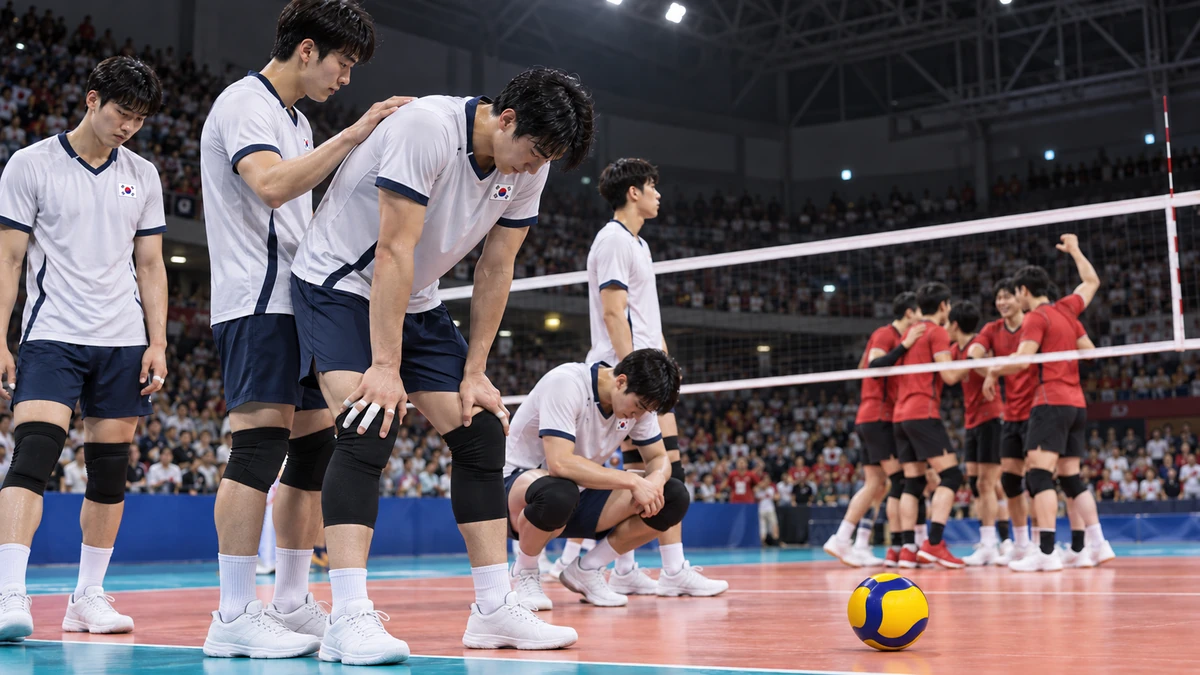
South Korea’s return to the Asian men’s volleyball semifinals ended with a blunt reminder of how far it remains from the region’s top tier. Against Japan, a neighboring rival playing at home, the Koreans lost in three sets — 25-13, 25-11, 25-14 — in a match that lasted just 59 minutes.
The result carried significance beyond regional bragging rights. According to the Korean news account of the 2026 Asian championship, the tournament winner receives a direct berth in the 2028 Los Angeles Olympics. South Korea’s defeat therefore closed that particular route to a Games that will bring international volleyball’s biggest ambitions into the American sports spotlight. It did not, by itself, establish that South Korea was out of Olympic contention altogether.
For American readers more accustomed to encountering South Korea through K-pop, television dramas or consumer technology, the match offers a different perspective on the country’s international ambitions. Cultural influence and sporting strength do not necessarily travel together. In men’s volleyball, South Korea is trying to regain regional ground while Japan is setting a much higher competitive standard.
The immediate task for South Korea is now less glamorous but still consequential: beat Australia in the third-place match and secure the international tournament berth that the source says is available to the championship’s top three finishers.
The numbers describe more than a bad afternoon
South Korea entered the semifinal ranked No. 23 in the world, according to the rankings cited in the report. Japan was No. 6. Rankings cannot predict every match, but this one offered little evidence that the gap overstated the difference between the teams.
Japan led 43-19 in attack points and 10-2 in service aces. Its advantage in blocks was smaller, 8-6, but South Korea could not turn that relatively competitive category into sustained resistance. Japan’s superiority was not confined to a single rotation or a short stretch of exceptional serving. It shaped all three sets.
Those categories help explain a sport that can look deceptively simple on television. An attack point generally comes when an offensive hit wins the rally. An ace wins a point directly from the serve. A scoring block stops an opponent’s attack at the net. Together, the figures show Japan finding points both before South Korea could organize an offense and after rallies developed.
Under rally scoring, every rally produces a point, including those decided by errors. Japan won 75 total points to South Korea’s 38 across the three sets. That nearly two-to-one margin matters more than the sweep alone: A 3-0 result can conceal three close contests. This one did not.
Japan also had several reliable scoring options. Yuki Ishikawa led all players with 15 points, Ran Takahashi added 14 and Yuji Nishida scored 10. South Korea’s leading scorer, Heo Su-bong, finished with six, while Lim Dong-hyeok had five. No Korean player approached the output of any of Japan’s three leading scorers.
South Korea could not stop Japan’s runs
The opening set established the pattern. South Korea trailed only 8-6 before Japan won seven consecutive points, transforming a manageable deficit into a commanding advantage. Japan finished the set 25-13, leaving the Koreans little time to settle into a contest against both a strong opponent and an overwhelmingly supportive home crowd.
The second set was more decisive. South Korea struggled to find attacking routes around Japan’s block. From a 13-6 lead, Japan collected another five straight points through a sequence that included quick attacks and blocks. A Korean service error at 24-11 ended the set.
South Korea briefly changed the tone in the third, moving ahead 5-1. That start demonstrated that it could win individual exchanges and create an opening. But a promising lead is different from an adjustment that holds up over a full set.
With South Korea leading 6-3, Japan won five straight points to move in front. The Koreans never recovered control, and Japan closed out the match 25-14. Across the afternoon, the damaging feature was South Korea’s inability to interrupt Japan’s scoring bursts before they became decisive.
For coach Isanaye Ramirez, the result leaves specific performance questions rather than a mystery about the outcome. How can South Korea sustain its attack against a disciplined block? How can it keep an opponent’s strong serving rotation from producing a cascade of points? The supplied account does not include his postmatch assessment, so those remain analytical questions, not an explanation attributed to the coaching staff.
A comeback measured against a moving standard
South Korea’s semifinal appearance was its first in this competition since finishing fourth in 2019, according to the report. Returning to the final four after seven years represents progress in tournament placement. The difficulty is that placement and proximity to a championship are not the same thing.
A team can advance farther than it has in years while still finding that the strongest opponent is well beyond its reach. That is the central tension in South Korea’s result. The semifinal run offers something to build on; the margins against Japan show how much remains unfinished.
It would be premature to treat one match as a complete diagnosis of South Korean volleyball. The account provides no detailed evidence about youth development, injuries, roster availability or training resources. It cannot establish whether the loss arose from structural weaknesses, match-specific problems or some combination of the two.
What it does establish is a demanding benchmark. Against the world’s sixth-ranked team, South Korea produced fewer than half as many attack points and only one-fifth as many aces. Any claim of renewed competitiveness at the highest regional level will eventually need to survive that sort of test, not simply an improvement in finishing position.
Understanding the rivalry — and the club names
South Korea and Japan are neighboring democracies, major economies and U.S. allies with a relationship shaped by cooperation as well as unresolved historical tensions, including the legacy of Japan’s colonial rule over Korea. Sporting meetings can attract attention beyond what a tournament bracket alone would suggest.
Still, the semifinal should not be reduced to a geopolitical metaphor. The available account describes a volleyball match dominated by Japan’s serving and offense, not a political confrontation. The home crowd provided an emphatic setting; the score and performance statistics explain the result.
Another detail may look unfamiliar to American readers: South Korean players are identified with clubs bearing corporate names. Heo plays for Hyundai Capital, while Lim is associated with Korean Air. Those are club affiliations, not references to the players’ national-team sponsors or everyday occupations.
Corporate ownership and branding are prominent features of South Korean professional sports. An American fan might expect a city name and mascot, such as those used throughout the NBA or Major League Baseball. In Korean coverage, a company name can serve as an equally immediate identifier of a player’s professional team.
That distinction also helps separate two levels of competition. Players who face one another in South Korea’s domestic professional league join forces for the national team, much as NBA rivals become teammates for USA Basketball. Success at the club level supplies experience and recognition, but international competition brings a different collection of opponents and demands.
What this means for the United States
The clearest American connection is Los Angeles. An Olympic qualifying opportunity attached to an Asian championship makes a regional result relevant to the future field at a U.S.-hosted Games. For American spectators, the eventual Olympic competition will be shaped partly by matches played years earlier, far from California.
Japan’s victory moved it into the final and kept the reported direct Olympic berth within reach. South Korea’s loss ended its chance to claim that berth at this tournament. Neither outcome should be stretched further: Reaching the final is not the same as winning the qualification place, and losing a semifinal is not necessarily the end of every Olympic pathway.
For American volleyball fans, Japan also provides a useful team to follow beyond the U.S. program. The performance illustrates the value of serving pressure, coordinated blocking and multiple attacking threats — elements familiar to anyone who watches NCAA volleyball. The international setting changes the uniforms and stakes, but the basic competitive problems are recognizable.
The comparison with the American game is especially useful because indoor volleyball occupies a different place in each country’s sports landscape. NCAA competition is a major point of entry for U.S. fans. South Korean coverage routinely connects national-team players to their corporate-backed professional clubs. These are different institutional settings for the same sport, and neither should be mistaken for a guarantee of international success.
For American broadcasters, sponsors and other sports companies, the responsible business conclusion is limited. A home Olympics gives them a reason to understand potential participating teams and the audiences that follow them. But this match report contains no evidence of new U.S. media agreements, sponsorship deals, ticket demand or commercial expansion. The Los Angeles connection is concrete; any financial payoff remains unproven.
The same caution applies to the broader U.S.-South Korea relationship. International sports can add another point of contact between American and Korean audiences, but a volleyball result does not signal a change in diplomatic ties. Its significance is sporting and potentially cultural, not a measure of the strength of an alliance.
Why the Australia match still matters
South Korea next faces Australia, ranked No. 37 in the report, in the third-place match. Australia reached that game after losing its semifinal to No. 17 Iran in four sets, 25-21, 17-25, 25-17, 25-22. Iran advances to face Japan for the championship.
The rankings put South Korea above Australia, but they do not award a bronze medal in advance. After such a one-sided semifinal, the Koreans must recover quickly enough to play a match with a separate, tangible reward.
According to the Korean account, the top three teams qualify for a 2027 FIVB men’s event identified there as the World Cup. On those reported terms, the bronze-medal match is also a qualification playoff: South Korea must win to take the remaining place. That reported berth is distinct from the Olympic place assigned to the champion.
For readers accustomed to American professional playoffs, that gives the consolation game an unfamiliar weight. A third-place contest may sound like an exercise in deciding who finishes behind the finalists. Here, the source describes a result that would affect South Korea’s subsequent international schedule as well as its medal position.
The match is scheduled for 3:30 p.m. local time on the 13th, followed by Japan-Iran at 7:30 p.m. The supplied summary does not specify the month, so those times do not provide a complete viewing date for American audiences.
What to watch beyond the final score
Against Australia, the first question is whether South Korea can rebuild an effective offense. A victory would fulfill the immediate objective, but the way it generates points will help show whether the problems exposed by Japan persist against a different opponent.
Serving is another clear area to watch. South Korea’s two aces against Japan were insufficient to offset the pressure coming from the other side of the net. Aces alone do not measure serving quality — a difficult serve can disrupt an opponent without winning the point outright — but the semifinal figures show an obvious imbalance.
Over the longer term, South Korea’s progress should be judged through repeated performances rather than a single emotionally charged rivalry match. Returning to a semifinal matters. Converting that return into sustained competitiveness against leading teams would matter more.
Japan, meanwhile, still has to finish the tournament against Iran. Its overwhelming semifinal performance made it a formidable finalist, not an automatic champion. For American audiences looking ahead to Los Angeles, that distinction captures the appeal of following qualification early: The Olympic story is already taking shape, but its outcomes are not yet settled.
Comments
Post a Comment