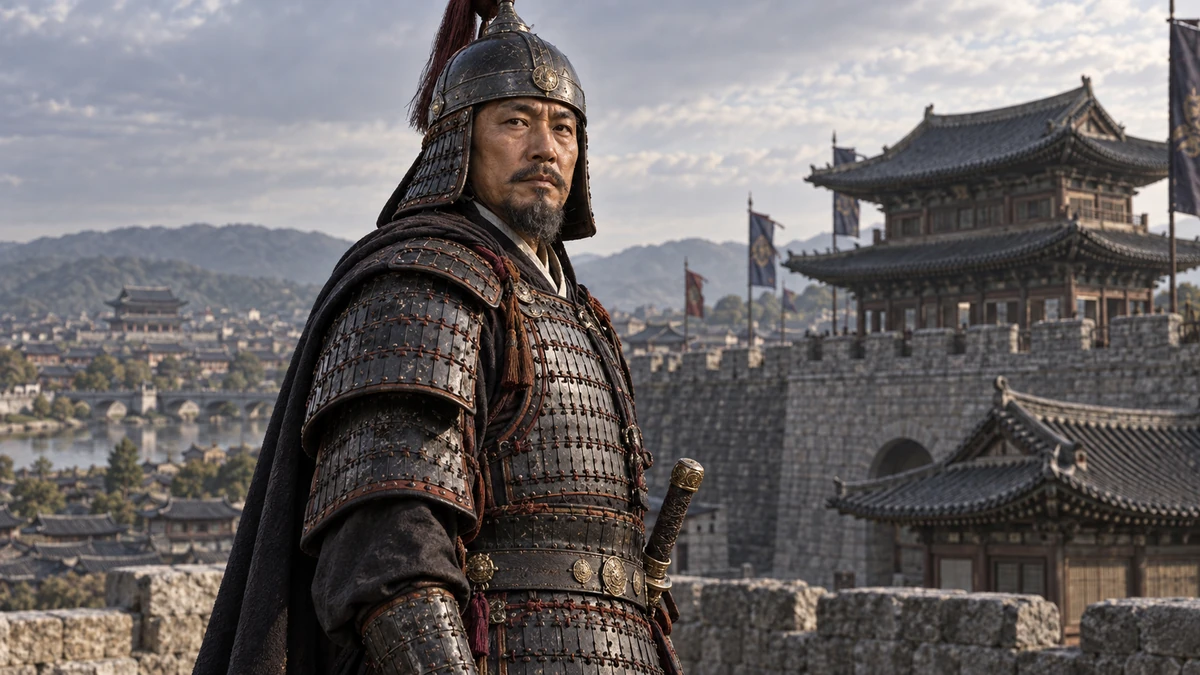
Image to help understand the article
A commander close to the king
Jeong Se-un was a military commander during the final decades of Goryeo, the Korean kingdom that ruled from 918 to 1392. His family seat was in Gwangju, and he was born in Jangtaek County, an area believed to correspond to parts of present-day Jangheung and Boseong counties in South Jeolla Province.
Jeong served King Gongmin while the future monarch was staying at the court of China’s Yuan dynasty. After Gongmin took the Goryeo throne, Jeong was named a first-rank meritorious subject for accompanying and supporting him. He rose through a succession of senior military and government posts, becoming a grand general in 1352 and later serving as minister of military affairs.
In 1354, Jeong joined a Goryeo force sent at the Yuan government’s request to fight Zhang Shicheng. Serving alongside commanders including Choe Yeong, Yi Bang-sil and An U, he fought in the Jiangsu region before returning to Goryeo the following year. Jeong later received another first-rank honor for his role in the elimination of Gi Cheol, a powerful figure associated with Yuan influence in Goryeo, and continued to rise in the royal administration.
Defending Goryeo from invasion
When Red Turban forces crossed the frozen Yalu River in November 1359, Jeong was appointed the following January to oversee military operations in Goryeo’s northwestern region. After returning from Hwangju, he reported that the enemy had entered Pyongyang, then known as Seogyeong, but appeared focused on repairing its defenses rather than advancing. He urged the government to calm the population and prevent panic. Soldiers who distinguished themselves in battle received gold, silver and other rewards.
Jeong also asserted civilian government norms during a separate crisis. When Japanese raiders attacked Yang광 Province and martial law was imposed in the capital, officials were ordered to join the military campaign. Jeong objected when government remonstrance officials — whose role was to criticize and advise the king — prepared to depart for battle. He argued that sending such officials to war was without precedent and would undermine the dignity of the state, and they were exempted from service.
A second Red Turban invasion began in November 1361 with a force reported at more than 100,000. Jeong was responsible for military affairs in the northwest and defended fortifications at Jeollyeong. The defensive line collapsed, however, and the invaders captured Gaegyeong, the Goryeo capital in what is now Kaesong, North Korea. King Gongmin fled south to Bokju, and Jeong accompanied the royal court.
Retaking Gaegyeong
King Gongmin appointed Jeong commander-in-chief and gave him broad authority to punish soldiers who disobeyed orders. Known for loyalty and personal integrity, Jeong imposed strict discipline as he prepared the campaign to recover the capital.
He warned officials and commanders that delays would not be tolerated and argued that destroying the invading army was the only way to save both themselves and the country. Senior official Yi Am encouraged him, saying the restoration of the state and revival of royal authority depended on the campaign.
Before the army advanced, Jeong told the king not to begin discussing rewards based on preliminary reports. He promised to submit a full account only after a decisive victory. When a man from Seogyeong reported that about 10,000 civilians had escaped enemy control, Jeong dispatched a senior official to provide them with relief.
In 1362, Jeong directed commanders including Yi Bang-sil, Kim Deuk-bae, An U, Yi Seong-gye, Choe Yeong and An U-gyeong as a Goryeo force reported at 200,000 surrounded Gaegyeong. Jeong established his headquarters at Dosolwon, and the Goryeo army defeated the invaders and recovered the capital.
Jeong sent messengers to the king’s temporary court with news of the victory. Rather than claim personal credit, he attributed the result to King Gongmin’s virtue. The king rewarded the messengers and sent clothing and wine to Jeong and members of the royal family.
Murder after victory
Jeong did not survive long enough to enjoy his triumph. Kim Yong, jealous of the commander’s achievements, falsely invoked royal authority and persuaded An U, Yi Bang-sil and Kim Deuk-bae to kill him. Jeong was murdered shortly after the recovery of Gaegyeong in 1362.
King Gongmin declared that Jeong, as commander-in-chief, had exercised authority on the monarch’s behalf. By killing him without permission, the subordinate generals had shown contempt for the throne. On the first day of the third lunar month of 1362, the king ordered the execution of An U, Kim Deuk-bae, Yi Bang-sil, Min Hwan and Kim Rim. He spared their wives and children in recognition of the commanders’ previous military service. Kim Deuk-bae was captured in Sanyang County and beheaded, with his head displayed publicly in Sangju; records also say An U and Yi Bang-sil received the same punishment.
King Gongmin posthumously elevated Jeong to a senior government rank and gave him a formal burial. The court recognized both his service during the royal flight to Bokju and his leadership in retaking Gaegyeong, naming him a first-rank meritorious subject and honoring him with a portrait displayed among the kingdom’s distinguished officials.
Jeong’s military career has remained part of South Korea’s public memory. The War Memorial of Korea selected him as a patriotic figure in September 2018, and his life has been portrayed in the KBS historical drama “The Foundation of the Kingdom” and the MBC series “Sin Don.”
Comments
Post a Comment