Image to help understand the article
A Korean Defender’s Milestone Behind Bayern’s Winning Goal
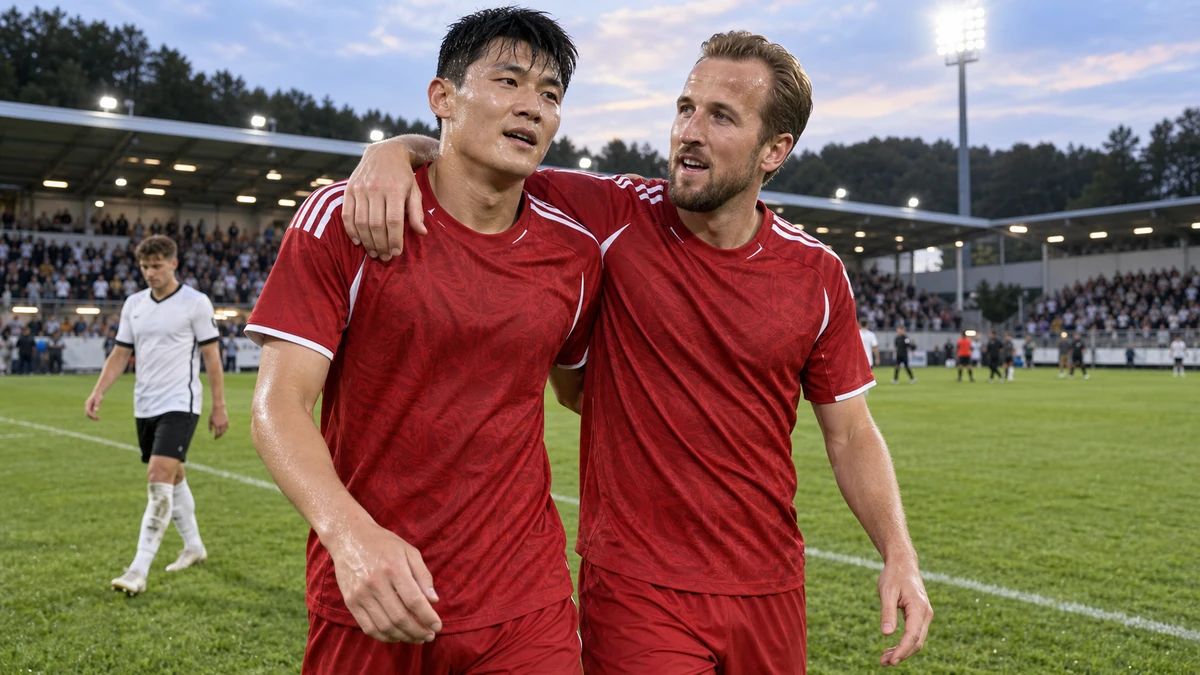
Harry Kane supplied the decisive finish, but for South Korean defender Kim Min-jae, the significant number was not on the scoreboard. It was 90: a full regulation game on the field after an uneven start to his league schedule.
According to the supplied Korean news account, Kim completed his first full Bundesliga match of the 2026-27 season as Bayern Munich defeated Elversberg 2-1 on the road. Kane’s second-half winner delivered Bayern’s second victory in three league games, leaving the club fourth with seven points.
The result offers two ways to understand a major European soccer club: through the star striker who decides games and through the less visible work of players trying to establish continuity. For American audiences increasingly following clubs across national borders, Kim also represents a connection among South Korean sporting ambition, European soccer’s competitive demands and the international audience that sustains both.
The match details and statistics here come from the supplied account and have not been independently verified. It identifies the game as taking place on the 14th, Korean time, but does not specify the month. That limits the precision of the match chronology and makes broader conclusions about the season premature.
Why Staying on the Field Matters
Kim had started Bayern’s league opener against Stuttgart but came off in the 84th minute, according to the account. He did not appear in the second league game against Schalke. Against Elversberg, he played without being substituted.
For an American fan accustomed to football’s rotating defensive packages or basketball’s frequent substitutions, completing a soccer match may not sound especially notable. Starting center backs, the defenders who generally operate closest to their own goal, often do play entire games. Their positioning, communication and understanding of one another can be central to a team’s defensive organization.
Yet that routine is precisely what made Kim’s appearance worth attention. After one early exit and one game without playing time, a full match gave him an uninterrupted assignment. It was evidence of his involvement on this occasion, not proof that his place in the lineup is permanently settled.
The distinction matters. The account does not explain why Kim missed the Schalke game, so it would be misleading to describe his return as a recovery from injury, a response to poor form or the end of a coaching dispute. Rotation, fitness and tactical decisions can all affect selection, but none should be presented as the explanation without evidence.
Nor does 90 minutes alone establish how well a defender played. The summary provides no detailed breakdown of tackles, interceptions, aerial challenges or positioning. Bayern conceded once and won. That supports a straightforward account of Kim completing the match, not a sweeping declaration that he dominated it.
An Uncomfortable Assignment Against a Promoted Club
Bayern took the lead at Ursapharm Arena in Spiesen-Elversberg through Lennart Karl in the 26th minute. The advantage disappeared in the 61st, when Maurice Krattenmacher scored for the home team. Kane restored Bayern’s lead in the 72nd minute, receiving a ball played back by Aleksandar Pavlovic, finding a shooting angle with a defender in front of him and finishing with his right foot.
That sequence turned a potentially frustrating draw into a victory. Under soccer’s league scoring system, teams receive three standings points for a win, one for a draw and none for a loss. Bayern’s seven points through three games therefore reflected two wins and a draw.
Elversberg’s status as a promoted club adds important context. Unlike Major League Soccer and the major American professional leagues, German soccer moves teams between divisions based on results. Successful clubs in a lower division can earn promotion; struggling clubs in a higher division can be relegated.
Promotion is not the same as receiving an expansion franchise. A promoted team has earned entry through competition, then must adjust to a schedule against opponents that may have far greater resources and deeper squads. For readers unfamiliar with the system, imagine a successful minor league baseball team moving into the majors and immediately hosting one of the sport’s biggest spenders — an imperfect comparison, but one that captures the jump in competitive demands.
The narrow score illustrates the challenge Bayern faced, but it does not explain the whole performance. Without fuller match evidence, it cannot establish whether Bayern controlled play, wasted chances or spent long stretches defending. What the supplied sequence does show is that Elversberg erased a deficit and forced Bayern to find another goal.
Kane’s Numbers — and the Burden of Expectations
The Korean account credits Kane’s winner as both his first league goal of the season and his 150th goal for Bayern in all competitions, reached in his 153rd appearance since joining the club in 2023. It also lists his Bundesliga total at 99 goals in 97 games, putting him one short of 100 league goals. Those figures are reported by the source rather than independently confirmed here.
For readers encountering European soccer statistics for the first time, the categories are important. A club’s season typically includes its domestic league, domestic cup competitions and, if it qualifies, European tournaments. An all-competitions total therefore covers more games than a Bundesliga total. The two figures describe different records, not conflicting accounts of the same one.
Kane’s reported postgame comments emphasized satisfaction at scoring and helping Bayern win. He also pointed to the expectations created by the team’s previous two seasons, while stressing that taking three points mattered most at this stage. The summary does not detail those previous results, so his remarks should not be expanded into claims about specific trophies or records.
The underlying pressure is recognizable in the United States. Teams such as the New York Yankees or Los Angeles Lakers are often assessed against their reputations as much as against the immediate opponent. Winning narrowly can still invite questions about why the game was close. Bayern operates under a comparable expectation that victory should be accompanied by authority.
For Kim and the other defenders, that standard complicates the narrative. Kane’s goal offers an obvious highlight and a clear statistical milestone. Defensive work is less easily condensed into a replay, even when maintaining enough stability to win is essential to the result.
Why Kim’s Role Resonates in South Korea
South Korean interest in Kim reflects more than enthusiasm for one overseas club. A player competing for a prominent European team is also a highly visible representative of the country’s soccer development. His playing time becomes something fans can follow alongside national team appearances and results.
Two established reference points help explain that attention. Park Ji-sung built a prominent career at Manchester United, while Son Heung-min became a major figure at Tottenham. Their careers helped make English club soccer familiar to Korean audiences through the sustained presence of a Korean player, rather than solely through international tournaments.
Kim offers a different view of elite European competition. As a center back, his contribution is primarily judged through defending, organizing and moving the ball out of the back, not through the goal totals that make forwards easy to market. His visibility broadens the positions in which Korean players can be recognized at the highest club level.
There is also a direct connection within this story: Kane and Son were longtime Tottenham teammates before Kane moved to Bayern. Korean fans who followed that partnership already had years of exposure to the English striker. His role alongside Kim at Bayern creates continuity for viewers whose interest crosses both club and national boundaries.
That is not the same as saying all Korean fans support Bayern or judge Kim identically. National pride, club loyalty and individual preference can coexist or conflict. But it helps explain why a Korean report might lead with a defender’s first complete league game while another outlet gives top billing to the winning scorer.
What This Means for the United States
For the United States, the most useful angle is how audiences form around international soccer. An American viewer need not choose between following MLS, the U.S. national team and a European club. A Korean American family might have an additional reason to watch Kim; an England supporter might follow Kane; another fan might arrive through Bayern’s history or its Champions League appearances.
These overlapping loyalties matter to American broadcasters, sponsors and sports media companies trying to explain why a game thousands of miles away deserves attention. Kim provides a human connection that a standings table alone cannot offer. For viewers unfamiliar with German soccer, following one player can become a way to learn the competition, its clubs and its stakes.
A useful American comparison is the attention Japanese stars have brought to Major League Baseball. Shohei Ohtani’s career demonstrates how an athlete can connect a domestic league to audiences with different languages and cultural reference points. That is a comparison of audience behavior, not a claim that Kim has equivalent commercial influence or that soccer and baseball markets function identically.
The United States also has its own experience following national team players at European clubs, including Christian Pulisic. Fans often examine starts, substitutions and minutes because club participation can inform expectations for international competition. Kim’s full game is meaningful to Korean followers in a similarly understandable way: it is one measurable sign of where a national team player stands in his club environment.
The connection to U.S.-South Korea relations is cultural rather than diplomatic. Shared interest in athletes creates everyday points of contact beyond trade, security and government policy. It would be an overstatement to describe this result as affecting the bilateral alliance. Its relevance lies in how American audiences encounter contemporary Korea through sports as well as through music, film and television.
The commercial limits are equally important. The supplied story contains no U.S. viewership figures, merchandise sales, sponsorship announcements or evidence of new American investment. Any claim that this match boosted Bayern’s American business would be speculation. The defensible conclusion is narrower: players such as Kim give companies and journalists additional ways to reach and serve an international audience.
Beyond K-Pop: A Different Kind of Korean Visibility
The Korean Wave, often called Hallyu, generally refers to the international spread of South Korean popular culture, especially music, television and film. Kim’s career belongs to professional sports, not the entertainment industry. Treating him simply as another Korean cultural export would obscure the distinct demands of his work.
Still, the broader audience dynamic has points of overlap. Fans can discover a country through an individual performer or athlete, then develop an interest in its language, media and other public figures. Digital coverage makes it possible to maintain that connection without living near the team or sharing its home language.
There is an important difference, however, between visibility and influence. A prominent club shirt, a full match and international headlines demonstrate exposure. They do not, by themselves, measure changes in public attitudes toward Korea or spending by overseas fans. Responsible coverage should preserve that distinction rather than turn every appearance by a Korean star into evidence of a cultural breakthrough.
Kim’s immediate story is more concrete: a defender received a full game, his team conceded an equalizer, and a teammate supplied the winner. Explaining why people in different countries care about those facts adds context without replacing the sport itself.
What to Watch Next
The next question for Kim is continuity. Does he keep starting? Does he complete more league games? Does his role remain consistent as Bayern balances its schedule? Repeated selections would offer stronger evidence of an established place than one full appearance can provide.
Performance needs a separate assessment. Match footage and fuller reporting would help establish how he handles opposing forwards, communicates with defensive partners and contributes when Bayern has possession. Minutes are a useful starting point, but they are not a substitute for evaluating the work done during them.
For Kane, the next statistical marker in the supplied account is a 100th Bundesliga goal. For Bayern, the broader competitive question is whether narrow early wins develop into more convincing performances. Fourth place after three games is a snapshot, not a reliable forecast of the final standings.
For American readers, the lasting significance is the convergence of those stories: an English scorer, a Korean defender and a German club followed across borders. Kane delivered the winning moment. Kim’s full appearance supplied another reason to watch — and a reminder that global soccer’s appeal often begins with one player before expanding into an entire sporting world.
Comments
Post a Comment