Image to help understand the article
South Korea Tests a New Way to Electrify Apartment Living
LG Electronics is beginning a real-world demonstration project on South Korea’s Jeju Island to test whether heat pumps can replace traditional gas-based heating systems in apartment buildings. The project focuses on converting an occupied apartment building into an all-electric home energy system, allowing researchers to measure performance under actual living conditions rather than only in laboratory settings.
The demonstration, called the "Apartment Heating, Cooling and Hot Water Electrification and P2H (Power-to-Heat) Demonstration Project," brings together LG Electronics, Jeju Special Self-Governing Province, Jeju Development Corporation and the Korea Institute of Industrial Technology. The agreement was signed at the Jeju International Convention Center.
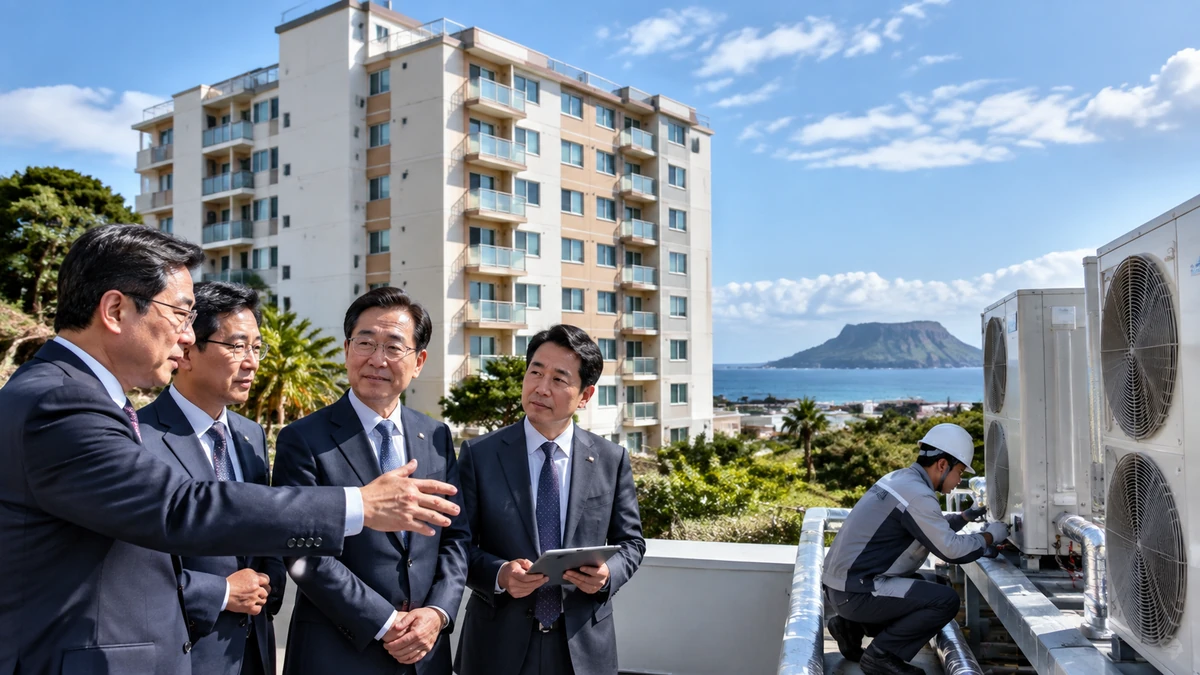
The test site is the Shinhyo Apartment building in Hyodon-dong, Seogwipo City, on the southern side of Jeju Island. The seven-story residential building, which also has one underground floor, currently houses 12 households. Unlike a new construction project designed from scratch, the experiment will modify an existing residential building while residents continue using the property, making it closer to the challenges faced by older apartment communities around South Korea.
For American readers, the concept may be easier to understand by comparing it to replacing a home’s furnace, water heater and air-conditioning system with an integrated electric system while keeping the existing structure intact. The goal is not simply installing new equipment, but proving that electrification can work in dense residential environments.
How Heat Pumps Could Replace Traditional Korean Heating Systems
South Korea’s apartment culture is a key part of understanding why this project matters. Unlike many American suburbs where single-family homes dominate residential life, South Korea’s cities are filled with large apartment complexes. These high-density buildings house millions of families and are a defining feature of urban life.
Many Korean homes have historically relied on gas-powered boilers for heating and hot water. A common system is "ondol," a traditional Korean underfloor heating method that has been adapted into modern apartment heating systems. Residents expect warm floors during winter, making heating technology especially important in Korean housing.
LG Electronics’ project will examine whether heat pumps can provide the same level of comfort while reducing reliance on fossil fuels. The system includes household-level heat pumps capable of handling both cooling and floor heating using a single outdoor unit.
Hot water will be produced through a centralized system rather than individual household equipment. An air-source heat pump and a large hot water storage tank will be installed in an unused space on the first-floor pilotis area, a type of open structural space commonly found in Korean apartment buildings. Heated water will then be distributed to individual homes.
The project also incorporates P2H technology, or Power-to-Heat. This approach uses electricity generated from renewable sources, such as solar power, when supply is available and converts that electricity into stored heat for later use. Supporters say the technology could help balance electricity demand while lowering energy costs.
Why South Korea Is Looking Beyond Gas Boilers
The Jeju demonstration reflects a broader global shift toward building electrification. Governments and companies worldwide are exploring ways to reduce carbon emissions from buildings, which are responsible for a significant share of energy consumption through heating, cooling and hot water systems.
South Korea faces a particular challenge because of its dense apartment environment. Technologies developed for detached homes in other markets cannot always be directly applied to high-rise residential buildings. A solution that works in a single-family house may require significant redesign for a multi-unit apartment complex with shared infrastructure and different energy demands.
The project’s main question is whether heat pumps can replace existing boilers and gas networks while maintaining both technical performance and economic competitiveness. Data collected during the demonstration will be used to develop a Korean-style electrification model that could potentially be applied to public rental housing, older apartment renovations and future residential developments.
LG Electronics entered the global heat pump market in 2008 and has continued research for different climate conditions. The company operates cold-weather research facilities in locations including South Korea, Alaska in the United States, Oslo in Norway and Harbin in China, reflecting the challenge of improving heat pump performance in colder regions.
What This Means for the United States and the Clean Energy Market
The Jeju project has relevance beyond South Korea because the United States is also experiencing rapid growth in interest around heat pump technology. American homeowners, utilities and policymakers have increasingly examined heat pumps as an alternative to traditional furnaces, especially as states pursue lower-emission energy systems.
The U.S. market, however, has a different housing landscape. While apartment living is common in major cities such as New York, Chicago and Los Angeles, much of America’s residential market consists of detached houses. South Korea’s experiment offers a different perspective: how to electrify dense residential communities where many families share a single building infrastructure.
For American companies working in heating, ventilation and air-conditioning, the Korean demonstration highlights the importance of adapting electrification technologies to different housing environments. Apartment retrofits are often more complicated than new construction because engineers must work around existing buildings, residents and energy systems.
The project also connects to broader U.S.-South Korea cooperation in clean technology. Korean companies such as LG Electronics have expanded their presence in the American market, while U.S. policymakers and businesses continue to seek solutions for improving energy efficiency in buildings. Although the Jeju project does not directly create a U.S. deployment program, its findings could contribute to global discussions about how heat pumps can be used in different climates and building types.
Jeju as a Living Laboratory for Future Energy Systems
Jeju Island has become one of South Korea’s most visible testing grounds for renewable energy and smart energy projects. The island’s geography, tourism economy and growing renewable energy capacity have made it a strategic location for experimenting with new approaches to energy management.
The heat pump demonstration adds another layer to that effort by focusing on everyday residential life. Instead of testing only equipment performance, researchers will observe how the technology operates in homes occupied by real residents, including how efficiently it provides heating, cooling and hot water throughout changing seasons.
The participating organizations have divided responsibilities. LG Electronics will handle the overall heat pump system design, equipment supply, operation testing, maintenance and performance evaluation using collected data. Jeju Province will focus on policy connections and regulatory improvements. Jeju Development Corporation will provide the demonstration building and support operations, while the Korea Institute of Industrial Technology will work on P2H system design and data analysis.
The Next Test: Can Electrification Scale Across Korean Housing?
The success of the Shinhyo Apartment demonstration will depend on more than whether the technology works. Researchers will also need to determine whether it can be economically attractive for residents, practical for building operators and scalable across Korea’s diverse housing stock.
South Korea has millions of apartment units, many of which were built decades ago. Retrofitting these buildings represents a major challenge but also a significant opportunity for reducing emissions. A successful model could influence how future apartment renovations are planned and how energy systems are designed for new developments.
For the United States and other markets watching the transition toward cleaner buildings, South Korea’s experiment offers a valuable case study. The future of electrification may not depend on one universal solution, but on technologies that can adapt to different cultures, climates and housing systems.
As governments and companies worldwide pursue lower-carbon energy systems, projects like LG Electronics’ Jeju demonstration show how the next phase of the energy transition may happen not only in power plants or industrial facilities, but inside the homes where people live every day.
Comments
Post a Comment