Image to help understand the article
Seoul Wants to Be More Than a Showcase for Artificial Intelligence
SEOUL — South Korea’s capital is preparing to bring artificial intelligence startups, global investors, major corporations and public-sector innovation officials under one roof for Try Everything 2026, a two-day startup festival that reflects Seoul’s ambitions to become a central meeting point for emerging technology and international capital.
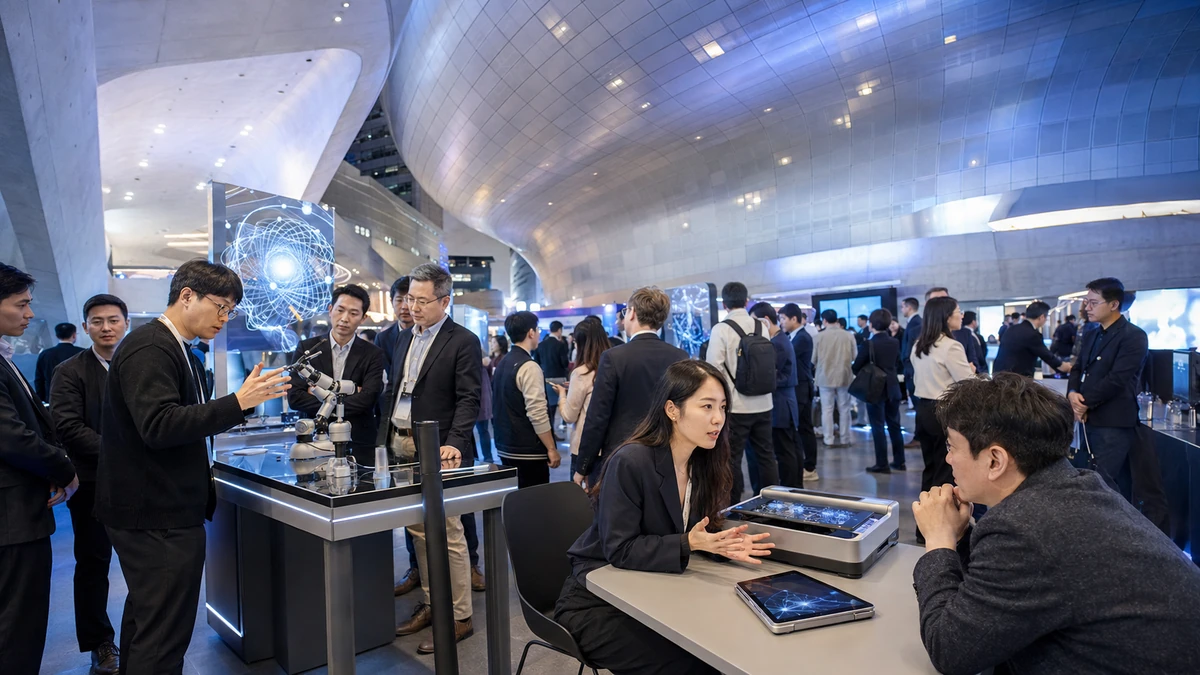
The Seoul Metropolitan Government said the event will be held on the 9th and 10th at Dongdaemun Design Plaza, better known in Korea as DDP. The sweeping, silver-toned cultural complex in central Seoul is one of the city’s most recognizable contemporary landmarks. Designed by architect Zaha Hadid, it occupies a role somewhat comparable to a combination convention center, design museum and public gathering place in a major American city.
Try Everything is structured around global conference sessions, technology exhibitions, public demonstrations and one-on-one meetings connecting startups with investors, corporations, accelerators and organizations that help companies enter overseas markets. The event’s central question is no longer whether businesses will use AI. Instead, it is how companies can turn the technology into measurable performance, commercial products and practical changes in workplaces and industrial operations.
That distinction matters as the global AI conversation shifts away from the initial excitement surrounding chatbots and image generators. Businesses in South Korea, the United States and elsewhere are now under pressure to show that expensive AI investments can improve productivity, create revenue or solve problems that existing software cannot. Seoul’s program appears designed around that next phase, linking researchers and technology developers with the corporations, investors and government organizations that can help move an idea from a demonstration into a functioning business.
The conference’s featured speakers underscore the event’s international orientation. Stanford University professor Erik Brynjolfsson is scheduled to deliver a keynote address on how businesses can produce results in an era when AI is becoming commonplace. Yeop Lee, who leads Asia-Pacific startup partnerships at the American AI company Anthropic, and Ray Zhong, co-founder of U.S. AI unicorn Genspark, are also expected to speak. Their participation gives Korean founders direct exposure to people working inside the American research and startup ecosystems that continue to shape much of the global AI market.
From Chatbots to Machines That Move
The defining phrase at this year’s event is “physical AI.” The term describes artificial intelligence that does more than generate or analyze information on a screen. It refers to systems that perceive conditions, make decisions and act through physical devices such as robots, vehicles or wearable equipment.
For American consumers, the concept may bring to mind warehouse robots, self-driving vehicles, robotic delivery systems or powered devices intended to reduce strain on workers. The important difference from a conventional machine is that a physical AI system can use data and sensors to respond to changing conditions rather than simply repeat a fixed set of motions.
Hyundai Motor and Kia’s Robotics LAB will demonstrate two examples at DDP. MobED is a mobile robotic platform designed to move across different environments, while X-ble Shoulder is an industrial wearable robot intended to assist people performing physically demanding overhead work. Presenting a mobile platform alongside a wearable device illustrates how broadly Korean companies are defining the physical AI market. The category can include machines that travel independently as well as devices that remain closely connected to a human worker.
The emphasis also plays to South Korea’s established economic strengths. The country is globally known for consumer electronics and semiconductors, but its industrial base also includes automobiles, batteries, shipbuilding, machinery and advanced manufacturing. That gives Korean AI developers access to factories, engineering expertise and large corporate customers that can serve as testing grounds for robotics and automation.
In that respect, South Korea’s approach differs from an AI strategy focused mainly on building the largest language model or the most popular consumer application. Korean companies may still compete in those areas, but the country has a practical incentive to combine AI with the physical industries in which it already holds global influence. A robot that improves assembly-line safety or moves equipment through a factory can become part of an existing manufacturing and export network.
About 80 startups from South Korea and abroad are expected to exhibit technologies at the festival. Eighteen institutions from 11 countries, along with large companies, venture capital firms and content businesses, will operate separate exhibition spaces. For participating startups, the exhibition floor is intended to function as more than a place to attract attention. It offers a concentrated environment in which a young company can compare its technology with competitors, meet potential industrial customers and test whether overseas organizations see a path to adoption.
The Real Business May Happen Away From the Main Stage
Large technology conferences are often judged by celebrity speakers, elaborate booths and attendance figures. Try Everything is placing significant weight on a less visible part of the program: scheduled one-on-one meetings between startups and organizations that can provide money, customers or market access.
Domestic and international venture capital firms, accelerators, major corporations, midsize businesses and overseas expansion organizations are expected to participate in on-site meetings. Government agencies, cities, startup support institutions and investors from the United States, Europe and Asia will also take part in programs focused on international growth and open innovation.
“Open innovation” is a common term in South Korean corporate and government programs. In practice, it generally means that a large company looks beyond its own research departments for new technology, often working with startups through pilot projects, investments or commercial partnerships. The arrangement can give a small company access to facilities and customers it could not reach alone, while allowing an established corporation to experiment without building every new product internally.
For Korean startups, the need for those connections is especially acute. South Korea is a wealthy and digitally sophisticated country, but its domestic market is far smaller than the United States. A young Korean company seeking rapid growth often has to plan for international expansion much earlier than an American company serving a large home market. Yet entering another country requires more than translating a website. Companies must understand local regulations, hiring practices, distribution networks, business customs and customer expectations.
That is why the presence of regional officials can matter. Christine Davis, deputy secretary of the West Virginia Department of Commerce, and Kristjan Järvan, deputy mayor of Tallinn, Estonia, are among the officials expected to discuss the development of global innovation ecosystems. Their involvement signals that international startup expansion is not treated solely as an export transaction. It can also involve relationships with local governments, economic development agencies, universities and business networks.
Seoul is effectively trying to reduce the distance between technology and the institutions needed to commercialize it. Instead of asking founders to separately pursue investors, corporate buyers and foreign market advisers, the festival brings those groups into the same venue. The measure of success will be whether those introductions produce investment agreements, pilot programs or lasting overseas partnerships after the booths are dismantled.
Results from the previous event offer a benchmark. Organizers said Try Everything drew 7,729 participants last year and resulted in 180.9 billion won in investment. The figure is notable because it presents the festival’s performance in terms of capital connections rather than attendance alone. For 2026, the more revealing numbers will be how many physical AI demonstrations advance to commercial trials and how many Korean startups establish meaningful operations or partnerships outside the country.
What This Means for the United States
For the United States, Try Everything 2026 offers a view into a Korean technology sector that may become increasingly relevant to American manufacturing, investment and supply chains. U.S. attention to South Korean business has often centered on familiar names such as Samsung, Hyundai, Kia, LG and SK. The festival is designed to expose investors and corporate partners to a wider group of early-stage companies working beneath those global brands.
The American and Korean technology economies are already closely linked. South Korean companies sell cars, electronics and digital services in the United States, while American software, cloud computing and AI companies view South Korea as an advanced Asian market. The appearance of representatives connected to Stanford, Anthropic and Genspark at the Seoul conference illustrates the two-way nature of that relationship: American AI expertise is seeking partners and opportunities in Asia, while Korean startups are looking toward the U.S. for capital, customers and global credibility.
Physical AI could deepen those ties because it intersects with industries in which both countries have significant interests. Hyundai and Kia operate in the American auto market, and Korean companies have made major investments tied to U.S. manufacturing and advanced technology. If robotics systems developed or demonstrated in Korea prove useful in factories, logistics centers or mobility services, American facilities could become important places for testing and deployment.
There are also clear comparisons with the U.S. startup industry. American technology events routinely promise to connect founders with venture capitalists and corporate customers, from large gatherings in Silicon Valley to industry shows in Las Vegas. Seoul’s festival follows a similar model but adds a stronger municipal-government role. The city is not merely providing a venue; it is helping organize competitions, international connections and access to startup infrastructure.
The participation of a West Virginia commerce official is particularly relevant. American discussions about technology investment often focus on California, New York, Boston, Austin, Texas, or Seattle. West Virginia represents a different part of the U.S. economic landscape, one where state officials may see international startups and advanced technology as tools for diversification and regional development. The Korean source material does not identify specific agreements involving the state, but the official’s presence highlights the possibility that U.S.-Korea startup ties could extend beyond the traditional coastal technology hubs.
American investors and companies will also be watching whether Korean startups can adapt products to the U.S. market. A robot designed for a Korean factory may face different safety rules, labor arrangements, building layouts and purchasing processes in the United States. Success will depend not only on technical performance but also on local service, cybersecurity protections, regulatory compliance and the ability to explain how a system affects workers.
That last issue could become especially important. In both countries, AI and robotics create tension between hopes for greater productivity and fears about job displacement. Wearable robots that reduce shoulder strain can be presented as worker-assistance tools, while autonomous machines may raise questions about whether employers intend to reduce headcount. Korean companies entering the U.S. will need to address those concerns in a labor environment shaped by unions, workplace safety rules and public skepticism toward automation.
For American consumers and Korean culture fans, the event also broadens the meaning of the “Korean Wave.” In the United States, that phrase is usually associated with K-pop, television dramas, movies, beauty products and food. South Korea increasingly wants technological innovation to travel through some of the same global networks of attention. The country’s cultural visibility can make audiences more receptive to Korean brands, but technology companies still must prove safety, value and reliability in ways that entertainment products do not.
A Startup Competition Designed as a Launchpad
The festival will include the Seoul Unicorn Challenge, a competition in which seven selected startups are scheduled to make their final presentations on the 10th. The program offers a combined 120 million won in prize money, recognition from the mayor of Seoul and a potential connection to space at Seoul Startup Hub.
The use of “unicorn” follows the same startup vocabulary common in the United States, where it refers to a privately held company valued at more than $1 billion. The seven finalists are not necessarily companies that have reached that valuation. Instead, the name expresses the competition’s goal of identifying businesses that could eventually achieve exceptional growth.
The package of awards reflects a broader Korean approach to startup support. Cash is valuable, but office space, mentoring, investor access and institutional recognition can be equally important to an early-stage company. An endorsement associated with Seoul City may help a founder gain meetings in a business culture where institutional reputation and trusted introductions can carry considerable weight.
At the same time, winning a staged pitch competition is not the same as establishing a sustainable company. Investors will be looking for evidence that finalists can secure customers, protect intellectual property, recruit skilled employees and expand beyond government-supported programs. For AI businesses, they will also want to know whether a company has access to the computing resources and specialized data needed to improve its technology.
Applications for participation are open through 6 p.m. on the 8th through the official website, according to the city, and on-site registration will be available during the two festival days. That combination suggests the organizers are trying to serve both industry participants who arrange meetings in advance and members of the public who decide to attend after seeing the program.
Why a Virtual Idol Belongs at an AI Conference
Try Everything is not being presented as a closed gathering for engineers and financiers. Organizers are also planning interactive programs for residents interested in AI and future technologies, including a special booth featuring PLAVE, a virtual idol group that serves as a Seoul promotional ambassador.
To Americans unfamiliar with Korean entertainment, a virtual idol is a performer represented publicly through an animated digital character rather than a conventional onstage identity. The format draws on livestreaming, motion-capture technology, online fan communities and the highly organized promotional system of K-pop. Virtual performers are not unique to Korea, but the country’s entertainment industry has integrated them into the idol business with fan events, music releases and carefully developed fictional identities.
Including PLAVE at an AI startup festival may initially seem like an attempt to add celebrity appeal. It also illustrates how technology in South Korea moves across categories that American audiences often treat separately. Entertainment companies, online platforms, gaming businesses and consumer technology developers frequently compete for the same digitally engaged audiences. A virtual idol can therefore serve as both pop culture attraction and an accessible example of how digital tools are changing creative work and fan relationships.
The choice also helps organizers address a challenge faced by technology conferences everywhere: making abstract innovation understandable to people who are not specialists. Visitors may not immediately grasp the significance of an AI model or industrial software platform, but they can interact with a robot, try a participatory exhibit or recognize a popular entertainment property. That public engagement can build interest, although it should not be confused with evidence that the underlying technology is commercially ready.
For South Korea, connecting advanced technology with popular culture is a natural extension of its recent global influence. K-pop fandoms have demonstrated how quickly Korean products can build international communities through social media. Startups would like to capture some of that momentum, but enterprise technology travels differently from music. Corporate purchasing cycles are slower, safety standards are higher and customers expect long-term support. Cultural visibility can open a door; it cannot substitute for business performance.
The Trend to Watch After the Festival Ends
Try Everything 2026 captures a broader transition in South Korea’s AI ambitions. The focus is expanding from software that produces text and images toward systems that operate in factories, vehicles and public spaces. At the same time, Seoul is treating startup growth as an ecosystem challenge involving researchers, corporations, investors, foreign governments, local agencies and ordinary residents.
The immediate spectacle will be easy to see: robots moving through exhibition areas, founders presenting products and international speakers discussing the future of AI. The more consequential developments will take longer. Observers should watch whether startups secure follow-on financing, whether major companies announce pilot projects, whether Korean physical AI products enter American or European markets and whether foreign firms establish durable partnerships in Seoul.
It will also be important to examine how companies handle safety, employment and accountability. Physical AI raises higher stakes than a chatbot that gives an incorrect answer. A machine moving near workers or assisting with industrial tasks must perform reliably in unpredictable environments. Regulators, employers and labor representatives will expect clear standards for testing and responsibility when systems fail.
Seoul’s wager is that South Korea can combine its manufacturing depth, digitally connected population, global cultural profile and public startup programs into a competitive advantage. The presence of American researchers, companies and government representatives suggests the effort will develop in close contact with the United States rather than in isolation.
Whether the festival succeeds will not ultimately be determined by the number of visitors at DDP. It will be determined by what happens after the introductions: which technologies reach real workplaces, which investments produce viable companies and whether Seoul can become a lasting bridge between Korean engineering and global markets. For U.S. businesses and investors, that makes the event less a distant technology celebration than an early look at potential partners — and competitors — in the next phase of AI.
Comments
Post a Comment