Image to help understand the article
A memorial takes shape in southern South Korea
Officials in southern South Korea have begun formal preparations for the 78th anniversary memorial marking the Yeosu-Suncheon Oct. 19 Incident, a violent and politically sensitive episode from the turbulent years surrounding the founding of the modern South Korean state. The regional organizing authority, identified in the Korean report as the Jeonnam-Gwangju Integrated Special City, held an initial planning session Sept. 4 at its eastern government office. The ceremony is scheduled for Oct. 19 at Ocheon Green Square in Suncheon, a city near South Korea’s southern coast.
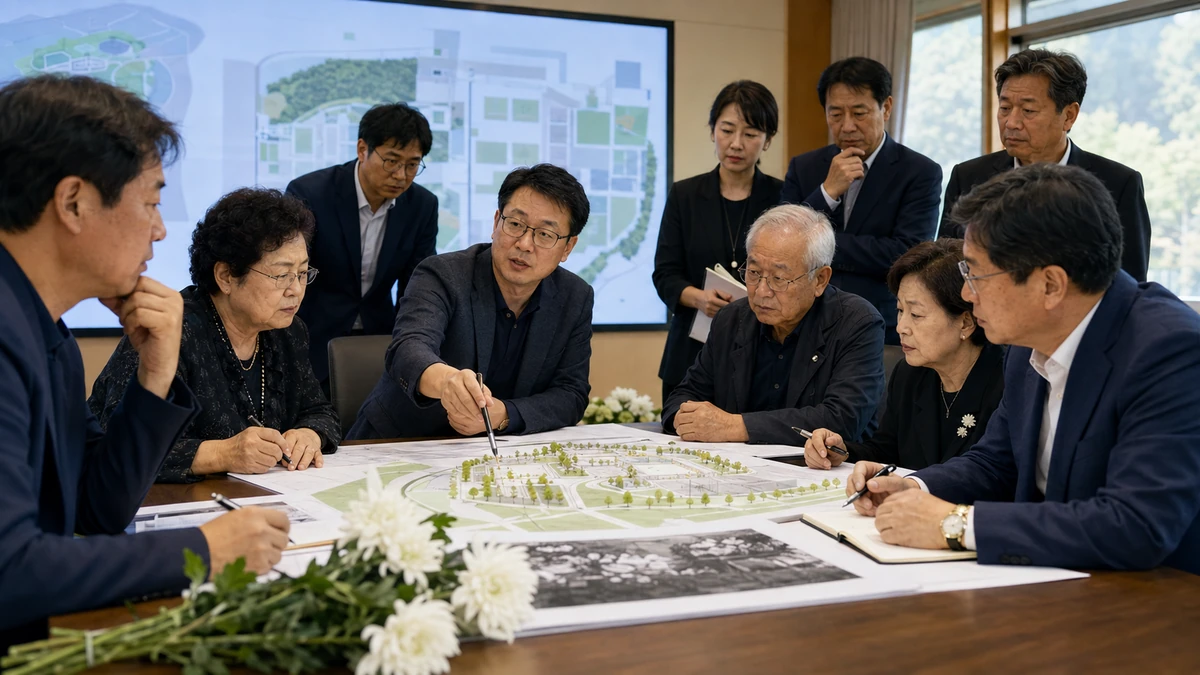
The planning meeting focused on more than the staging of a public event. Organizers reviewed how the venue would operate, what accommodations would be available for victims’ relatives and how safety would be managed for an expected crowd of about 800 people. Family members, national government representatives and lawmakers are among those expected to attend. The program remains under development and will be revised in consultation with victims’ representatives, a central review committee, the Suncheon city government and other agencies.
The central principle, according to the account of the meeting, is that victims and their families should come first. Participants called for a ceremony that honors the dead, treats surviving relatives with dignity and presents the tragedy as part of a shared national history rather than as a grievance belonging only to one region or one generation. Officials said the gathering should emphasize reconciliation and coexistence, language that carries particular weight in South Korea, where unresolved disputes over the Cold War, authoritarian rule and state violence continue to shape politics.
Some participants also expressed hope that South Korea’s president would attend, pay respects to the victims and personally comfort their families. No presidential appearance has been confirmed. Even so, the request illustrates how much symbolic importance Koreans can attach to the presence of the nation’s chief executive at memorials involving alleged or documented abuses by the state. A presidential visit can be understood not merely as ceremonial courtesy but as a form of national recognition.
What was the Yeosu-Suncheon Incident?
The Yeosu-Suncheon Incident began Oct. 19, 1948, only two months after the Republic of Korea was formally established in Seoul. Members of a South Korean army regiment stationed in Yeosu refused orders to deploy to Jeju Island, where government forces were suppressing an uprising and conducting a campaign that killed large numbers of civilians. The soldiers’ rebellion spread into Yeosu and nearby Suncheon before government forces retook the area.
What followed was not limited to combat between rebellious soldiers and the government. Civilians were swept into arrests, interrogations, summary proceedings and killings as authorities searched for insurgents and suspected leftist sympathizers. Communities across the eastern part of South Jeolla province were affected. The precise number of victims has long been disputed, in part because records were incomplete, families were silenced and public discussion was constrained for decades.
The Korean name is often shortened to the Yeosun Incident, combining the names Yeosu and Suncheon. Official commemorations increasingly use the date, Oct. 19, in the title. That naming convention resembles the way South Koreans refer to other turning points by date, including the May 18 Democratic Uprising in Gwangju and the April 3 violence on Jeju Island. For Americans, it may recall shorthand such as 9/11, although the historical circumstances are entirely different. In Korea, using a date can turn a local event into a widely recognizable marker of collective memory.
The incident unfolded in the ideological chaos of Korea’s division after 35 years of Japanese colonial rule. At the end of World War II, the peninsula was split into Soviet and American occupation zones. Rival governments emerged in 1948: the Republic of Korea in the South and the Democratic People’s Republic of Korea in the North. Anti-communism became a defining principle of the southern state, while left-wing organizing, labor unrest and opposition to separate governments were treated as grave security threats.
That setting is essential to understanding why the Yeosu-Suncheon tragedy remained difficult to discuss. The rebellion involved soldiers and leftist forces, but the state’s response also harmed civilians, including people accused on thin evidence or because of family and community connections. After the Korean War began in 1950, association with communism could bring imprisonment, social exclusion or worse. Relatives of suspected leftists sometimes faced guilt by association, a stigma that discouraged families from demanding investigations or even speaking openly about how loved ones died.
Why official recognition matters now
South Korea’s approach to its modern history has changed substantially since the country’s transition from military-backed authoritarian government to democracy in the late 1980s. Democratic institutions created more space for victims’ families, historians, journalists and civic organizations to revisit episodes that had been minimized or described almost entirely through the government’s security narrative. The process has been uneven and politically contested, but it has produced truth commissions, special investigations, court decisions and more prominent public memorials.
The Yeosu-Suncheon case received a major institutional boost when South Korea enacted a special law in 2021 to investigate the incident, identify victims and restore their honor. In Korean public life, restoring honor is more than a rhetorical gesture. Official classification can affect whether a person is remembered as an innocent civilian, an unjustly punished suspect or an enemy of the state. It can also determine whether relatives receive documentation, recognition or access to forms of assistance.
The planned 78th anniversary ceremony therefore represents part of a longer transition from silence to public acknowledgment. Its significance does not depend entirely on crowd size or production value. Decisions about who speaks, which terms are used, how victims are described and whether national leaders attend can indicate how far the state is prepared to go in accepting responsibility for past abuses.
The organizers’ emphasis on victims’ convenience is also meaningful. Many direct witnesses and first-generation family members are elderly. A memorial designed around their mobility, seating, transportation and emotional needs signals that they are not simply background figures in a government event. That focus reflects a broader lesson from historical justice efforts around the world: institutions often move slowly, while survivors and witnesses have limited time to tell their stories.
This year’s ceremony carries an additional administrative dimension because organizers describe it as the first joint memorial in the inaugural year of the new Jeonnam-Gwangju integrated special-city structure. Gwangju is a major metropolitan center in southwestern Korea, while South Jeolla, known in Korean as Jeonnam, encompasses surrounding cities and rural areas, including communities affected by the 1948 violence. The report does not provide the full legal or administrative details of the new arrangement, but officials are clearly presenting the memorial as an early test of whether the reorganized regional government can build a shared civic identity across local boundaries.
The political weight of a presidential visit
The request for presidential attendance is likely to remain one of the most closely watched elements as Oct. 19 approaches. In South Korea, presidents have often used visits to historical sites and anniversary ceremonies to define their administration’s position on democracy, state violence and national reconciliation. Their words can affect not only the immediate audience but also school curricula, media coverage and the willingness of government agencies to pursue further investigations.
For victims’ relatives, a president’s physical presence may carry an emotional meaning that written statements or lower-level delegations cannot match. Families who spent decades fearing that public discussion could expose them to accusations of disloyalty may view direct acknowledgment by the head of state as a reversal of that stigma. It places the authority of the republic behind remembrance rather than silence.
At the same time, presidential attendance can turn a memorial into a partisan event. South Korean politics remains sharply divided over how to describe the country’s founding, the anti-communist campaigns of its early governments and the conduct of later authoritarian leaders. Conservatives may stress the genuine armed threat faced by the new state, while progressives tend to focus more heavily on civilian deaths, unlawful punishment and suppressed testimony. Responsible commemoration must hold more than one historical fact at once: An armed rebellion occurred, and the state’s response inflicted profound harm on civilians.
The organizers appear to be trying to manage that tension by centering victims and using the language of reconciliation rather than political triumph. Whether that approach succeeds will depend on the final program, the speakers selected and the specificity of their statements. Reconciliation can create space for a broad audience, but it can also sound evasive if officials invoke healing without clearly identifying what happened and who suffered.
What this means for the United States
For Americans, the Yeosu-Suncheon memorial offers a window into a period of Korean history that is often compressed into a simple sequence: liberation from Japan in 1945, division of the peninsula, the Korean War and the rise of South Korea as a democratic economic power. The reality was more turbulent. The United States administered southern Korea from 1945 to 1948 and remained deeply involved in the creation and security of the new republic. The 1948 incident occurred in a South Korean state closely aligned with Washington at the opening of the Cold War.
That history does not make the Yeosu-Suncheon Incident an American event, nor does it mean every action by South Korean authorities was directed by the United States. It does mean Americans have reason to understand the political environment in which the violence occurred. U.S. strategic priorities emphasized containing communism and building a viable anti-communist government in the South. Those priorities formed part of the wider setting in which security institutions gained extraordinary power and accusations of leftist sympathy could become matters of life and death.
The anniversary also matters for the present-day U.S.-South Korea alliance. Washington and Seoul now describe their relationship as one based not only on deterrence against North Korea but also on democratic values, human rights, technology and cultural exchange. A mature alliance should be able to acknowledge the difficult history surrounding its formation. Historical scrutiny need not weaken the partnership. It can make public understanding of that partnership more honest and resilient.
There are imperfect but useful comparisons in American public life. U.S. presidents and other officials have participated in commemorations tied to the Tulsa Race Massacre, the internment of Japanese Americans, the Sept. 11 attacks and racial violence in places such as Birmingham, Alabama. These cases are not equivalents of the Yeosu-Suncheon Incident. Each arose from a different political system and historical context. But they demonstrate a shared principle: The rank of the official who appears, the language used and the people placed at the center can determine whether a ceremony feels like routine protocol or meaningful national acknowledgment.
American museums, universities and Korean American organizations also have a role in widening the historical frame through which Korea is understood. U.S. audiences are now highly familiar with Korean popular culture, from K-pop and television dramas to films, beauty products and food. That cultural success can create curiosity about Korea beyond entertainment. The same country that produces globally influential pop culture is also engaged in difficult debates over dictatorship, democratization, war and historical justice.
For Korean Americans whose families came from Jeolla, Jeju or other regions marked by political violence, these commemorations may carry personal significance. Immigration records and family stories do not always explain why relatives left, remained silent or avoided political discussion. More open research in South Korea can help diaspora families recover histories fragmented by migration, fear and the passage of time. American scholars and archives may also hold diplomatic or military records relevant to the period, making historical understanding an area for continued cooperation.
From regional grief to national memory
The choice of Suncheon as the host city grounds the ceremony in one of the communities most closely associated with the incident. But organizers have repeatedly emphasized that the memory should not remain confined to Yeosu, Suncheon or South Jeolla. That is a significant ambition in a country where regional identity has long influenced elections, economic development and social perceptions.
Southwestern Korea, including Gwangju and the Jeolla provinces, has a distinctive place in the country’s political memory. The region is strongly associated with democratic opposition, particularly because of the military’s bloody suppression of the May 1980 uprising in Gwangju. The Yeosu-Suncheon story predates that event by more than three decades, but both involve disputes over state power, civilian suffering and the struggle to establish an accepted public record.
Moving an event from regional memory to national history usually requires more than one annual ceremony. It involves documentation, education, accessible archives and sustained reporting. It also requires language that younger Koreans can understand without inheriting the ideological labels of the 1940s. Organizers’ stated goal of bridging generations recognizes that fewer people now have direct memories of Korea’s early post-liberation years.
Public memorials can help fill that gap, but they can also flatten complicated events into a few safe phrases. The challenge for the October ceremony will be to honor grief without stripping away historical detail. Terms such as harmony and coexistence may help prevent partisan confrontation, yet families may also expect concrete progress on victim determinations, investigations and official accountability.
The location at Ocheon Green Square suggests an effort to create an accessible civic gathering rather than a closed government ritual. The projected attendance of about 800 makes the event significant but still relatively intimate compared with South Korea’s largest national ceremonies. Much of its impact will come through television, online video and news coverage, especially if senior national officials attend.
What to watch before Oct. 19
The first question is whether the president accepts the invitation sought by participants. Because attendance has not been confirmed, any suggestion that a presidential visit is settled would be premature. If the president does appear, attention will turn to the wording of the address: whether it offers condolences alone, recognizes state responsibility, announces additional measures or connects the incident to a broader democratic narrative.
The second question concerns the families’ role. Organizers have promised a victim-centered ceremony, but that commitment will be tested by practical choices. Observers will look for whether relatives receive prominent speaking time, whether testimony is incorporated into the program and whether elderly participants can attend safely and comfortably. The planning meeting’s discussion of venue operations and accommodations indicates that officials understand those expectations.
The third question is whether the new regional administrative structure can use the commemoration to deepen cooperation rather than merely display its new name. The incident touched multiple communities, and historical investigations often require coordination across local and national agencies. A well-run ceremony could establish a model for shared regional remembrance. Poor coordination, by contrast, could reinforce concerns that institutional reorganization is more cosmetic than substantive.
Finally, the lasting measure of success will come after the memorial ends. Ceremonies can focus public attention for a day, but truth recovery depends on continuing work: reviewing claims, identifying victims, preserving testimony and making findings available to the public. The 78th anniversary arrives at a point when time is pressing for surviving witnesses and first-generation relatives.
The gathering planned in Suncheon is therefore best understood not as a single local event but as part of South Korea’s continuing negotiation with its own democratic identity. Nearly eight decades after soldiers rebelled and civilians were caught in a brutal crackdown, the country is still deciding how fully that history belongs in the national story. The answer will be shaped not only by who attends on Oct. 19, but by whether remembrance leads to durable recognition for the families who lived with the consequences long after the gunfire ended.
Comments
Post a Comment