South Korea Rewrites Its Unemployment Formula, Offering a Window Into a Broader Debate Over Work, Welfare and Fairness
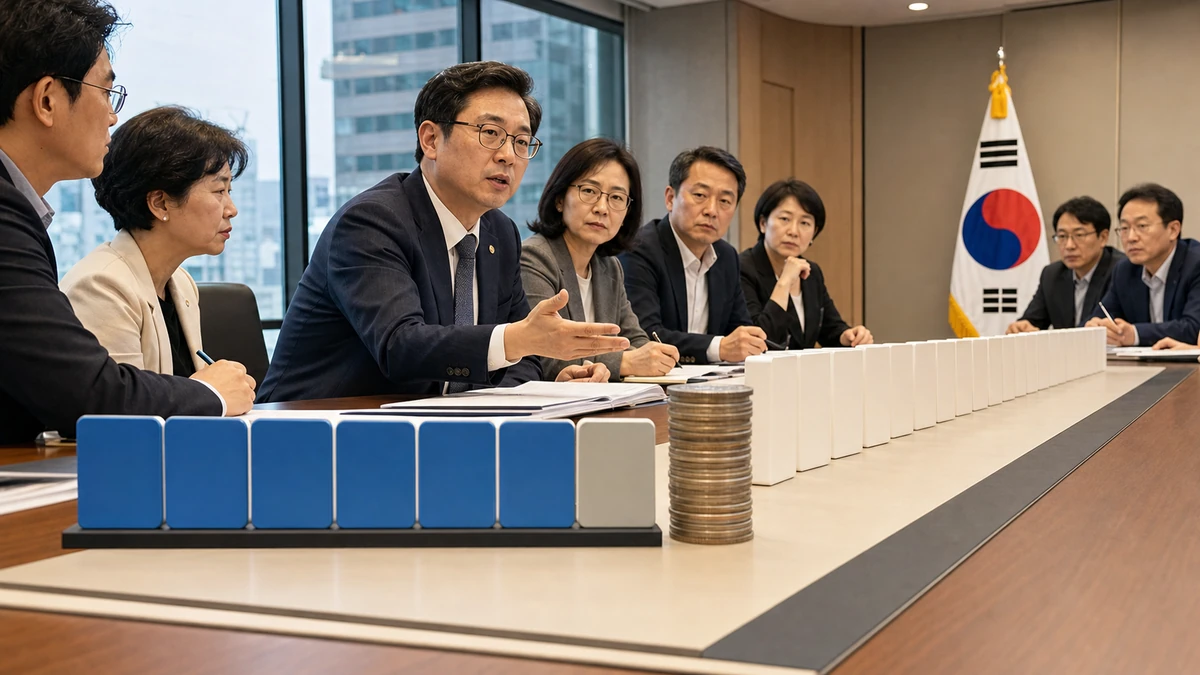
Image to help understand the article
South Korea is changing the math, not necessarily cutting the safety net
South Korea is moving to overhaul the way it calculates unemployment benefits, and the change says as much about the country’s changing work culture as it does about its welfare system. The headline detail is technical: The government has agreed in principle to shift the payment basis for jobless benefits from seven days a week to six, excluding unpaid rest days. But the policy’s political meaning is easier to grasp. Officials are trying to fix a mismatch between an older labor system and the reality of a modern five-day workweek, while avoiding the optics and the social damage of an outright benefit cut.
Under the plan discussed by South Korea’s Employment Insurance Committee, the total amount a recipient is entitled to would stay the same. The standard eligibility window of 120 to 270 days would also remain unchanged. What changes is how that money is spread out. Instead of being divided using a seven-day weekly standard, the same total would be calculated on a six-day basis. That means the monthly amount some recipients see may decline, but the benefit period itself would stretch out by roughly three weeks to as much as six weeks, depending on the case.
That distinction matters. In the United States, where policy fights are often reduced to whether a benefit is being expanded or cut, South Korea’s approach is closer to a structural recalibration. It is an attempt to preserve the protective function of unemployment insurance while addressing a fairness problem that has become more visible over time. Korean officials are not arguing that unemployed workers deserve less help in total. They are arguing that the formula used to deliver that help no longer fits the labor market it is supposed to serve.
The debate has become especially sensitive because unemployment insurance is never just a bookkeeping exercise. It reflects a society’s answer to a hard question: How much support should a person receive while looking for work, and how should that support compare with the earnings of someone who is still employed? In South Korea, that question has become politically loaded because in some cases the monthly unemployment benefit appeared to exceed the monthly wages of low-income workers earning the minimum wage. That kind of inversion can erode public trust, even when the broader policy goal of income protection remains widely accepted.
So while the reform may look dry on paper, it is really about legitimacy. South Korea is trying to preserve confidence in a core social insurance program by updating a formula that has drifted out of sync with the rhythms of everyday work.
Why this issue surfaced now: a 1990s system in a 2020s labor market
To understand the reform, it helps to understand how South Korea’s labor market evolved. When unemployment benefits were introduced in 1995, a six-day workweek was still common, and the broader calculation framework aligned more naturally with workplace norms at the time. But South Korea introduced a five-day workweek in 2004, and over the two decades that followed, that became the prevailing standard in much of the economy. Even so, unemployment benefit calculations continued to use a seven-day payment basis.
That gap between old rules and current practice created a distortion. According to the policy explanation cited in local reporting, wages for many minimum-wage workers effectively reflect a six-day standard because of the way weekly paid leave and pay structures work in Korea. But unemployment benefits for low-wage recipients were still being calculated using a seven-day standard tied to 80% of the minimum wage floor. Over time, that helped create cases in which the monthly payout to an unemployed person looked higher than the monthly earnings of a person still working full time at the minimum wage.
In any country, that kind of comparison is politically combustible. It can feed the argument that welfare discourages work, even when the underlying reality is more complicated. Sometimes the issue is not that benefits are too generous in absolute terms, but that the formulas governing wages, floors, caps and eligibility were designed in different eras and no longer fit together cleanly.
That seems to be what South Korea’s policymakers are trying to address. The labor ministry said a task force made up of workers, employers and experts held 16 meetings beginning last November to discuss changes to the benefit structure and ways to stabilize the system financially. That detail is worth noting. Employment insurance reform touches businesses that pay into the system, workers who may one day depend on it, and a government that has to maintain political credibility while controlling long-term costs. The fact that the talks involved all three groups suggests officials understood this was not just an administrative adjustment but a social bargain.
It also reflects a broader reality facing aging, advanced economies: Labor institutions often lag behind labor markets. People work different schedules, switch jobs more often, face greater uncertainty and expect older social protections to adapt. South Korea’s reform is one example of that catch-up process.
The fairness problem at the center of the reform
At the center of the Korean debate is what economists and policymakers might describe as an incentive and equity problem, but what ordinary workers would recognize as a basic question of fairness. If someone who is unemployed can appear, at least on a monthly basis, to receive more than someone working for minimum wage, political support for the system becomes harder to sustain. Even people who support a strong safety net may begin to question whether the formulas are working as intended.
South Korean officials appear to be threading a narrow needle. They are not scrapping the minimum protections in unemployment insurance. The current system still pays 60% of a worker’s average wage over the three months before separation, with eligibility lengths varying by age and employment insurance contribution history. This year’s daily ceiling is 68,100 won, and the floor is tied to 80% of the minimum wage. Those design features show that Korea, like many other developed economies, views unemployment insurance as temporary income replacement rather than a token benefit.
But income replacement systems are especially vulnerable to public backlash when monthly comparisons become politically salient. That is true in South Korea, and it is true in the United States. Americans saw a version of this argument during the coronavirus pandemic, when enhanced federal unemployment payments briefly led some workers to receive more in weekly benefits than they had earned on the job. Critics said that discouraged people from returning to work; supporters argued that the benefits reflected an extraordinary crisis, weak wages and a public health emergency. Even years later, the episode remains a touchstone in debates about how generous unemployment support should be.
South Korea’s current reform is less dramatic, but the logic is familiar. Officials are trying to reduce the appearance and incidence of monthly income reversal between employed low-wage workers and unemployed benefit recipients without stripping recipients of the total support they were promised. In practical terms, that means recipients may need to adjust household budgets because monthly benefit flows could be lower than before. At the same time, they may gain more time before benefits expire, which matters during a slow job search.
That trade-off captures the balancing act at the heart of modern social insurance. Too little support, and people fall into instability just as they need time to find another job. Too much support relative to low wages, or support delivered through a visibly distorted formula, and public backing can weaken. South Korea’s answer is to stretch the same money over a longer period and make the formula better match the structure of actual work.
What else is changing: caps, floors and the architecture of the system
The proposed overhaul does not stop with the six-day calculation. South Korea is also changing how the upper limit on unemployment benefits is set. Until now, the ceiling has been a fixed amount, while the floor has moved each year with the minimum wage. That created a structural problem: Over time, if the minimum wage kept rising, the lower bound could eventually approach or even exceed the upper bound. In other words, the system risked producing a formula in which the floor and ceiling no longer made logical sense.
To prevent that, the committee agreed to link the cap to the floor rather than keep it as a static number. One reported example is a ceiling set at 103% of the minimum benefit floor. Tying the upper limit to the lower limit would automatically reflect annual changes in the minimum wage and preserve the basic relationship between the two. This may sound like technocratic housekeeping, but it is important policy design. Social insurance systems can become unstable not only because they are too expensive, but because their formulas collide in ways lawmakers did not anticipate years earlier.
Local reports also said the government plans to create a separate account for maternity-related benefits, including parental leave payments, within the broader employment insurance framework. That separation is significant because unemployment benefits and maternity or parental protections serve different purposes, even if they sit under the same institutional umbrella. One is designed to cushion the shock of job loss; the other supports caregiving and workforce continuity. Splitting the accounts should make it easier to track where money is going and which part of the system is under pressure.
For international readers, this is one of the more interesting aspects of the Korean case. The reform is not only about whether unemployed people receive enough support. It is also about the state’s capacity to make social insurance legible. Clearer accounts, more consistent formulas and rules that better reflect real work patterns all help build trust. And trust is especially important in a contributory system, where workers and employers are both paying in with the expectation that the rules will feel fair when they need protection.
That trust has become harder to maintain in many advanced economies, where labor markets have changed faster than benefit systems. South Korea’s move suggests that one path forward is not simply expanding or shrinking benefits, but redesigning how they are calculated so the system better aligns with current conditions.
What this means for the United States
For Americans, the Korean debate should sound strikingly familiar, even if the policy mechanics are different. The United States also wrestles with how to balance work incentives, wage floors and unemployment benefits, especially for lower-income workers. But the U.S. system is far more fragmented. Unemployment insurance in America is administered largely at the state level, with benefit amounts, durations and replacement rates varying widely. Federal intervention tends to come during recessions or emergencies, as it did during the pandemic.
That decentralized structure means the United States often addresses unemployment insurance in bursts of crisis politics rather than through the kind of systemwide formula correction now underway in South Korea. Americans are accustomed to hearing about whether benefits should be extended, whether eligibility should be tightened, or whether fraud has become a problem. What is less common is a national conversation about whether the underlying arithmetic still matches the way people work.
That is one reason South Korea’s case matters in Washington policy circles and to U.S. businesses with operations in Korea. Korean labor policy affects the cost structure, hiring environment and social stability of one of America’s closest allies and a major economic partner. South Korea is home to globally important manufacturers and technology firms, and U.S. companies from automakers to chipmakers increasingly think about labor policy as part of broader supply-chain resilience. A welfare system seen as unfair or financially unstable can become a source of political friction. One seen as predictable and updated can strengthen confidence in the market.
There is also a cultural and political lesson here for the United States. American debates over social benefits often harden into ideological camps: one side emphasizes dependency and incentives; the other emphasizes dignity and protection. South Korea’s reform, at least as described so far, is an example of a middle path. It accepts the need for meaningful support during unemployment while also confronting the public discomfort created when benefits appear out of line with work-based income at the bottom of the wage scale.
That does not mean the U.S. can or should copy South Korea directly. The systems are too different, and Korea’s labor market institutions, wage structures and employment insurance design are more nationally unified than America’s. But the underlying challenge is shared. In both countries, policymakers are under pressure to design safety nets that are generous enough to prevent hardship, disciplined enough to maintain public trust, and flexible enough to keep up with shifts in how people actually work.
For American audiences, especially those interested in labor policy, South Korea offers a reminder that the most important welfare debates are sometimes not about the headline dollar amount. They are about the formulas underneath: the definitions of a workweek, the interaction between wage floors and benefit caps, and the perception of fairness between those working and those temporarily out of work.
Why this matters beyond one country’s benefits system
South Korea’s reform is best understood not as an isolated bureaucratic fix but as part of a larger global trend. Across advanced economies, institutions built for an earlier era are being revised to reflect new labor patterns, demographic pressures and political expectations. People live longer, switch jobs more often and move through employment disruptions that do not fit the old model of one stable employer over a career. At the same time, governments face more scrutiny over whether social spending is equitable and sustainable.
That is particularly true in South Korea, where economic pressures are layered. The country has grappled with high youth job anxiety, a demanding work culture, an aging population and long-running concerns about inequality between regular and non-regular workers. In that setting, employment insurance is more than a narrow labor-market tool. It is part of the social compact around risk.
The current reform suggests Korean officials are trying to preserve that compact by modernizing its foundations. They are not abandoning protection for the unemployed. Instead, they are trying to remove a distortion that made the system more vulnerable to criticism. By keeping the overall entitlement intact, they appear to be signaling that social insurance remains necessary. By changing the calculation basis and adjusting the relationship between the floor and ceiling, they are signaling that support must still make sense to contributors and workers on the job.
That is likely why the reform is being framed as a question of alignment rather than retrenchment. South Korea’s labor market moved from the norms of the mid-1990s to those of a modern five-day workweek, but the unemployment formula did not fully follow. The current moment is an attempt to close that gap before it grows into a broader crisis of confidence.
What to watch next is implementation. Technical reforms often generate confusion when they reach households. If recipients focus mainly on smaller monthly payments rather than unchanged total entitlements, the government may face criticism despite its effort to preserve overall support. Communication will matter, especially around how the six-day calculation works, how unpaid rest days are treated, and how the revised ceiling and floor operate year to year. In social insurance, clarity is not cosmetic; it is part of the policy itself.
For the rest of the world, including the United States, South Korea’s move is a useful case study in how governments can adapt welfare systems to labor-market change without defaulting to the binary choice of expansion versus austerity. Sometimes the real reform is not bigger or smaller government. It is better-calibrated government.
A technical reform with political consequences
It is tempting to dismiss changes like this as administrative fine print. But those details often carry the biggest political consequences. When a benefits system no longer reflects everyday work, frustration builds quietly until it erupts in a broader argument about fairness, abuse or decline. South Korea appears to be acting before that frustration does more damage.
The country’s approach may not satisfy everyone. Workers who count on monthly unemployment payments may feel the shorter monthly cash flow immediately, even if the overall entitlement remains unchanged. Employers and fiscal conservatives may continue to push for tighter controls if they believe the system still weakens incentives to return to work. Advocates for the unemployed may worry that any reduction in monthly support, however technical, could make it harder for vulnerable households to pay rent, cover transportation or manage debt during a job search.
Those concerns are real, and they explain why even technical labor reforms can take months of negotiation. But the broader significance of the Korean case lies in the choice policymakers have made. Rather than gutting benefits or ignoring public unease, they are trying to repair the formula at the center of the dispute. That is a different kind of politics from simple retrenchment, and perhaps a more durable one.
For American readers used to all-or-nothing fights over social policy, that may be the most important takeaway. South Korea’s unemployment insurance overhaul is not a flashy ideological project. It is a reminder that modern welfare states survive not only by spending more or less, but by updating the rules so that citizens can still recognize them as fair. In an era of economic uncertainty and political mistrust, that kind of maintenance may be one of the hardest jobs governments have.
Comments
Post a Comment