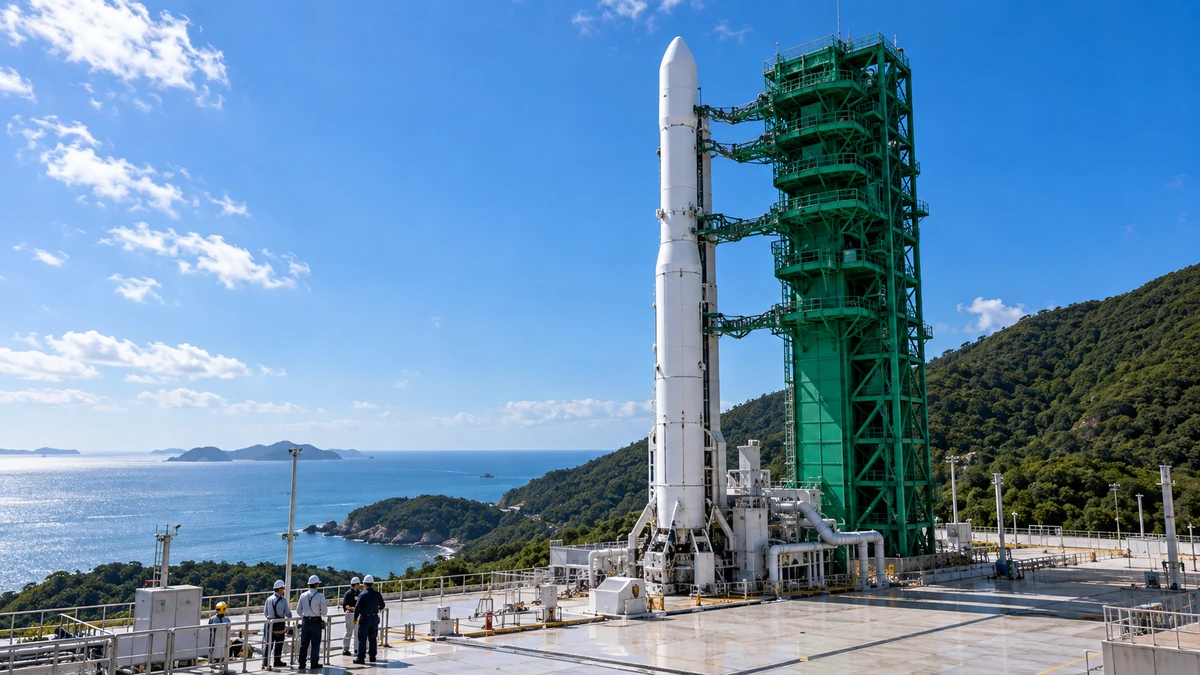
Image to help understand the article
Record Satellite Deployment Planned
South Korea plans to launch its homegrown Nuri rocket for the fifth time on Oct. 7, with liftoff scheduled between 12:23 p.m. and 1:23 p.m. from the Naro Space Center in Goheung, a coastal county in South Jeolla province.
Oh Tae-seog, head of the Korea AeroSpace Administration, said at a forum in Seoul that preparations were proceeding smoothly. The mission will carry 15 satellites, the largest payload count for any Nuri launch so far.
The satellites include five NeonSat microsatellites designed to observe the Korean Peninsula and 10 cube satellites developed by South Korean universities and companies. Oh said the mission’s biggest challenge will be separating the satellites accurately and placing them into their intended orbits, particularly because they must be released in different directions.
Oh said developing the ability to deploy different satellites at varying altitudes is essential for building a commercial launch service.
Final Assembly and Launch Preparations
The Korea Aerospace Research Institute is scheduled to finish connecting the three stages of the 154-foot Nuri rocket at the Naro Space Center by Sept. 30. Engineers will then inspect the rocket’s electrical systems. If no problems are found, it will be moved to the launchpad on Oct. 6.
Oh said unexpected problems could still emerge before liftoff, but officials would work to resolve them quickly and launch within the scheduled window to improve the rocket’s reliability. He said spare components could be drawn from preparations for Nuri’s sixth launch if replacements are needed.
Weather and Solar Activity Remain Variables
The launch will be postponed if average winds exceed 15 meters per second, or about 34 mph, on launch day. Historical observations near the space center suggest winds in early and mid-October have generally remained well below that threshold. No typhoons affected the Korean Peninsula during that period over the past five years, though three did over the past decade.
Officials are also monitoring solar flares. The research institute said severe activity at the R4 or R5 level on a five-tier scale could disrupt communications equipment aboard the rocket and its satellites. Weather and space conditions will be tracked until launch.
Moon Missions and a New Rocket
Oh said South Korea intends to build its launch capabilities through repeated missions while supporting privately led rocket development. He described launch vehicles as both transportation for satellites and critical infrastructure for maintaining national autonomy in space.
South Korea is also developing a next-generation successor to Nuri. The government plans to launch a lunar-orbit communications satellite in 2029 and a 1.8-metric-ton lunar lander in 2032. It is also pursuing a Korean low-Earth-orbit satellite communications network by 2035, beginning with two test satellites in 2030.
Comments
Post a Comment