Image to help understand the article
A familiar North Korea story is back, but with a more careful signal from Seoul
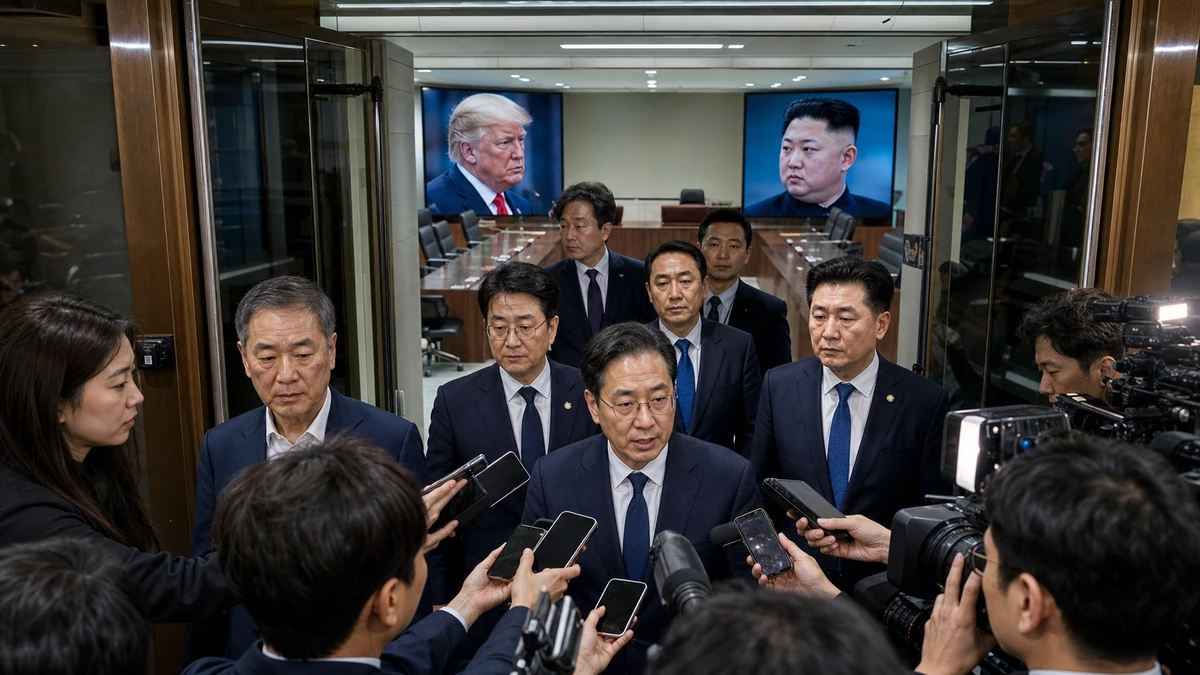
South Korea’s main intelligence agency says a summit between President Donald Trump and North Korean leader Kim Jong Un could be possible at virtually any time — a striking assessment, even with a major caveat attached. According to lawmakers briefed behind closed doors by the National Intelligence Service, or NIS, Seoul has detected signs pointing toward a possible return to dialogue between Washington and Pyongyang. But the agency also said it has not confirmed any concrete contact between the two sides.
That distinction matters. In the diplomacy of the Korean Peninsula, hopeful language can travel much faster than verified facts. A phrase like “a summit could happen at any time” can quickly generate headlines, market chatter and geopolitical speculation. Yet South Korean officials, at least as relayed by lawmakers after the briefing, appear to be drawing a bright line between political possibility and observable reality. They are not saying negotiations are underway. They are not saying a meeting has been scheduled. They are saying the door does not appear to be shut.
For American readers, the difference may sound technical, but it is central to how Korea watchers read signals from the region. North Korea diplomacy has long moved in bursts of rhetoric, indirect signaling and abrupt reversals. Public messaging can be part of the process rather than a reflection of a settled agreement. That helps explain why Seoul’s latest assessment is important without being definitive: It suggests movement in the atmosphere, not proof of a breakthrough.
South Korea’s message is therefore less about predicting a photo op than about defining the current moment. The NIS appears to be telling lawmakers that the strategic environment is fluid enough that a top-level U.S.-North Korea meeting cannot be ruled out, while also warning against the kind of wishful thinking that has repeatedly overtaken past rounds of diplomacy. In a region where overreaction can be costly, that is a notable balancing act.
It also reflects a broader truth about North Korea policy. Diplomatic openings rarely arrive in a straight line. They tend to emerge amid military tension, intelligence uncertainty and competing political agendas in Washington, Seoul and Pyongyang. The latest South Korean readout, taken on its own terms, is not the start of a peace process. It is a reminder that on the Korean Peninsula, the possibility of sudden change is itself a strategic fact.
Why Seoul is emphasizing both the opportunity and the limits
The most revealing part of the South Korean briefing may be its restraint. Intelligence agencies are often judged not just by what they know, but by how carefully they describe what they do not know. In this case, the NIS appears to have gone out of its way to separate “signs of dialogue” from verified engagement. That is not semantic hedging. It is a signal about discipline.
South Korean officials have lived through enough cycles of North Korea diplomacy to know the risks of overselling early indicators. In 2018 and 2019, summit diplomacy between Trump and Kim reshaped the political conversation around North Korea almost overnight, culminating in high-profile meetings in Singapore, Hanoi and briefly at the Demilitarized Zone. Those encounters showed that direct leader-to-leader engagement is possible even after periods of intense hostility. They also showed how quickly momentum can evaporate when symbolism outruns substance.
That history helps explain why Seoul is being careful now. By saying a summit remains possible while insisting that direct contact has not been confirmed, South Korea is preserving diplomatic space without presenting an unverified opening as a real negotiating process. It is, in effect, telling domestic and international audiences to watch the sequence closely: rhetoric first, then possible signals, then working-level contact, and only after that anything resembling an actual summit.
This sequencing matters because North Korea policy has often been distorted by attention to dramatic events rather than the groundwork beneath them. Americans are used to summitry as political theater — the handshake on the White House lawn, the major treaty announcement, the carefully staged breakthrough. But with North Korea, the stagecraft can arrive before the architecture. Seoul’s warning is that the world should not confuse atmospheric change with institutional progress.
There is also a credibility issue at stake for South Korea itself. As a frontline U.S. ally that is directly exposed to shifts in North Korean behavior, Seoul has an interest in being seen as measured and fact-based. If it sounds too optimistic too early, it risks being accused of trying to will diplomacy into existence. If it sounds too dismissive, it could miss a genuine opening. The NIS briefing suggests South Korea is trying to avoid both traps.
That may be especially important now, as South Korea seeks to maintain room for diplomacy while navigating a more complex security environment than the one that existed during the first Trump-Kim summit cycle. The intelligence picture, according to the briefing, includes not only possible diplomatic movement but also North Korea’s military and intelligence activity, internal organizational changes and broader international variables linked to the war in Ukraine. In other words, the atmosphere may be shifting, but the risks have not disappeared.
Seoul’s own proposal on ending the Korean War is not the same thing
One of the easiest mistakes in covering Korea is to assume that every diplomatic statement is part of a single coherent track. The South Korean briefing pushes against that assumption. The NIS said there had been no dialogue contact at the intelligence-agency level tied to South Korean President Lee Jae Myung’s recent proposal, made during an Aug. 15 Liberation Day speech, for talks among the relevant parties on formally ending the 1950-53 Korean War.
For Americans, this is an area where context is essential. The Korean War ended in an armistice, not a peace treaty. That means the conflict was halted, but never formally concluded in legal and diplomatic terms. Periodic calls for an “end-of-war declaration” or peace discussions are not new. Supporters tend to frame them as confidence-building measures that could lower tensions and create political momentum for broader talks. Critics often worry they could produce symbolism without reducing North Korea’s military threat, or complicate the rationale for the U.S. military presence in South Korea.
What Seoul is saying now is narrower than some outside observers may assume. The fact that South Korea has floated a war-ending discussion does not mean that proposal triggered U.S.-North Korea engagement, and it does not prove the North is responding to it. The NIS appears to be warning against connecting dots that have not yet been connected by facts.
That caution is important because South Korea’s role in peninsula diplomacy is often misunderstood in the United States. Seoul is neither a bystander nor an all-powerful broker. It is a sovereign actor with its own political agenda, security concerns and domestic debates, but it is also deeply affected by choices made in Washington and Pyongyang. A new opening between the United States and North Korea can create space for South Korea — or leave it scrambling to ensure its interests are represented.
That is why separating these tracks matters so much. If Trump-Kim diplomacy were to revive, it would not automatically merge with inter-Korean relations or with any South Korean proposal on ending the war. These are overlapping but distinct channels, each with different incentives, participants and potential outcomes. A summit between Washington and Pyongyang could focus narrowly on deterrence, sanctions, military risks or leader-to-leader signaling without resolving wider questions about peace arrangements on the peninsula.
For Seoul, the challenge is strategic clarity. It must keep supporting the possibility of talks while making sure that unverified signs are not mistaken for policy gains. It also has to communicate to allies and domestic audiences that Korean Peninsula diplomacy is not a single master negotiation in which every issue naturally falls into place. The NIS briefing, by drawing careful boundaries, suggests South Korea understands that problem well.
What this means for the United States
For the United States, the immediate significance of South Korea’s assessment is not that a Trump-Kim summit is imminent. It is that America may once again be approaching a familiar but difficult question: whether direct leader diplomacy with North Korea can produce more than a pause in tensions and a burst of headlines.
That question matters well beyond the Korean Peninsula. North Korea policy touches U.S. alliance management in Asia, missile defense planning, nuclear deterrence strategy and the political credibility of American diplomacy. It also shapes how allies such as South Korea and Japan judge Washington’s reliability. If signals of possible dialogue grow stronger, U.S. officials, lawmakers and analysts will quickly begin debating whether another round of summit diplomacy would reduce risk or repeat earlier mistakes.
Americans have seen comparable debates in other foreign-policy arenas. In Washington, high-level engagement is often defended as a way to break bureaucratic deadlock, especially when traditional negotiations have stalled. Critics counter that summitry without detailed preparation can hand legitimacy to an adversary while producing weak or reversible outcomes. That argument is not unique to North Korea, but North Korea is one of the clearest examples because the visual power of a summit has repeatedly outpaced the policy results.
There is also a domestic political angle in the United States. Trump’s earlier meetings with Kim were among the most dramatic foreign-policy images of his presidency. Supporters portrayed them as proof that unconventional diplomacy could lower the risk of war. Skeptics noted that North Korea retained its weapons capabilities and that working-level negotiations failed to secure a durable agreement. If another summit becomes plausible, those competing narratives will return almost immediately.
For American companies and markets, the implications are indirect but real. Renewed diplomacy could temporarily calm regional security concerns that affect investor sentiment in East Asia, global supply chains and defense-sector expectations. South Korea is a major U.S. trading partner and a key node in semiconductors, batteries, autos and advanced manufacturing. Tension on the peninsula does not just stay in Asia; it can ripple into corporate planning, energy markets and logistics calculations that matter to American business.
For American audiences more broadly, there is a cultural and strategic lesson in the South Korean briefing. The United States often views North Korea through moments of crisis: missile launches, nuclear tests, fiery rhetoric or unexpected summits. South Korea, living with the issue every day, tends to read a more layered picture — one that includes military posture, intelligence signals, domestic politics and the careful management of ambiguity. If Washington is indeed heading toward another possible diplomatic opening, Americans would do well to pay attention to that more cautious Korean reading of events.
The Ukraine factor shows diplomacy and military pressure can move together
One of the more consequential details from the briefing concerns the war in Ukraine. The NIS reportedly assessed that additional North Korean troop deployments tied to the conflict would be significantly less likely if North Korea entered a phase of dialogue with Trump, though the situation remains fluid. That is not a prediction of peace, and it is not confirmation that deployments are imminent or halted. It is, however, a reminder that North Korea’s diplomacy cannot be separated cleanly from its military calculations abroad.
For U.S. readers, this is an increasingly important point. North Korea is no longer just a standalone peninsula problem to be handled in a regional box. Its actions intersect with wider strategic competitions involving Russia, U.S. alliances, sanctions enforcement and the credibility of the Western response to war in Europe. If Pyongyang calibrates its overseas military involvement in part according to its relationship with Washington, then U.S.-North Korea diplomacy affects more than Northeast Asia.
That does not mean a summit, if one occurred, would automatically moderate North Korean behavior across the board. In fact, the broader thrust of the South Korean briefing points in the opposite direction: diplomacy and hard-power preparation can coexist. States often negotiate while strengthening intelligence collection, refining military options and keeping leverage intact. North Korea, by this reading, appears to be no exception.
That dual-track behavior should not surprise American observers. The United States itself routinely mixes deterrence and diplomacy, particularly in arms-control or crisis settings. The difference is that North Korea’s opaque political system makes it much harder for outsiders to judge intent. When the NIS says the risk of additional troop deployments could fall in a dialogue phase but remains changeable, it is effectively describing a regime that may use diplomacy not as a substitute for pressure, but as one variable inside a broader strategic playbook.
This is one reason the current moment deserves to be understood as a trend story rather than a single-day development. The larger pattern is not simply “summit possible.” It is that North Korea appears to be preserving maneuvering room on several fronts at once: signaling that dialogue may not be off the table, maintaining or adjusting its external military posture as conditions change, and continuing to reshape its internal security institutions. That is a more complicated picture than either optimism or alarm alone can capture.
North Korea’s internal changes suggest the security threat is still evolving
The South Korean briefing also pointed to changes inside North Korea’s security apparatus, saying Pyongyang had expanded its Reconnaissance General Bureau into a broader intelligence-focused body, with a role linked to stronger counterintelligence functions and the handling of operational information from the war in Ukraine. Lawmakers also relayed that the NIS has obtained and is analyzing internal Workers’ Party documents and missile design materials, though no public details were provided about the type of missile involved or the results of that analysis.
These details are easy to overlook beside the headline possibility of Trump-Kim diplomacy, but they may be the most important signal in the long run. They suggest that even if dialogue becomes more plausible, North Korea is not pausing the machinery of state security. It is adapting, learning and possibly integrating overseas operational experience into its intelligence structure.
For American readers, the takeaway is straightforward: diplomatic possibility should not be confused with strategic relaxation. North Korea can keep a channel open to Washington while simultaneously improving internal control, refining intelligence capabilities and protecting sensitive weapons programs. That is not unusual behavior for an adversarial state. It is exactly what many governments would do when facing uncertainty.
This is where Korea coverage can become misleading if it focuses too heavily on summit speculation. The real story is often not whether leaders might meet, but what each side is doing while the possibility of a meeting hovers in the background. South Korea’s intelligence briefing effectively says that the peninsula remains a place where diplomatic openings and military uncertainty coexist. That is a harder story to tell than one about a possible handshake, but it is probably the more accurate one.
It also underscores why Seoul’s role matters. South Korea is not only interpreting North Korean signals for itself; it is helping shape how the wider world, including the United States, understands the relationship between those signals. By publicizing both the possibility of dialogue and the absence of confirmed contact, while also disclosing concerns about North Korean intelligence and military developments, South Korea is presenting a multidimensional assessment. That kind of message resists easy narratives — and that may be the point.
What to watch next on the Korean Peninsula
If the South Korean assessment is correct, the next stage will not be defined by a summit announcement so much as by the appearance, or continued absence, of concrete intermediary steps. The most important signals to watch are practical rather than theatrical: signs of working-level communication, coordinated public messaging from Washington and Pyongyang, shifts in military posture, and any indication that Seoul is being formally looped into a renewed diplomatic framework.
In past cycles, the danger has been to treat leader-level diplomacy as the entire story. But summits are endpoints of one process and starting points of another. Without preparation, they can clarify atmosphere without resolving substance. That is why the South Korean briefing’s insistence on factual boundaries is so important. It tells analysts, allies and markets not to jump from “possible” to “imminent,” let alone from “imminent” to “successful.”
Still, it would be a mistake to dismiss the assessment altogether. On the Korean Peninsula, the difference between a closed door and an ajar one can be geopolitically significant. An opening, however tentative, affects the calculations of Seoul, Washington, Pyongyang, Tokyo, Beijing and Moscow. It can influence how much risk governments are willing to take, how they frame public messaging and how they position themselves for sudden diplomatic movement.
For the United States, the central challenge will be one Americans have faced before: how to engage an adversary that values spectacle, ambiguity and leverage, without letting the performance of diplomacy outrun its substance. For South Korea, the challenge is equally delicate: preserving room for talks while guarding against false momentum and making sure its own interests are not sidelined in a U.S.-North Korea channel.
The latest message from Seoul does not tell the world that history is about to repeat itself. It tells the world that the conditions for surprise may be returning. In Korea, that is not a small distinction. It is often where the real story begins.
Comments
Post a Comment