South Korea Takes Its AI Playbook to the G20, Signaling a New Phase in the U.S.-Korea Tech Relationship
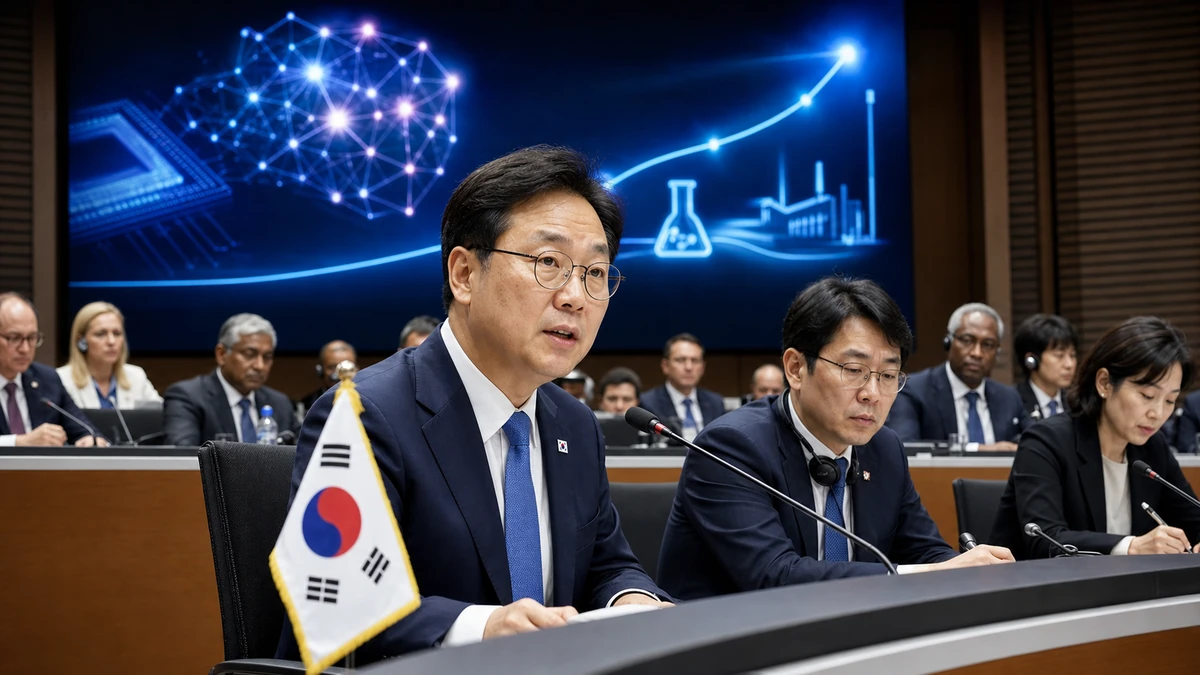
Image to help understand the article
From a domestic tech race to a global policy pitch
South Korea arrived at this year’s G20 innovation ministers meeting with a message that went beyond faster chips, smarter chatbots or the latest headline-grabbing AI model. In Chapel Hill, North Carolina, South Korean officials used an international stage to argue that the real contest in artificial intelligence is no longer only about who builds the most impressive technology first. It is also about which country can create the most effective system for turning research into products, products into industries, and industries into durable economic growth.
That is a notable shift in emphasis, and not just for Seoul. For years, the global AI conversation has often been framed around a handful of large U.S. companies, China’s state-backed push, and Europe’s regulatory muscle. South Korea has certainly been part of that conversation, especially through its world-leading semiconductor sector and globally recognized consumer technology brands. But at the G20 meeting, South Korea positioned itself less as a supporting player in someone else’s AI race and more as a country with a model to offer: one that links basic research, real-world testing, commercialization, market adoption, legal frameworks and ethical principles into a single national strategy.
That matters because the structure of the meeting itself reflected a broader global change. The G20 had previously treated research and innovation policy separately from the digital economy. This year, under the U.S. presidency, those conversations were merged into one innovation ministers forum. That may sound like bureaucratic housekeeping, but it captures something important about the AI moment. Artificial intelligence is no longer an issue that fits neatly inside academic science policy or the tech sector alone. It is now viewed as an economy-wide force with implications for manufacturing, health care, finance, education, national competitiveness and public governance.
South Korea’s presentation fit that new logic. According to the Korean government’s account of the meeting, Science and ICT Minister Bae Kyung-hoon described a policy approach designed to connect every stage of the innovation pipeline, from early-stage research and development to demonstration projects, commercialization and broad market diffusion. The point was not simply that Korea wants more AI. It was that Korea wants fewer breaks between the laboratory and the marketplace.
For American readers, the comparison is familiar. In the United States, policy debates over AI increasingly revolve around a similar question: how to preserve scientific leadership while making sure discoveries reach factories, hospitals, classrooms and small businesses rather than remaining concentrated in a narrow band of elite firms or research labs. South Korea is making a version of that argument from a smaller but highly advanced economy, one that has long depended on converting technical capability into export strength. Its message at the G20 suggests that countries in the AI era are competing not only on invention, but on institutional design.
Why South Korea is talking about the whole AI pipeline
One of the most revealing aspects of South Korea’s presentation was what it chose to emphasize. Rather than focusing primarily on model performance or a single flagship company, Seoul highlighted the machinery of innovation itself. Officials described increased investment in basic research, efforts to simplify research administration and the elimination of a preliminary feasibility review system for some R&D spending. They also pointed to high-risk, high-reward initiatives such as the SEED project and the K-Moonshot project.
Even without all the fine-grained details of those programs, the signal is clear. South Korea wants to be seen as a country willing to back more ambitious and uncertain research, not just safer projects with predictable short-term returns. That is an important distinction in AI and other emerging technologies, where the most transformative gains often come from experiments that do not have guaranteed outcomes. In plain English, the Korean government is arguing that innovation policy should make room for failure if it wants a real chance at breakthrough success.
That is a lesson the United States knows well. America’s own technology history is full of examples in which public support, defense spending, university research and private-sector risk-taking combined to produce industries that later came to define the modern economy. Silicon Valley itself emerged from an ecosystem that linked research institutions, government support and commercial ambition. Agencies such as DARPA became shorthand for the idea that governments can catalyze big technological leaps by tolerating uncertainty and betting on long horizons.
South Korea’s version of that story reflects its own economic history. The country’s development model was built on speed, coordination and industrial scale, helping transform a war-scarred nation into one of the world’s most technologically advanced economies in just a few generations. But the AI era presents a new challenge. It is not enough to manufacture well or adopt technology quickly. Countries must now build systems that let ideas move fluidly from basic research through regulation and into mass use. That is particularly true in AI, where progress depends not just on algorithms, but also on access to data, computing infrastructure, talent, sector-specific deployment and public trust.
In that sense, South Korea’s policy pitch is less about a one-off event at the G20 than about a broader attempt to redefine what counts as AI competitiveness. The old question was: Who has the best model? The new question is: Which country can consistently convert scientific capability into widely used, socially accepted and economically productive AI? Korea is betting that the answer lies in reducing the friction between one stage of innovation and the next.
What “AI for all” says about Korea’s domestic strategy
South Korea also used the G20 forum to discuss what it called the “AI for All” project, along with a government-wide AI transformation initiative, major national projects, a basic AI law and AI ethics principles. That combination is telling. It suggests Seoul is trying to present AI not as a niche technology portfolio managed by one ministry, but as a cross-government and cross-industry framework.
For audiences outside Korea, some translation of the policy culture is useful here. South Korean governments often pursue national technology agendas through coordinated state planning in a way that can feel more centralized than the typical American approach. That does not mean the government controls the whole market. It means that ministries, industrial policy, large firms, research institutions and legal frameworks often move in more deliberate alignment than Americans are used to seeing. In sectors from broadband to batteries to semiconductors, that coordination has been one source of Korean strength.
Applying that playbook to AI makes strategic sense for Seoul. Artificial intelligence is not just another consumer app category; it is a foundational technology expected to reshape productivity across many parts of the economy. A “whole-of-government” approach can help accelerate adoption in public services and regulated industries, while also creating domestic demand for homegrown AI tools and infrastructure. At the same time, Korea’s decision to present legal and ethical frameworks alongside industrial projects reflects another reality: countries have learned that public acceptance cannot be treated as an afterthought.
That balancing act is now central to AI policymaking almost everywhere. Move too slowly on regulation and governments risk losing control of safety, privacy, labor and accountability questions. Move too aggressively and they risk stifling experimentation before the technology matures. South Korea appears to be trying to occupy a middle ground, one that encourages fast deployment while building enough legal and ethical architecture to keep that deployment politically and socially sustainable.
There is also an important political subtext. By sharing these policies at a G20 forum, South Korea is signaling that it does not want to be viewed simply as a consumer of U.S. AI systems or a manufacturing base for global tech supply chains. It wants recognition as a policy actor, a country with governance experience and strategic ideas that can shape international norms. That does not put Seoul in the same category as Washington or Beijing in terms of sheer market power. But it does point to an increasingly confident Korean role in the global technology conversation.
What this means for the United States
For the United States, South Korea’s G20 pitch matters on several levels: as a market signal, as a policy signal and as a diplomatic signal. First, the market dimension. American technology companies are already deeply intertwined with South Korea through semiconductors, cloud services, consumer electronics, software platforms and advanced manufacturing. If Seoul succeeds in speeding the path from AI research to commercial adoption, U.S. firms could find in Korea an even more valuable test bed for enterprise AI, smart manufacturing, health technology and public-sector digital services.
South Korea’s appeal to American companies has always rested on a distinctive combination: a highly connected population, strong digital infrastructure, sophisticated consumers and globally competitive industrial champions. In practical terms, that makes it one of the few markets where new technologies can be trialed quickly at scale. For U.S. businesses looking for partners in Asia beyond the sheer size of China’s market, Korea offers something different but strategically important: a technologically dense environment with strong institutions and longstanding alliance ties to Washington.
Second, there is a policy lesson for the United States. Washington’s AI debate is often split among several camps: those focused on frontier-model competition with China, those focused on safety and governance, and those focused on industrial policy and domestic manufacturing. South Korea’s message in Chapel Hill was that these are not separate lanes. Research policy, digital policy, commercialization strategy and ethics all belong in the same frame. That is close to what many U.S. policymakers say they want, but the American system often struggles to execute due to fragmented authority, partisan deadlock and the sheer complexity of federal-state-market relationships.
Korea’s experience will not map neatly onto the United States. America is larger, more decentralized and more dependent on private-sector giants to drive technological direction. But the Korean example may still resonate in Washington, especially as the U.S. government tries to ensure that AI gains do not remain concentrated in a handful of coastal companies while the rest of the economy lags behind. The U.S. has seen versions of this problem before in advanced manufacturing, broadband buildout and clean-energy deployment. In each case, invention alone did not guarantee wide economic benefit. Diffusion mattered.
Third, the diplomatic angle. South Korea’s separate meeting with the White House Office of Science and Technology Policy underscores how AI is becoming part of alliance management, not just trade or defense cooperation. For decades, the U.S.-South Korea alliance was defined primarily by security concerns on the Korean Peninsula. In recent years, that relationship has expanded to include semiconductors, supply chains, batteries, quantum research and now AI governance. The result is that science and technology are becoming more central to the alliance’s everyday meaning.
That has implications for American audiences and companies alike. If Washington increasingly treats AI and emerging technology cooperation as pillars of its relationship with Seoul, then U.S. universities, startups, cloud providers, chipmakers and enterprise software firms all stand to gain from a thicker web of bilateral ties. At the same time, they may face a more capable Korean policy environment that expects partnership on terms shaped not only in Silicon Valley, but also in Seoul.
For American fans of Korean culture, there is another angle worth noting. The Korean Wave, or Hallyu, introduced many Americans to South Korea through K-pop, film, television and beauty products. AI policy is obviously less glamorous than a Netflix drama or a sold-out arena tour. But it represents a deeper kind of influence: the export of systems, standards and strategic ideas. If K-culture helped make South Korea familiar to global audiences, AI diplomacy may become part of how Korea seeks to be taken seriously as a rule-shaper in the next phase of the digital economy.
The bigger global trend: AI policy is moving beyond tech companies
One reason this story matters is that it illustrates a broader shift in the way governments think about AI. In the earliest phase of the generative AI boom, public attention centered on a small group of companies and their products. The drama was corporate: Which chatbot was better, which model was bigger, which company had access to more computing power? That conversation is still with us, but it is no longer enough. Governments now seem increasingly focused on the less flashy but more durable question of how AI becomes embedded in national economies.
The G20’s decision to merge research and digital-economy discussions is part of that shift. It suggests that policymakers no longer view AI as a siloed topic. Instead, they are treating it as a horizontal force, something that cuts across regulation, labor, industrial competitiveness, education and international cooperation. That is also why so many countries are now trying to assemble complete AI policy stacks: research funding, infrastructure, workforce development, legal frameworks, public-sector adoption and ethical guardrails.
South Korea’s intervention fits neatly into that emerging pattern. What makes it especially interesting is that Korea has enough institutional capacity and industrial depth to test whether a tightly connected AI strategy can actually work. It has major hardware capabilities, a digitally mature society, strong education levels and a government willing to act strategically. In other words, it is not merely drafting policy papers. It is in a position to attempt implementation.
That will be the real test. The Korean government can present an elegant theory of innovation at a G20 podium, but success will depend on whether researchers really face fewer administrative obstacles, whether businesses can pilot new tools more quickly, whether legal frameworks provide clarity rather than confusion, and whether talent development keeps pace with demand. Those are hard problems in every country, including the United States.
Still, there is growing evidence that the countries best positioned in AI may be those that solve these connective problems most effectively. The winners may not be the nations with the loudest rhetoric or the single most famous companies, but those that make it easiest for knowledge to move from the lab to the factory floor, from startup to scale-up, and from technical possibility to social legitimacy.
What to watch next in Korea, Washington and the wider G20
The immediate outcome of the G20 meeting should not be overstated. South Korea did not announce a new treaty, a major bilateral AI agreement with the United States or a binding international framework. The Korean government’s own description makes clear that this was primarily a moment to share policy experience, present priorities and invite interest from other countries. But in international technology politics, agenda-setting can be meaningful even when it does not produce an instant deal.
The first thing to watch is whether South Korea can translate these policy ideas into measurable domestic outcomes. That means looking for evidence that administrative simplification changes research behavior, that basic science investment yields stronger AI pipelines and that risk-tolerant projects actually generate valuable capabilities rather than simply attractive slogans. If Korea can show progress there, its model will be easier for partners to take seriously.
The second question is how the United States responds. The fact that the meeting took place in North Carolina and that Korean officials also met with the head of the White House science office is symbolically important. North Carolina, with its universities and research institutions, is a reminder that American innovation is not only a Silicon Valley story. If Washington wants broader AI-based growth, it may be more receptive to allied examples of how to connect research ecosystems with industrial outcomes. Korea could become a useful partner not just in supplying key technologies, but in comparing governance approaches.
The third issue is whether middle-power countries like South Korea can carve out a distinctive role in AI diplomacy. The global conversation is often dominated by U.S.-China competition and Europe’s regulatory agenda. Yet countries such as South Korea, Japan, Singapore and others may have outsize influence in shaping practical standards for deployment, commercialization and public-sector adoption. They often combine advanced infrastructure with enough policy cohesion to test ideas quickly.
For American readers, that makes South Korea worth watching not only as a consumer trendsetter or cultural powerhouse, but as a country trying to turn technological competence into diplomatic and economic leverage. The Korean Wave taught the world that South Korea could shape global taste. Its AI strategy suggests Seoul now wants to help shape global rules and innovation pathways as well.
That ambition is still a work in progress. But the message from Chapel Hill was unmistakable: in the age of AI, Korea does not want to be known only for making the hardware, adopting the apps or supplying the culture. It wants to be part of designing the system. And for the United States, that makes South Korea not just an ally in Asia, but an increasingly consequential partner in the global contest over how artificial intelligence moves from breakthrough to broad-based power.
Comments
Post a Comment