Image to help understand the article
From Government Software Users to Software Builders
South Korea is moving to give public employees a bigger role in building the software they use, pairing artificial intelligence coding tools with career incentives and a promise of institutional support. The experiment addresses a problem familiar to Americans who have navigated a cumbersome government website or watched an agency struggle with outdated technology: The people who understand a broken process are not always the people empowered to fix it.
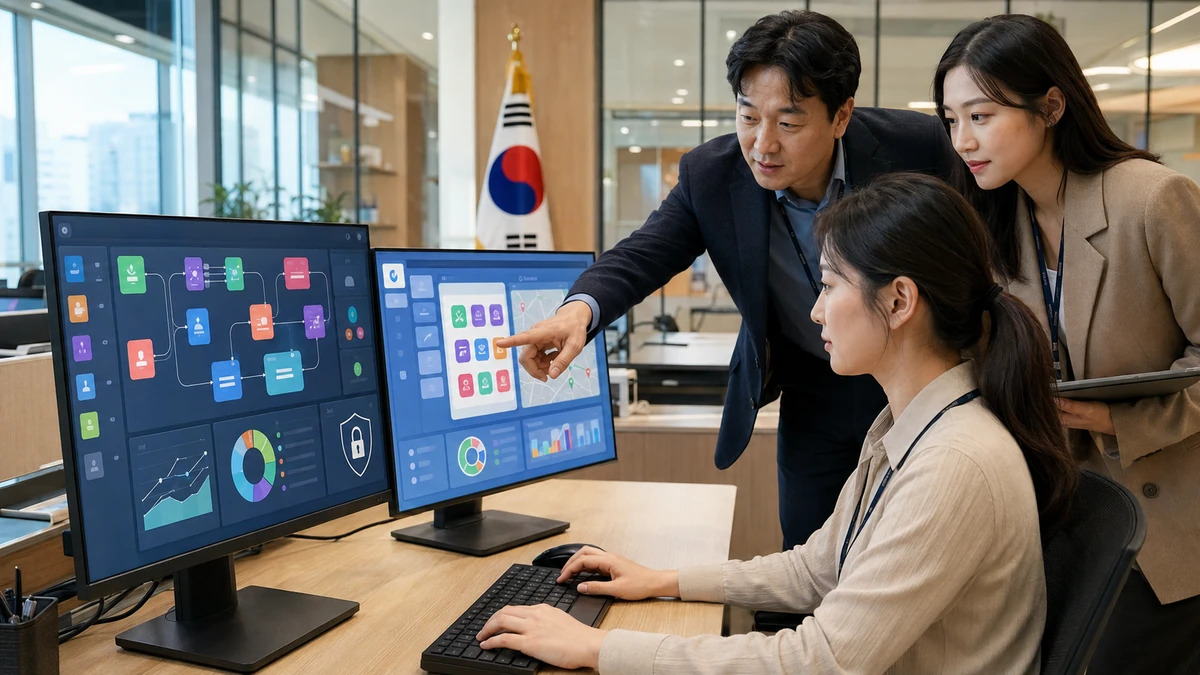
The Ministry of the Interior and Safety, which oversees public administration and government innovation, has reported plans to the Cabinet to expand support for civil servants who use AI to develop their own work tools. The approach goes beyond encouraging employees to ask a chatbot questions or summarize documents. It would help them identify a workplace problem, build a prototype and potentially share a verified solution with other agencies.
For American readers, the significance is not that South Korea has demonstrated an automated government. It has not. The policy instead offers a case study in a more immediate question facing public agencies and businesses alike: What happens when software development becomes accessible to employees outside the IT department, and who takes responsibility when their experiments become operational tools?
A Personnel Policy as Much as a Technology Policy
The ministry's central move is to connect AI development with the systems that influence behavior inside a bureaucracy: recognition, training, promotion reviews and institutional performance evaluations. It plans to expand incentives for AI-driven administrative innovation, including special performance bonuses and support for training and study. It also intends to give additional credit to highly skilled AI practitioners in performance assessments within the advanced science and technology talent category of an early-promotion program to Grade 5.
That terminology requires some unpacking. South Korea's civil service uses numbered ranks, with lower numbers generally indicating greater seniority. Grade 5 is an important officer-level rank, not the equivalent of Grade 5 in the U.S. federal government's General Schedule pay system. The announced measure concerns additional credit in a particular promotion assessment; it does not guarantee advancement simply because an employee uses AI.
The government also plans to broaden the AI transformation component of ministry innovation evaluations. That matters because an employee can build a promising prototype only to find that a supervisor sees the project as a distraction. Rewarding both individual achievement and institutional support could help align those interests. Whether it does so will depend on what evaluators reward: useful, maintainable tools or merely visible activity.
What the Government's AI Lab Actually Shows
The foundation for the initiative is a program called the AI Government Lab, where public employees develop prototypes for work-related problems. According to figures in the announcement, the program had 2,073 participants and 770 registered projects as of the third day of the reporting month. Of those projects, 376 had been made available for other civil servants to use.
Those numbers establish participation and sharing, not proven improvements in public services. A registered project is not necessarily a finished application. A shared prototype is not necessarily operating in an agency. The announcement did not provide an overall deployment rate or measured time savings across the portfolio, so it cannot establish that the program has already shortened processing times or reduced administrative costs.
Still, sharing is an important part of the design. Government agencies often perform similar administrative tasks, even when their missions differ. If employees can inspect and adapt another office's work, they may avoid solving the same problem from scratch. The potential benefit is not just reusable code but reusable knowledge about how to approach a task. That potential becomes a public benefit only when the tools work reliably in their intended settings.
Why AI Changes Who Can Attempt the Work
AI coding tools can generate or revise computer code in response to instructions written in ordinary language. They do not eliminate the need for technical expertise, but they can lower the barrier to building an initial version of a program. Someone who understands a workflow may be able to demonstrate a possible solution before a traditional development team would have the capacity to take it on.
The Korean initiative combines those tools with open data and public application programming interfaces, or APIs. An API is a defined way for software systems to exchange information or access functions. For an American comparison, a transit application might use an agency's API to retrieve arrival information rather than maintain its own separate version of the schedule. Access to an API, however, does not automatically confer permission to use every underlying record.
The distinction between a prototype and a dependable service remains crucial. A tool can appear successful with a small sample of data while failing when information is missing, formats change or many people use it at once. AI makes it easier to begin development. It does not by itself settle questions of accuracy, access, security or long-term maintenance.
The Obstacles Are Familiar: Budgets, Security and Data
A survey of 244 lab participants provides a more grounded picture of what employees need. Sixty-eight percent cited insufficient development environments or subscription funding, 59% reported difficulty applying security guidelines, and 40% cited trouble connecting data. These are findings from participating respondents, not a representative measure of the entire South Korean civil service.
Even with that limitation, the responses identify practical obstacles that a promotion incentive alone cannot resolve. Employees need approved places to build and test software. They need access to tools without uncertainty about who pays for recurring subscriptions. And they need security rules they can apply to real development decisions, rather than broad instructions that leave them guessing about what is permissible.
Data connections may be especially consequential. Building an interface that looks useful is different from connecting it safely to the information required for actual work. For example, a hypothetical document-tracking tool might perform well with fictional records but require additional controls before handling personal information. The ministry's findings suggest that the next phase must address infrastructure and governance alongside employee enthusiasm. More participants will not necessarily produce more usable tools if those constraints remain.
What This Means for the United States
For the United States, South Korea's experiment is most useful as an organizational comparison, not a ready-made policy to import. American government technology is spread across federal departments, states, counties, cities and other public bodies, each operating under its own mix of legal obligations, budgets and procurement rules. A development model that works within one Korean ministry would still require adaptation to an American agency's responsibilities and systems.
The underlying challenge is recognizable, however. Front-line employees often know precisely where a routine process wastes time, while centralized technology teams must balance security, maintenance and competing demands. South Korea is trying to create a path between those groups: Let employees explore solutions, then make the organization responsible for deciding what is safe and useful enough to operate. American agencies considering employee-built AI tools face the same need for clear ownership.
The initiative also matters to U.S. technology companies offering coding assistants, cloud services and development platforms. It illustrates requirements that public-sector customers may bring to this market: manageable subscription costs, controlled testing environments, data protection and support for reviewing generated code. The announcement identifies no American supplier, contract or procurement commitment, so it should not be read as evidence of a commercial win for a U.S. company.
In the broader U.S.-South Korea relationship, the policy presents a possible subject for exchanging administrative experience alongside the countries' established security and economic ties. It does not announce a bilateral AI program. For Americans, the value would lie in evidence about what works, what fails and what responsible deployment costs, rather than in treating an ally's participation targets as proof of success.
A Public-Sector Version of Citizen Development
The closest American business reference point is often called citizen development: Employees outside a formal software engineering team use accessible tools to build applications or automate tasks. Spreadsheet macros and low-code platforms have long allowed workers to solve local problems without commissioning a full software project. AI-assisted coding extends that idea by helping users produce code through conversational instructions.
The advantage is proximity to the work. A person who handles the same administrative process every day may spot an improvement that a distant development team would miss. The risk is that a useful experiment becomes essential before anyone has documented its behavior, checked its security or assigned someone to maintain it. In corporate IT, unmanaged tools of this kind are often described as shadow IT.
Government adds particular stakes because residents may have little choice about using a public service. A private company's internal productivity shortcut and a tool affecting access to a government benefit do not carry the same consequences. The Korean announcement does not establish that lab projects are making such decisions. But any expansion into consequential public-facing uses would demand scrutiny beyond whether the software appears to function. American agencies and companies serving them should draw that same distinction.
Experimentation Belongs to Employees; Accountability Does Not
Interior and Safety Minister Yoon Ho-jung said the government would support civil servants' freedom to experiment while assigning responsibility for security, quality and operations to their organizations at the point of actual deployment. He also outlined a direction in which verified results could be shared across agencies. That separation is among the most consequential elements of the plan.
Developing a small tool and running a lasting service are different jobs. Operational responsibility includes deciding who can access a system, responding when it fails and ensuring that someone remains accountable after its creator changes roles. An employee's initiative should not quietly turn into a permanent obligation to support software alone. Nor should institutional responsibility mean approving a tool once and assuming it will remain safe indefinitely.
The ministry plans guidelines for employee-led AI development and management of resulting software in the second half of the announcement year. It also plans safety-check criteria covering software vulnerabilities and personal information protection. These are proposed safeguards, not evidence of a disclosed incident. AI leadership training for bureau and division heads, along with a public-sector AI transformation competition planned for November, would complement the technical measures by involving managers and highlighting promising examples.
The Next Test Is Results, Not Just Scale
The government's ambitions are substantial. It plans to expand the lab's simultaneous-user capacity from about 200 to 6,000 in the year following the announcement. By 2030, it aims to develop 20,000 specialists capable of building AI tools themselves and applying them in workplace settings. Those are future targets, not achievements already secured.
The figures also measure different things. Total participation counts people involved in the program; simultaneous-user capacity measures how many can access it at once. Neither establishes how many applications are reliable enough for routine use. A meaningful evaluation would look beyond enrollment and project registration to deployment, maintenance costs, verified time savings and service quality. Where tools affect residents, accuracy and accessibility would matter as much as speed.
That is why the Korean initiative is worth watching as a shift in how government organizes technological change. It asks whether employees' practical knowledge can become a source of software innovation without abandoning institutional controls. For American public agencies, technology vendors and the residents who depend on public services, the lesson remains conditional: Easier software creation may open the door, but budgets, sound incentives and accountable operations will determine what makes it through.
Comments
Post a Comment