Image to help understand the article
Seoul Considers a Carefully Calibrated Military Role
South Korea is considering whether to send military personnel and assets to the Strait of Hormuz in response to a U.S. request, a debate that puts one of Washington’s closest Asian allies at the intersection of energy security, alliance politics and the risk of a wider confrontation with Iran.
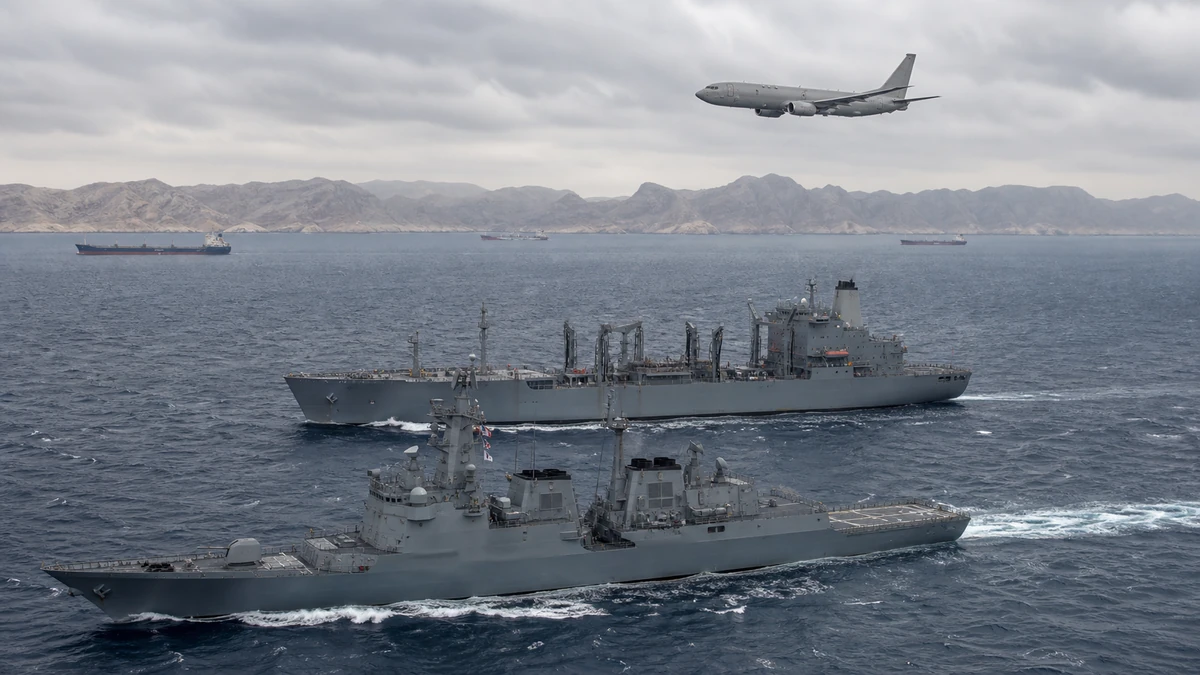
According to multiple South Korean government sources cited in local reporting, officials are discussing the possible deployment of a P-8A maritime patrol aircraft and the Soyang, an approximately 11,000-ton naval logistics support ship. The government is also reportedly reviewing language for a deployment consent motion that would have to go before the National Assembly, South Korea’s legislature.
No final decision has been made. South Korea’s presidential office and Defense Ministry have stressed that the government remains in the review stage. That distinction is important in Seoul, where an overseas military deployment requires a formal process that includes national security deliberations, Cabinet approval and legislative consent.
The assets under consideration suggest that South Korean officials are looking for a limited, primarily defensive contribution rather than a large combat force. The P-8A is a sophisticated maritime patrol aircraft designed to monitor broad stretches of ocean and locate submarines and surface vessels. It also has strike capabilities. The Soyang can provide fuel, ammunition and other supplies to naval vessels operating far from home ports.
That combination could allow Seoul to offer practical help without sending a conventional ground force or assigning South Korean troops an openly offensive mission. It would also help the government argue that its objective is maritime security and freedom of navigation, not participation in a war against Iran. Whether Tehran would accept that distinction is another matter.
Why the Strait of Hormuz Matters to South Korea
The Strait of Hormuz is a narrow maritime passage connecting the Persian Gulf with the Gulf of Oman and the Arabian Sea. It is one of the world’s most strategically important energy chokepoints, carrying oil and other petroleum products from major Gulf producers to markets around the world. For Americans, its importance is comparable to that of a major interstate bridge through which a large share of an essential commodity must pass: Even a temporary closure can affect prices and confidence far beyond the immediate area.
South Korea has an especially strong interest in keeping those shipping lanes open. As an export-driven industrial economy with limited domestic energy resources, it depends heavily on imported fuel. Disruption in the Gulf can ripple through Korean refineries, petrochemical companies, manufacturers and transportation networks before reaching consumers. It can also affect the price competitiveness of Korean products sold in the United States, including cars, electronics, batteries and industrial equipment.
For Seoul, however, economic dependence on safe passage through Hormuz does not automatically translate into support for a military deployment. The question is whether sending forces would reduce the danger to commercial shipping or instead make South Korea a participant in a regional conflict.
Supporters of a deployment argue that South Korea cannot rely indefinitely on the United States and other partners to protect shipping while declining to share the military burden. They also contend that demands or threats that interfere with free navigation would be difficult for a major trading nation to accept. From that perspective, surveillance and logistical support could be presented as defensive tools serving South Korea’s own national interest.
Critics see a more dangerous calculation. The area is being described in Seoul’s debate as effectively operating under wartime conditions. A patrol aircraft capable of detecting and striking submarines or ships is not politically neutral merely because it spends most of its time gathering information. A supply vessel can sustain other forces engaged in military operations. Mission definitions, rules of engagement and command arrangements would therefore matter as much as the platforms themselves.
U.S. Pressure Raises the Stakes
The review has gained urgency because of public pressure from President Donald Trump, who has complained that South Korea has not contributed enough on Iran-related security issues. Trump said the United States had asked South Korea for help and had been turned down, adding that he would remember the refusal.
Such language lands heavily in Seoul. The United States and South Korea are treaty allies, and roughly three generations of South Korean security planning have been built around the U.S. military commitment to deter North Korea. The alliance is not simply a diplomatic partnership; it is embedded in joint exercises, intelligence sharing, weapons procurement and the presence of U.S. forces on the Korean Peninsula.
At the same time, South Korean leaders have traditionally resisted the idea that alliance obligations give Washington an automatic claim on Korean forces for conflicts unrelated to North Korea. Each overseas mission can become a debate over sovereignty, national interest and the limits of alliance solidarity.
A South Korean presidential official indicated that any meaningful contribution in Hormuz must be weighed against readiness on the peninsula. The official suggested that Seoul might have room to act if it could do so without seriously damaging its ability to respond to North Korean threats.
That is one reason the P-8A and Soyang are emerging as possible options. They could provide visible support to the United States while limiting the number of personnel exposed and avoiding the political symbolism of a major combat deployment. But both are valuable military assets. Sending them to the Middle East could create operational trade-offs thousands of miles away in Northeast Asia.
The dilemma reflects a broader trend in U.S.-South Korean relations. Washington increasingly expects wealthy allies to contribute beyond their immediate neighborhoods, particularly in maritime security and the protection of global trade. Seoul, meanwhile, is becoming more capable of doing so. South Korea is no longer the aid-dependent country it was after the Korean War; it is a major economy, a shipbuilding power and an increasingly important defense exporter. Greater capacity brings greater expectations, including requests that can be difficult to refuse.
What This Means for the United States
For the United States, South Korea’s decision will be watched as a measure of how far an Indo-Pacific ally is willing to support American strategy in the Middle East. A Korean patrol aircraft or logistics ship would not by itself transform the military balance around Iran. Its larger value would be political and operational: It would demonstrate that Washington is not acting alone and could free U.S. assets for other missions.
The P-8A also provides a direct connection to the American defense industry. The aircraft is made by Boeing and is based on the same platform used by the U.S. Navy for long-range maritime patrol and anti-submarine warfare. South Korea’s consideration of the aircraft illustrates how American-made systems can deepen alliance interoperability while also creating new expectations. When allies buy equipment compatible with U.S. forces, Washington may see them as more capable of joining multinational operations.
American consumers and businesses also have an indirect stake in the outcome. The United States is more energy independent than many Asian economies, but oil is traded in a global market. A serious disruption around Hormuz can still contribute to higher fuel prices, shipping costs and insurance premiums. It can also interrupt supply chains involving South Korean companies that play major roles in the U.S. market, from automakers and electronics producers to battery manufacturers and shipbuilders.
There is also a diplomatic cost for Washington if pressure becomes too public or punitive. American administrations have often asked allies to share more of the security burden, much as NATO members are pressed to increase defense spending. But alliance management depends on convincing partners that a contribution serves a common purpose rather than extracting support through threats. Trump’s warning that he would remember South Korea’s refusal may strengthen the case of Korean officials who favor deployment, but it could also fuel public resistance by making the mission appear coerced.
The closest American comparison is the recurring debate over coalition warfare. U.S. presidents often seek foreign participation not only for additional military capacity but also for legitimacy. Even a modest allied contribution can allow Washington to describe an operation as multinational. Yet Americans have also seen how narrowly defined deployments can expand over time, particularly when surveillance, logistics and force protection become connected to combat operations.
Congressional and public debates in the United States frequently turn on similar questions: What is the mission, who is the adversary, how long will personnel remain, and what event would trigger the use of force? South Korea’s National Assembly will confront its own version of those questions. The answer will shape not only the Hormuz mission but also future U.S. expectations of Korean military support beyond East Asia.
South Korea’s History of Overseas Deployments
South Korea has sent forces abroad before, but those missions were generally presented to the public with specific objectives such as reconstruction, medical assistance, peacekeeping or protection of commercial vessels. That history gives Seoul a set of precedents, though none maps perfectly onto the present situation.
The Zaytun Division was deployed to Iraq in 2004 after the South Korean government accepted a U.S. request for additional forces. Created with about 3,800 personnel, it served as part of the multinational presence and focused on peacekeeping, security and reconstruction around Irbil in Iraq’s Kurdish region. The contingent was gradually reduced to roughly 650 personnel before its withdrawal in December 2008, but it maintained a separate operating structure.
That mission remains relevant because it showed that Seoul could answer a U.S. request while defining its role more narrowly than that of American combat forces. It also demonstrated the domestic sensitivity surrounding participation in a controversial U.S.-led war.
The Cheonghae Unit offers a more direct maritime precedent. South Korea deployed the naval unit to the Gulf of Aden in 2009 amid United Nations Security Council action and requests for international cooperation against piracy. Its responsibilities included protecting Korean ships, supporting maritime safety, responding to terrorism and participating in multinational naval security operations.
The unit became widely known in South Korea after a 2011 operation that rescued all 21 crew members aboard the hijacked chemical tanker Samho Jewelry. The mission helped establish a public narrative in which an overseas naval deployment could be justified by the direct protection of Korean citizens and commerce.
South Korea has also contributed troops to United Nations peacekeeping missions. The Evergreen Unit served in Somalia, Angola and East Timor. Engineering personnel repaired roads and conducted civil assistance in Somalia and Angola. In East Timor, South Korea sent combat troops with National Assembly approval in 1999 to maintain security, provide humanitarian relief, support the creation of an independent government and monitor elections.
The Dongui medical unit, numbering about 100 personnel, deployed to Afghanistan in 2002 and carried out medical and civil support work from Bagram Air Base before withdrawing. These missions were easier to distinguish from direct participation in offensive warfare because their mandates centered on medical care, reconstruction or internationally authorized peacekeeping.
Why Hormuz Is a More Difficult Case
The proposed Hormuz deployment differs from those earlier missions because neither the final mandate nor the decision to send forces has been settled. In previous cases, Seoul could point to a defined purpose: rebuilding communities in Iraq, providing medical support in Afghanistan, carrying out U.N. peacekeeping or protecting ships from pirates.
Hormuz presents a less stable dividing line between defense and combat. Pirates threatening a commercial tanker are not the same as the armed forces of a sovereign state. Monitoring submarines and warships during a confrontation with Iran could place South Korean personnel close to military escalation, even if their formal orders emphasize surveillance and shipping security.
Iran has warned that it would regard South Korean action against it as direct military aggression and participation in the war. That position clashes sharply with Seoul’s apparent effort to define the contemplated assets as defensive.
The disagreement is not merely rhetorical. In a crisis, Iran may judge a ship or aircraft by the information and support it provides to U.S. forces rather than by the description offered in a South Korean deployment resolution. Intelligence gathered by a P-8A could influence military operations. Fuel or ammunition supplied by a logistics vessel could sustain ships involved in them. Seoul would need to determine whether information would be shared, which vessels could receive support and what South Korean forces should do if attacked.
Those details could determine whether the deployment remains limited or becomes entangled in hostilities. They also explain why parliamentary scrutiny is more than a procedural formality. Lawmakers would be asked to approve not just the movement of equipment, but the exposure of South Korean personnel to a conflict in which the opposing side has already signaled that it may treat them as belligerents.
Domestic Politics and the Legal Path Ahead
Under South Korea’s constitutional system, dispatching military forces overseas requires National Assembly consent. Before a proposal reaches lawmakers, it would typically pass through deliberations by the National Security Council and the Cabinet. The reported review of draft language for a consent motion suggests that officials are examining concrete options, but it does not mean the deployment is assured.
The Defense Ministry initially said information would be released at an appropriate point as procedures moved forward under relevant laws. It later emphasized, in line with the presidential office, that no decision had been made. For now, the confirmed picture is one of planning: Officials are assessing possible forces, missions, legal requirements and the impact on readiness against North Korea.
Political opposition could become decisive. Concerns have surfaced even within the governing party, and a legislative majority does not guarantee approval if public resistance rises. Lawmakers will have to weigh the alliance with the United States against troop safety, the possibility of Iranian retaliation and the military requirements of the Korean Peninsula.
South Korea’s political culture gives the National Assembly’s vote particular importance. Overseas deployments often revive memories of earlier wars and arguments over whether the country is acting in its own interest or following Washington’s lead. Those debates can cut across party lines, especially when the mission lacks a U.N. peacekeeping framework or an obvious connection to defending Korean citizens.
A limited deployment might be more politically acceptable if the government defines its purpose narrowly, establishes a fixed duration and places clear restrictions on combat activity. But limitations that make the proposal easier to pass could also reduce its usefulness to the United States. Seoul must therefore negotiate on two fronts: with Washington over what assistance counts as meaningful, and with Korean lawmakers over what risks are acceptable.
What to Watch Next
The first signal will be whether the South Korean government formally submits a deployment motion to the National Assembly. The wording will matter. A mission described as protecting commercial navigation may draw a different response from one tied directly to U.S. operations against Iran. Lawmakers are also likely to seek details about the size of the contingent, the chain of command, rules for the use of force and the expected duration.
A second issue is whether Seoul proposes an independent Korean mission, participation in a multinational maritime framework or direct integration with U.S. forces. Those arrangements carry different political and military implications. An independent patrol focused on Korean shipping could give Seoul greater control, while a closely integrated operation could deliver more value to Washington but heighten Iran’s claim that South Korea has joined the conflict.
The effect on peninsula readiness will be another test. South Korea must show that sending a P-8A or a major support ship will not create a serious gap in surveillance or naval sustainment closer to home. That case could become harder to make if tensions with North Korea rise while the debate continues.
Finally, officials will watch whether public pressure from Washington helps or hurts the proposal. Alliance solidarity remains a powerful argument in South Korea, but so does the principle that Korean troops should be deployed only after an independent assessment of the national interest.
The broader trend is clear even if the immediate decision is not. As South Korea’s military capabilities and global economic reach expand, Seoul will face more requests to contribute to security operations far from the peninsula. The Hormuz debate is therefore about more than one aircraft, one ship or one parliamentary vote. It is a test of how South Korea defines itself as a U.S. ally and global trading power — and of how much risk it is prepared to accept when those roles collide.
Comments
Post a Comment