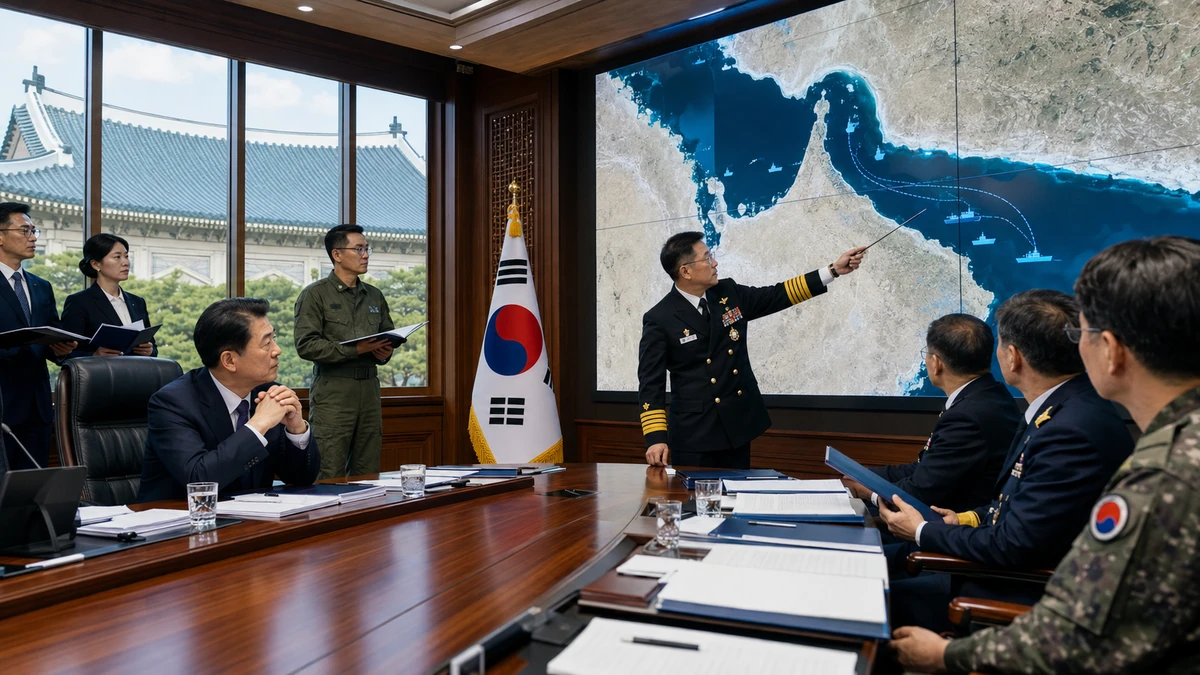
Image to help understand the article
Seoul is considering options, not announcing a deployment
South Korea is examining whether its military could make a practical contribution to security in and around the Strait of Hormuz, but the government has not decided to send forces overseas, according to statements from the presidential office and Korean news reports.
The distinction is central to understanding the debate now unfolding in Seoul. Officials have left open a range of possibilities, including combat, noncombat and search-related missions, while emphasizing that those categories describe options rather than an approved plan. No specific unit, ship, aircraft, mission or timetable has been formally selected.
The presidential office, traditionally known as Cheong Wa Dae, or the Blue House, said South Korea would have to weigh any meaningful contribution against the military’s primary responsibility: maintaining readiness on the Korean Peninsula. That means policymakers are not simply asking whether South Korea should help protect a strategically important waterway. They are also asking what equipment and personnel could be sent without weakening the country’s ability to respond to North Korea.
That calculation makes the issue unusually sensitive. South Korea is a major U.S. ally with an increasingly capable military and an economy dependent on international trade. At the same time, it faces an immediate security threat across the heavily fortified Demilitarized Zone. A naval vessel or surveillance aircraft assigned to the Middle East is an asset that cannot simultaneously perform its regular mission closer to home.
The government’s public position as of the latest statements is therefore deliberately limited: Officials are reviewing ways to contribute, military tools may be among them, and nothing has been decided. Reports that particular assets are under consideration should not be confused with a final deployment order.
Why the Strait of Hormuz matters to South Korea
For many Americans, the Strait of Hormuz is most familiar as a recurring flashpoint in U.S.-Iran tensions. For South Korea, it is also a direct economic concern. The narrow waterway connects the Persian Gulf with the Arabian Sea and serves as a major route for energy shipments moving from the Middle East to customers in Asia.
South Korea has few domestic energy resources and has built its modern economy around imported fuel, export manufacturing and reliable maritime transportation. Its refineries, petrochemical producers, automakers, steel companies and electronics manufacturers all depend, directly or indirectly, on stable global shipping. Trouble in the Gulf can raise transportation and insurance costs, unsettle energy markets and create risks for Korean companies even when South Korea is not a party to the regional dispute.
This dependence helps explain why Seoul has repeatedly expressed an interest in making a practical contribution to maritime security. Diplomatic statements alone do not escort vessels, search for missing crews, monitor sea lanes or support ships operating far from their home ports. When Korean officials speak of a contribution that is meaningful or effective, they are signaling that the government is considering measures capable of producing an operational result.
That does not necessarily mean joining combat operations. Maritime security missions can involve intelligence gathering, surveillance, logistics, search and rescue, communications, protection of commercial traffic or support for other naval forces. Each role carries a different political meaning and a different level of danger.
The debate is also shaped by South Korea’s experience as a trading nation whose prosperity is tied to what military planners call sea lines of communication. The phrase may sound technical, but the concept is straightforward: Container ships, tankers and other commercial vessels must be able to move through key waterways without unacceptable disruption. For South Korea, keeping those routes open is not an abstract foreign policy goal. It is part of protecting the economic system on which the country depends.
A military contribution is not automatically a combat mission
One of the most important points in the presidential office’s explanation is that military participation and combat participation are not synonymous. In public debate, the Korean word commonly used for dispatching troops abroad can create the impression that soldiers are being sent directly into battle. In practice, an overseas military deployment can cover a much wider range of missions.
A search operation, for example, could involve locating ships, aircraft or personnel in distress. A noncombat assignment could include surveillance, logistics or maritime coordination. A support ship might deliver fuel, ammunition and other supplies to vessels at sea without taking the lead in an enforcement operation. A patrol aircraft could monitor a large area and relay information while remaining outside the most dangerous part of a mission.
Korean reports have identified the P-8A maritime patrol aircraft and the 11,000-ton logistics support ship Soyang as assets that may be under consideration in response to a U.S. request. The P-8A, a military aircraft based on Boeing’s 737 design, is familiar to the U.S. Navy as a platform for maritime surveillance and anti-submarine operations. The Soyang is designed to resupply other ships with necessities such as fuel and ammunition, extending the amount of time a naval force can remain at sea.
Neither asset has been formally assigned to a Hormuz mission, according to the presidential office’s stated position. Their appearance in news coverage is nevertheless revealing because it illustrates the range of possible contributions. An aircraft providing maritime awareness would represent a different commitment from a ship accompanying commercial traffic, and both would differ from participation in an operation with a significant likelihood of armed confrontation.
The details would also determine how South Koreans judge the risks. Who commands the mission? What rules would govern the use of force? Would Korean personnel operate independently, under a U.S.-led framework or alongside a broader multinational group? How long would the deployment last? What geographic area would it cover? Those questions matter more than a general label such as military contribution.
For the government, describing multiple options preserves flexibility. It allows Seoul to demonstrate that it is taking allied concerns seriously without committing itself before military planners, diplomats and lawmakers have evaluated the consequences. It also reduces the risk that an early discussion of one possible asset will be treated as an irreversible policy decision.
North Korea makes every overseas mission more complicated
South Korea’s security debate differs fundamentally from that of many other U.S. partners because the country remains in a state of unresolved conflict with North Korea. The 1950-53 Korean War ended with an armistice rather than a peace treaty, and the two Koreas continue to face each other across the Demilitarized Zone.
South Korea maintains a large standing military, backed by U.S. forces stationed on the peninsula, to deter another conflict and respond to North Korea’s nuclear weapons, missiles and conventional forces. That continuing threat shapes nearly every decision about sending military resources abroad.
The presidential office has identified readiness on the peninsula as the first test for any Hormuz option. In practical terms, military planners would have to determine whether assigning a ship, aircraft, crew or support unit to the Middle East would create a meaningful gap in South Korea’s defense posture. They would also have to consider maintenance schedules, training requirements, personnel demands and the time needed to move an asset back to Northeast Asia during a crisis.
This is not an argument that South Korea can never operate beyond its immediate region. The country has participated in overseas security, peacekeeping, reconstruction and anti-piracy missions as its international role has grown. South Korean warships have also operated in waters farther west to protect shipping and Korean nationals. But each additional mission requires Seoul to balance its ambitions as a global actor against the demands of deterrence at home.
For American readers, the closest comparison may be the Pentagon’s constant effort to allocate aircraft carriers, air defense systems and surveillance platforms among Europe, the Middle East and the Indo-Pacific. A capable asset can be strategically valuable in several places, but it cannot be everywhere at once. South Korea faces the same basic resource problem under more concentrated geographic pressure.
The readiness requirement could ultimately favor a limited or specialized contribution over a large deployment. It could also lead the government to choose an asset whose absence would have less effect on peninsula operations. But those are policy possibilities, not announced conclusions. The official review remains broader than any single reported proposal.
Parliamentary approval is a separate political test
Even if South Korea’s executive branch settles on a military option, the process would not necessarily end there. The presidential office has said domestic legal procedures must be considered, including consultation with and consent from the National Assembly, South Korea’s unicameral legislature.
That requirement gives the debate a democratic dimension beyond military planning. The government would need to explain the mission to lawmakers and, through them, to the public. Officials could be pressed to define the purpose, duration, command arrangements, likely costs and risks to service members. Opposition parties would have an opportunity to challenge the government’s assumptions or demand limits.
For Americans accustomed to long-running arguments over presidential war powers and congressional authorization, the basic tension will be recognizable. Democracies must often decide how much freedom an executive should have to respond quickly to an international security problem and when elected lawmakers should approve the use of military personnel abroad.
The institutional structure is different in South Korea, which has a presidential system but its own constitutional and legal requirements. According to the presidential office, the government has not yet reached the stage of formally seeking legislative consent. Reports that officials might prepare the issue for national security deliberations or submit a consent motion should therefore be understood as discussion of possible next steps, not evidence that the process is already complete.
The sequence matters: Government agencies review options, the executive decides whether to advance one of them, and lawmakers then consider the proposal if approval is required. Public reporting can blur those stages, especially when officials acknowledge that military assets are part of the review. Seoul’s repeated clarification appears intended to prevent a policy study from being portrayed as a settled deployment.
Transparency will become more important if the review advances. A mission described vaguely as maritime security could range from low-risk support work to operations conducted near hostile forces. South Korean lawmakers and voters are likely to want a more precise account before accepting the risks that accompany an overseas dispatch.
What the debate means for the United States
For Washington, South Korea’s deliberations are part of a larger question about how U.S. allies share responsibility beyond their home regions. The United States has long provided a substantial part of the military power used to protect international shipping in the Middle East. American administrations, including President Donald Trump’s, have urged allies and major trading nations to contribute more to collective security.
A South Korean role in Hormuz would carry practical and symbolic value for the United States. Practically, a patrol aircraft, logistics vessel or other specialized capability could reduce pressure on U.S. forces and improve surveillance or sustainment. Symbolically, participation would show that the alliance is not limited to deterring North Korea but can also address threats to the global economic system.
That broader interpretation of the alliance has implications for American defense companies. The reported consideration of South Korea’s P-8A highlights how sales of U.S.-made equipment can create operational compatibility between allied militaries. Shared platforms, communications practices and training can make it easier for U.S. and South Korean forces to work together. Boeing’s military aircraft business and the wider network of American defense suppliers are part of that relationship, although the review does not guarantee that any particular aircraft will deploy.
American businesses outside the defense sector also have an interest in stable Gulf shipping. Energy prices influence transportation, manufacturing and consumer costs across the United States. Disruption in the Strait of Hormuz can affect global markets even when the oil involved is headed primarily to Asian customers. U.S. automakers, airlines, chemical producers, retailers and shipping companies all operate in an economy in which energy and freight costs cross borders quickly.
For American audiences, South Korea’s caution should not automatically be read as reluctance to support the alliance. Seoul is being asked to reconcile two goals that Washington also considers important: contributing to maritime security and preserving deterrence against North Korea. Sending a high-value Korean asset away from the peninsula could help one U.S. priority while complicating another.
The issue also arrives amid difficult security and economic discussions between the two governments, according to the presidential office. Korean officials have not publicly established a direct bargain linking Hormuz participation to other negotiations. It would therefore be misleading to portray a possible deployment as payment for a trade concession, defense agreement or other U.S. action. Still, the overlapping talks create a diplomatic environment in which every decision can be interpreted as a measure of alliance solidarity.
Washington will likely pay close attention not only to whether South Korea participates, but also to the form of its contribution. A narrowly defined support mission could allow Seoul to answer an allied request while limiting exposure to combat. A larger or more integrated mission would signal greater willingness to operate alongside the United States outside Northeast Asia, but it would also be harder to defend politically at home.
South Korea’s shift from protected ally to global security partner
The Hormuz review reflects a longer-term change in South Korea’s international identity. The country once depended heavily on foreign aid and U.S. military protection after the devastation of the Korean War. It is now a major industrial economy, a weapons exporter, a prominent producer of semiconductors, automobiles and ships, and a cultural power whose music, television and film have developed large American audiences.
That rise has created expectations that South Korea will contribute more to international security. Economic influence and military capability often bring demands for greater responsibility, particularly when commercial interests are at stake. Allies may ask why a wealthy trading nation should rely on other countries to protect distant sea lanes that are vital to its own prosperity.
At the same time, global ambition does not erase domestic constraints. South Koreans can support a stronger international role while remaining wary of being drawn into conflicts with unclear goals. Memories of past overseas deployments, concern for service members and skepticism about great-power pressure can all shape public reaction. The National Assembly process provides a venue for those concerns.
The government’s language suggests it is trying to avoid a false choice between doing nothing and entering combat. By considering surveillance, logistics, search and other roles, Seoul can explore whether a carefully bounded mission would produce real value without assuming the highest level of risk.
This approach resembles the way other middle powers have expanded their global roles: They often begin with specialized capabilities, humanitarian support, training, peacekeeping or maritime patrols rather than large combat formations. Such missions can strengthen alliances and demonstrate competence while keeping political and military exposure manageable.
Whether that model works in Hormuz would depend on conditions at the time of deployment. Even a noncombat ship can enter a dangerous environment, and support personnel can become targets. Labels do not eliminate operational risk. A credible proposal would need clear rules, realistic threat assessments and contingency plans for escalation.
What to watch next
The first sign of a substantive policy shift would be an official narrowing of the options. That could include identifying a preferred mission, naming a military asset, describing a command structure or announcing formal discussions with the National Assembly. Until then, reports about individual ships or aircraft remain indications of what planners may be studying.
The mission’s legal basis will be another key issue. South Korean officials will need to explain what domestic authorization is required and whether the operation would be conducted independently or through an international framework. The answer could affect both legislative support and public acceptance.
Readiness assessments will also be decisive. If military leaders conclude that a proposed contribution would weaken surveillance, logistics or naval coverage near the peninsula, policymakers may scale it back or choose another option. Conversely, an asset judged to be available without significant harm to deterrence could become a leading candidate.
The final measure of the policy will not be whether Seoul uses the word deployment. It will be what South Korean forces are asked to do, where they operate, how much danger they face and how their work supports a defined objective. Those details will determine whether the mission is seen as prudent burden-sharing, unnecessary exposure or a new stage in South Korea’s emergence as a security actor beyond East Asia.
For now, Seoul is signaling willingness without commitment. That ambiguity is not merely diplomatic hesitation. It reflects the complexity of a decision connecting Gulf energy routes, North Korean deterrence, legislative oversight and the future of the U.S.-South Korean alliance. The eventual choice, if one is made, will show how far South Korea is prepared to extend its military reach and how carefully it can do so without losing sight of the threat closest to home.
Comments
Post a Comment