Image to help understand the article
A Small Party Pushes an Unprecedented Dual Role
South Korea’s Basic Income Party is asking one of its most prominent lawmakers, Yong Hye-in, to remain in the National Assembly while also serving as the country’s minister of gender equality and family, setting up an unusual test of political convention, coalition government and public trust. Yong, a proportional-representation lawmaker, has been nominated for the Cabinet post in President Lee Jae-myung’s administration. South Korean lawmakers have served as Cabinet ministers before, reflecting a constitutional system in which the executive and legislative branches overlap more than they do in the United States. But according to the party, no proportional-representation member has previously held both positions at the same time. That distinction has made Yong’s nomination more than a routine personnel decision. It raises questions about who would represent her small party in parliament, how much influence one politician should hold and whether an experiment in coalition politics can overcome concerns about conflicts of interest.
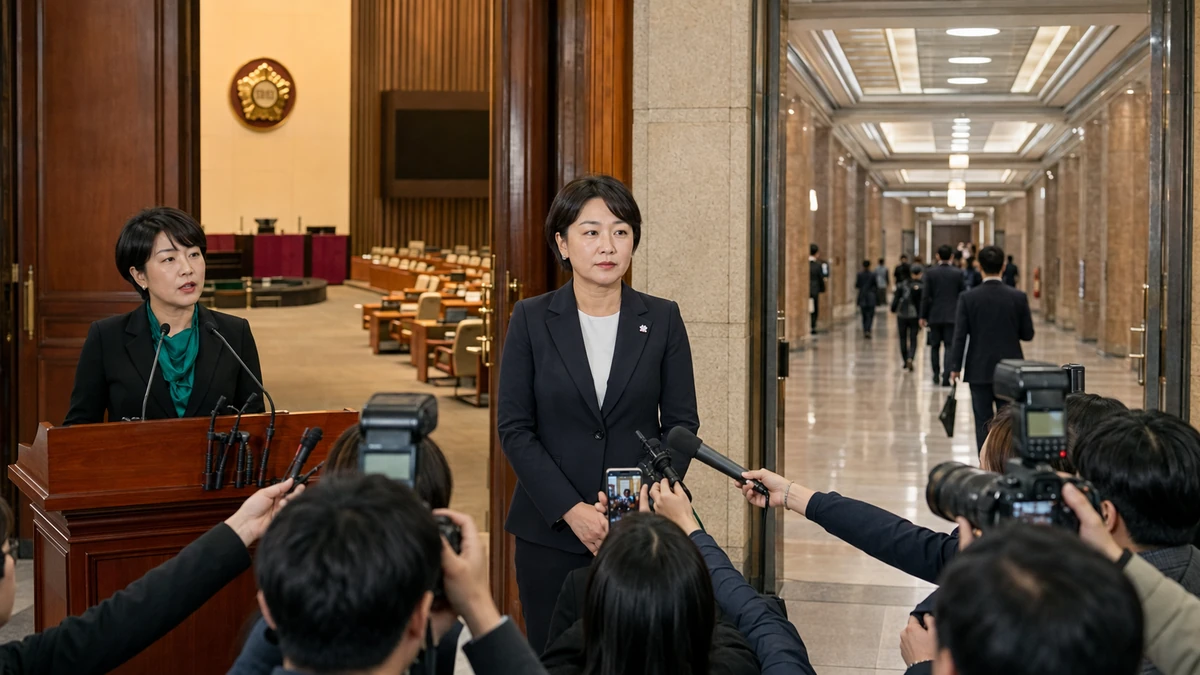
At a National Assembly news conference on the 7th, Basic Income Party leaders described the proposed arrangement as a deliberate attempt to create a new precedent. Shin Ji-hye, a member of the party’s Supreme Council, said political institutions develop only when leaders are willing to attempt something new. She characterized Yong’s possible dual service as part of a broader effort to practice coalition politics and help the Lee administration’s Gender Equality and Family Ministry produce tangible results. The party’s argument is that Yong should not have to choose between representing voters in the legislature and bringing the party’s policy priorities into the executive branch. Critics inside and outside the party have offered the opposite view: Yong should either surrender her National Assembly seat or decline the Cabinet appointment. For them, the lack of precedent is a warning rather than an opportunity.
The dispute is especially consequential because the Basic Income Party is a minor political organization whose national profile is closely tied to Yong. Unlike South Korea’s two dominant forces — Lee’s liberal Democratic Party and the conservative People Power Party — smaller parties have limited parliamentary personnel and fewer opportunities to shape government policy. A Cabinet appointment can therefore offer influence far beyond what a party’s seat count might ordinarily provide. At the same time, concentrating legislative, executive and party authority around a small circle of figures can invite sharper scrutiny. The Basic Income Party says the presidential office wants the public to receive a detailed explanation during Yong’s confirmation hearing and that the nominee is preparing seriously for that process.
Why a Proportional-Representation Seat Matters
To American readers, the phrase “proportional-representation lawmaker” may sound technical, but it is central to the controversy. South Korea elects most members of its unicameral National Assembly from geographic districts, in a system broadly comparable to elections for the U.S. House. A separate group of seats, however, is distributed through party lists based on each party’s share of the vote under the applicable electoral formula. Voters therefore help determine not only who represents a local constituency but also the balance of parties in parliament. Yong entered the legislature through this party-list system rather than by winning a single geographic district.
That difference affects the politics of resignation. A district lawmaker can claim a direct mandate from a particular community, while a proportional member’s seat is closely linked to the party and its national vote. If a party-list member leaves office, South Korean election rules generally allow the vacancy to pass to another eligible candidate from the party’s list rather than requiring a conventional district by-election. Even so, the departure of a nationally recognizable figure can significantly change a small party’s influence. The Basic Income Party’s insistence that Yong retain both jobs appears designed to preserve her legislative voice while expanding the party’s role inside the administration.
The Basic Income Party takes its name from the idea that the government should provide people with a regular minimum income without the work requirements commonly attached to traditional welfare programs. Versions of universal basic income have also circulated in the United States, notably in technology policy debates and in entrepreneur Andrew Yang’s 2020 Democratic presidential campaign. In South Korea, the issue has had particular resonance because of concerns about economic inequality, precarious employment, high housing costs and the future of work. The party remains small, but it has used Yong’s public profile and parliamentary platform to keep basic income and social policy in the national conversation.
The ministry Yong has been nominated to lead is itself politically sensitive. South Korea’s government body responsible for gender equality and family policy has been a recurring target in the country’s polarized debate over feminism, discrimination, demographic decline and the division of caregiving responsibilities. South Korea has one of the world’s lowest birthrates, and arguments over employment, housing, child care and gender expectations frequently overlap with partisan conflict. A minister in that portfolio must manage policy questions while also navigating a political environment in which the ministry’s mission and even its continued existence have been contested. Yong’s supporters can argue that her legislative experience would help her negotiate those pressures. Skeptics can argue that retaining a parliamentary position would blur accountability when she is expected to defend administration policy.
Family Appointments Add a Second Layer of Scrutiny
The debate over Yong’s dual role is unfolding alongside questions about the place of her husband, Park Ki-hong, in the party leadership. Park, who had served as a deputy chief for strategy and planning, won election to the Basic Income Party’s Supreme Council with 20.85% of the vote, finishing third. His victory came on the same day party officials defended Yong against allegations that she had effectively installed her spouse in an important party position. The convergence of those developments has intensified attention on how the party makes decisions and how much authority is concentrated among people close to Yong.
Party spokesperson Roh Seo-young rejected the characterization of Park’s appointment as a self-directed or personal personnel decision by Yong. Roh said Park’s appointment as secretary-general had been discussed during preparations to establish the party and later passed through internal procedures, including designation by an executive body and approval by the party’s national committee. The party also denied any connection to a purported unofficial organization that critics and some news reports have linked to Yong. Roh said further answers would be provided during the confirmation process.
Those denials are significant, but they do not by themselves settle the issue. Confirmation hearings are designed to test claims through documents, testimony and questioning from lawmakers. Allegations involving hidden organizations or improper influence should not be treated as established fact without supporting evidence. At the same time, political parties have a responsibility to show that formal approval procedures are meaningful rather than ceremonial, particularly when a senior figure’s spouse rises within the organization. The public question is not limited to whether a rule was followed. It also concerns whether the process was independent, transparent and competitive.
Americans will recognize the broader pattern even if South Korea’s party structure is different. U.S. administrations from both parties have faced accusations of nepotism, insider access or blurred lines between family and public service. American political organizations have also relied on spouses and relatives as advisers, campaign officials and informal confidants. Such arrangements are not automatically illegal or improper, but they tend to produce demands for disclosure because family loyalty can complicate institutional oversight. In Yong’s case, her potential Cabinet role makes scrutiny of her party relationships more intense: A minister controls a government bureaucracy and helps set national policy, while a lawmaker exercises legislative authority over budgets and oversight.
A Leadership Election Signals Continuity
As the party defended Yong, it also announced the results of its internal leadership elections. Oh Jun-ho, the only candidate for party leader, was elected with 93.89% of the final vote. The party reported that he received 1,276 votes from dues-paying members and 173 votes from delegates. A high percentage in an uncontested election indicates broad approval among those who participated, but it should not be confused with a competitive mandate. The result primarily confirms continuity within a party led by a relatively small group of established figures.
Oh previously served as a co-leader of the Basic Income Party with Yong from 2022 to 2024. He now heads the party’s policy institute and was its candidate in South Korea’s 2022 presidential election. After his election as leader, Oh said the party would work to ensure that the Lee administration’s gender equality policies succeed and that Yong and the party would act together toward that goal. He also categorically denied claims involving an unofficial organization.
Oh warned that the party could pursue legal action if the People Power Party or news organizations repeatedly spread what he called false information or insulted the party’s democratic order. That response reflects the increasingly legalistic edge of South Korean political conflict, where disputes over speech, defamation and allegedly false claims often move quickly from press conferences to threatened litigation. South Korea’s defamation framework differs from the strongly speech-protective American standard established through the First Amendment and Supreme Court precedent. U.S. public figures generally face a high bar when suing over statements about them, while South Korean disputes can create greater legal exposure even when the contested claim involves public affairs. Oh’s warning therefore carries practical weight, though any legal case would still depend on the specific statements and evidence involved.
In the Supreme Council election, Roh finished first with 35.16%, followed by incumbent council member Shin at 28.50% and Park at 20.85%. The results put the party’s spokesperson, a current leader and Yong’s husband in senior positions at a moment when the organization is seeking a place in the governing coalition. That does not prove improper coordination. It does, however, make internal governance a legitimate subject for questioning, especially because the party is presenting itself as an innovator capable of setting a new national precedent.
What This Means for the United States
The most immediate American comparison highlights how different the two countries’ constitutional systems are. In the United States, a sitting member of Congress cannot simultaneously serve as a Cabinet secretary. The Constitution’s incompatibility clause bars members of the House and Senate from holding federal executive office while remaining in Congress. A senator or representative selected for the Cabinet must resign the legislative seat before taking the executive job. That separation is so familiar to Americans that Yong’s proposed arrangement may initially seem extraordinary, but parliamentary and hybrid democratic systems often permit greater overlap between legislatures and cabinets.
South Korea has a presidential system, yet its constitutional structure and political practice allow National Assembly members to serve as prime minister or Cabinet ministers without automatically giving up their seats. Supporters say lawmakers bring political experience, electoral legitimacy and legislative relationships to the executive branch. The arrangement can make it easier to move budgets and bills through parliament. Critics see a risk that lawmakers will become less independent in overseeing the same administration they serve. Yong’s case sharpens that tension because her seat comes through proportional representation and because her small party is framing the appointment as coalition-building rather than simply an individual promotion.
For Washington, the personnel dispute is not likely to alter the fundamentals of the U.S.-South Korea alliance, which is anchored in security cooperation, trade and decades of diplomatic ties. Yet the policy area Yong may oversee has implications for how Americans understand contemporary South Korea. U.S. coverage of the country often centers on North Korea, semiconductors, electric vehicle batteries or Korean popular culture. Domestic debates over gender, family policy and demographic decline receive less sustained attention even though they influence elections, labor markets and South Korea’s long-term economic outlook. American companies investing in South Korea, particularly those seeking skilled workers, have reason to follow policies affecting child care, workplace equality and labor force participation.
The controversy also matters to American audiences drawn to Korea through K-pop, television and film. Korean entertainment has made the country feel culturally familiar to millions of Americans, but celebrity exports can obscure the intensity of its political divisions. Gender issues have become especially combustible, with younger men and women often reporting sharply different political attitudes. Popular media can reflect those tensions, but government policy determines how discrimination complaints, family services and equality initiatives operate in practice. The leadership of the relevant ministry therefore affects more than symbolic debates.
There is also a useful lesson for U.S. political observers studying the rise of smaller, issue-focused parties. America’s winner-take-all elections make it difficult for parties outside the Democratic-Republican duopoly to win congressional representation. South Korea’s proportional seats give smaller parties a route into the legislature, but representation does not automatically produce power. Such parties must decide whether joining or supporting a larger administration advances their agenda or compromises their independence. The Basic Income Party is presenting Yong’s nomination as a way to turn limited parliamentary representation into concrete policy influence. American progressives who have debated whether insurgent movements should work inside the Democratic Party, and conservatives who have built factions within the Republican Party, will recognize the strategic dilemma even though the electoral machinery differs.
Coalition Politics or Concentrated Power?
The Basic Income Party’s strongest case is that democratic systems need experimentation. Minor parties often complain that larger parties welcome their votes but exclude them from meaningful authority. Giving Yong responsibility for a Cabinet ministry could demonstrate that coalition partners can do more than issue endorsements. Allowing her to remain in the National Assembly could preserve the political identity that made the appointment valuable in the first place. From that perspective, the dual role is a test of whether South Korean presidential government can accommodate broader alliances.
The strongest argument against the arrangement is that innovation is not a substitute for guardrails. A Cabinet minister must answer for executive decisions, while a legislator is expected to scrutinize the government, vote on budgets and represent an independent source of democratic authority. Holding both offices can create tension even when it is legally permissible. Questions surrounding Park’s party leadership role deepen concerns that formal power may be accumulating around one political family and its closest allies.
Much will depend on Yong’s confirmation hearing. Lawmakers are likely to seek a clear account of how she would handle overlapping responsibilities, avoid conflicts of interest and divide her time between the ministry and the National Assembly. They can also press for evidence concerning the disputed party appointments and alleged unofficial network. The quality of Yong’s answers will matter more than abstract claims that the arrangement is either groundbreaking or inherently unacceptable.
The presidential office also faces a strategic choice. If it supports Yong’s dual role, it will need to explain why this nominee and this moment justify departing from precedent. If it ultimately pushes her to give up one position, the move could weaken the Basic Income Party’s claim that the appointment represents genuine coalition government. Either decision will send a message to other small parties considering cooperation with the Lee administration.
What to Watch Next
The first test is procedural: whether Yong reaches the hearing while still committed to holding both offices and whether the administration publicly endorses that plan. The second is evidentiary. Party leaders have promised detailed explanations of Park’s appointments and have denied ties to an unofficial organization. Legislators and journalists will be looking for records that establish who proposed appointments, who approved them and whether outside groups exercised influence over party decisions.
The third test is political durability. Oh’s election gives the Basic Income Party a leader closely associated with Yong and her policy agenda. His ability to defend the party without appearing merely to protect an ally will shape its credibility. Threatening legal action may deter unsupported accusations, but aggressive responses to scrutiny can also reinforce perceptions that a party is unwilling to answer difficult questions. The distinction between misinformation and legitimate investigation will be crucial.
Finally, observers should watch whether this becomes a lasting model or a one-time exception. If Yong serves effectively in both roles, the case could encourage future presidents to bring proportional-representation lawmakers from minor parties into the Cabinet without forcing them out of parliament. If the arrangement produces conflicts, missed responsibilities or continuing ethics disputes, it may strengthen demands for clearer legal or parliamentary rules. The controversy is therefore larger than one nomination. It is a test of how South Korea distributes power in an era of fragmented politics — and whether coalition-building can broaden representation without sacrificing accountability.
Comments
Post a Comment