South Korean Nomination Fight Pits Leak Allegations Against Source Protection, With Lessons for U.S. Allies
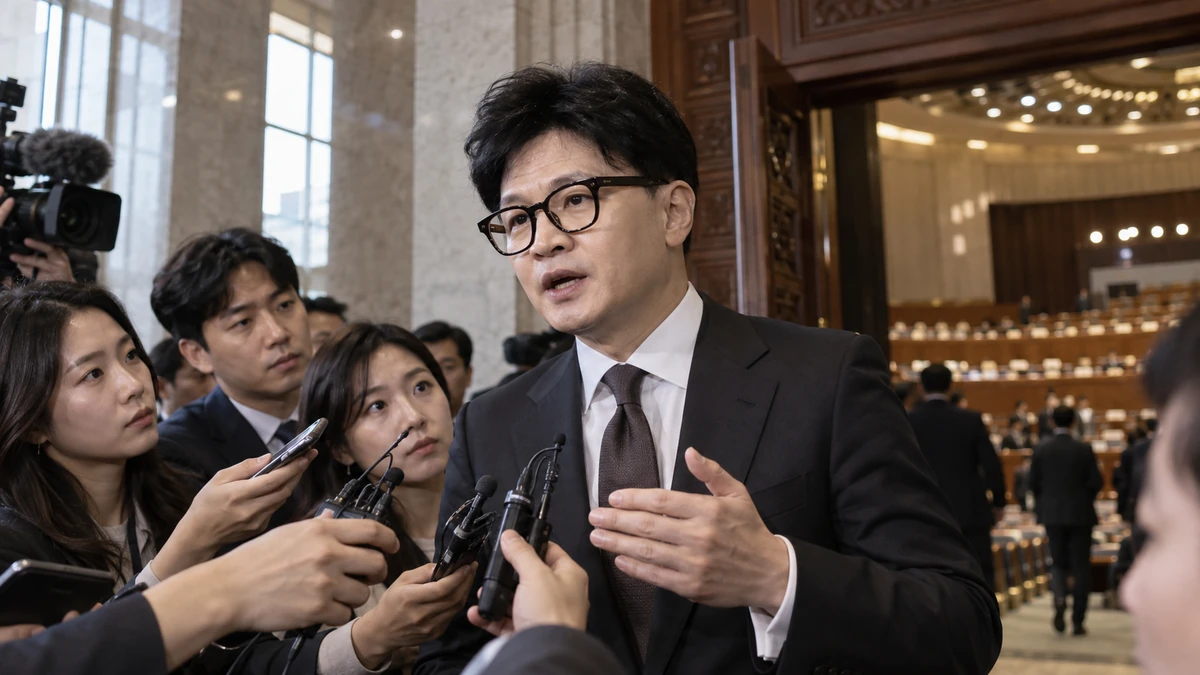
Image to help understand the article
A Fight Over a Nominee Becomes a Fight Over Information
A dispute over South Korea’s next justice minister has widened into a confrontation over confidential sources, alleged prosecutorial leaks and the opposition’s ability to police its own ranks — a combination that will sound familiar to Americans accustomed to bruising battles over the Justice Department.
According to the Korean news account provided for this article, independent lawmaker Han Dong-hoon said on the 10th that he had filed a criminal complaint with Seoul’s Yeongdeungpo Police Station against Democratic Party leader Kim Min-seok, alleging the dissemination of false information. The account does not specify the month or year. Han’s complaint followed Democratic leaders’ allegations that his attacks on justice minister nominee Kim Seung-won depended on leaked investigative material and help from inside the prosecution service.
Han denied receiving material from prosecutors or cooperating with them. He also refused demands to identify the person who supplied information behind his allegations. Democratic leaders, meanwhile, described the dispute as an investigative-material leak scandal and raised the possibility of expelling him from the National Assembly, South Korea’s legislature.
The available account establishes that accusations and denials were exchanged, not that either side’s underlying claims have been proved. It does not describe the substantive allegations against the nominee in enough detail to assess them, reproduce the criminal complaint or report a police finding. That distinction matters: A complaint can initiate a legal process, but it is not a determination that a crime occurred.
Why the Justice Ministry Is Such Sensitive Ground
For an American audience, the closest reference point is a fight over an attorney general nominee that expands into accusations about who inside the Justice Department is feeding information to Congress. The comparison is useful, but incomplete. South Korea’s justice minister operates within a different constitutional and administrative system, and its legislature does not perform precisely the same appointment role as the U.S. Senate.
The broader institutional concern is recognizable in both countries. Prosecutors possess information that can damage reputations well before allegations are tested in court. Political officials must be able to scrutinize the people overseeing law enforcement. Those two realities create recurring tension between legitimate oversight and the improper use of investigative power.
South Korea’s prosecution service has long been central to disputes over political accountability and institutional reform. Investigations involving powerful figures can demonstrate that no one is above the law. They can also prompt accusations that law enforcement is being deployed selectively. A justice minister nomination therefore carries significance beyond the qualifications of one candidate: It can become a proxy battle over who controls investigative institutions and whether the public trusts them.
In this case, the competing arguments operate on separate tracks. Han is challenging the nominee and defending his source. Democratic leaders are challenging how Han obtained his information. Neither argument automatically resolves the other. Evidence of an improper disclosure would not, by itself, establish that the underlying allegations were false. Nor would accurate allegations automatically establish that every method used to obtain information was lawful.
The Legal Complaint Raises the Stakes
Han announced his complaint while speaking to reporters before attending a National Assembly plenary session, according to the account. His central denial was categorical: He said he had neither received documents from prosecutors nor worked with them. He also dismissed the suggestion that prosecutors serving under the current administration would have supplied him with such material.
Democratic leaders offered a sharply different interpretation. They argued that the episode could not have unfolded without a collaborator inside the prosecution service. Their use of a scandal label, coupled with discussion of parliamentary expulsion, moved the confrontation beyond an ordinary disagreement over a nominee’s record.
Filing a criminal complaint creates the possibility of an official inquiry into statements that otherwise might remain part of political debate. But the summary does not identify the precise statutory provision Han invoked or establish whether police had begun substantive investigative work. It would therefore be premature to predict charges, a trial or any particular legal outcome.
Americans should also be careful about assuming that South Korean disputes over false statements operate under U.S. free-speech rules. South Korea retains criminal defamation provisions, while American public officials generally face demanding constitutional standards when bringing civil defamation cases over statements concerning their official conduct. That broad difference helps explain why a political clash in Seoul may produce a criminal complaint where a comparable Washington dispute would more often center on a civil lawsuit, an ethics proceeding or public rebuttals. It does not establish which law governs this particular complaint.
Protecting a Source Is Not the Same as Proving a Claim
Han framed his refusal to identify the informant as an obligation to protect someone who had come forward. In unusually combative language, he compared the demand for disclosure to a gangster trying to identify the people whose tips had helped send him to prison. He pledged to protect his source even at personal risk.
That analogy was Han’s political characterization, not evidence that the officials seeking disclosure had committed a crime or threatened the informant. Its purpose was clear: to portray the dispute as a test of whether people can expose wrongdoing without becoming targets themselves.
The issue has a close American parallel in congressional investigations, inspector general complaints and reporting based on confidential sources. People with knowledge of possible misconduct may fear retaliation, loss of employment or public harassment. Protecting their identities can make oversight possible. At the same time, confidentiality makes it harder for outsiders to evaluate a source’s access, motives and firsthand knowledge.
Those concerns are not mutually exclusive. A credible review can seek corroborating records, establish a timeline and test specific allegations without immediately publishing a source’s name. Conversely, an assertion that someone is a protected informant cannot substitute for evidence. The account does not establish whether Han’s source qualifies for any particular legal whistleblower protection, and that status should not be assumed.
For readers, the practical question is not simply whether Han names the source. It is whether the information can be independently substantiated and whether any alleged disclosure violated an applicable rule. Keeping those questions distinct is essential to avoiding a political trap in which either secrecy or disclosure is treated as automatic proof of guilt.
A Divided Opposition Complicates the Hearing
The dispute also exposed a separate struggle inside the conservative People Power Party. Although the account identifies Han as an independent, an ally on the party’s leadership council urged officials to restore a path for him to participate in the nominee’s hearing.
Woo Jae-jun, a youth representative on the party’s Supreme Council, argued that Han should be included because he had taken the lead in bringing the allegations to public attention. His proposed route was to cancel or suspend the party discipline affecting Han, restore his membership and place him on the hearing panel.
Cho Gwang-han, an appointed member of the same council aligned with the party leadership, opposed that idea. He cited suspected criminal conduct as the reason Han had been expelled from the party and argued that including him would be inappropriate. The account supplies no underlying evidence with which to evaluate that accusation. Party expulsion is also distinct from expulsion from the National Assembly: The former concerns membership in a political organization, while the latter would concern an elected legislative seat.
Floor leader Jung Jeom-sik raised both procedural and institutional objections. He said an independent lawmaker could not simply be substituted for a People Power Party member because National Assembly rules allocate committee positions among parliamentary negotiating groups and independents. He also argued that temporarily suspending discipline for immediate political needs would undermine the party’s foundations.
For Americans, the closest comparison is a congressional party deciding whether a controversial former member of its caucus should receive a prominent committee platform. Committee assignments determine who gets to question witnesses, request records and shape a televised proceeding. South Korea’s specific allocation rules differ, but the political dilemma is familiar: An effective attacker may also be someone party leaders do not trust.
What This Means for the United States
The immediate American stake is institutional rather than commercial. South Korea is a U.S. treaty ally, a major economy and an important partner in regional security and technology supply chains. Washington benefits from a Korean government whose decisions are credible, whose legal institutions are trusted and whose political disputes can be managed through established procedures.
That does not mean this nomination fight threatens the alliance. Nothing in the supplied account establishes a change in defense cooperation, trade policy or Seoul’s approach to Washington. Nor does it document a reaction from the U.S. government, American investors or U.S. companies. Treating the complaint as an alliance crisis or a market-moving event would outrun the evidence.
For American businesses operating in South Korea, the broader relevance is predictability. Companies in any foreign market need to understand how regulators, prosecutors and political leaders exercise authority. A dispute involving the leadership of the justice system is worth monitoring for what it may reveal about institutional priorities, but this account identifies no new compliance requirement or specific business exposure.
American audiences also have a useful domestic comparison. Washington has repeatedly wrestled with whether disclosures involving law enforcement represent protected whistleblowing, unauthorized leaks or partisan efforts to influence public opinion. Congressional investigations often become battles over the source of information as well as its substance. The lesson is not that the two countries’ legal systems are interchangeable; it is that democracies face similar pressures when sensitive investigative information enters electoral politics.
For Americans whose connection to Korea begins with K-pop, television dramas or Korean films, this story offers a different view of the country behind those exports. South Korea’s cultural reach coexists with intense disputes over executive power and legal accountability. There is no demonstrated connection here to entertainment companies, artists or American fans’ access to Korean content. The relevant connection is civic: Understanding a major cultural partner requires looking beyond its entertainment industry.
Two Standards of Accountability Collide
The confrontation illustrates a recurring problem in democratic oversight. An administration can reasonably demand to know whether confidential investigative material has been mishandled. An opposition politician can reasonably insist that allegations against a powerful nominee deserve examination. Either position becomes less persuasive when it is used to avoid the other question altogether.
Han escalated the political pressure by urging President Lee Jae-myung to withdraw Kim Seung-won’s nomination. He warned that proceeding with the appointment would damage the administration and characterized the president as becoming complicit if he failed to act. That was a political accusation. The account does not establish a legal basis for attributing criminal responsibility to Lee.
Han also called for opponents of the nomination to work together, while dismissing criticism from within the conservative camp. His response highlights how the nomination fight and his own standing have become intertwined. A hearing role could give his allegations an official platform; refusing him that role could limit his participation without resolving the allegations themselves.
The resulting incentives are difficult. Democratic leaders have an interest in scrutinizing the provenance of damaging information. Conservative leaders must decide whether cooperation with Han serves their oversight goals or weakens their disciplinary authority. Han has an interest in keeping attention on both the nominee and his pledge to protect the source. None of those interests tells the public which factual claims are correct.
What to Watch Next
The most important next development is evidence, not another forceful statement. A fuller account of the allegations against the nominee, supporting documentation and a substantive response would make it possible to assess the nomination on its merits. The summary supplied here does not include a response from Kim Seung-won to the underlying claims.
A second question is what happens to Han’s complaint. Confirmation of its legal basis and any subsequent police action would clarify whether the dispute is moving toward a formal investigation or remains primarily a political confrontation. Filing, investigation, charging and conviction are separate stages and should not be conflated.
A third issue is the hearing itself: who will participate, what information lawmakers will be able to examine and whether committee procedures can accommodate a meaningful review despite the opposition’s internal conflict. A decision about Han’s party status would matter politically, but it would not settle whether the nominee is fit to serve.
For U.S. observers, the useful measure is whether South Korea’s institutions can separate those questions and answer them through a credible process. The immediate story is a complaint between political rivals. The larger issue is how a close American ally handles the collision of confidential information, prosecutorial authority and legislative oversight — without allowing allegations about one to erase scrutiny of the others.
Comments
Post a Comment