Image to help understand the article
Gangwon Expands Its AI Ambitions Beyond a Single City
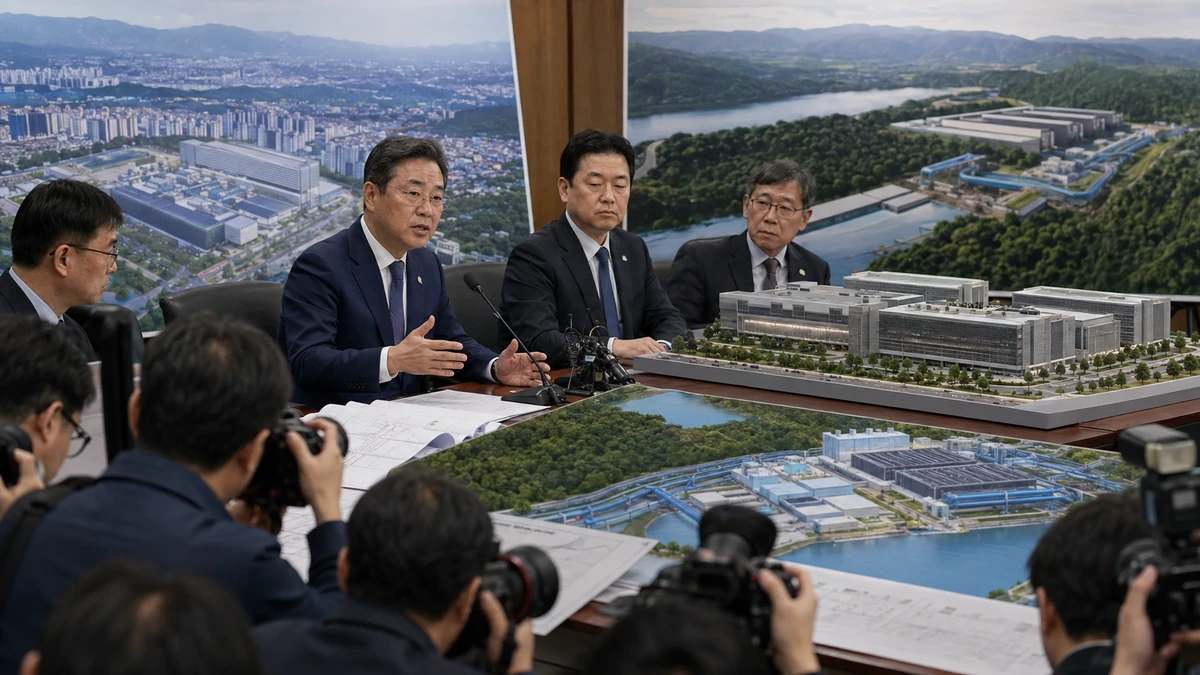
South Korea’s Gangwon State is pursuing talks with some of the country’s best-known corporate groups as it tries to build a network of artificial intelligence data centers outside the Seoul metropolitan area. Gov. Woo Sang-ho said the provincial government is discussing a proposed facility in Wonju with telecommunications giant KT, while retail-to-property conglomerate Shinsegae is considering an investment in an energy-focused industrial cluster in Chuncheon. Neither project has received final approval, and Woo drew a clear distinction between corporate interest and a binding investment decision. That caution matters in the data center business, where a promising site can still be derailed by questions about electricity supply, cooling systems, land use, financing and regulation.
The discussions nevertheless reveal a larger strategy. Gangwon is already promoting proposed AI data center projects involving GS in the eastern coastal city of Donghae and SK in Gangneung. If the Wonju and Chuncheon negotiations also advance, the result would be a multi-city development plan rather than a single showcase facility. Gangwon appears to be matching different locations with different companies and local advantages, an approach that resembles regional economic development strategies in the United States in which governors assemble clusters of projects across several cities instead of betting everything on one large corporate campus.
Gangwon, officially designated a special self-governing province, is best known internationally for mountains, ski resorts and the 2018 Winter Olympics in Pyeongchang. It sits east of Seoul and includes both inland cities and communities along the Sea of Japan, which Koreans call the East Sea. The province has historically had a smaller industrial base than the densely populated Seoul region. Its push into AI infrastructure therefore reflects a broader question facing South Korea: whether the economic gains from the next technology cycle can be distributed beyond the capital and its surrounding cities.
Why Data Centers Have Become a Regional Prize
AI systems depend on enormous amounts of computing power. Data centers house the servers, networking equipment and storage systems that train AI models, process information and deliver digital services. The rapid spread of generative AI has increased demand for specialized chips and facilities capable of operating them at scale. It has also intensified competition among governments seeking the investment, construction spending and prestige associated with those projects.
But a data center is not the same kind of economic engine as a traditional factory. A manufacturing plant may employ hundreds or thousands of workers directly on production lines. A large data center can require substantial investment and create many construction jobs while employing a comparatively limited permanent operations staff once it opens. It can also consume large amounts of electricity and water, depending on its design and cooling technology. Those trade-offs are familiar in the United States, where proposed data center developments frequently prompt debates over utility capacity, tax incentives, water use and whether the number of long-term jobs justifies public support.
Gangwon’s leaders appear conscious of that limitation. The province is not presenting server buildings alone as an automatic technology ecosystem. Instead, officials say they want participating corporations to work with small and midsize companies in the region, recruit local workers and encourage affiliates or suppliers to make follow-on investments. The distinction is important. A data center that buys few goods and services locally can function as an isolated piece of infrastructure. A project tied to training programs, regional contractors, software companies, energy providers and equipment suppliers has a better chance of producing benefits that remain in the community.
That is why the most consequential part of Gangwon’s proposal may not be the number of facilities. It is the structure surrounding them. Provincial officials are effectively asking whether AI infrastructure can serve as an anchor for a broader industrial network, much as an auto assembly plant can attract parts suppliers or a semiconductor factory can stimulate specialized construction, materials and engineering businesses.
Big Korean Business Groups Remain Central
Gangwon’s preference for projects involving major South Korean corporations reflects the distinctive role of large business groups in the country’s economy. Often described by the Korean term chaebol, these groups typically consist of many affiliated companies connected through ownership, management or family control. Americans may recognize Samsung, Hyundai, LG and SK, but similar corporate networks operate across retail, telecommunications, construction, energy, finance and logistics. KT, once the state telecommunications monopoly, remains one of South Korea’s dominant communications and digital-services companies. Shinsegae is widely associated with department stores and retail but also has interests across a much larger corporate portfolio. GS and SK likewise operate through numerous affiliates.
Woo said Gangwon is considering three broad categories of potential investors: partnerships between a Korean conglomerate and a large foreign technology company, direct investment by a foreign company, and investment funds that have secured overseas customers. The province is giving priority to the first category, according to the governor. That does not amount to a rejection of foreign capital. Rather, it suggests Gangwon wants international technology and demand to be connected to Korean companies with established domestic operations.
From the province’s perspective, a Korean corporate partner may be better positioned to sign cooperation agreements with local businesses, recruit from regional universities or vocational programs and bring additional affiliates into the area. A large domestic group also has experience navigating South Korea’s permitting, utility and labor environment. Whether those potential benefits materialize will depend on the final contracts. Cooperation pledges, hiring plans and follow-on investments are goals at this stage, not confirmed outcomes.
The strategy also reflects a balancing act familiar to governments around the world. Officials want access to global capital and cutting-edge technology, but they also want domestic companies and workers to capture a meaningful share of the value. For South Korea, a country whose export economy is closely connected to global supply chains, the challenge is not choosing between foreign and Korean investment. It is designing partnerships that keep international projects connected to local industry.
Chuncheon’s Water-Energy Cluster Faces a Regulatory Test
The Chuncheon proposal carries an additional complication: the method used to choose companies for the site. Shinsegae is reviewing an investment in the city’s so-called water thermal energy convergence cluster. The concept uses the thermal characteristics of water as part of an energy system, an approach that could be relevant to data centers because servers generate intense heat and require continuous cooling. Cooling efficiency has become a major concern for operators as AI hardware increases the power density inside data halls.
According to Woo, current guidance from South Korea’s Ministry of Land, Infrastructure and Transport calls for a lottery when multiple companies seek to enter the cluster. Gangwon officials argue that such a system creates uncertainty for large corporations, which may spend months evaluating power, engineering, financing and customer requirements before making a commitment. A company may be reluctant to complete that work if it cannot predict whether it will receive the site.
The province has asked the ministry to allow a review process that would select the bidder offering the strongest overall terms. Such a system could consider not only the size of the investment but also local hiring, cooperation with regional companies and the possibility of additional projects. No change has been finalized, and no company has been selected for the Chuncheon site. The dispute remains a policy negotiation rather than a completed reform.
Still, the issue illustrates how rules written for conventional industrial land can clash with the demands of modern technology projects. A lottery may appear neutral and transparent, but it gives the local government little ability to compare the quality of competing proposals. A discretionary selection process can reward a stronger economic package, but it also requires clear standards and safeguards against favoritism. American communities encounter a similar tension when they negotiate development agreements, tax abatements or requests for proposals. Officials want flexibility to secure the best deal, while residents expect the process to be fair and publicly accountable.
What the Gangwon Push Means for the United States
For the United States, Gangwon’s plans offer another sign that AI infrastructure is becoming an international supply-chain and economic-development issue, not merely a competition among software companies. American cloud providers, chip designers, equipment vendors and institutional investors operate in a market where the physical location of computing capacity increasingly matters. Power availability, cooling costs, network connections and national rules governing data can shape where companies expand. South Korea is both a major technology market and a treaty ally of the United States, making its infrastructure choices relevant to American businesses even when no U.S. company has been publicly identified in a particular negotiation.
Gangwon has explicitly said it is interested in partnerships that connect large foreign technology companies with Korean conglomerates. That model could eventually create openings for American companies seeking a local partner, although the talks described by provincial officials do not establish that any U.S. company is participating. Korean groups can contribute domestic relationships, land-development experience and knowledge of the regulatory system. A foreign technology company could bring customers, computing platforms or technical requirements. For American executives, the key question would be whether such partnerships provide reliable access to electricity, transparent site selection and commercially workable rules.
American audiences should also recognize the local political argument. Across the United States, elected officials have marketed data centers as part of the AI economy, while communities have asked harder questions about utility bills, land consumption, tax revenue and permanent employment. Gangwon is trying to answer the jobs question by attaching data centers to regional suppliers and hiring commitments. If those requirements become enforceable parts of investment agreements, the province could offer a case study for U.S. states looking to increase the local payoff from capital-intensive technology facilities. If they remain broad aspirations, Gangwon could face the same criticism heard in American development debates: that the public helped secure expensive infrastructure without receiving a proportionate number of lasting jobs.
The initiative also fits into the larger U.S.-South Korea technology relationship. The two countries already cooperate closely across semiconductors, batteries, telecommunications and advanced manufacturing. AI data centers sit at the intersection of those sectors because they require chips, electrical equipment, construction expertise, software and dependable energy. Gangwon’s preference for alliances between domestic and international companies is consistent with an era in which Washington and Seoul increasingly view technology capacity through both commercial and strategic lenses. The specific Gangwon projects remain preliminary, but the partnership model is one American companies and policymakers will likely encounter more often.
A Test of South Korea’s Effort to Spread Growth Beyond Seoul
South Korea’s economic geography is unusually concentrated. Seoul, neighboring Incheon and the surrounding Gyeonggi province account for a large share of the country’s population, corporate headquarters and high-paying professional jobs. That concentration has fueled persistent concerns about housing costs in the capital region and population decline elsewhere. Regional governments have responded by seeking universities, government agencies, factories and technology projects that can retain younger residents.
Gangwon’s data center strategy belongs to that decentralization effort. Wonju, Chuncheon, Donghae and Gangneung have different economic profiles, transportation links and geographic advantages. Connecting projects across all four would allow the province to present itself as a broader AI infrastructure corridor rather than a single secondary market. It could also reduce the pressure to reproduce Seoul’s startup scene in one location, an unrealistic goal for many regional governments.
Yet infrastructure does not erase structural challenges by itself. Technology workers may still prefer the capital region if career opportunities, schools, transportation and professional networks remain concentrated there. Local companies cannot automatically become data center suppliers without meeting demanding standards for security, reliability and technical performance. Universities and training institutions would need a clear understanding of the jobs that operators actually plan to create. In other words, the province would have to build the links it is promising rather than assume proximity will produce them.
This is another point of comparison with the United States. Communities that land a semiconductor plant, battery factory or cloud-computing campus often discover that the announcement is only the beginning. Roads, transmission lines, workforce programs and supplier recruitment determine whether a project becomes part of the regional economy. Gangwon’s emphasis on an ecosystem suggests officials understand that lesson. The eventual investment terms will show how seriously they apply it.
What Could Still Derail the Plans
The most immediate risk is that preliminary discussions never become signed projects. KT’s talks over Wonju and Shinsegae’s review of Chuncheon indicate corporate interest, but they do not guarantee construction. The initiatives involving GS in Donghae and SK in Gangneung are also described as projects the province is pursuing, not completed facilities. Investors will still need to assess costs, energy access, customers, permits and the broader business environment.
Electricity is likely to remain central to any AI data center decision. Advanced computing facilities need not only large amounts of power but also confidence that the grid can deliver it continuously. Cooling is another major cost and engineering challenge, which helps explain the appeal of Chuncheon’s water-based energy cluster. Local acceptance may also matter if communities become concerned about environmental effects or whether promised economic benefits will reach residents.
The selection rules in Chuncheon create a more immediate institutional question. If the national government retains the lottery system, potential investors may decide that the uncertainty is too great. If the rules shift to competitive evaluation, officials will need criteria that are measurable and transparent. Commitments involving local hiring or supplier participation would be more meaningful if they include timelines and reporting requirements.
Gangwon must also manage expectations. Public announcements involving household-name conglomerates can create the impression that deals are complete long before contracts are signed. Woo’s effort to separate ongoing talks from final decisions is therefore significant. Maintaining that distinction will be essential if negotiations take longer than expected or companies alter their plans.
The Real Measure Will Be the Network Around the Servers
Gangwon’s initiative is best understood as an early blueprint rather than a finished investment map. The province has identified cities, corporate partners and a preferred model linking Korean conglomerates with international technology companies. It has also articulated a goal that goes beyond construction: using data centers to connect regional businesses, workers and future investors.
The next phase will determine whether that language becomes an operating strategy. Observers should watch whether KT and Shinsegae move from discussions to formal commitments, whether the Donghae and Gangneung projects advance, and whether the national government changes the company-selection process in Chuncheon. Equally important will be the details of any local hiring, training or supplier agreements. Those provisions will indicate whether Gangwon is building an AI economy or simply hosting its hardware.
For American companies and policymakers, the province’s experiment bears watching because it combines several trends shaping the global technology market: intense demand for AI computing, pressure on electricity and cooling systems, competition among regions for capital, and government efforts to tie foreign investment to domestic economic benefits. South Korea’s established corporations give Gangwon potential partners with deep resources, but corporate scale alone will not guarantee regional development.
The province’s wager is that AI infrastructure can become a platform for a new industrial ecosystem in a part of South Korea better known for tourism and natural scenery than for computing. Whether that wager succeeds will not be measured by the number of servers installed or the size of the opening-day investment announcement. It will be measured by the businesses that grow around the facilities, the workers who gain durable careers and the partnerships that connect Gangwon to South Korea’s technology sector and the wider global market.
Comments
Post a Comment