Image to help understand the article
A mosquito rebound after the worst heat
South Korea’s mosquito population nearly doubled in a single week as extreme summer heat eased and wetter, milder conditions returned, offering a counterintuitive lesson for public health officials and residents: The end of a heat wave does not necessarily mean the end of mosquito season.
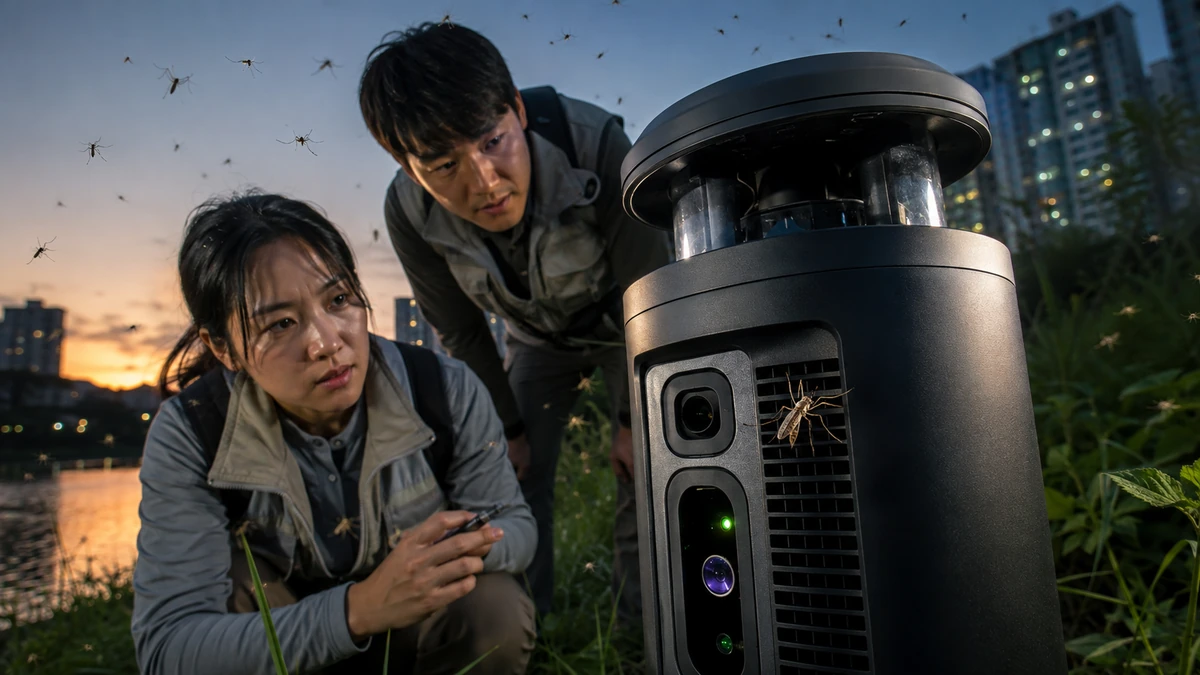
According to figures released Sept. 6 by the Korea Disease Control and Prevention Agency, or KDCA, the country’s real-time mosquito index reached 100.9 specimens during the week of Aug. 24-29, the 35th monitoring week of 2026. That was up from 53.0 the previous week, an increase of about 90%. It was also the first time the index had exceeded 100 since South Korea introduced artificial intelligence-based real-time mosquito monitoring equipment earlier in the year.
The index is not a simple estimate of how many mosquitoes exist nationwide. It reflects mosquito activity recorded by monitoring devices across seven regions and is intended to help authorities follow changes over time. The most important signal is the direction and speed of the movement: Mosquito activity can rise sharply even after appearing to retreat.
The weekly pattern has been volatile rather than steadily increasing. From monitoring weeks 28 through 32, the index moved around the 40-to-50 range. It then jumped to 99.5 in week 33, dropped to 53.0 in week 34 and climbed again to 100.9 in week 35. Those swings illustrate how quickly mosquito activity can respond to short-term changes in temperature, rainfall and humidity.
For residents, the practical message is that a few quiet nights are not proof that mosquito season is over. Screens, repellents and other precautions can still be necessary as summer gives way to fall, particularly after rain creates new pools of standing water.
Why cooler weather can bring more mosquitoes
The rebound may seem surprising to anyone who assumes mosquitoes thrive most during the hottest part of summer. In reality, mosquitoes are highly sensitive to environmental conditions, and extreme heat can suppress their activity. They are generally active at temperatures around 77 to 86 degrees Fahrenheit, or 25 to 30 degrees Celsius. Conditions approaching 104 degrees Fahrenheit, as parts of South Korea experienced during the summer, can become less favorable.
South Korea endured intense heat through the middle of August, with daytime temperatures approaching 40 degrees Celsius in some places. During that period, people may have felt as if there were fewer mosquitoes. The apparent relief did not last. Rain arrived around the Aug. 15 Liberation Day holiday, humidity increased and morning lows fell below 25 degrees Celsius. Those changes made mornings and evenings more comfortable for people — and apparently more suitable for mosquitoes.
Liberation Day is one of South Korea’s most important national holidays. It commemorates the end of Japanese colonial rule in 1945 and is marked by ceremonies, flags and a public holiday. In this case, the holiday also served as a familiar point on the calendar for a noticeable change in weather.
Rain matters because mosquitoes lay eggs in or near standing water, depending on the species. Water collected in clogged drains, flowerpot saucers, buckets, discarded containers and other small spaces can provide breeding habitat. A period of severe heat followed by rain and moderate temperatures can therefore produce conditions more favorable to mosquito activity than the hottest days themselves.
This is why calendar-based assumptions can be misleading. Meteorological summer may be ending, but biological activity does not follow a fixed holiday schedule. In a warming and increasingly variable climate, abrupt changes between heat, rainfall and humidity may become as important to public health planning as seasonal averages.
Not every mosquito carries the same risk
The sharp increase in the overall index does not mean every mosquito-borne disease threat rose at the same rate. South Korean surveillance separates total mosquito activity from the presence of particular species that can transmit infections. That distinction is essential because most mosquito encounters are a nuisance, while only certain species are relevant to specific diseases.
The index for Culex tritaeniorhynchus, the principal mosquito associated with Japanese encephalitis transmission in South Korea, averaged 102 specimens in the 35th week. That was up from 68 a week earlier, a 50% increase. However, it remained less than half the 228 recorded during the same period a year earlier.
Both comparisons matter. The week-to-week rise indicates that the mosquito was becoming more active, while the year-over-year decline shows that its level remained comparatively lower than in 2025. Focusing on only one of those figures could produce a distorted interpretation — either unwarranted reassurance because the number was lower than last year’s or unnecessary alarm because it rose quickly in a week.
Japanese encephalitis is a viral disease transmitted through the bite of an infected mosquito. South Korea has a vaccination program, and the disease is far less familiar to most Americans than illnesses such as West Nile virus. Still, it remains an established public health concern across parts of Asia and the Western Pacific. The mosquito’s presence is a signal for surveillance and prevention, not evidence that every bite is likely to cause infection.
Mosquitoes associated with malaria showed a different trend. During the 34th monitoring week, Aug. 17-23, the index for Anopheles mosquitoes averaged 3.5 specimens. That was nearly unchanged from 3.6 the previous week and below the 7.9 recorded during the same period a year earlier.
South Korea’s malaria context may be unfamiliar to many Americans. The country has dealt with locally acquired cases of vivax malaria, particularly in areas near the Demilitarized Zone separating South and North Korea. The heavily fortified border is best known internationally as a military flashpoint, but surrounding rural and wetland environments also shape disease surveillance. The relatively low mosquito index in the period reported does not eliminate malaria concerns; it shows why species-specific information is more useful than treating every increase in the total mosquito count as an equal increase in every disease risk.
Artificial intelligence enters mosquito surveillance
The new monitoring system also reflects a broader shift in public health: Authorities are seeking faster and more detailed information instead of relying only on slower collection and laboratory identification. South Korea’s AI-based equipment is designed to provide real-time information about changing mosquito activity across seven regions.
Traditional mosquito surveillance often involves traps whose contents must be collected, counted and identified. Automated systems can potentially shorten the time between a change in local insect activity and the government’s awareness of it. In South Korea’s case, the technology produced a clear numerical picture of a phenomenon residents might otherwise describe only as a sudden return of mosquitoes after the heat eased.
The value of such a system is not that an index of 100.9 can predict exactly who will be bitten or whether an outbreak will occur. Its value lies in detecting movement, comparing regions and separating the trends of disease-carrying species from the overall mosquito population. A rapid rise can prompt officials and the public to reinforce prevention before hospital reports or confirmed infections provide a later warning.
There are limits to interpreting any surveillance index. Trap locations, local weather and the behavior of different species can all affect what equipment records. A national figure can also obscure neighborhood-level differences. Dense apartment districts, rural rice-growing areas, military zones and coastal communities do not provide identical mosquito habitats. The data are therefore best understood as a public health indicator rather than a literal mosquito census.
South Korea is well positioned to make this kind of technology visible to the public. The country has extensive digital infrastructure and a population accustomed to government-issued alerts, including emergency messages sent to mobile phones during severe weather and other hazards. The mosquito index fits into that larger culture of using frequently updated data to guide individual behavior.
What the surge means for the United States
For Americans, South Korea’s numbers are not a direct forecast. The two countries have different mosquito species, climates, disease patterns and surveillance systems. But the Korean experience reinforces a principle that applies across much of the United States: Mosquito risk depends on recent conditions, not simply on whether the calendar says summer is ending.
American communities routinely monitor mosquitoes linked to West Nile virus and other diseases, and local mosquito-control districts often adjust trapping and treatment based on rainfall and temperature. As in South Korea, total mosquito abundance does not automatically equal disease risk. The species present, the pathogens circulating among animals and people, and the timing of mosquito activity all matter.
The comparison is especially relevant in U.S. regions where late-summer heat is followed by storms or periods of moderate weather. Residents may spend more time outdoors once oppressive temperatures break, just as mosquitoes encounter improved conditions. That combination can increase opportunities for contact even if the hottest days have passed.
South Korea’s real-time approach may also interest American public health agencies and technology companies developing automated insect traps, image-recognition systems and environmental sensors. AI can help sort large volumes of information, but public agencies still need transparent standards, trained specialists and disease testing to interpret what automated systems detect. A machine-counted surge should lead to better questions and faster fieldwork, not replace epidemiology.
The issue also has a direct connection to the U.S.-South Korea relationship. Tens of thousands of U.S. service members, along with military families and civilian employees, are stationed in South Korea under the countries’ security alliance. American tourists, students and business travelers also move between the two nations. Seasonal health guidance issued in South Korea can therefore be relevant to Americans living or traveling there, particularly those spending time outdoors near rural areas or the border region.
For the U.S. travel industry and companies with operations in Korea, the immediate implications are modest: The reported increase is a prevention signal, not a declaration of a health emergency. Employers and travel programs can nevertheless reinforce practical advice on repellents, clothing and lodging screens. That is similar to the routine guidance American universities and companies provide for travel to regions where mosquito-borne illnesses are present.
The larger lesson for U.S. audiences is about risk communication. A dramatic percentage increase can attract attention, but it needs context. The Japanese encephalitis mosquito index rose 50% in a week while remaining well below the previous year’s level. The malaria-related mosquito index stayed nearly flat. Communicating all three facts — the total surge, the species differences and the year-over-year comparison — gives the public a more accurate picture than a headline about mosquitoes doubling.
Prevention continues into October
South Korean health authorities are asking the public to maintain mosquito precautions through October. Their recommendations are familiar but effective: Reduce outdoor activity after sunset when possible, wear light-colored long sleeves and loose-fitting pants, and apply mosquito repellent to exposed skin.
Loose clothing adds distance between fabric and skin, making it more difficult for mosquitoes to bite through material. Light colors are commonly recommended because some mosquitoes are more attracted to darker visual targets. Repellents should be used according to product directions, including instructions for children and for reapplication.
At home, residents are urged to inspect window and door screens for tears or gaps. Screens are common in South Korean housing because many homes rely on open windows for ventilation during parts of the year. In high-rise apartment buildings — a defining feature of urban life in Seoul and other Korean cities — mosquitoes can still enter through damaged screens, open hallways and other access points.
Removing standing water is the other major step. Residents should check containers, drainage areas and other places where rainwater can collect. The amount of water does not have to resemble a pond; relatively small accumulations can support breeding. Prevention works best when personal protection and environmental cleanup happen together. Repellent does not remove breeding habitat, and eliminating water around a home does not prevent exposure somewhere else.
The Korean guidance is comparable to advice from U.S. health agencies and local mosquito-control programs. That similarity is important: Although the diseases and species vary by country, the core tools available to households remain remarkably consistent. Screens, appropriate clothing, registered repellents and standing-water removal are low-technology measures that complement increasingly sophisticated surveillance.
A longer mosquito season requires a different mindset
The significance of South Korea’s 100.9 reading is not the number alone. It is the demonstration that mosquito activity can rebound rapidly when extreme heat gives way to rain, humidity and cooler nights. The decline from week 33 to week 34 might have appeared to signal relief. One week later, the index was at its highest point since the AI monitoring system began operating.
That volatility complicates the traditional public understanding of mosquito season as a smooth rise in early summer followed by a steady decline toward fall. In practice, local populations can surge and retreat in response to short weather windows. Public health messages may need to become more flexible as a result, focusing on current surveillance and conditions rather than broad seasonal expectations.
The next figures to watch are the species-specific trends. If total mosquito activity remains high while malaria-related mosquitoes stay at low levels, the public health interpretation will differ from a scenario in which disease-vector indexes climb at the same time. Authorities will also be looking at whether the Japanese encephalitis mosquito index continues its short-term rise or remains below last year’s levels.
For South Korea, the new system creates an opportunity to test whether rapid data can improve public behavior and local mosquito control. For the United States, it provides another example of how allies with advanced technology are adapting public health surveillance to environmental volatility. The most useful response is neither panic nor dismissal. It is to understand that cooler evenings can bring people back outside — and can bring mosquitoes with them.
Comments
Post a Comment