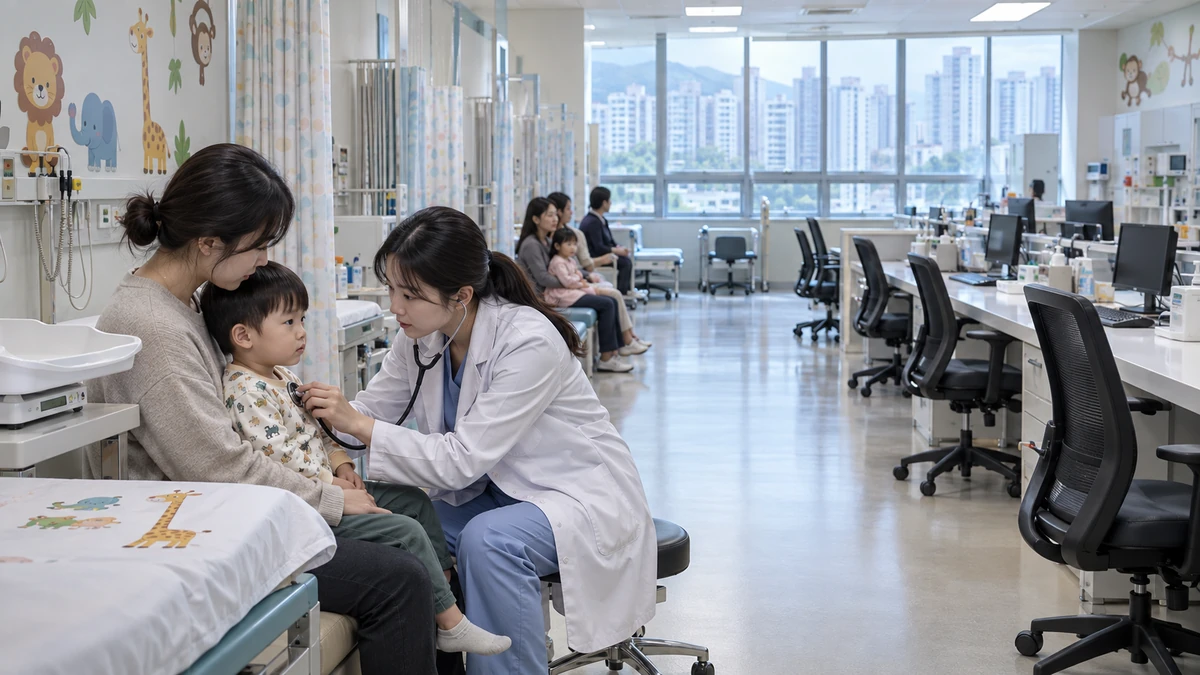
Image to help understand the article
South Korea has only 113 pediatric residents working at teaching hospitals nationwide, and nearly four in five are concentrated in Seoul, according to government data released by a lawmaker on the National Assembly’s Health and Welfare Committee.
Rep. So Byung-hoon of the opposition Democratic Party disclosed the Ministry of Health and Welfare figures on the 29th. As of September, 89 pediatric residents, or 78.8% of the national total, were working in the capital.
Resident workforce falls sharply
The remaining pediatric workforce included 35 first-year residents, 33 second-year residents, 35 third-year residents and 10 fourth-year residents. The total was down by 480, or 80.9%, from the 593 physicians eligible for appointment in 2021.
In South Korea, residents are physicians receiving specialty training after medical school, broadly comparable to residents in the U.S. health care system.
Pediatrics had filled nearly all available residency positions through 2018, but its recruitment rate began declining in 2019. It fell to 36.8% in 2021 and 27.5% in 2022. The application rate dropped from 112.1% in 2017, when applicants outnumbered positions, to 25.5% in 2023.
Departures accelerated during the 2024 conflict between the government and doctors. Of 236 pediatric residents eligible for appointment, 194 resigned, an 82.2% resignation rate. Those leaving included 59 first-year residents, 40 second-year residents, 44 third-year residents and 51 fourth-year residents.
Severe shortages outside Seoul
Outside the capital, the figures showed four pediatric residents each in Gwangju, Daejeon and Busan; three in Daegu; two each in Gyeonggi province, Ulsan and Jeju; and one each in South Chungcheong, North Chungcheong and North Jeolla provinces. Six major cities and provinces — Gangwon, North Gyeongsang, South Gyeongsang, South Jeolla, Sejong and Incheon — had none.
Recruitment for 2025 showed little sign of improvement. Sixty-one teaching hospitals sought 199 first-year pediatric residents but secured only 27, a 13.6% recruitment rate. Fifty-two hospitals, or 85.2%, failed to fill a single position.
Asan Medical Center recruited 10 residents, Seoul National University Hospital recruited eight and Samsung Medical Center recruited two. Asan and Seoul National University Hospital alone accounted for more than half of all newly recruited pediatric residents. Major regional national university hospitals, including those affiliated with Kyungpook National, Pusan National, Jeonbuk National, Chungbuk National, Kangwon National and Jeju National universities, recruited none.
Pay, workload and legal exposure
Low compensation, demanding working conditions and fears of legal liability following medical accidents have been cited as reasons young doctors avoid pediatrics.
Medical groups point to a 2017 case at Ewha Womans University Mokdong Hospital, where four infants being treated in a neonatal intensive care unit died of sepsis. Medical workers were detained before being acquitted after more than five years of investigation and court proceedings, intensifying concerns about potential criminal liability.
The government also lacks hospital-level employment data for pediatric subspecialists. The Health Ministry told So’s office that these credentials are privately certified by the Korean Academy of Medical Sciences and that it does not separately collect hiring information.
Children transferred for critical care
Only 59.7% of seriously ill pediatric patients receive treatment within their home region, meaning about four in 10 must be transferred elsewhere.
In July, a 32-month-old child whose condition deteriorated in Pyeongtaek, south of Seoul, could not find a nearby hospital able to provide critical emergency care. The child was first transported more than 12 miles to Cheonan, where doctors diagnosed septic shock, and was later transferred to Seoul. The child died the next day.
Officials and medical professionals warn that if the decline in residents leads to a broader shortage of pediatric specialists, it could destabilize both local emergency care and the system for transferring critically ill children between hospitals.
So called the shortage a crisis approaching “the level of a national disaster,” citing the 113 remaining residents and the failure of 85% of teaching hospitals to recruit even one new trainee. He urged the government to fund pediatric residency training and provide direct financial support to help hospitals retain subspecialists.
Comments
Post a Comment