South Korea’s President Lee Jae Myung Sees Approval Rating Fall Into the 30s, Raising Political Questions Ahead of 2028 Election
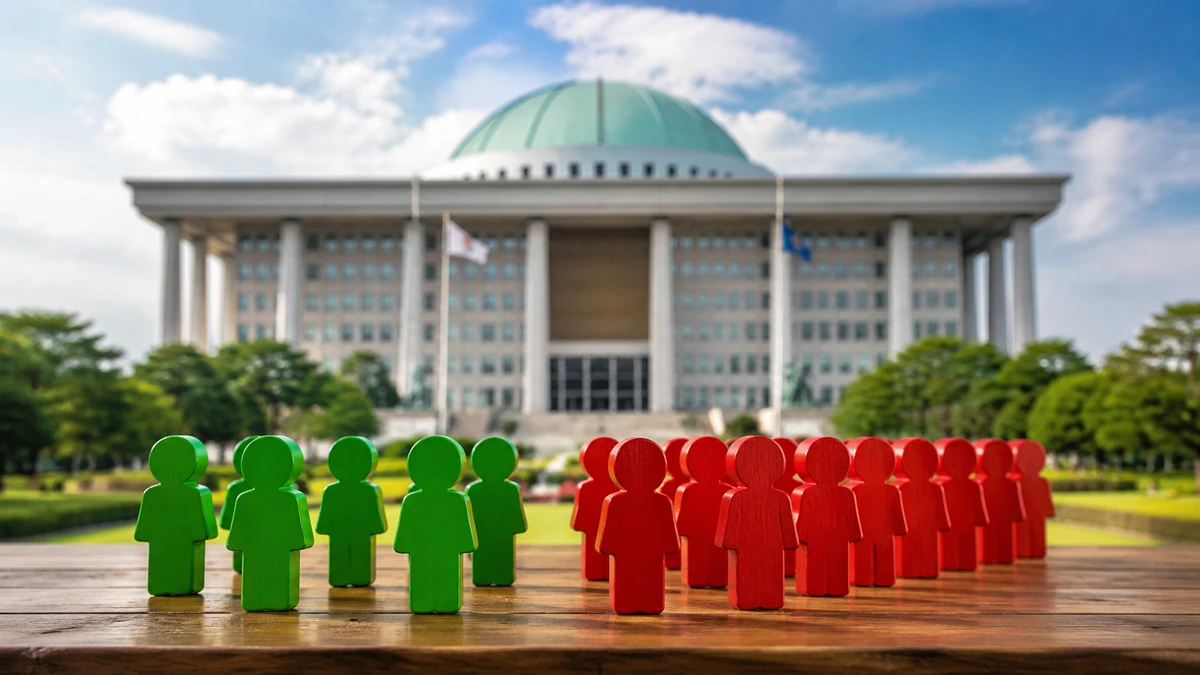
Image to help understand the article
South Korean President’s Approval Rating Drops Below 40% for the First Time
South Korean President Lee Jae Myung’s public approval rating has fallen into the 30% range for the first time since he took office, according to recent polling, marking a significant shift in the political environment surrounding his administration.
A Realmeter poll conducted from Aug. 24 to Aug. 28 among 2,509 South Korean adults found that 38.9% of respondents approved of Lee’s handling of state affairs, while 58.7% disapproved. The approval rating declined by 1.3 percentage points from the previous week, extending a seven-week downward trend in the survey.
For international observers, including audiences in the United States, presidential approval ratings in South Korea carry particular weight because the country’s political system is highly responsive to shifts in public sentiment. Unlike the U.S. system, where presidents serve fixed four-year terms with strong institutional separation from Congress, South Korean presidents often face intense pressure from public opinion because approval ratings can influence legislative cooperation, party unity and future election dynamics.
The decline does not automatically indicate a political crisis, but it highlights growing challenges for Lee’s administration as it attempts to maintain public support while managing economic concerns and internal political disputes.
Different Polling Methods Show Similar Direction, but Different Numbers
Other polling organizations reported similar trends, although the exact approval figures varied depending on methodology.
A Research Well survey conducted Aug. 26-27 among 1,000 adults showed Lee’s approval rating at 38.4%, with disapproval at 58.6%. Like the Realmeter poll, the survey used automated response technology, commonly known in South Korea as an ARS poll, where respondents answer questions through an automated phone system.
A Korea Gallup survey conducted Aug. 25-27 among 1,001 adults produced a somewhat different result. The poll, which used live telephone interviews rather than automated responses, showed Lee’s approval rating at 42% and disapproval at 50%, with 8% undecided.
The difference reflects a broader issue in modern political polling. Survey methodology can influence results because people may respond differently when speaking directly with an interviewer compared with using an automated system. Analysts generally caution against focusing on a single poll and instead examine broader trends across multiple surveys.
Despite differences in measurement, the surveys shared one important point: Lee’s approval rating has weakened compared with earlier periods of his presidency.
Housing Costs and Political Controversies Weigh on Public Sentiment
Polling analysts pointed to several issues that may have contributed to the decline in support for Lee’s government, including housing concerns, political disputes and questions about government credibility.
Realmeter cited public dissatisfaction over housing prices and rental costs as one factor. Housing affordability has long been one of South Korea’s most sensitive political issues, particularly in major cities such as Seoul, where home ownership is closely linked to financial security and social status.
For many South Koreans, especially younger generations, housing is not simply an economic issue but a symbol of opportunity and fairness. Rising property prices and difficult rental markets have repeatedly influenced elections and government approval ratings across administrations.
The polling analysis also cited controversy surrounding Lee’s refusal to appoint a Supreme Court justice nominee, which sparked debate over constitutional interpretation. Additional concerns included public distrust toward police following a high-profile missing-person case in Jeju and internal disagreements within the ruling Democratic Party of Korea.
Political divisions inside the ruling party have become another challenge. Reports following the party’s national convention on Aug. 17 indicated that factional tensions resurfaced shortly after new leadership took office. Party unity and preparation for future elections are now viewed as major tasks for Lee’s political allies.
What This Means for the United States: A Key Test for a Major Asian Ally
The political shift in South Korea matters to the United States because Seoul is one of Washington’s most important allies in Asia. South Korea plays a central role in regional security, technology supply chains and economic cooperation, particularly as tensions continue involving North Korea, China and broader competition in the Indo-Pacific.
For American policymakers and companies, changes in South Korean domestic politics are closely watched because government approval ratings can affect policy momentum. Issues such as semiconductor cooperation, artificial intelligence development, defense coordination and trade relationships often depend on political stability and public support.
South Korea’s political environment also has implications for American businesses operating in or partnering with Korean industries. Companies involved in advanced manufacturing, electric vehicles, batteries and technology infrastructure pay close attention to government priorities and regulatory direction.
There are also parallels with political dynamics familiar to Americans. U.S. presidents frequently experience approval changes based on inflation, housing costs, economic confidence and political controversies. However, South Korea’s presidential system creates a different political atmosphere because presidents typically serve a single five-year term without the possibility of immediate re-election, making each period of declining approval especially significant.
For American audiences following Korean affairs, the current decline should be understood as a snapshot of public sentiment rather than a prediction of political collapse. South Korea has experienced similar moments under previous presidents, and outcomes have varied widely.
History Shows Low Approval Ratings Do Not Always Determine Political Fate
South Korea’s political history provides examples of presidents whose approval ratings fell sharply but whose legacies developed differently.
Former President Kim Young Sam saw approval fall to 37% in the mid-1990s before eventually reaching much lower levels near the end of his presidency. Former President Park Geun Hye entered the 30% range in 2015 before experiencing a dramatic collapse that eventually led to her removal from office after a corruption scandal.
However, low approval ratings have not always resulted in political failure. Former President Roh Moo Hyun experienced approval ratings below 30% early in his term, yet his party gained significant support after the 2004 parliamentary election following his impeachment crisis.
Former President Moon Jae In also recorded a low approval rating of 29% in 2021 during a period marked by a real estate controversy and losses in local by-elections. Despite those challenges, Moon left office with relatively strong approval numbers compared with many previous South Korean presidents.
These examples demonstrate that approval ratings reflect current public mood but do not guarantee future electoral outcomes. Economic conditions, policy decisions, opposition strategy and unexpected events can all reshape political landscapes.
Looking Ahead to South Korea’s 2028 Parliamentary Election
The next major nationwide election in South Korea will be the parliamentary election scheduled for 2028, roughly two years away. Until then, Lee’s administration will face opportunities and risks as it attempts to address public concerns.
The decline follows the June 3, 2026 local elections, where the Democratic Party won 12 of 16 metropolitan and provincial governor races, while the opposition People Power Party won four. In Seoul, opposition candidate Oh Se Hoon won the mayoral race. Parliamentary by-elections held on the same day did not change the overall balance of power in the National Assembly.
The current polling decline therefore represents a change in public evaluation rather than an immediate shift in political control. The government’s future approval ratings are likely to depend on economic performance, housing policy, responses to social issues and the ability of the ruling party to manage internal disagreements.
For global observers, the key question is not simply whether Lee’s approval rating has fallen below 40%, but whether his administration can convert public concerns into policy results before the next major electoral test.
South Korea remains a highly dynamic democracy where public opinion can move quickly. The coming months will provide a clearer indication of whether the current decline represents a temporary adjustment or the beginning of a longer political challenge.
Comments
Post a Comment