Image to help understand the article
South Korea’s Prime Minister Responds to Declining Public Support
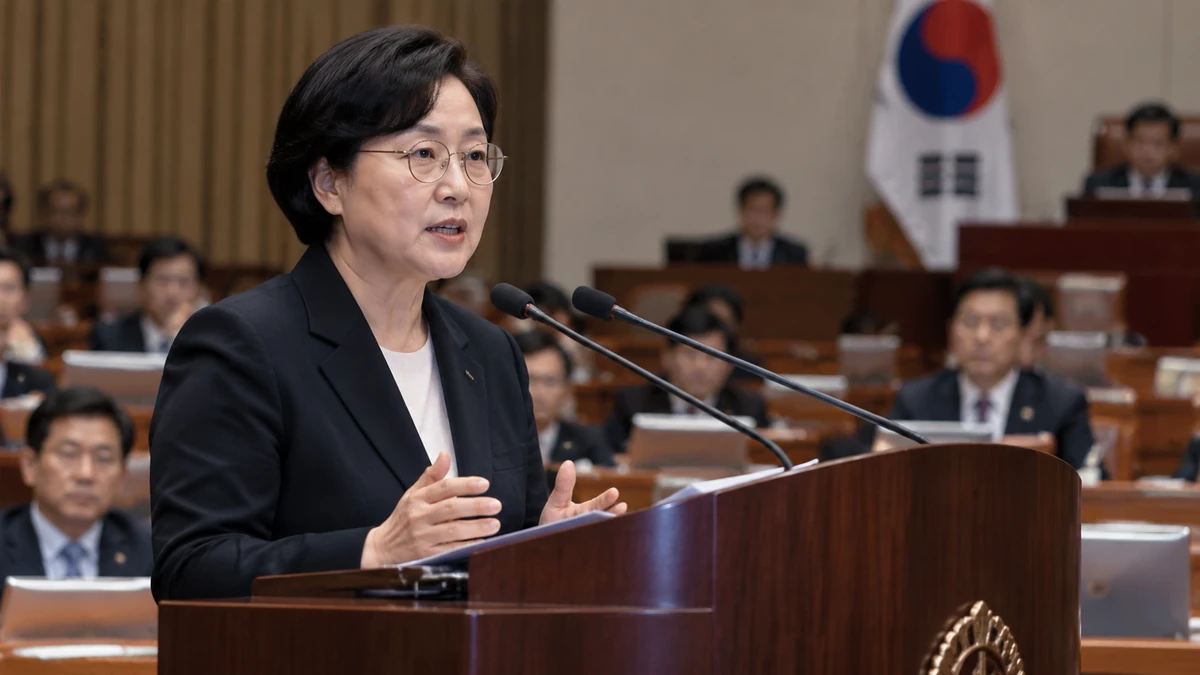
South Korea’s Prime Minister Han Seongsook addressed growing concerns over the government’s declining approval ratings during a parliamentary hearing on Sept. 14, saying the administration is taking public sentiment seriously.
In South Korea, approval ratings are closely watched as a measure of political legitimacy and public confidence. Similar to the role of presidential polling in the United States, these numbers often shape political strategy, influence debates over leadership changes and become a key topic during periods of controversy.
During the National Assembly’s government questioning session, Han said that approval ratings serve as a way to listen to citizens’ concerns. Responding to questions from opposition lawmakers about whether the government was ignoring public opinion, she said that the administration was paying close attention to the messages reflected in polling results.
Han said she viewed the situation with seriousness and responsibility, adding that she was considering how the government could improve its performance and better meet public expectations.
Personnel Controversies Put Focus on Government Decision-Making
The parliamentary questioning also focused on recent disputes surrounding government appointments, including criticism related to the resignation of Gender Equality and Family Minister nominee Yong Hye-in.
When asked whether she would apologize over the nomination process, Han said the nominee’s decision to step down was her own judgment. She added that once the overall appointment process was completed, any issues related to the recommendation process would be reviewed and addressed.
Government personnel decisions are often politically sensitive in South Korea. Cabinet appointments require careful consideration because ministers are expected not only to manage policy areas but also to represent the administration’s broader political direction. Controversies over nominees can quickly become tests of public trust and government competence.
Han also addressed vacancies involving senior positions in South Korea’s criminal justice system, including the police chief and prosecutor general. She said appointments would move forward with consideration of ongoing reforms to the criminal justice structure and that suitable candidates would be selected.
Parliamentary Hearings Reveal South Korea’s Political Accountability Culture
The National Assembly’s government questioning sessions are a distinctive feature of South Korean politics. Known as “gukjeong gamsa” or government audits in a broader context, these proceedings allow lawmakers to publicly challenge government officials on policies, appointments and administrative decisions.
Unlike many U.S. congressional hearings, where testimony often focuses on legislation, investigations or oversight of agencies, South Korean parliamentary questioning frequently becomes a direct political confrontation between lawmakers and senior government officials.
During the session, lawmakers from both the ruling and opposition parties questioned Han about falling approval ratings and the government’s ability to regain public confidence.
Opposition lawmakers pressed Han on whether the administration was responding adequately to public dissatisfaction. Members of the governing side also raised concerns about areas requiring improvement. Han said the government needed to correct shortcomings and continue efforts to rebuild trust.
She also responded to supportive comments from Democratic Party lawmaker Choi Min-hee, who offered encouragement regarding the approval rating decline. Han said that political support can rise and fall, but emphasized that the government must understand what message citizens are sending during difficult periods and return to its original goals.
Economic Concerns and Holiday Price Management Become Key Issues
Beyond political controversies, Han also discussed economic issues facing ordinary South Korean households, particularly ahead of the Chuseok holiday season.
Chuseok, often described as Korea’s Thanksgiving-like holiday, is one of the country’s most important family holidays. Millions of Koreans traditionally travel, exchange gifts and prepare large meals during the holiday period. Because demand for food and household goods increases, governments typically pay close attention to inflation and supply conditions before the holiday.
Han said that as prime minister, her focus was on managing holiday-related prices and reducing inconveniences experienced by citizens. She noted that broader political recovery efforts involved areas that would be addressed by the president, while the prime minister’s responsibility included practical administration and responding to public needs.
She also discussed a nationwide agricultural land investigation. Han explained that the review was intended to rebuild agricultural land data systems and improve understanding of land ownership conditions. She said minor violations discovered during the process would not necessarily result in punishment but emphasized that suspected land speculation would receive further attention.
What South Korea’s Political Debate Means for the United States
For American observers, South Korea’s debate over approval ratings and government trust offers insight into the close relationship between public opinion and policymaking in one of Washington’s most important Asian allies.
The United States and South Korea maintain a decades-long security and economic partnership, with cooperation extending from defense and technology to trade and cultural exchange. Political stability in Seoul is closely watched in Washington because South Korean governments play a major role in regional issues, including relations with North Korea, supply chain security and cooperation on emerging technologies.
While the current discussion centers on domestic approval ratings rather than foreign policy, leadership confidence can influence how governments approach international commitments. In the United States, similar debates occur when presidents and administrations face declining approval numbers, particularly during periods of economic uncertainty or political controversy.
American companies and investors also monitor South Korean political developments because Korea is a major global economy and home to leading technology, automotive and manufacturing companies. Government decisions involving economic policy, regulation and industrial strategy can affect international business conditions.
For American audiences interested in Korean culture, politics may also provide context for understanding the broader Korean Wave, or “Hallyu,” which includes K-pop, television dramas, films and digital entertainment. The global popularity of Korean culture has developed alongside South Korea’s growing international influence, making domestic political trends increasingly relevant to international observers.
A Broader Test of Public Trust in South Korea’s Government
Han Seongsook’s parliamentary appearance reflects a familiar challenge faced by governments around the world: maintaining public confidence during periods of criticism and uncertainty.
In South Korea, where citizens have a highly engaged political culture and where public opinion can rapidly shift through traditional media and digital platforms, approval ratings are more than simple statistics. They are often treated as signals of whether a government is successfully communicating with voters and responding to everyday concerns.
The government’s next challenge will be demonstrating that its response to public dissatisfaction leads to visible changes. Issues such as appointments, household costs and administrative reforms are likely to remain central topics in political debate.
For international observers, including those in the United States, South Korea’s ongoing discussion highlights the country’s democratic process and the public scrutiny faced by leaders in one of Asia’s most influential democracies.
Comments
Post a Comment