South Korea’s Prosecutor Overhaul Tests Who Will Police the Police — and Offers a Lesson for America
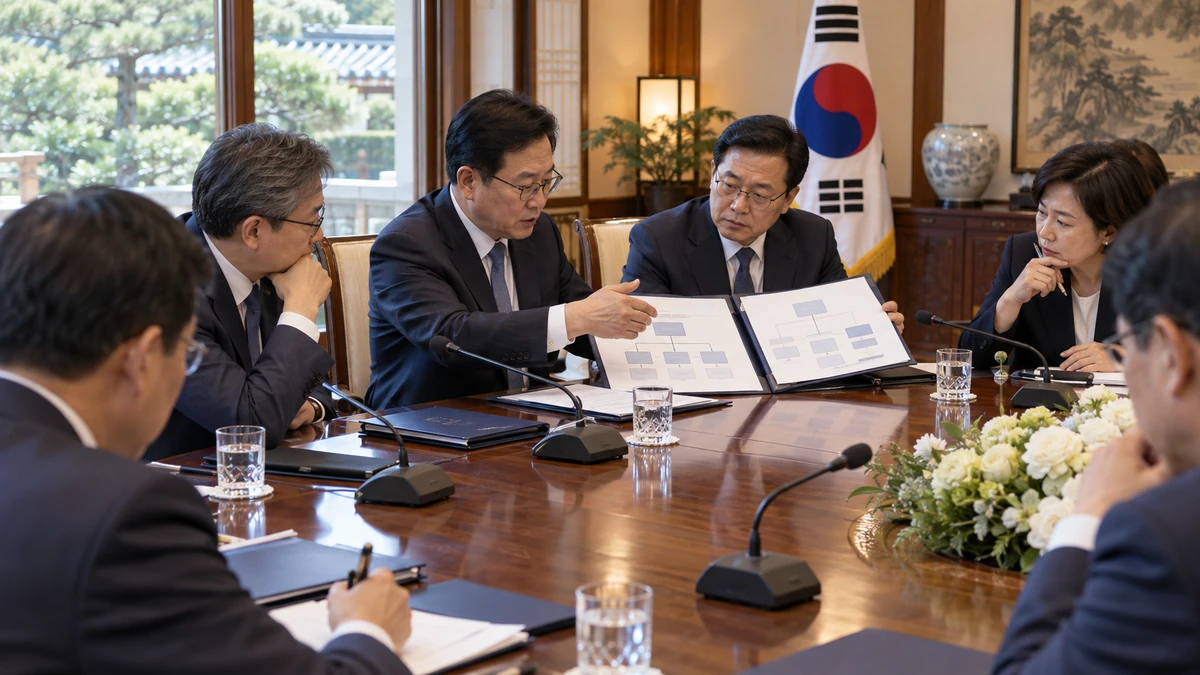
Image to help understand the article
A fight over a name reveals a struggle over power
South Korea’s effort to redraw the boundaries between prosecutors and police has reached a deceptively technical question: What should the government call the office that reviews investigations police decide to close? Behind that naming dispute is a more consequential argument over who can challenge a failed investigation, how much authority prosecutors should retain and whether shifting power from one institution to another will make the justice system more accountable.
The Democratic Party and the government agreed at a high-level meeting on the 13th to actively consider renaming a proposed division within a new prosecution agency scheduled to launch Oct. 2. The division’s proposed Korean name translates roughly as “judicial control department.” The alternative would describe its specific assignment: reviewing cases that investigative agencies close without referring them to prosecutors. Officials also agreed to consider eliminating two planning posts dealing with criminal affairs and serious-crime investigations.
Those changes remain under review, rather than completed decisions. But the discussion exposes the central tension in the overhaul: Reformers want to dismantle prosecutors’ investigative authority without leaving police decisions beyond meaningful scrutiny. For American readers, the closest reference point is the recurring debate over the relationship between police departments and district attorneys — although South Korea’s nationally organized prosecution system makes this a different, and more centralized, institutional struggle.
Why prosecutors became the focus of reform
South Korean prosecutors have traditionally occupied a powerful position in criminal justice, combining charging and courtroom responsibilities with substantial investigative authority. That concentration of functions has made the prosecution service a recurring focus of political conflict. Supporters of separating those powers argue that the institution responsible for deciding whether to prosecute should not also wield such broad control over how a case is investigated.
The new agency, referred to in Korean as the Gongso-cheong, is intended to center prosecutors’ work on bringing and sustaining criminal charges rather than conducting investigations. Its name emphasizes prosecution in court. The practical question, however, is not simply whether investigative functions disappear from an organizational chart. It is whether the remaining powers allow prosecutors to exercise something resembling their old authority under a different description.
That concern helps explain why an apparently bureaucratic title has become politically sensitive. “Judicial control” suggests an expansive supervisory mission. A name explicitly limited to reviewing cases not referred for prosecution sounds narrower. Neither label, by itself, establishes what officials can legally do. The decisive details will be the division’s statutory powers, the procedures it follows and the consequences of its findings.
The meeting took place at the prime minister’s official residence in Seoul’s Samcheong-dong neighborhood. Such government-party consultations bring together administration officials and governing-party leaders to coordinate policy and legislation. The review followed President Lee Jae-myung’s instruction to revise and supplement the proposed organizational structure for the prosecution agency and its subordinate offices.
The cases that never reach a prosecutor
The Justice Ministry’s proposed review division would examine whether police and other investigative bodies properly handled cases they closed without sending them to prosecutors. In the Korean system, this is described as reviewing a “non-referral” decision. For readers unfamiliar with that terminology, the essential point is straightforward: An investigation can end before a prosecutor is asked to decide whether charges should be brought.
A non-referral decision is not a court’s acquittal. It is an investigative disposition that can prevent a case from moving to the next stage. There may be sound reasons to close an investigation, including insufficient evidence. But a review mechanism can also serve as a safeguard against inadequate investigative work or the concealment of a case — the concerns the ministry cites in support of the proposed division.
Lawmakers pressing for a stronger break with the existing prosecution system see another risk. They argue that review authority could become an indirect way of reviving prosecutors’ power to direct investigations, even as that authority is being abolished. The disagreement therefore concerns the boundary between checking another institution’s decisions and commanding its work.
A narrower name could clarify the intended mission, but it would not resolve that boundary. The final rules would need to establish what happens when reviewers conclude that police improperly closed a case. Can they require further action, and on what grounds? What protections govern that process? Those are questions to watch as the framework develops; the reported meeting did not settle them.
A staffing dispute with no simple arithmetic
The proposed elimination of the criminal affairs and serious-crime investigation planning posts is another part of the organizational review. Their titles raise an obvious question for a prosecution-centered agency: What planning responsibilities should remain after investigative functions are removed? The available account does not establish the full duties of those posts or how their work would be reassigned if they are abolished.
Staffing presents a related dispute. According to the Justice Ministry figures cited in the report, South Korea currently has 2,051 prosecutors, below a legally authorized complement of 2,292. The ministry argues that maintaining the authorized number is necessary to address unresolved cases and the workload associated with prosecuting cases in court.
Critics question why an institution losing investigative responsibilities should retain the same staffing ceiling. Democratic Party spokesman Lee Yong-woo acknowledged that the issue had been raised, while saying the high-level meeting did not include a detailed exchange on it. He indicated that a review was expected to proceed quickly.
Both arguments point to a measurement problem familiar to Americans who follow court backlogs and prosecutor budgets. Removing one category of duties does not automatically reveal how many attorneys another category requires. Evaluating the staffing proposal would require information about caseloads, case complexity, pending matters and the work prosecutors will actually perform. The head count alone cannot establish whether the new agency will be overstaffed or stretched too thin.
Police reform becomes the other half of the story
The meeting also highlighted an uncomfortable implication of prosecution reform: Reducing prosecutors’ authority makes accountability elsewhere in the investigative system more important. Democratic Party leaders called for police reform to proceed more forcefully, criticizing the effort so far as insufficiently active. The message was that reorganizing the prosecution service cannot stand in for reforming the broader criminal justice system.
A missing-person case on Jeju, South Korea’s southern island province, supplied a concrete example. According to the Korean report, false closure of the case exposed weaknesses in the management system. The summary does not provide enough detail to reconstruct the investigation or assign responsibility to particular officials, but government and party leaders agreed that organizational improvements were needed.
Planned measures include increasing dedicated personnel so police station missing-person teams can have at least two people working at night. Officials also intend to establish dedicated units at the Korean National Police Agency and metropolitan and provincial police agencies. Unlike the debate over departmental titles, these changes address operational questions: who is available after hours, who supervises a case and whether missing-person work has a clear institutional home.
For families, those arrangements may matter more immediately than which agency occupies the commanding position in the justice system. An oversight structure can identify a failure after it occurs. Adequate staffing and supervision are intended to reduce the chance that a case is mishandled in the first place. A credible reform program needs to address both.
Missing adults, urgent searches and digital privacy
Officials also agreed to discuss legislation allowing authorities to access location information and card-use records without a warrant in cases involving high-risk missing adults. That proposal introduces a separate civil liberties question: How should the government balance a potentially lifesaving search against an adult’s interest in keeping movements and financial activity private?
Digital records can offer investigators clues about where a person has been. Yet an adult’s disappearance does not necessarily establish that a crime has occurred or that the person wants to be found. The design of any exception to warrant requirements would therefore matter enormously, particularly the definition of “high risk” and the process for determining that a case qualifies.
The reported discussion does not specify those safeguards. Important questions include who could authorize access, how narrowly a search would be limited, how long information could be retained and what review would follow. Those are not details to infer from the proposal’s public-safety rationale. They would need to be addressed in the legislation and its implementation.
Americans will recognize the underlying tension from debates over cellphone location records, financial privacy and emergency access to personal information. U.S. legal rules vary with the records involved and the circumstances of a request; there is no single American rule that can simply be imported into this Korean proposal. The useful comparison is the need to distinguish a genuine emergency power from routine investigative access.
What this means for the United States
For the United States, the clearest immediate significance is institutional rather than commercial. South Korea is a treaty ally and an important economic partner. How its justice system allocates authority matters to the broader environment in which Americans visit, work and do business there. But the reported decisions concern domestic agency design. They do not announce a change in U.S.-South Korean security cooperation, trade policy or the legal treatment of American citizens and companies.
The American comparison also has limits. The United States divides law enforcement across federal, state and local institutions. Many state and local prosecutors are elected, while federal prosecutors serve in the Justice Department. American prosecutors can participate in investigations, advise investigators and work with grand juries; the U.S. system is not a clean separation between police who investigate and lawyers who only appear in court.
Still, South Korea’s debate will be recognizable to Americans following disputes over police misconduct and prosecutorial independence. Investigators need scrutiny, but giving prosecutors that responsibility creates its own questions about institutional power and accountability. Neither country can solve those problems simply by declaring one profession more trustworthy than another.
For American companies operating in South Korea, the relevant issues to watch are practical: where complaints go, how closed cases are reviewed and whether the transition creates uncertainty about responsibility. The source reports no business disruption or company response, so claims of an investment impact would be premature. American audiences drawn to Korea through K-pop, film or television likewise should not mistake this for an entertainment-industry measure. It is a domestic governance story about the institutions behind the country’s global cultural profile.
What to watch before the new agency opens
The Oct. 2 launch target places attention on the legal and administrative work still ahead. Lee Yong-woo said government and party officials agreed that preparations should proceed without disruption, that the National Assembly should complete related legislative amendments promptly and that a range of public views should be sought during preparations.
The strongest test of the overhaul will be whether the final framework makes responsibility clearer. That means defining the review division’s authority, resolving the planning posts’ future and explaining prosecutor staffing needs in terms of actual work. It also means establishing how investigative bodies will be held accountable when they fail, without quietly recreating the concentration of power reformers say they want to dismantle.
The police measures deserve equal scrutiny. Additional missing-person personnel and dedicated units would need to translate into reliable coverage and supervision. Any expansion of access to private records would need an explicit legal boundary. These are different policy instruments, and progress on one would not substitute for progress on the others.
The broader story is a transition from arguing about whether prosecutors have too much power to deciding how a replacement system should function. That is the difficult stage of institutional reform, in South Korea or the United States: turning a promise to disperse authority into procedures that protect people both from official overreach and from official neglect.
Comments
Post a Comment