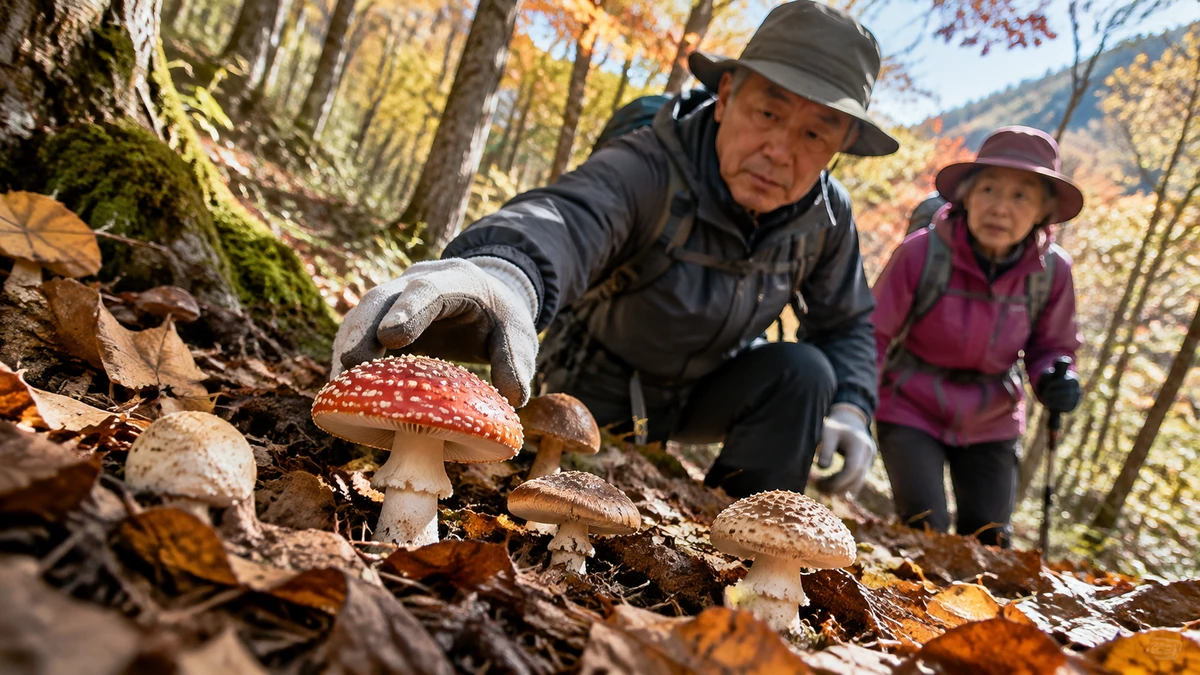
Image to help understand the article
A Seasonal Tradition Meets a Hidden Risk
As South Koreans prepare for autumn visits to family graves and hikes through mountain forests, agricultural officials are urging the public to leave wild mushrooms where they find them. The warning is striking not because of one newly discovered poisonous species, but because of the scale of the uncertainty: Of 2,389 mushroom species known to grow naturally in South Korea, only 418 — about 17% — have been confirmed as edible, according to the country’s Rural Development Administration.
Put another way, more than eight in 10 native mushroom species have not been established as safe to eat. That does not necessarily mean every unverified species is poisonous. It means ordinary hikers and amateur foragers cannot responsibly assume that a mushroom is safe based on its color, shape, location or resemblance to something they have eaten before.
The agency’s warning comes ahead of a period when many Koreans spend more time outdoors. Autumn is a popular hiking season in a country where mountains are easily accessible from major cities and hiking is a mainstream pastime rather than a niche outdoor pursuit. The season also includes traditional family visits to ancestral burial sites, often located on wooded hillsides or in rural areas.
Two customs are particularly relevant. During seongmyo, families visit the graves of ancestors to pay their respects, especially around Chuseok, the Korean harvest holiday often compared with Thanksgiving because of its emphasis on family gatherings, travel and shared meals. Families may also perform beolcho, clearing tall grass and weeds around burial mounds. These trips can bring people who are not experienced foragers into direct contact with mushrooms growing along trails, near graves or at the edges of forests.
The Rural Development Administration’s central message is deliberately simple: Do not collect or eat wild mushrooms. Officials are emphasizing avoidance rather than offering the public a short list of visual tricks for identifying poisonous varieties. With thousands of species in the environment, and with edible and toxic mushrooms sometimes growing in the same area, a familiar appearance is not a reliable safety test.
Why Experience Can Create False Confidence
Wild mushrooms do not appear in exactly the same places at exactly the same times every year. Their growth can shift with rainfall, temperature and other weather conditions. That makes one of the most common forms of informal reasoning — that a mushroom must be safe because something similar was gathered from the same mountain in the past — especially dangerous.
A person may remember eating mushrooms from a particular hillside without becoming ill. But a successful meal in one year does not prove that mushrooms collected there the next year are the same species. Even within one patch, edible and poisonous varieties can grow close together. A basket gathered from familiar ground can therefore contain multiple species that look broadly alike to an untrained observer.
That uncertainty exposes the limits of folk identification methods. Color, cap shape and stem structure can be useful parts of a scientific identification, but they are not enough by themselves for most members of the public to determine whether a mushroom belongs on a dinner table. Lighting, age, moisture and damage can change how a specimen looks. A photograph may also fail to capture features underneath the cap, at the base of the stem or inside the mushroom that could matter to an expert.
The 17% figure should not be read as a quiz score that ambitious foragers can improve by memorizing more names. It is better understood as a warning about the limits of personal judgment. In an environment containing 2,389 known native species, the margin for error is too wide to treat a casual visual match as proof of safety.
This is also why confidence can be more hazardous than ignorance. Someone who knows little about mushrooms may leave them alone. Someone who has gathered them several times without incident may believe experience has eliminated the risk. But repeated luck does not turn an uncertain identification method into a verified one. The safer standard is not whether a mushroom looks familiar, but whether it comes through a food supply in which its identity and suitability for consumption have been established.
One Mistake Can Reach an Entire Family
Mushroom poisoning often begins with an individual decision, but it can quickly become a group health emergency. Foraged ingredients are frequently brought home, cooked as part of a shared dish and offered to relatives or neighbors. In a culture where giving food is an important expression of care and community, a well-intended gift can expose people who had no role in collecting or identifying it.
South Korean officials pointed to incidents last year in Jeju, Haenam and Wanju, three places in different parts of the country. Residents who shared wild mushrooms experienced symptoms including vomiting and abdominal pain and required hospital treatment. The geographic spread of those cases underscores that this is not a danger limited to one famous mountain, one province or one unusually hazardous patch of forest.
Shared meals can also complicate the response after people become sick. The person who gathered the mushrooms may not be the person who prepared them. The cook may have mixed them into a larger dish, and recipients may not know where they were collected. By the time symptoms emerge, investigators and medical professionals may have difficulty determining exactly which species was eaten and how much each person consumed.
Eating only a small portion is not a valid test, and serving the same food to several people does not provide reassurance. It merely increases the number of people exposed. Nor should the confidence of an experienced friend, relative or neighbor be treated as confirmation that a wild mushroom is edible. Familiarity with a forest is not the same as verified expertise in fungal identification, and even experienced collectors can confuse similar-looking species.
The public health lesson extends beyond mushroom biology. Risk changes when food circulates through a community. What begins as one person’s private gamble can become a household or neighborhood incident once the ingredients are shared. The most important intervention may therefore occur before cooking: A collector who decides not to distribute uncertain mushrooms protects people who may never have seen the original specimens.
Why an AI Identification App Is Not a Safety Certificate
Smartphone applications have made nature identification feel nearly instantaneous. A user can photograph a mushroom, upload the image and receive a suggested name within seconds. That can be useful for education or curiosity, but South Korean officials say it should not be used as the final basis for deciding whether to eat a mushroom.
Noh Hyoung-jun, a mushroom official at South Korea’s National Institute of Horticultural and Herbal Science, said changing weather can affect where and when mushrooms emerge. He cautioned the public against relying on either past experience or artificial intelligence applications to determine whether a specimen is edible.
The concern is not that all identification technology is useless. It is that users can mistake a probable visual match for a safety guarantee. An app may compare a photograph with patterns in a database and return the name of a likely species. But a likely result is not the same as a laboratory finding or an examination by a qualified specialist, and a species label on a screen is not official approval to eat what is in the user’s hand.
AI systems and untrained human observers share a central weakness in this setting: Both can place too much weight on visible similarities. A single image may omit decisive details, and two species can appear nearly identical in an ordinary photograph. The software also cannot ensure that every mushroom in a basket is the same as the one photographed. Correctly identifying one specimen would not establish that the entire collection is safe.
This is a broader example of automation bias, the tendency to place excessive trust in a computerized recommendation because it appears precise or authoritative. A digital tool can be helpful while still being unsuitable for a high-stakes decision. The cost of an incorrect song recommendation or mislabeled vacation photo is minor. The cost of an incorrect mushroom identification can be a medical emergency affecting several people.
The practical dividing line is straightforward: Use nature apps to learn, not to authorize consumption. When the decision could determine whether a person is poisoned, convenience and speed should not be confused with certainty.
What the Korean Warning Means for the United States
South Korea’s warning has direct relevance for Americans. Foraging has become increasingly visible in the United States through hiking communities, social media, cooking videos and interest in local or minimally processed food. Mushrooms can carry an appealing image of wilderness, sustainability and culinary adventure. But a food’s natural origin does not make it safe, and tradition does not eliminate the need for accurate identification.
The United States has its own strong regional mushroom cultures, from woodland foraging groups to chefs interested in seasonal ingredients. Americans may also encounter wild mushrooms in backyards, parks, campsites and areas where children or pets play. As in Korea, visual resemblance can create a false sense of security. Grocery shoppers are accustomed to cultivated varieties sold through regulated commercial channels, but the consistency of a supermarket package should not be projected onto mushrooms found outdoors.
American technology companies also have a stake in the issue. Image-recognition tools increasingly identify plants, animals and fungi for consumers, and their polished interfaces can make uncertain outputs appear definitive. Developers should clearly distinguish between educational suggestions and safety-critical determinations. Labels, confidence scores and disclaimers matter, but product design also matters: An app should not encourage users to treat a photographic match as permission to consume a wild organism.
For American audiences, the Korean experience is also a reminder that food-sharing customs can amplify risk across cultures. A basket of foraged mushrooms offered to friends at a cookout, brought to a neighborhood potluck or incorporated into a family dinner creates the same chain of exposure seen in Korean communities. The social setting may differ, but the public health pattern is familiar: One uncertain ingredient can affect many diners.
The issue also fits into the broader U.S.-South Korea relationship, which extends far beyond defense and trade to tourism, technology and cultural exchange. More Americans are visiting South Korea, and Korean hiking culture is highly accessible to travelers. Trails often begin near subway stations or dense urban neighborhoods, making a mountain outing easy to add to a visit. Tourists should not assume that a mushroom is safe because it appears near a busy trail, a maintained grave site or a place frequented by local residents.
Korean food’s growing popularity in the United States adds another layer of context. American diners have become familiar with dishes featuring cultivated mushrooms and with Korean ingredients sold through supermarkets and specialty grocers. The warning is not about those verified commercial foods. It is specifically about mushrooms gathered in the wild. Consumers should distinguish between ingredients moving through established retail channels and unknown specimens collected from forests or hillsides.
The strongest takeaway for U.S. companies and consumers is that AI identification should remain informational when health is at stake. The safest option for eating mushrooms is to buy cultivated or otherwise verified products from reputable commercial sources. That approach is less romantic than carrying home a basket from the woods, but it replaces guesswork with a traceable supply chain.
Do Not Wait for Symptoms
South Korean authorities say anyone who has eaten a wild mushroom, or who is uncertain about the type consumed, should immediately contact emergency services or a medical institution even if no symptoms are present. In South Korea, the emergency number is 119, the local equivalent of calling 911 for fire or medical assistance in the United States.
The instruction not to wait is important. Feeling normal immediately after a meal is not proof that the mushroom was safe. A person without symptoms is still unable to identify an unknown species simply by monitoring how the body feels. Delaying a call until vomiting or abdominal pain begins can cost time that medical professionals could use to assess the exposure and advise the people involved.
In the United States, someone who has eaten an unidentified wild mushroom should promptly contact Poison Control at 1-800-222-1222 for expert guidance. The service is available nationwide. A person with severe symptoms or an immediate medical emergency should call 911. People should follow professional instructions rather than attempting to manage a potentially serious exposure through online searches or an identification app.
If it can be done safely, preserving information about what was eaten may help professionals evaluate the situation. But gathering evidence should not delay the initial call for help. The priority is connecting with emergency or poison specialists, explaining that an unidentified wild mushroom may have been consumed and following their directions.
Korea’s recommended sequence is easy to understand: Do not collect wild mushrooms; if they have been collected, do not eat or share them; and if they have already been eaten, seek help immediately regardless of whether symptoms have appeared. Each step addresses a different point in the chain of risk, from mistaken identification to group exposure to delayed treatment.
A Trend Toward Simpler Safety Rules
The larger story is not about teaching the public to recognize a handful of notorious mushrooms. It is about how authorities communicate risk in an era when people have unprecedented access to images, crowdsourced advice and automated identification tools. More information does not always produce a safer decision, particularly when users cannot evaluate the quality or limits of that information.
The Rural Development Administration’s approach favors a simple behavioral rule over a complicated field guide. That reflects the nature of the problem. If only 418 of South Korea’s 2,389 native mushroom species are confirmed as edible, there are too many unknowns and too many opportunities for look-alike errors to expect occasional hikers to make dependable judgments.
What changed is not the basic danger of poisonous mushrooms. What has changed is the environment in which people make decisions about them. A person can now photograph a specimen, receive an immediate algorithmic answer, find a similar image on social media and interpret that accumulation of weak signals as certainty. At the same time, interest in outdoor recreation and wild foods can make collecting feel like an appealing extension of a hike.
What matters next is whether public agencies, technology platforms and consumers maintain a clear distinction between identification assistance and verified safety. Officials can continue emphasizing prevention. App developers can design warnings that users cannot easily mistake for approval. Families and community groups can normalize declining uncertain wild foods without treating the decision as rude or wasteful.
The lesson crosses borders because the underlying human impulses are universal: trust in experience, attraction to natural foods, confidence in technology and the desire to share a special ingredient with others. South Korea’s autumn warning challenges all four. In the woods, a mushroom that looks familiar may still be unknown. On a phone, a name may still be a guess. At the table, generosity may still spread harm. The safest conclusion is also the least complicated one: If a wild mushroom has not been reliably verified through an established food channel, leave it off the menu.
Comments
Post a Comment