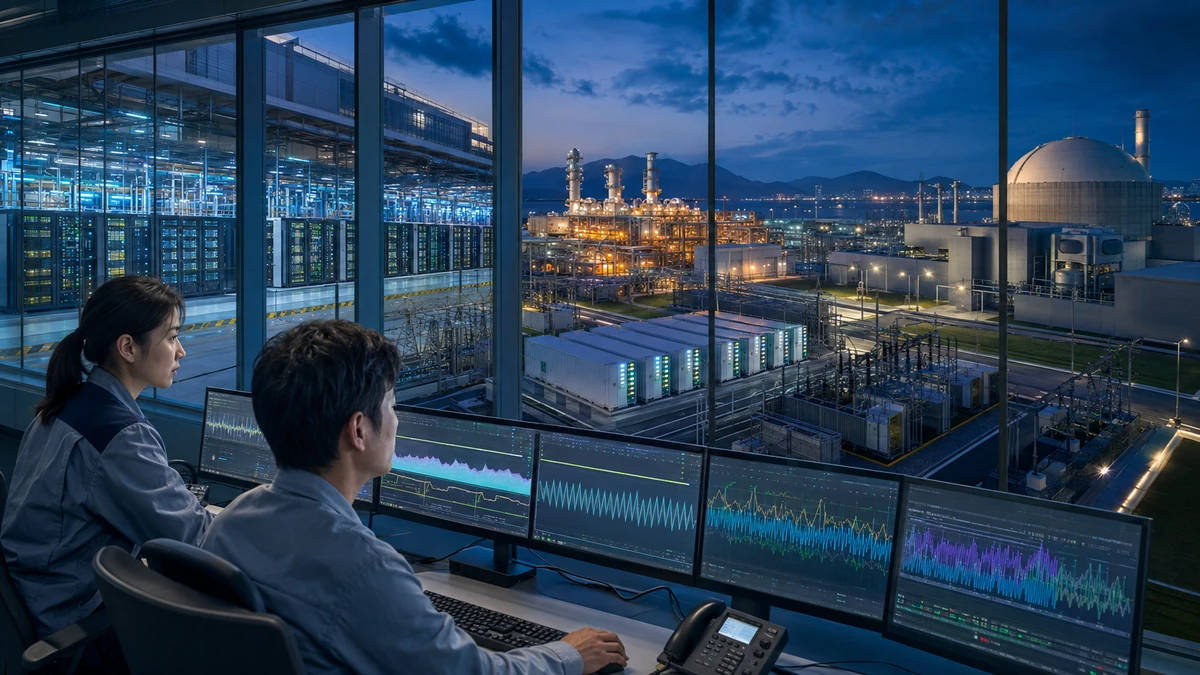
Image to help understand the article
AI’s New Bottleneck Is Electricity
For much of the artificial intelligence boom, the industry’s defining shortage was measured in semiconductors. Technology companies competed for advanced graphics processing units, or GPUs, while governments treated chip fabrication capacity as a matter of economic and national security. That contest is not over. But a second constraint is moving rapidly to the foreground: Even the most sophisticated AI chips are useless without enormous quantities of reliable electricity.
South Korea’s energy industry is beginning to organize around that reality. Companies are exploring integrated systems that combine liquefied natural gas generation, battery-based energy storage and, over the longer term, small modular nuclear reactors. The emerging concept is sometimes described in Korea as an “energy all-in-one” solution — not a single power plant, but a package designed around the operating schedule, electricity demand and climate goals of an AI data center or semiconductor factory.
The shift reflects a fundamental change in how the data center business works. A developer may obtain land, finish a building and install servers, but the facility cannot begin operating at full capacity if a utility cannot deliver enough power on time. For conventional commercial construction, electricity service is often treated as one element of a larger project. For an AI data center, it can determine whether the project is viable at all.
AI facilities also create a more complicated engineering challenge than simply consuming a large amount of power. Tens of thousands of GPUs and servers can operate simultaneously, and their electricity use can change sharply as computing workloads rise and fall. Operators therefore need not only sufficient generating capacity but also stable voltage and frequency, backup resources, systems that can respond quickly to demand changes and a credible plan for limiting carbon emissions.
That is why the next stage of AI infrastructure may resemble an energy project as much as a technology project. The competitive question is no longer only who can buy the fastest chips. It is who can secure dependable power, connect it to a site, manage fluctuations and expand supply as additional computing equipment comes online.
Why Natural Gas and Batteries Come First
In the near term, liquefied natural gas, commonly called LNG, offers several advantages for large data centers. In a combined-cycle gas plant, turbines generate electricity by burning gas, while heat from that process produces steam that drives an additional turbine. Such plants can provide substantial power and adjust output more readily than many traditional baseload facilities. They can also be expanded in stages as a data center adds servers.
For an operator trying to open a facility on a commercial timetable, those qualities matter. Wind and solar power remain central to reducing emissions, but their output depends on weather and time of day. Gas generation can produce electricity when fuel is available and dispatch is required. That makes it useful as a bridge for projects that cannot wait for more transmission lines, large nuclear plants or entirely new regional power systems.
Batteries serve a different purpose. An energy storage system does not create electricity; it stores power produced earlier and releases it when needed. At an AI data center, batteries can help smooth sudden changes in demand, reduce the gap between generation and consumption, and provide support during brief interruptions or transitions between power sources. In simplified terms, a gas plant can supply the volume of electricity, while a battery system can help refine its timing and quality.
This pairing is not a complete answer. Gas-fired generation produces carbon dioxide and exposes operators to fuel costs and commodity-market volatility. Batteries can stabilize a system, but they cannot indefinitely power a massive computing campus unless they are supported by adequate generation. The economics also depend on battery duration, replacement cycles, grid rules and the local price of electricity.
The South Korean industry’s emerging approach is therefore based on sequencing rather than finding a single perfect technology. LNG and batteries could support the relatively rapid launch and early expansion of a data center. Small modular reactors, if they clear technical, regulatory and commercial hurdles, could later provide continuous power with far lower direct carbon emissions. Renewable generation and grid-supplied electricity could be incorporated according to local conditions.
That layered strategy is significant because it treats energy reliability, flexibility and decarbonization as separate problems requiring different tools. It also recognizes a practical tension at the heart of the AI boom: Technology companies want more electricity immediately, but many have also made long-term commitments to reduce their climate impact.
What Small Modular Reactors Could Add — and What Remains Uncertain
Small modular reactors, or SMRs, are designed to be smaller and potentially more standardized than conventional nuclear plants. Supporters argue that factory-built components and repeatable designs could eventually shorten construction schedules, reduce some financial risks and allow operators to add generating units in increments. For power-hungry industrial sites, the attraction is clear: Nuclear reactors can provide electricity around the clock without the direct carbon emissions associated with burning fossil fuels.
Yet SMRs should not be confused with an immediate solution. Most advanced designs remain years away from widespread commercial deployment. They must pass national safety reviews, establish reliable fuel supplies, demonstrate construction costs and win public acceptance. Nuclear projects also require plans for security, radioactive waste, emergency preparedness and eventual decommissioning. Those obligations do not disappear because a reactor is smaller.
The long development timeline helps explain why technology companies are looking at several options simultaneously. According to the Korean industry account, Meta is pursuing long-term access to electricity from established nuclear plants while also examining future projects involving developers such as TerraPower and Oklo. Amazon has invested strategically in the U.S. reactor developer X-energy and is working with Energy Northwest, a public power consortium, on a high-temperature gas reactor project in Washington state.
These arrangements illustrate a broader change in corporate behavior. Major technology companies once approached electricity primarily as utility customers: They purchased power and negotiated renewable energy contracts. Now some are acting more like infrastructure investors, development partners and long-term anchor customers. Their involvement can help a power project attract financing because it signals that a large buyer may be prepared to purchase the electricity.
The strategy also resembles practices in other energy-intensive American industries. Aluminum smelters, chemical plants and large manufacturing complexes have historically been built near abundant power or developed alongside dedicated energy infrastructure. AI is bringing a similar industrial logic to the digital economy. The cloud may sound weightless, but its physical foundation consists of buildings, cooling systems, substations, transmission equipment and power plants.
For policymakers, the nuclear component presents a difficult balance. SMRs could support both energy security and decarbonization if they become commercially viable. But officials and investors must avoid planning as though unproven reactors will arrive on a guaranteed schedule. Near-term data center growth will still depend heavily on existing grids, gas plants, renewable generation, conventional nuclear facilities and storage.
South Korea’s Industrial Opportunity
South Korea is unusually positioned to treat the AI power challenge as an industrial systems problem. The country is a global force in memory chips, batteries, shipbuilding, heavy engineering and nuclear construction. It also has major conglomerates, known as chaebol, whose affiliates span multiple industries. The Korean term refers to large, family-influenced corporate groups such as Samsung, SK, Hyundai and LG. Americans might compare their breadth loosely to old-style industrial conglomerates, although the chaebol have a distinct role in South Korea’s postwar development and corporate governance.
That structure can be controversial, particularly because of concerns about economic concentration. But it can also make cross-industry coordination possible. A group with experience in energy trading, power generation, batteries, materials and engineering may be able to offer a data center customer one integrated proposal rather than requiring the customer to assemble multiple suppliers.
SK Innovation is being discussed in Korea as one company with pieces of such a platform. The company has access to LNG sourcing capabilities tied to gas resources in the United States and Australia, along with experience in power and energy businesses. Its restructuring involving battery-materials affiliate SK IE Technology could also create opportunities to connect battery expertise with stationary storage and broader energy operations.
SK Innovation has additionally signed a cooperation agreement with TerraPower, the U.S. advanced nuclear company founded by Bill Gates, concerning a Korean-oriented next-generation SMR business model known as “K-Natrium.” The name refers to TerraPower’s Natrium reactor concept, which is designed around sodium cooling and energy storage. The agreement signals strategic intent, but it does not by itself establish when a reactor will be built, how much it will cost or whether regulators will approve a particular project.
The commercial test for SK and its competitors will be whether they can make these assets function as a coherent service. Owning interests across several sectors is not the same as delivering an integrated power system. A provider would need to analyze a customer’s planned opening date, expected computing load, expansion schedule and emissions targets, then coordinate fuel procurement, generation, battery storage, grid connections and long-term replacement power.
If Korean companies succeed, their export opportunity could extend well beyond chips and battery cells. They could sell engineering, project management and energy optimization to data center developers around the world. That would represent a new stage in South Korea’s global economic role: not merely supplying components for the digital economy, but designing the systems that keep it running.
What This Means for the United States
For the United States, South Korea’s integrated energy push matters on several levels. American technology companies are among the world’s largest builders and users of AI infrastructure, and their demand is reshaping power planning in regions with large data center clusters. Utilities, state regulators and local governments are confronting questions about who pays for new generation and transmission, how quickly projects can connect to the grid, and whether rising industrial demand will affect electricity bills for households and smaller businesses.
Korean companies could become important suppliers in that build-out. South Korean battery manufacturers already have a substantial presence in the American market, including manufacturing partnerships linked to the electric vehicle industry. Korean engineering and industrial groups also bring experience in nuclear power, energy equipment and large-scale project execution. If stationary battery storage and data center power systems expand, those companies may find a market adjacent to — but distinct from — electric vehicles.
The LNG connection is also bilateral. South Korea is a major importer of energy, while the United States has become a leading exporter of liquefied natural gas. An integrated Korean energy company drawing on American gas resources could link U.S. fuel production with Korean engineering, storage technology and overseas data center development. At the same time, that relationship would be exposed to debates over methane emissions, export policy, domestic gas prices and the long-term compatibility of LNG with climate goals.
Advanced nuclear energy creates another area of cooperation. TerraPower, X-energy and Oklo are American companies seeking to commercialize new reactor designs, while Korean firms have manufacturing, construction and nuclear supply-chain capabilities. Partnerships could combine U.S. reactor development with Korean industrial execution. But they could also raise questions over intellectual property, export controls, nuclear nonproliferation rules and which country captures the highest-value parts of the supply chain.
For American communities, the Korean model offers a useful lesson: A data center should not be evaluated only as a real estate project promising construction jobs and tax revenue. Local officials also need to examine where its electricity will come from, whether new infrastructure is required, how backup generation will affect air quality, how much water cooling may require and who bears the cost if projected demand does not materialize.
American consumers and AI users have a stake as well. The cost and availability of electricity will influence the price of cloud computing and AI services. If power constraints delay new capacity, companies may face higher costs or limit access to advanced computing. If developers solve the problem primarily with fossil fuels, the environmental footprint of everyday AI products could grow even as technology companies advertise sustainability goals.
The U.S.-Korea relationship has long been anchored in security cooperation and, more recently, expanded through semiconductors, batteries and clean-energy investment. AI infrastructure adds another layer. The two countries are not simply trading finished goods; their companies are becoming intertwined across fuel, generation, storage, chips and computing. That integration creates opportunities, but it also means regulatory decisions or supply disruptions in one country can reverberate through the other.
From the Cloud to the Power Plant
The rise of all-in-one energy proposals marks a conceptual shift for the technology industry. In the first phase of the AI boom, investors focused on model performance, chip design and access to computing clusters. In the next phase, the winning companies and regions may be those able to coordinate digital infrastructure with the physical energy system.
This does not mean every AI company will build a power plant or every energy company will become a technology provider. It does mean the boundary between the two sectors is becoming less distinct. Data center developers need expertise in generation and grid operations, while energy companies increasingly need to understand computing workloads, server expansion cycles and corporate carbon accounting.
The trend could also change where data centers are built. Historically, operators have considered factors such as fiber-optic connectivity, tax incentives, land prices and proximity to customers. Those remain important, but access to expandable, round-the-clock electricity may carry more weight. Regions with available grid capacity, supportive permitting and a mix of generation resources could gain an advantage over traditional technology hubs where power connections are constrained.
South Korea faces its own geographic and policy limitations. It is densely populated, imports much of its fuel and has limited room for large new energy facilities. Public attitudes toward nuclear power and transmission development can shift with political leadership and local concerns. Those pressures make integrated planning more important, but they also make projects difficult to execute.
For Korean energy groups, the opportunity is therefore matched by substantial risk. LNG assets could lose value if carbon rules tighten or gas prices rise. Battery projects must meet strict safety standards. SMRs may take longer or cost more than developers expect. Data center demand forecasts could also change as chips become more efficient, AI business models evolve or communities resist rapid construction.
Still, the direction of travel is clear. AI competition is expanding from the semiconductor fab and server rack to the substation, battery site, gas terminal and nuclear laboratory. South Korea’s proposed combination of LNG, storage and advanced nuclear power is one attempt to bridge immediate demand with longer-term climate objectives. Its significance lies less in any single corporate agreement than in the industrial strategy taking shape around it.
What to Watch Next
The first measure of success will be execution. Companies must show that an integrated package can bring a data center online faster or operate it more reliably than conventional utility arrangements. That requires real projects, firm construction schedules, transparent costs and clear divisions of responsibility among technology companies, utilities and energy suppliers.
A second issue is whether batteries can move beyond their established role in short-duration grid support. AI data centers may create demand for systems capable of covering longer interruptions or shifting larger quantities of electricity across the day. Advances in battery chemistry, fire protection and energy management software will influence how much storage can realistically contribute.
Third, investors should distinguish announcements about SMR cooperation from projects that have secured permits, financing, customers and construction contracts. The advanced nuclear sector has drawn intense interest because it promises reliable, low-carbon power, but commercial milestones will matter more than memorandums of understanding.
Finally, governments will need to decide how much of the infrastructure should be planned publicly and how much should be left to private developers. Electricity networks serve entire communities, not only data centers. Policies that accelerate AI investment without protecting reliability and affordability could provoke public opposition. Conversely, slow permitting and inadequate transmission could send projects — and their economic benefits — elsewhere.
The larger lesson is that AI is not merely a software story. It is becoming one of the defining infrastructure stories of the decade. South Korea’s effort to combine gas, batteries and next-generation nuclear power shows how countries with deep manufacturing and energy expertise may compete in that market. For the United States, the development creates potential customers for American gas and nuclear technology, competitors for high-value engineering work, and Korean partners capable of helping build the next generation of digital infrastructure. The race to lead in AI increasingly depends on who can keep the machines running — every hour of every day.
Comments
Post a Comment