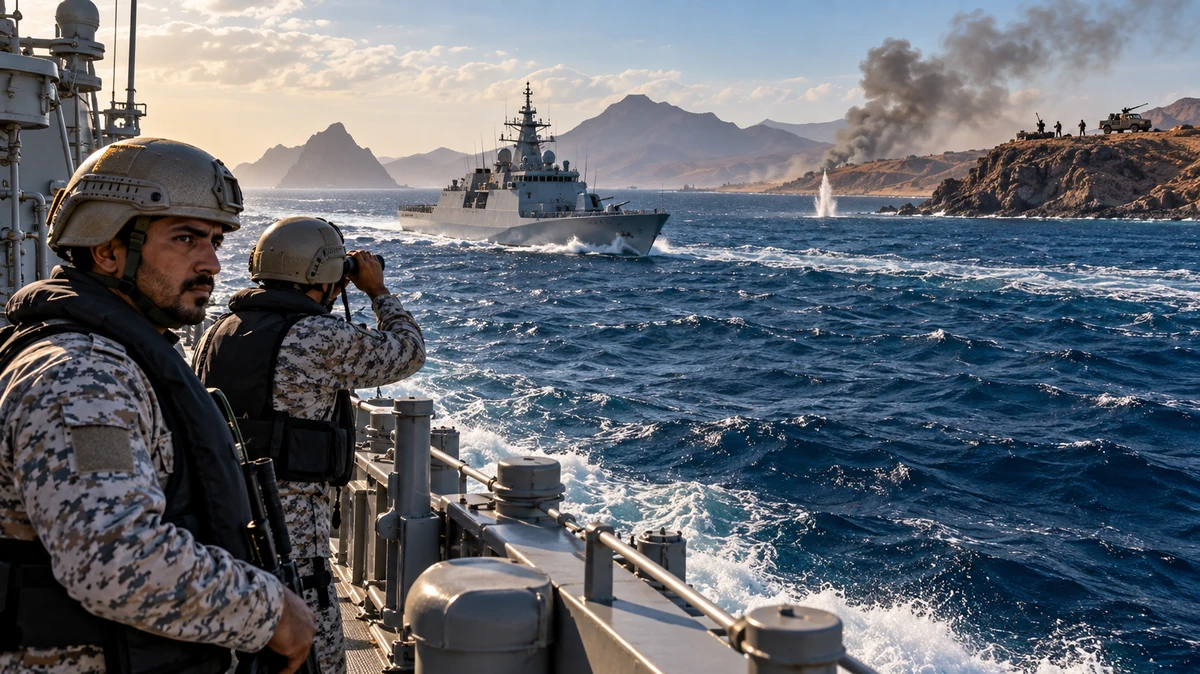
Image to help understand the article
A regional crisis with more than one front
Escalating fighting between Saudi Arabia and Yemen’s Houthi movement is adding a second maritime flashpoint to the confrontation between the United States and Iran, raising a difficult question for Washington and its allies: Can retaliation in one part of the Middle East be contained when another conflict is intensifying nearby?
A Korean news account describes Saudi-Houthi clashes over control of the Bab el-Mandeb strait, the southern entrance to the Red Sea, alongside exchanges involving American and Iranian forces around the Strait of Hormuz. The waterways are geographically separate, and the combatants are not identical. But both are important to the movement of energy and commercial goods, making simultaneous instability a concern well beyond the region.
For Americans, the stakes include the safety of deployed troops, the cost of protecting shipping and the possibility that higher transportation and energy costs could reach businesses and households. For South Korea, a U.S. treaty ally heavily dependent on imported energy and overseas trade, the same tensions expose vulnerabilities that military cooperation alone cannot eliminate.
Significant uncertainties remain. The supplied account describes developments on the eighth and ninth and references September, but does not identify a year. Several battlefield assertions come from statements attributed to the governments involved, without independent verification or a full assessment of damage. The clearest analytical distinction is between a widening set of reported confrontations and proof that the region has entered a single, coordinated war.
Why these two waterways matter
The Strait of Hormuz connects the Persian Gulf with the Gulf of Oman and the wider ocean. It is an outlet for energy exports from Gulf producers. Bab el-Mandeb lies farther west, between Yemen and the Horn of Africa, connecting the Gulf of Aden with the Red Sea. Ships using the Suez Canal to travel between Europe and Asia generally must pass through that southern gateway.
For an American audience, these are best understood as bottlenecks in the global transportation system. A disruption at a major interstate interchange can affect traffic far beyond the crash site. At sea, the consequences can include longer voyages, higher insurance costs and uncertainty about when cargo will arrive. The analogy has limits, however: Some shipments can take alternate routes, while others face much more restricted options.
A vessel avoiding the Red Sea on an Asia-Europe voyage can sail around southern Africa, adding distance and time. That does not make the route irrelevant to American companies. Businesses with European customers, Asian suppliers or globally coordinated shipping networks can face secondary effects even when their cargo is not headed directly to a U.S. port.
None of this establishes that either strait has closed. The account does not document a comprehensive halt to shipping, identify the volume of delayed cargo or establish how many commercial operators have changed routes. Fighting near a maritime passage and the loss of that passage to commercial traffic are different developments.
The Saudi-Houthi front has its own history
The Houthis are an armed Yemeni movement with roots in the country’s Zaydi Shiite community. They became a central force in Yemen’s civil war, and a Saudi-led coalition intervened in 2015. Iran has supported the Houthis, while Saudi Arabia has long maintained close security ties with the United States. Those relationships help explain why renewed fighting draws attention in Washington.
They do not, by themselves, explain every military decision. The Houthis have their own leadership and political objectives. Saudi Arabia has its own border-security concerns and regional interests. Describing the conflict only as a contest between American and Iranian proxies would obscure those local dynamics and could wrongly suggest that Washington and Tehran control every action.
The Korean account characterizes the latest clashes as approaching full-scale warfare and says they follow four years of a cease-fire. That description of the cease-fire’s duration cannot be independently established from the supplied material, particularly without a year. More broadly, a formal truce, an informal pause and a sustained reduction in hostilities are not interchangeable terms.
The consequential point is that an arrangement limiting violence is reported to be weakening. A cease-fire need not resolve a conflict to matter: It can reduce casualties, preserve room for talks and make military behavior more predictable. Intensified fighting would threaten those benefits. Still, the account does not establish a formal termination of the cease-fire, a newly declared Saudi war aim or a long-term Houthi campaign plan.
Missile claims require a careful reading
The account attributes to Iran’s Islamic Revolutionary Guard Corps a statement that it attacked a U.S. military base at al-Azraq in Jordan with ballistic missiles. It also reports that Jordan, through state media, confirmed that 20 ballistic missiles had been launched from Iran toward Jordanian territory. Those are related assertions, but they do not establish the same thing.
Even confirmation that missiles entered a country’s territory would not prove they struck their intended target. Interceptions, missed targets and impacts elsewhere can produce very different outcomes. The supplied material includes no confirmed casualty count or damage assessment for the installation Iran said it targeted. It therefore cannot support a conclusion that American personnel or facilities sustained specific losses.
Similar caution applies to statements attributed to the Revolutionary Guard claiming successful missile strikes on U.S. destroyers identified by the hull numbers DDG-119 and DDG-53. The account describes the vessels as carrying cruise missiles and the Aegis combat system, which integrates radar, tracking and weapons functions. Their capabilities help explain their military significance, but reveal nothing about whether Iran’s claimed strikes succeeded.
The account also cites an Iranian assertion that its forces captured an advanced American unmanned underwater vehicle in the Strait of Hormuz. It supplies no independent confirmation of that claim. A reported missile launch, a claimed warship hit and an alleged equipment seizure should not be added together as though they were three verified American losses.
Retaliation brings commercial shipping into the equation
The Korean summary attributes to U.S. Central Command a statement that American forces destroyed five Iranian oil tankers in retaliation for two ballistic missile attacks on U.S. Navy vessels during the preceding two days. That is a U.S. military assertion as presented in the account, not an independently verified assessment of the ships’ fate.
Important operational details are missing. The material does not identify the vessels, their cargoes, their locations, the status of their crews or the amount of oil, if any, lost. Without that information, a count of reported ship losses cannot be converted into a reliable estimate of reduced energy supply. Nor does the description alone resolve questions about the ships’ military role or the legal basis for attacking them.
The account also attributes to Secretary of State Marco Rubio, during a visit to Colombia, a warning that Iran would lose tankers whenever it continued trying to attack American warships. As described, that message presents retaliation as a repeatable policy rather than an isolated response. Its apparent purpose is deterrence: Make the expected cost of an attack outweigh its potential benefit.
But deterrence depends partly on how the other side interprets the action. Iran, according to the account, threatened tankers near Kuwait and Bahrain in response. That threat is not proof of an attack, and no affected shipowners or casualties are identified. Nevertheless, it points to a dangerous possibility: Commercial vessels could become targets in a cycle initially framed around attacks on military forces.
What this means for the United States
The most immediate American interest is protecting service members. Claims involving a base in Jordan and Navy destroyers raise questions about force protection, missile defenses and the demands placed on commanders operating across several locations. Before drawing conclusions about a new deployment or a larger campaign, however, policymakers and the public need verified information about what was attacked and what damage occurred.
The economic exposure is broader than America’s direct dependence on any one foreign oil supplier. The United States is a major oil producer, but oil is traded internationally. A credible threat to supplies elsewhere can affect market expectations and prices. Domestic production provides advantages; it does not completely separate American motorists, airlines or manufacturers from global energy conditions.
U.S. companies also have exposure through freight contracts, insurance and inventory management. A retailer sourcing goods internationally might face uncertainty over delivery schedules. A manufacturer could find that a supplier’s shipment to a European facility takes longer than planned. These are potential channels of disruption, not documented consequences of the specific clashes described in the account.
Americans have a useful reference point in the pandemic-era supply chain crisis: Delays in one part of a transportation network can become problems for businesses elsewhere. That comparison does not mean a similar inflation surge or shortage is inevitable. It explains why executives watch shipping reliability as closely as dramatic images of military action.
For Washington, the strategic challenge is that success on one front may not stabilize the other. An arrangement reducing U.S.-Iranian exchanges near Hormuz would not necessarily settle Saudi-Houthi fighting near Bab el-Mandeb. Protecting American interests may therefore require separate diplomatic efforts alongside maritime security measures, rather than treating every escalation as part of one negotiation.
South Korea gives the crisis another American connection
South Korea’s interest is not peripheral. Its economy relies heavily on imported oil and gas, while its manufacturers depend on international shipping to move raw materials, components and finished products. Instability in Middle Eastern energy routes can therefore create risks for an American ally whose companies are deeply embedded in U.S. commerce.
Americans encounter those connections in Samsung electronics, Hyundai and Kia vehicles, and the expanding industrial relationship around batteries and semiconductors. That does not mean a particular phone, car or battery shipment passes through either contested strait. Many direct Korea-U.S. shipments cross the Pacific. The more defensible connection is through energy costs, global production networks and corporate operations spanning several continents.
This distinction matters for understanding the U.S.-South Korea relationship. The alliance is commonly discussed in terms of North Korea and security on the Korean Peninsula. Yet the two countries also share an interest in dependable trade routes far from Northeast Asia. A disruption affecting Korean industry can become relevant to American partners, customers and facilities even without interrupting a direct trans-Pacific voyage.
The supplied account does not establish a new South Korean naval deployment, a joint U.S.-Korean operation or a specific emergency agreement. It would be premature to describe one. What the situation illustrates is the overlap between economic resilience and security cooperation — and the need to examine actual government decisions rather than infer commitments from alliance ties alone.
Inflation data offer context, not proof of causation
The summary cites Chinese figures showing producer prices rising 3.8% in August from a year earlier and consumer prices increasing 0.8%, with stronger energy-price increases contributing to consumer inflation. Because the year is not specified, those numbers should not be presented as a current reading of China’s economy without checking the underlying release.
There is also a basic timing problem with using them to measure the reported attacks: August prices cannot be the result of military actions described as occurring Sept. 8-9. At most, the figures as presented suggest that energy-price pressure was already part of the economic backdrop before the latest exchanges.
The same discipline applies to American inflation. A threat against tankers does not automatically produce a measurable increase in U.S. gasoline prices, much less a particular change in the consumer price index. The outcome would depend on the duration and scale of any disruption, available supplies, inventories, alternative routes and how markets respond.
That is why actual commercial behavior matters. Confirmed vessel diversions, insurance changes, loading delays and sustained shifts in energy prices would provide stronger evidence of economic spillovers than battlefield statements alone. They would also help distinguish a temporary surge in anxiety from a lasting interruption to trade.
What to watch before calling this a wider war
The next meaningful developments are not necessarily the largest numbers in official statements. Independent evidence of damage to American vessels or facilities would clarify the military stakes. Verified attacks on tankers near Kuwait or Bahrain would show whether Iran’s threats had become operations. Sustained Saudi-Houthi fighting would indicate whether the reported deterioration is becoming a longer campaign.
Diplomatic signals deserve equal attention. A formal change in cease-fire status, an announced negotiating channel or clearly defined limits on retaliation could alter the trajectory. Conversely, increasingly broad target lists could make de-escalation harder by giving more governments and armed groups reasons to respond.
There is no basis in the supplied material to conclude that Iran directed the latest Houthi actions or that all the reported attacks were jointly planned. Political alignment is not evidence of unified military command. Separate conflicts can nevertheless amplify one another by stretching defenses, unsettling shipping companies and reducing confidence that any single agreement will restore stability.
For the United States and South Korea, that is the central risk: not a proven shutdown of two waterways, but a less predictable environment for troops, energy supplies and international commerce. The test of the coming phase will be whether the parties can interrupt the retaliation cycle on each front — and whether verified events support, or contradict, the sweeping claims being made in their names.
Comments
Post a Comment