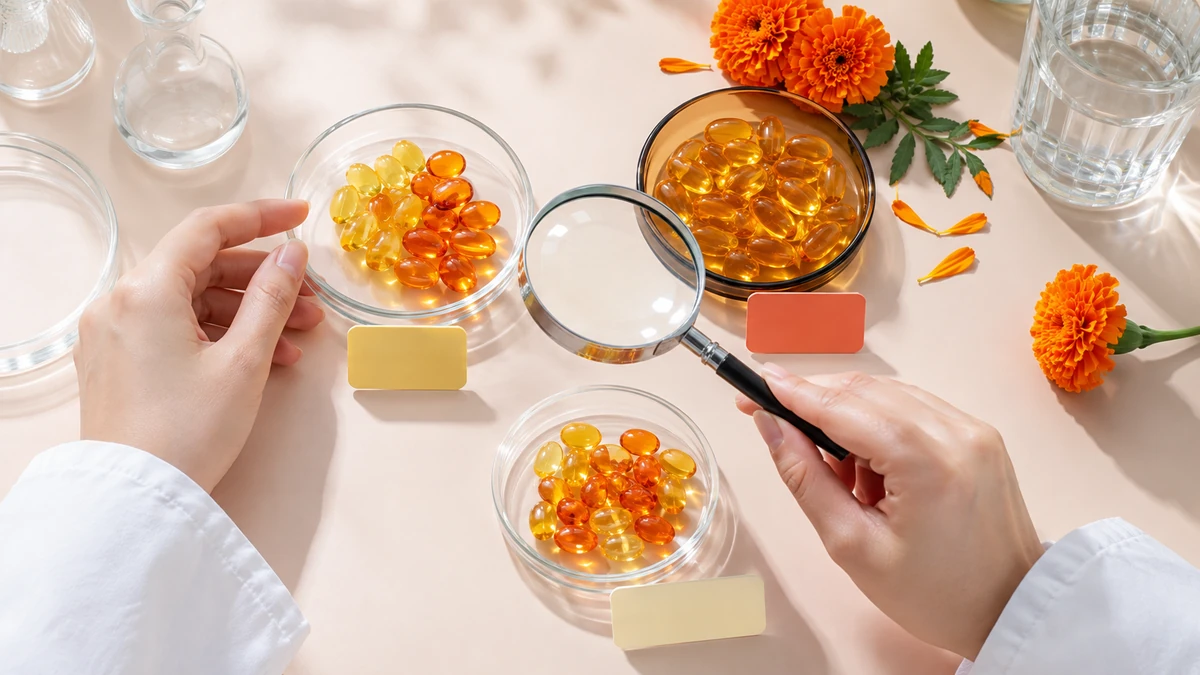
Image to help understand the article
One Familiar Ingredient, Three Regulatory Identities
For consumers scanning a supplement aisle, lutein can look like a straightforward product: Find the word on the front of the bottle, compare the dose and price, and choose a brand. South Korean regulatory records show why that shortcut can be misleading. Korea’s Ministry of Food and Drug Safety, the national agency broadly comparable to the U.S. Food and Drug Administration, lists three separately recognized functional ingredients associated with lutein. They have different official names, different recognition numbers and, in some cases, different warnings, even though their authorized health claim is essentially the same.
The three entries are a lutein-zeaxanthin mixed extract, recognition No. 2008-66; marigold extract in the form of lutein esters, recognition No. 2012-22; and a lutein-zeaxanthin extract complex, recognition No. 2022-29. Those distinctions are more than bureaucratic fine print. They tell consumers which specific ingredient was reviewed, how it is identified in Korea’s regulatory system and which precautions apply to it.
The Korean records describe all three ingredients as potentially helping maintain macular pigment density that may decline with age, thereby supporting eye health. The operative phrase is “may help.” It is not a promise that the supplement will prevent vision loss, treat an eye disease or produce a guaranteed result. Korea’s wording reflects the same basic dividing line American consumers encounter in supplement advertising: A product can be marketed as supporting a normal body function without being authorized as a medicine that diagnoses, treats, cures or prevents disease.
The larger lesson extends beyond lutein. As supplements become more specialized and their labels more crowded with scientific language, the ingredient’s exact regulatory identity matters more than the largest word on the package. Two bottles may both prominently advertise lutein while relying on ingredients with different formulations, records and use instructions.
Why Lutein Is Marketed for Aging Eyes
Lutein and zeaxanthin are carotenoids, naturally occurring pigments found in foods including leafy green vegetables and egg yolks. They are also present in the macula, the central portion of the retina associated with detailed vision. That biological role has made the compounds familiar fixtures in products marketed to older adults and people concerned about long hours in front of screens.
Macular pigment density is a technical phrase that can sound more definitive on a label than it really is. In plain English, it refers to the concentration of pigment in the macula. Korea’s authorized claim says the listed ingredients may help maintain that density as it decreases with aging. It does not establish that every user will experience a measurable improvement, and it does not turn a supplement into a treatment for age-related macular degeneration or another diagnosed condition.
That distinction is especially important in South Korea, where health and beauty products frequently overlap in retail culture. Pharmacies, online marketplaces, television shopping channels and large stores sell an extensive range of products promoted for specific functions, from joint and liver support to skin and eye health. Korean consumers often encounter supplements in carefully designed daily packets or branded wellness routines, much as Americans now see personalized vitamin subscriptions and condition-specific products marketed through social media.
Under Korean law, a “health functional food” is a regulated category with recognized functional ingredients and approved claim language. The Korean term does not mean the product is a prescription drug, nor does it mean the government guarantees that it will work for every person. Instead, the category allows particular claims when products meet relevant requirements. Consumers should therefore read the exact approved wording rather than converting a qualified statement about support into an unqualified claim about prevention or treatment.
The Ingredient Name Matters More Than the Front Label
The records highlighted in the Korean report illustrate a common problem in global supplement shopping: Marketing language simplifies what regulation treats as distinct. A package may place “lutein” in oversized type while listing the formal functional ingredient in much smaller print. That formal name is the key to matching the product with the correct government record.
For Korean products, shoppers can look for the ingredient names corresponding to the lutein-zeaxanthin mixed extract, marigold extract containing lutein esters or the lutein-zeaxanthin extract complex. If a recognition number appears, it can provide another point of verification: 2008-66, 2012-22 or 2022-29. The dates embedded in those numbers also show that Korea has recognized lutein-related ingredients at different points over more than a decade, rather than treating every formulation as one permanent and interchangeable entry.
Marigold, in this context, is not merely a decorative flower used as a folksy branding image. Marigold flowers are commonly used as a commercial source of lutein. The reference to lutein esters describes the chemical form in the recognized ingredient. Consumers do not need to become chemists, but they should understand that source and form can be part of a product’s regulatory identity.
The Korean data include daily intake figures of 10 for the lutein-zeaxanthin mixed extract, 18.5 for marigold extract containing lutein esters and 12 for the lutein-zeaxanthin extract complex. The source summary does not provide units for those figures. It would therefore be unsafe to assign units or compare the numbers as though they were equivalent doses. A larger number does not automatically mean a stronger or better product, particularly when the substances, forms and measurement bases may differ. The appropriate reference is the full label on the product being used, not a detached number circulated in an article, advertisement or social media post.
This is a practical form of label literacy. Consumers should first identify the functional ingredient, then read the serving instructions and warnings connected to that ingredient. Comparing only milligram figures, capsule counts or bold claims on the front can create a false impression of precision.
The Warnings Are Not Identical
All three Korean ingredient records warn that excessive consumption can temporarily turn the skin yellow. Such discoloration can occur when high levels of carotenoid pigments accumulate in the body. The warning is a reminder that a nutrient-related product is not automatically risk-free and that taking more than the labeled amount is not a shortcut to better results.
Other precautions vary. According to the Korean information, pregnant women should consult a physician before taking the lutein-zeaxanthin mixed extract. The newer lutein-zeaxanthin extract complex carries cautions for infants, children, pregnant women and breastfeeding women. Smokers are instructed to consult a professional before using that complex. Its record also tells users to stop taking the product and seek professional advice if an adverse event occurs.
The differences do not necessarily mean one ingredient is categorically safe and another is dangerous. They mean consumers should not copy a warning from one lutein product onto another or assume that precautions omitted from a casual product description are irrelevant. The exact formulation and its official label control the decision.
Smokers should pay particular attention to ingredient-specific advice rather than relying on broad assumptions about carotenoids. Research and warnings involving one carotenoid or formulation should not be casually generalized to every eye supplement. The Korean record’s direction is narrower and more responsible: A smoker considering the specified lutein-zeaxanthin complex should consult a qualified professional.
Anyone with an eye condition, another chronic illness or a regular medication regimen should also avoid treating a supplement label as personalized medical advice. A health functional food is not a substitute for an examination by an ophthalmologist or another clinician. Sudden vision changes, eye pain or other acute symptoms call for medical evaluation, not a trip to the supplement aisle.
What This Means for American Consumers
The Korean distinctions matter in the United States because supplements and their ingredients move through international supply chains, while American shoppers increasingly buy Korean wellness products through e-commerce platforms and specialty retailers. The popularity of Korean skin care helped establish a broader U.S. market for Korean beauty and wellness goods. Supplements are not identical to cosmetics, but they can benefit from the same halo of technological sophistication, attractive packaging and interest in Korean lifestyle trends.
American consumers should not assume that a Korean government recognition number is an FDA approval. The two countries use different legal categories and review systems. A claim or ingredient recognized for a Korean health functional food does not automatically have the same status in the United States. Conversely, a product sold legally as a dietary supplement in the U.S. may carry labeling that differs from its Korean version.
In the United States, dietary supplements generally do not go through the same premarket approval process required for prescription drugs. Companies remain responsible for ensuring that their products are safe and properly labeled, while the FDA oversees the market under the American legal framework. Structure-function claims, such as language about supporting eye health, must not be presented as unauthorized disease-treatment claims. Labels commonly carry a disclaimer stating that the claim has not been evaluated by the FDA and that the product is not intended to diagnose, treat, cure or prevent disease.
That makes cross-border shopping particularly complicated. An American buyer may see a Korean recognition number, a translated product page, an importer’s sticker and a U.S.-style disclaimer on different parts of the same listing. The safest approach is to identify which label governs the product sold in the United States, check the complete ingredient list and serving directions, and be skeptical of retailers that blur the line between Korean recognition and American approval.
U.S. companies also have reason to watch Korea’s ingredient-specific system. American supplement makers increasingly sell products in multiple markets, where regulators may authorize different wording and require different warnings. A brand cannot responsibly use one global marketing page if that page erases legally significant distinctions among formulations. Importers, retailers and online marketplaces need accurate product descriptions that preserve the formal ingredient name instead of reducing every version to “lutein.”
For American eye-care professionals, the issue is familiar in another form. Patients often arrive with bottles chosen from online reviews, warehouse-club shelves or influencer recommendations. A clinician needs the precise formulation and dose, not simply the headline ingredient. Korea’s three-name example reinforces a useful U.S. practice: Bring the bottle, a clear photograph of the label or the full product information to a medical appointment.
A Broader Test for the K-Wellness Boom
Korean consumer culture has become a powerful global export. K-pop, television dramas, films, food and beauty products have built audiences that often develop interest in other Korean goods. That cultural momentum creates opportunities for legitimate wellness companies, but it also raises the risk that consumers will transfer trust from entertainment or cosmetics to products making health-related claims.
Korean beauty’s rise in the U.S. offers a useful comparison. American shoppers learned terms such as essence, ampoule and sheet mask, then began distinguishing between product categories that once appeared interchangeable. Supplements may require a similar learning curve, but the stakes are higher. Misunderstanding a moisturizer’s role can waste money or irritate skin; misunderstanding a supplement’s dosage, warning or interaction potential can create a more serious problem.
The next phase of Korean wellness in America will depend partly on whether brands and retailers make regulation understandable without turning it into a sales gimmick. Recognition numbers can improve transparency when they help consumers locate an official record. They can mislead when displayed like seals of universal government endorsement. Responsible marketing should explain what was recognized, by which country, for which formulation and with what exact qualified claim.
This is also an issue in U.S.-Korea trade. Both countries have sophisticated life-sciences, food and consumer-products industries, but their regulatory terminology is not interchangeable. As more small brands sell internationally through digital marketplaces, compliance is no longer only a concern for multinational corporations. A Korean manufacturer, an American importer and an online platform may all play roles in presenting one product to a U.S. buyer. Accurate translation is necessary, but translation alone is not enough; the seller must preserve the regulatory meaning.
How to Read a Lutein Product Without Falling for the Hype
A useful first step is to ignore the front of the package temporarily. Turn to the panel that identifies the functional or dietary ingredients. Determine whether the product contains lutein alone, lutein with zeaxanthin, a marigold-derived form or a named complex. For a Korean health functional food, compare the formal name and any recognition number with official Ministry of Food and Drug Safety information. For a product marketed in the United States, read the Supplement Facts panel and U.S. labeling rather than relying solely on a foreign-language package image.
Next, separate three different ideas that advertising often blends together: what an ingredient is, what a regulator allows a company to say about it and what a consumer can expect personally. The Korean records identify three ingredients and permit a qualified statement about helping maintain age-related macular pigment density. They do not guarantee an outcome for an individual user.
Consumers should then review the serving size and instructions as a complete unit. The daily-intake figures in the Korean source cannot be meaningfully compared without their missing units and context. A shopper should not improvise a dose based on those numbers. Nor should consumers stack several eye-health products without checking whether they contain overlapping ingredients.
Finally, read every caution. Pregnant or breastfeeding women, parents considering products for children, smokers, people taking medication and those being treated for medical conditions may need professional guidance. If an unexpected reaction occurs, stop using the product and seek advice. Excess intake is not justified by the fact that lutein is associated with foods or occurs naturally in the body.
What to Watch Next
The most important trend is not the arrival of another lutein product. It is the growing need for ingredient-level transparency in a market built around simplified promises. Korea’s records show that regulators may recognize multiple related ingredients under distinct names even when the authorized function sounds the same. As formulations evolve, newer entries may carry warnings that older or differently defined ingredients do not.
Consumers should watch whether companies make those distinctions easier to find, especially in online listings where package images may be incomplete. Retailers should clearly identify the country-specific product version and avoid using an approval claim from one jurisdiction to imply endorsement in another. Regulators and health professionals, meanwhile, face the continuing challenge of explaining qualified claims in language that can compete with much louder marketing.
For Americans interested in Korean wellness, the message is not to reject imported products or assume that domestic supplements are inherently clearer. It is to apply the same scrutiny across borders. Look past celebrity endorsements, trend-driven packaging and headline ingredients. Match the exact product to the exact label, and treat “may help” as the carefully limited phrase it is.
Korea’s three lutein-related ingredient records offer an unusually clear case study. The names differ. The recognition numbers differ. Some precautions differ. The central authorized claim remains essentially the same: These ingredients may help maintain macular pigment density that can decline with age and thereby support eye health. That is useful information, but it is not a medical guarantee — and understanding the difference is the most important supplement consumers can take away.
Comments
Post a Comment