Image to help understand the article
A familiar mineral, a cross-border lesson
For Americans comparing bottles of zinc at a pharmacy or browsing Korean wellness products online, the most important words on the label may not be “immune support.” They may be “normal” and “necessary.” Those qualifications are central to South Korea’s recognized claims for the essential mineral — and they help explain the distance between meeting a nutritional need and promising protection from illness.
A Korean consumer health explainer based on public data from the Ministry of Food and Drug Safety identifies two recognized functions for zinc: It is necessary for normal immune function and normal cell division. The language is restrained. It does not describe zinc as a treatment, say that taking extra will strengthen an already adequately nourished person’s defenses or establish that a supplement prevents infection.
That distinction matters in the United States, where shoppers encounter similar language on dietary supplements. The Korean guidance offers a useful comparison between two regulatory systems addressing the same consumer challenge: how to communicate a nutrient’s legitimate biological role without turning that role into an oversized health promise.
The source is an educational summary, not an announcement of a new scientific discovery or regulatory change. Its relevance lies in what it reveals about reading wellness claims across borders. A familiar ingredient does not make Korean and American labels interchangeable, and an officially recognized function is not a guarantee of a noticeable benefit for every buyer.
What zinc does — and what that does not prove
Zinc is a chemical element, represented by the symbol Zn and atomic number 30. It is an essential trace element, meaning the body needs it in small amounts. Its importance is not unique to humans; animals, plants and microorganisms also depend on it. On a supplement label, however, the useful questions concern its nutritional role, the amount supplied and whether the person taking it needs additional zinc.
The Korean explainer identifies zinc carbonate and zinc gluconate as compounds used in supplements. These names describe forms containing zinc, not different nutrients. American shoppers may recognize zinc gluconate from domestic products. Seeing the same compound on a Korean label can help identify the ingredient, but it does not establish that two products have identical doses, formulations or quality controls.
The two recognized functions also require some unpacking. Normal immune function refers to the ordinary operation of the body’s defenses. Normal cell division refers to the process by which cells reproduce, a fundamental part of growth and tissue maintenance. Neither phrase, by itself, supports a claim that a supplement accelerates recovery, reverses aging or treats a disease involving the immune system.
The practical distinction is between necessity and added benefit. A nutrient can be indispensable without an extra dose improving health in someone whose intake is already sufficient. Correcting inadequate intake and adding more to an adequate diet are different situations. The Korean source establishes zinc’s recognized nutritional functions; it does not provide clinical evidence that everyone should buy a zinc supplement.
Understanding Korea’s “health functional food” category
South Korea uses a regulated category commonly rendered in English as “health functional foods.” For an American reader, dietary supplements are the closest familiar reference point, though the categories are not legally identical. The Korean term refers to products governed by rules concerning ingredients and recognized functions, rather than simply any food advertised as healthy.
The Ministry of Food and Drug Safety, often abbreviated as MFDS, oversees this area. In the public information summarized by the Korean article, zinc’s recognized functions are expressed narrowly: It is needed for normal immune function and normal cell division. Those statements are the basis for understanding the ingredient’s permitted functional positioning in the framework described by the source.
Calling something a health functional food does not make it a medicine. The Korean explainer explicitly makes that distinction and advises people with medical conditions or those taking medication to consult a professional before use. Americans should be equally cautious about treating an official-looking foreign label as proof of disease prevention or treatment.
There is also a translation issue with commercial consequences. A seller that shortens “necessary for normal immune function” to a much broader promise can change the impression a consumer receives, even while continuing to discuss the same ingredient. The qualifying words carry meaning. A responsible English-language description should preserve them rather than imply that Korean recognition amounts to a medical endorsement.
Why the Korean dose range is not an American daily requirement
The Korean source lists a daily intake range of 2.55 to 12 milligrams for zinc under the recognized health functional food information it describes. That figure needs context before an American reader uses it to make a purchasing decision. It should not be read as a universal nutritional requirement, a personalized prescription or an overall safety ceiling for zinc from every source.
In the United States, the National Institutes of Health’s Office of Dietary Supplements lists recommended dietary allowances of 11 milligrams a day for adult men and 8 milligrams for adult women. Recommendations differ during pregnancy and breastfeeding and for children. These U.S. dietary allowances concern total intake, including food, rather than an instruction to take that quantity in a separate supplement.
A third number often appears on American packaging: The Food and Drug Administration’s Daily Value for zinc is 11 milligrams for adults and children ages 4 and older. That labeling benchmark helps consumers compare products. It is not a personalized target for every person who reads the bottle, and it serves a different purpose from the Korean product-related range.
These numbers are not necessarily contradictory. They answer different questions. A Korean functional ingredient intake range, a U.S. dietary recommendation and a labeling reference value belong to different frameworks. Shoppers should first identify what each number represents, then check the serving instructions and other sources of zinc in their diet. Simply choosing the larger number is not a sound nutritional strategy.
What this means for American shoppers and companies
For the United States, the clearest implication is about consumer understanding and responsible commerce, not evidence of a new supplement boom. The Korean source provides no U.S. sales figures, export totals or indication that Americans are increasingly buying Korean zinc. It does, however, illustrate the questions American consumers and businesses must resolve when health-related products cross language and regulatory boundaries.
American fans of Korean entertainment, food or beauty products may already be comfortable encountering Korean brands. But cultural familiarity and nutritional evidence are separate matters. A product’s Korean origin does not make it more effective, just as an American origin does not make a competing product superior. Country of origin cannot substitute for a clear ingredient list, an appropriate dose and support for the actual claim being made.
For American retailers and importers, the commercial lesson is equally concrete: Korean regulatory recognition is not FDA approval. Products marketed in the United States must meet applicable U.S. requirements. An English product page should explain the amount of zinc supplied and the intended serving, avoid unsupported disease claims and accurately convey what the Korean regulatory language does — and does not — establish.
The broader U.S.-Korea connection here is informational. Consumer trust depends in part on whether companies carry meaning accurately from one market to another. Familiarity with Korean culture can make a brand approachable, but transparent labeling is what allows a shopper to evaluate the supplement. The source does not establish a bilateral trade development; it supplies a small, useful example of why cross-border wellness marketing requires more than translation.
The American parallel: “Supports” is not the same as “prevents”
American shoppers already face a comparable issue in their own supplement aisle. U.S. dietary supplement labels can carry structure/function claims, which describe a nutrient’s role in supporting the body’s normal structure or function. Such statements are different from claims to diagnose, treat, cure or prevent disease. The FDA generally does not approve dietary supplements for safety and effectiveness before they reach the market.
Under U.S. rules, supplement structure/function claims require substantiation and an accompanying disclaimer explaining that the FDA has not evaluated the statement and that the product is not intended to diagnose, treat, cure or prevent any disease. That framework is not identical to Korea’s, but both make the wording of a claim important to understanding its limits.
A useful comparison is a bottle that says it supports immune function versus an advertisement that says it prevents influenza. The first describes a role in normal physiology; the second promises a disease-related outcome. Consumers should not assume the second follows from the first. Evidence that the body needs zinc does not independently establish that a particular product will keep its user from getting sick.
Zinc’s association with cold remedies can further blur the distinction for Americans. Research on specific preparations, timing and outcomes is a separate subject from the basic nutritional claims in the Korean explainer. That source does not evaluate cold treatment. It therefore should not be used to recommend a lozenge regimen or justify taking larger amounts when respiratory symptoms begin.
No listed warning does not mean no risk
The Korean summary says the cited zinc entry contains no separately listed precautions. Readers should interpret that as a description of the information in that entry, not as a declaration that zinc has no adverse effects or interactions. The article’s own closing advice — consult a professional if you have a medical condition or take medication — is an important qualification.
U.S. guidance provides additional safety context. The NIH lists a tolerable upper intake level of 40 milligrams a day for adults, covering zinc from food and supplements. That is not a recommended intake or a target to approach. Limits are lower for children and adolescents. Clinician-directed treatment can involve different circumstances, which is another reason not to improvise a regimen based on a retail label.
Excess zinc can cause nausea, vomiting and other gastrointestinal symptoms. Taking high amounts over time can interfere with copper absorption and contribute to copper deficiency. Zinc can also interact with certain medicines, including some antibiotics. A pharmacist or clinician can advise whether a supplement is appropriate and whether doses need to be separated from medication.
Overlapping products deserve particular attention. A multivitamin, a standalone zinc supplement and another product marketed for immune support may each contribute zinc. The relevant amount is the combined intake, not just the number on the newest bottle. A missing warning in a short ingredient summary does not remove the need to review the full product label and the rest of a person’s routine.
A better way to compare products
The Korean explainer recommends checking three things: the ingredient name, the recognized functions and the daily intake. Americans can use the same basic approach while interpreting the numbers through the appropriate U.S. guidance. Start by confirming that the nutrient is zinc, whether it appears as the English word, the Korean name or the chemical symbol Zn.
Next, identify the amount of zinc per serving and the number of tablets, capsules or other units in that serving. On a U.S. Supplement Facts panel, the declared zinc amount represents elemental zinc — the zinc supplied — rather than the full weight of a compound such as zinc gluconate. Comparing compound weights with elemental zinc amounts can produce a misleading impression of relative strength.
Then examine the promise. Language about supporting normal function should not quietly become an expectation of fewer infections, faster healing or other clinical outcomes. The Korean source does not rank zinc compounds, establish that imported products outperform domestic ones or show that a higher-priced formulation produces better results. Those would require additional evidence.
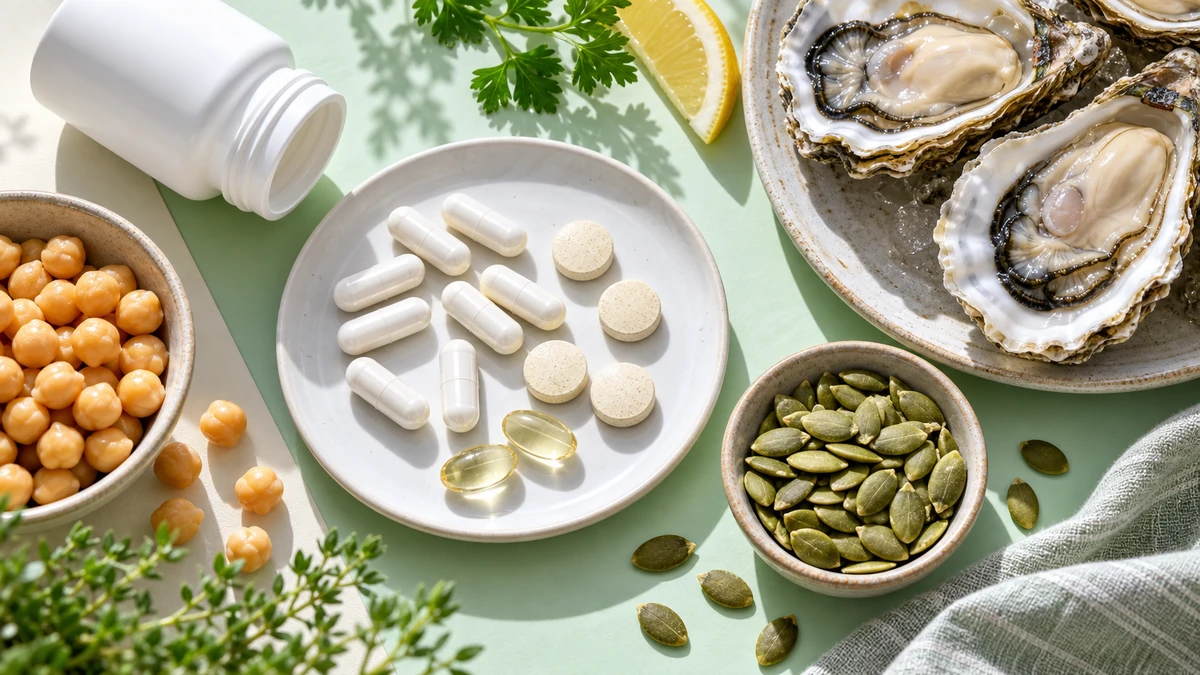
Finally, consider whether supplementation addresses a real need. Zinc is available in foods including meat, seafood, dairy products, beans, nuts and fortified cereals. Individual requirements and absorption can vary, so someone concerned about inadequate intake should seek advice rather than assume that everyone needs a separate pill. For American consumers navigating Korean and domestic wellness products alike, the takeaway is straightforward: Preserve the meaning of the claim, understand the dose and do not mistake a necessary nutrient for a universal remedy.
Comments
Post a Comment