Why Anseong Is Drawing Attention: A Korean Crossroads Tests New Models for Local Giving, Clean Air and Industrial Growth
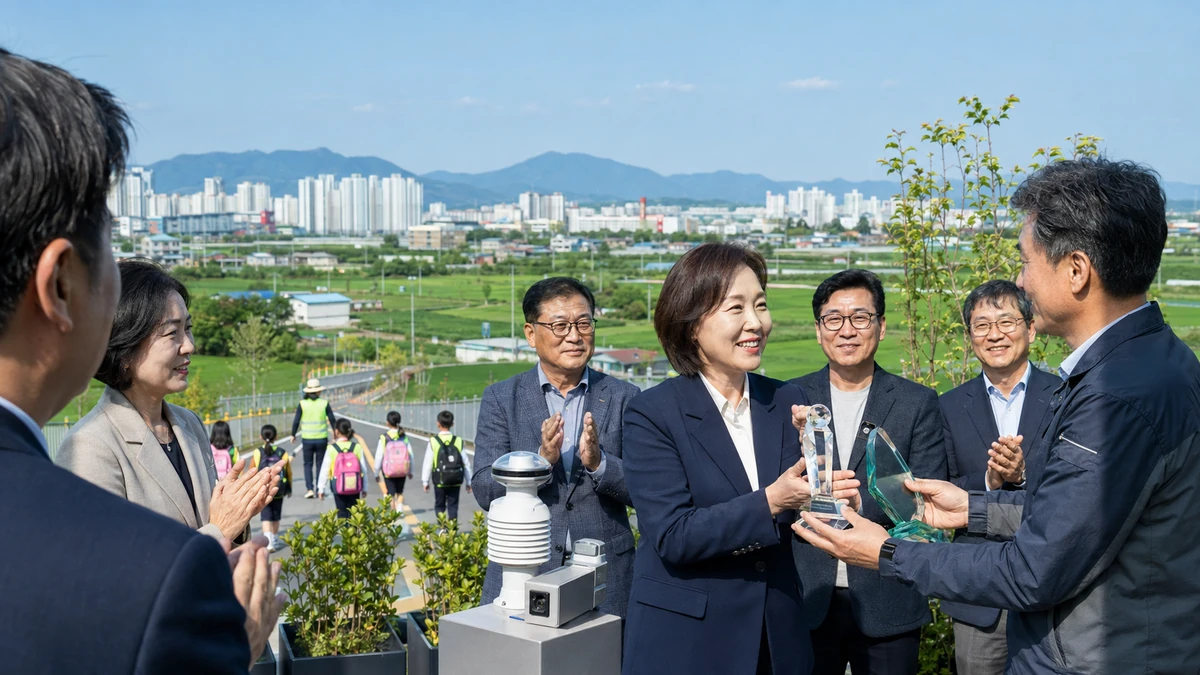
Image to help understand the article
A Korean city enters the spotlight for several different reasons
Anseong, a city near the southern edge of South Korea’s most populous province, has drawn a burst of public attention after several unrelated news reports appeared at roughly the same time. Some carried positive headlines: The municipal government reportedly won the top prize at the SBS Hometown Love Donation Awards for a second consecutive year, while also receiving the highest rating in a Gyeonggi Province assessment of fine-dust reduction for the seventh year in a row. Another report quoted Mayor Kim Bo-ra as saying that hometown donations would be used to help children return home safely.
Other headlines were more troubling. South Korea’s national audit agency was reported to be examining the Anseong city government, and a missing woman was reportedly found dead inside a container in the area. The available source material does not include the underlying articles, audit findings, investigative details or official explanations. It would therefore be irresponsible to infer wrongdoing, determine a cause of death or connect the cases to the city’s policy awards. The more defensible conclusion is that several stories with sharply different subjects converged around the same place name, causing searches for Anseong to rise.
That convergence offers a useful lesson about how regional news travels in South Korea. A midsize city can become a national search trend not because of one defining event, but because local government announcements, public safety stories, development plans and breaking crime news are aggregated on the same portals. For American readers accustomed to Google News, local television websites and social media feeds, the dynamic is familiar. The difference is that South Korea’s highly concentrated online news environment can make the name of a municipality appear suddenly prominent even when the stories are unrelated.
Anseong is worth examining beyond the day’s search traffic. Its location, mix of agriculture and industry, transportation links and expanding suburban districts place it at the center of several forces reshaping South Korea outside Seoul: regional competition for investment, pressure to improve environmental performance, experiments in locally directed giving and the uneven expansion of the greater capital region.
Understanding Anseong’s place on the Korean map
Anseong sits at the southernmost end of Gyeonggi Province, the large jurisdiction that surrounds Seoul and contains many of the satellite cities, industrial zones and commuter communities associated with the South Korean capital. It borders Icheon to the east, Pyeongtaek to the west and Yongin to the north. To the south, it meets Cheonan in South Chungcheong Province and Eumseong and Jincheon in North Chungcheong Province.
For Americans, one way to understand its geography is to think of a city at the outer edge of a major metropolitan region, where suburban development gives way to farms, logistics facilities and smaller towns. Anseong officially belongs to the Seoul-centered capital region, but its southern boundaries connect it directly to Korea’s central provinces. That makes it both an endpoint and a gateway: part of metropolitan Gyeonggi, yet closely tied to travel, commerce and development in the Chungcheong region.
The city covers about 553.47 square kilometers, or roughly 214 square miles. Its registered population stood at 192,262 people in 93,888 households in July 2024, according to the figures included in the source material. That puts it in the range of a substantial American regional city, although direct comparisons are imperfect because Korean municipal boundaries often include dense urban neighborhoods, small towns, villages and agricultural land under one city government.
Anseong’s administrative structure illustrates that complexity. It consists of one eup, 11 myeon and three administrative dong. An eup is generally a town-level jurisdiction, a myeon is a more rural township, and a dong is an urban neighborhood-level unit. Korean records also distinguish between administrative dong, which are used to deliver public services, and legal dong, which are used in official addresses and land records. Anseong has 33 legal dong, but that does not mean it has 33 administrative neighborhoods. The distinction resembles the way an American mailing address, census tract, township and city council district can describe the same place through different boundaries.
Population claims require similar care. Some online discussions put Anseong’s population above 300,000 by adding communities that were historically associated with the area but were transferred to neighboring Pyeongtaek in 1983. The source material says such hypothetical totals reach about 320,000 when five legal villages are included for 2024 and about 340,000 in a 2025 estimate. Those figures are not the city’s current registered population. For decisions involving schools, housing, retail demand or public services, the official population and the historical reconstruction should not be treated as interchangeable.
A transportation hub with several distinct centers
Anseong often appears in South Korean transportation and development coverage because it is connected to a dense road network. National Route 38 and a major state-supported local route pass through the area, while the Gyeongbu, Jungbu, Pyeongtaek-Jecheon and Sejong-Pocheon expressways provide broader regional access. The source describes Anseong as having nine highway interchanges, more than any other city in the country.
That road access matters in a nation where manufacturing, warehousing and just-in-time delivery are central to the economy. Anseong is close enough to the capital region to serve businesses and consumers there, but it also provides routes toward ports, industrial centers and cities farther south. In American terms, its economic role has elements of an interstate crossroads, an exurban growth corridor and a regional logistics base.
Still, a map label reading Anseong can be misleading because the municipality does not function as a single, uniform downtown. Gongdo, Daedeok, Bogae, Seoun, Juksan and Iljuk are different districts with different development patterns. A traveler heading to a shopping complex in Gongdo may be going in a very different direction from a student traveling to a university campus or an engineer visiting a planned industrial site.
Gongdo includes a Starfield shopping complex, part of a Korean retail format that combines a mall with dining, entertainment and family-oriented attractions. Daedeok is home to a Chung-Ang University campus, while Hankyong National University is located in the Ayang New Town area. Plans cited in the source include a specialized cluster in Bogae for semiconductor materials, components and equipment, as well as development in the Yangbok district. Seoun has also been mentioned in connection with a Hyundai Motor Group research facility plan. Because these projects may be planned rather than completed, their timelines and final scope remain important questions.
The city’s transportation advantages do not eliminate local disparities. Gongdo was described in 2024 as ranking among the 10 most developed of South Korea’s 236 eup-level towns. Anseong has begun construction of a civic center there in preparation for Gongdo’s population potentially reaching 100,000, with completion scheduled for 2026. By contrast, Juksan and Iljuk face development constraints because they are within the Han River watershed management area. The result is a city where growth can accelerate in one corridor while environmental rules limit construction in another.
Local donations become a tool for visible public projects
Anseong’s second consecutive top recognition at the SBS Hometown Love Donation Awards highlights a relatively new feature of South Korean local government: efforts to turn emotional attachment to one’s hometown or another community into financial support for local projects. The system is commonly known as the Hometown Love Donation program. It allows people to support municipalities outside the place where they currently live, linking private contributions with local policy priorities and regional promotion.
The idea has particular resonance in South Korea because millions of people have moved from smaller cities and rural counties to Seoul and its surrounding region over several generations. A person may live and work in the capital but retain strong family, school or ancestral ties to another part of the country. Korean culture often places lasting importance on one’s gohyang, or hometown, even when that place is no longer one’s legal residence. The term can carry a sense of identity, memory and family roots that is broader than the American question of where someone currently lives.
For American readers, the nearest comparison may be a combination of place-based philanthropy, an alumni fund and a community foundation campaign. Yet the Korean program is a government-administered policy rather than simply a private charitable appeal. Municipalities compete to present compelling projects and, in the broader national program, often use regional products and public messaging to build a relationship with donors. The available summary does not provide enough detail to assess Anseong’s fundraising totals, selection process, award criteria or the precise mechanics of its winning campaign.
What is clear is the emphasis on a tangible public benefit. Mayor Kim’s reported statement that hometown donations would support safer routes home for children gives donors an easily understood purpose. American cities and school districts have pursued comparable goals through Safe Routes to School programs, improved street lighting, crossing guards, sidewalks and traffic-calming projects. The political appeal is similar: Residents and donors are more likely to understand a program when officials can point to a safer intersection, a monitored route or another visible improvement.
The award also reflects a larger competition among Korean municipalities for attention and resources. Regions outside the most prosperous parts of the capital area face aging populations, uneven tax bases and the departure of younger residents. Even Anseong, which benefits from proximity to Seoul-region infrastructure, contains rural districts that do not share equally in suburban growth. Hometown giving offers local governments another way to finance targeted programs while reminding former residents and outside supporters that they can maintain a stake in a community’s future.
Seven years of clean-air recognition, with important limits
Anseong also reportedly earned the highest grade in Gyeonggi Province’s fine-dust reduction assessment for a seventh consecutive year. In South Korea, fine dust is not an abstract environmental term. Measurements of particulate pollution frequently appear in weather applications and television forecasts, and residents may adjust outdoor exercise, children’s activities or mask use according to daily air-quality readings.
The Korean phrase mise meonji, usually translated as fine dust, generally refers to airborne particulate matter small enough to penetrate the respiratory system. PM10 particles have diameters of 10 micrometers or less, while PM2.5 particles are 2.5 micrometers or less and pose greater health concerns because they can travel deeper into the lungs. Americans encounter the same pollutants through the Environmental Protection Agency’s Air Quality Index, especially during wildfire smoke events in the West, industrial pollution alerts and summer ozone episodes.
For a city such as Anseong, air-quality management intersects with transportation, farming, construction and industry. Its expressways and industrial ambitions create economic opportunity but can also increase scrutiny of vehicle emissions, diesel traffic, dust control and factory pollution. Agricultural activity may present another set of seasonal environmental challenges. A sustained high rating suggests that provincial evaluators have repeatedly credited the city’s reduction efforts, but the summary does not identify the assessment’s methodology, numerical pollution trends or specific programs. An award should not be interpreted as proof that the air is always clean or that every pollution source has been resolved.
The seven-year record nevertheless matters because local environmental policy depends on consistency. Municipal governments oversee or help enforce measures involving road dust, construction sites, vehicle restrictions, public alerts and support for cleaner equipment. Success is often less about a single dramatic project than about maintaining inspections, budgets and public compliance over many years.
Anseong’s geography adds another layer. The terrain is higher in the northeast and slopes more gently toward the southwest. The Cheongmi Stream runs through the eastern area, while the Anseong, Joryeong and Han streams join in the west and flow toward the Yellow Sea. Seoun Mountain, along the southern provincial boundary, rises about 547 meters, or roughly 1,795 feet. Broad plains and suitable rainfall have long supported agriculture. These natural features help explain why development policy in Anseong must balance farms, waterways, watershed protections and new industrial construction rather than treating the city as an uninterrupted urban zone.
What Anseong’s evolution means for the United States
For the United States, Anseong is most relevant not as a tourist destination or entertainment hub, but as part of the industrial geography behind the U.S.-Korea economic relationship. South Korea is a major American ally and a deeply integrated commercial partner, particularly in automobiles, batteries, electronics and semiconductors. Decisions made in Korean regional cities can eventually affect supply chains, research partnerships and investment strategies that reach American factories and consumers.
The planned semiconductor materials, parts and equipment cluster mentioned for Bogae is a case in point. The semiconductor industry depends on a network far broader than the companies whose names appear on computer chips. It includes specialized chemicals, production tools, components, testing operations and logistics providers. Both Washington and Seoul have placed greater emphasis on supply-chain resilience as governments and businesses seek to reduce vulnerability to geopolitical conflict, pandemics and concentrated production. If Anseong’s planned cluster advances, American companies will want to understand what firms locate there, what technologies they provide and whether they become suppliers or competitors in U.S.-linked production networks.
The reported Hyundai Motor Group research facility plan in Seoun also carries a potential American connection. Hyundai and its Kia affiliate are familiar brands in the United States, and the group’s decisions on vehicle technology, testing and research can influence products sold to American drivers. The source does not establish the project’s final status or specify its work, so conclusions about its impact would be premature. Still, the plan shows how research and manufacturing activity can spread beyond Korea’s best-known corporate centers into municipalities offering land and highway access.
Anseong’s experience may also interest American local officials competing for advanced manufacturing projects. Communities across the United States have offered infrastructure, tax incentives and workforce programs to attract semiconductor, battery and electric-vehicle investment. Korean municipalities engage in their own version of that competition, promoting transportation access, industrial districts and links to universities. The shared challenge is ensuring that headline investments produce durable local benefits rather than isolated facilities disconnected from nearby residents.
The city’s hometown donation recognition has another American parallel. U.S. towns routinely seek money from former residents, local foundations and businesses for parks, schools, libraries and public safety projects. Anseong’s approach suggests that a municipality can strengthen such appeals by attaching donations to a clear outcome, such as children’s safe travel. American policymakers would still need to account for major legal and tax differences, but the communications lesson crosses borders: Place-based giving is strongest when people can see who benefits and how results will be measured.
American audiences should also watch Anseong’s attempt to reconcile industrial growth with repeated recognition for particulate reduction. U.S. regions from Arizona to Georgia are building or recruiting technology and automotive facilities while confronting air pollution, water use and rapid housing growth. Anseong offers no simple model, and the available information does not prove that all of its policies are working. It does, however, illustrate the same central question facing American growth corridors: Can local governments welcome globally significant industry while protecting everyday quality of life?
Why one city can produce several conflicting narratives
The simultaneous attention to awards, an audit and a death investigation underscores the danger of collapsing all news about a place into a single story. A municipal government can receive recognition in one policy area while facing scrutiny in another. A serious crime or unexplained death can occur within city limits without reflecting the performance of the local administration. Search rankings erase those distinctions because algorithms group articles by repeated names rather than by institutional responsibility.
The audit-related headline should be treated with particular caution. South Korea’s Board of Audit and Inspection has broad oversight responsibilities, and the involvement of an anti-corruption investigation bureau does not by itself establish misconduct. Without the audit scope, findings, response from city officials or procedural status, it is not possible to say what conduct is under examination or whether any violation occurred.
The report involving the missing woman requires the same restraint. The source provides no confirmed account of the location beyond the Anseong area, no cause of death, no description of the container, no suspect information and no investigative conclusion. Responsible coverage should await statements from police or other authorities rather than turning a limited headline into a narrative.
For readers trying to understand Anseong, geography is often the first fact to verify. A housing development in Gongdo, a university event in Daedeok, an industrial proposal in Bogae and a watershed rule affecting Juksan may all carry the Anseong label while having very different consequences. Property buyers, travelers and companies should check the exact eup, myeon, dong or village rather than assume that a citywide trend applies uniformly.
What to watch next
The most important questions concern implementation. For the hometown donation program, the public should look for detailed accounting of how much money was raised, how projects were selected, what safeguards apply and how the promised child-safety improvements will be evaluated. A prestigious award creates expectations, but transparent results determine whether the program earns lasting trust.
For air quality, the next step is to compare recognition with measurable outcomes. Provincial ratings are meaningful, but residents need access to long-term PM2.5 and PM10 trends, enforcement data and neighborhood-level information. That will become more important if industrial facilities, construction and highway traffic expand.
For development, timelines matter. The Gongdo civic center is scheduled for completion in 2026, while the proposed semiconductor cluster and Hyundai-related research plans will need approvals, infrastructure and investment before their effects can be judged. Officials must also manage the divide between faster-growing western areas and eastern districts constrained by watershed protections.
Anseong’s moment in the news is therefore less about one award or one day of search traffic than about the changing identity of a regional Korean city. It remains agricultural, but it is pursuing advanced industry. It belongs to Gyeonggi Province, but it also serves as a bridge to central Korea. It promotes highways and development while seeking recognition for cleaner air. And it is asking people with emotional ties to the region to help finance practical local improvements.
Those tensions are recognizable on both sides of the Pacific. American communities also struggle to turn economic growth into safer streets, cleaner air and broadly shared prosperity. What makes Anseong significant is not that it has solved those problems, but that its policies, geography and ambitions bring them together in one rapidly changing place. The next measure of success will come not from another headline, but from whether residents can see the promised benefits in their daily lives.
Comments
Post a Comment