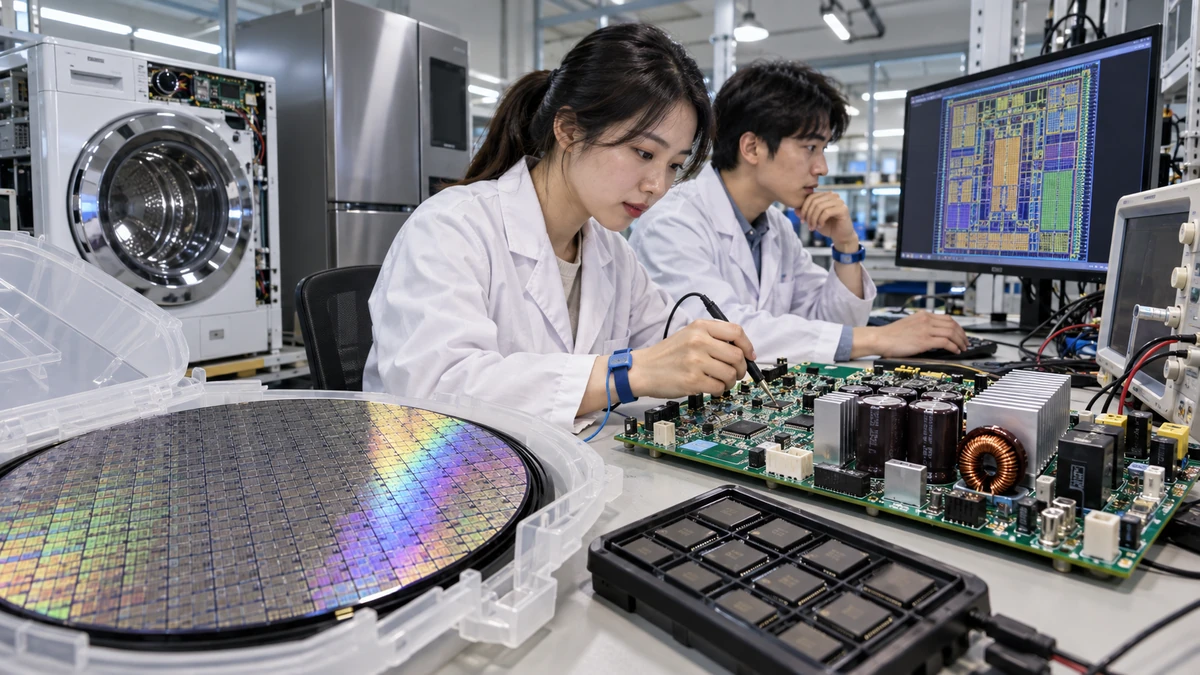
Image to help understand the article
The global industry inside an American home
For an American shopping for a refrigerator, the semiconductor industry might seem several steps removed from the decision. The concerns are more immediate: Will the appliance fit? How much electricity will it use? How reliable is it? Yet the chips controlling motors, processing sensor readings and managing digital displays connect that purchase to a global network of designers, factories and suppliers, including some of South Korea’s most important companies.
That connection helps explain why semiconductor news appears alongside coverage of household appliances, artificial intelligence and international trade. Chips are not a single product category with a single business model. They are components that enable many other industries, and the companies behind them perform different, sometimes overlapping jobs.
A Korean-language overview of the industry brings those connections into focus by placing manufacturing cooperation, memory competition, supply-chain concerns and regional investment under the same umbrella. Its central lesson is useful well beyond Korea: Understanding the electronics economy requires looking past the brand on the finished product to the businesses that make its capabilities possible.
For U.S. readers, the stakes extend from consumer choice to industrial policy. American technology companies depend on an international chip ecosystem, while Washington has sought to expand domestic manufacturing. South Korea is both a major participant in that ecosystem and a U.S. treaty ally. Its semiconductor industry is therefore not simply a foreign business story. It is part of the infrastructure supporting American computing, communications and manufacturing.
Why Korea’s chip story reaches beyond Korean brands
South Korea’s global visibility often comes through entertainment, food and consumer brands. Semiconductors represent a less visible connection: An American does not have to own a Korean-branded phone or television to use technology that depends on Korean suppliers.
Samsung Electronics and SK Hynix are major memory-chip producers. Memory allows computing systems to hold information needed for processing; storage retains information for later use. Different chip technologies serve those different functions, and their performance matters in devices ranging from smartphones to data-center servers. A finished device can combine American design, Korean memory and manufacturing or assembly performed elsewhere.
The Korean summary uses the compressed expression “Samjeonix” in one linked headline, combining references to Samsung Electronics and SK Hynix. For readers outside Korea, the shorthand is worth unpacking: The companies are separate businesses, not a joint enterprise. Grouping them together signals their prominence in discussions of Korea’s memory industry, but it should not obscure differences in their products, customers or strategies.
That distinction matters when competition intensifies. A rival’s manufacturing claim does not automatically establish an equivalent threat to every Korean producer, just as a new American electric vehicle does not affect every established automaker equally. The relevant questions concern the particular technology, whether it meets customer requirements and how much usable output the producer can deliver.
What the supplied headlines do — and do not — establish
The Korean overview presents semiconductors as a rising search term for Sept. 9, 2026, and groups several related headlines around it. Those headlines touch on a claimed memory-production milestone by China’s ChangXin Memory Technologies, manufacturing cooperation involving Samsung and Dutch equipment supplier ASML, and a supply-chain warning attributed to British semiconductor materials company IQE.
Other references concern investment recruitment by Gangwon, a province in northeastern South Korea; the relationship between AI data-center spending and memory demand; and a reported semiconductor-focused AI collaboration involving Samsung and France’s Mistral AI. Together, they illustrate how broadly chip developments can reach across business and policy coverage.
But the supplied material is a summary, not a set of independently verified underlying reports. It does not establish that every development occurred on the listed date, that those headlines caused a search increase or that announced cooperation produced commercial results. The date should not be treated as proof of a shared breaking-news moment.
The ChangXin headline, for example, attributes a claim of the world’s first mass production of LPDDR6, a low-power memory technology. The summary does not provide evidence sufficient to verify that claim. Similarly, a headline about expanded manufacturing cooperation does not disclose contractual commitments, production schedules or technical outcomes. These references offer a map of subjects drawing attention, not a reliable scoreboard of winners and losers.
Chipmaking is a division of labor, not one kind of company
The easiest way to understand semiconductor businesses is to ask what each company actually does. An American analogy is the separation among an architect, a construction contractor and specialist inspectors. All contribute to a building, but their responsibilities and economics differ. Chip production involves an even more technical division of labor.
A fabless company develops chip designs without operating the fabrication plants that manufacture those chips. Nvidia and Qualcomm are familiar American examples of this model. “Fabless” does not mean the business lacks engineering expertise; it means the company relies on manufacturing partners rather than owning the factories used to produce its designs.
A foundry manufactures chips for customers. Taiwan Semiconductor Manufacturing Co., widely known as TSMC, is a prominent example. Foundries can also provide tools and services that help customers prepare designs for manufacturing or coordinate later production stages. The exact scope varies, so the label alone does not establish that a company performs every task in-house.
An integrated device manufacturer, or IDM, combines chip design with manufacturing. Intel and Texas Instruments illustrate this model in the United States, although individual companies can also use outside manufacturers or operate businesses serving external customers. Samsung likewise operates across multiple semiconductor activities. These categories describe business functions; they are not rigid boxes that capture every transaction.
Other specialists supply photomasks, materials, equipment, packaging or testing. Packaging protects chips and provides electrical connections, while testing checks whether they work as required. Advanced packaging can also connect multiple chips closely enough to make the arrangement important to overall system performance. For investors, policymakers and readers, identifying the work being performed is more informative than assuming that every semiconductor company operates a leading-edge factory.
What this means for the United States
The central American interest is not whether Korea’s semiconductor companies succeed or fail in the abstract. It is whether U.S. businesses and consumers can obtain reliable, suitable chips at sustainable costs, and whether the United States has enough industrial capability to withstand disruptions. Those objectives involve cooperation with foreign suppliers as well as competition among them.
American companies occupy important positions in chip design, manufacturing equipment and design software. Korean companies are major participants in memory production, and Samsung also manufactures chips for outside customers. These roles make the bilateral relationship economically complementary even when individual companies compete. A U.S.-designed processor and Korean-produced memory can be essential parts of the same computing system.
The CHIPS and Science Act, signed in 2022, made federal support for domestic semiconductor manufacturing a central feature of American industrial policy. Its broader significance is that factory location, research capacity and supplier resilience became matters of national economic strategy, rather than decisions left entirely to individual companies. South Korea’s own attention to semiconductor investment fits into that international competition for production capacity and technical expertise.
For American audiences, this calls for a more precise understanding of “domestic” technology. A chip manufactured in the United States can still depend on foreign equipment, materials or intellectual property. Conversely, a foreign-headquartered company operating an American plant can contribute to U.S. manufacturing capacity. Corporate nationality and supply-chain geography are related, but they are not interchangeable.
The supplied Korean summary does not establish new U.S. contracts, American employment gains or changes in domestic chip availability. Those outcomes would require additional evidence. What it does illuminate is why Americans should follow Korea’s chip sector: Decisions there can intersect with the needs of U.S. cloud companies, electronics producers and industrial customers, even when the immediate announcement contains no American company name.
AI adds a demand story, but not a guarantee
Artificial intelligence has made the connection between semiconductors and the broader economy more visible. Operating advanced AI systems requires more than a powerful processor. Computing systems also need memory, networking, storage, electricity and cooling. A constraint in one part of that system can limit the usefulness of investment elsewhere.
This is why Korean memory producers attract attention in discussions of American data-center development. High-bandwidth memory, which places memory chips in closely connected stacks, is important to many advanced AI accelerators. It is distinct from the low-power memory category referenced in the ChangXin headline. Treating every memory announcement as an interchangeable AI breakthrough would blur meaningful technical differences.
For U.S. cloud providers and other large buyers, the practical questions include performance, energy use, availability and total system cost. For suppliers, the questions include how much capacity to add and whether customer demand will persist long enough to justify that investment. Strong interest in AI does not eliminate the semiconductor industry’s history of demand swings.
The summary also references semiconductor-focused AI development involving Samsung and Mistral AI. Without details, it would be premature to claim that such work has improved manufacturing yields, shortened design schedules or generated revenue. AI used to help make chips is a different proposition from chips used to run AI. Both may matter, but they require different evidence of commercial success.
Supply chains turn industrial news into foreign affairs
Semiconductor production depends on a network that crosses many borders. Equipment, specialty materials, chip designs and manufacturing services do not all originate in the same country. That makes trade policy and diplomatic relationships relevant even to companies that sell primarily to commercial customers.
The summary’s reference to an IQE warning about Chinese export controls illustrates the issue, but it does not identify enough detail to establish which materials, customers or production lines face a specific disruption. A warning signals a potential exposure. It is not, by itself, proof that factories have stopped operating or that American retail prices will rise.
The same discipline applies to Samsung’s reported cooperation with ASML. ASML supplies lithography equipment, which manufacturers use to create intricate patterns on semiconductor wafers. Cooperation with such a supplier can be strategically important, but a corporate announcement alone cannot demonstrate an improvement in manufacturing yield — the share of output that meets requirements — or a shift in market leadership.
For Washington and Seoul, these relationships complicate a simple choice between economic security and global trade. Resilience may require more domestic capability, but it can also depend on dependable international partners and multiple sources of supply. Watching which dependency a policy addresses is more useful than assuming that every new factory makes a country self-sufficient.
Regional ambitions need more than a factory announcement
Gangwon’s reported effort to attract semiconductor and packaging investment offers another point of comparison with the United States. Korean provincial governments, like American states, compete for industries expected to bring skilled employment, supplier spending and a stronger tax base. Participation in an industry exhibition is an investment-recruitment activity, however, not evidence that a company has committed to build a plant.
In both countries, the term “cluster” generally describes a geographic concentration of related businesses, workers, research institutions and infrastructure. The concept resembles the networks associated with American technology hubs: Companies may benefit from nearby suppliers and a workforce with relevant experience. A successful cluster depends on those practical relationships, not simply a designation or a promotional campaign.
Semiconductor facilities can require substantial electricity, water, technical training and infrastructure planning. Packaging operations and fabrication plants also have different needs, costs and employment profiles. Communities evaluating a project should therefore ask which activities are proposed, what resources they require and which commitments are enforceable.
That is the local-government story behind the national technology narrative. A semiconductor strategy can create opportunities, but the benefits depend on execution. Announced investment, construction spending, operating capacity and lasting employment are separate milestones, whether the project is in a Korean province or an American state.
What consumers and investors should watch next
The Korean overview describes an industry characterized by both long-term expansion and substantial volatility. Those conditions can coexist. Demand for computing can grow over many years while particular chip categories experience shortages, excess inventory or falling prices along the way. Expensive factories and changing product requirements make the timing of investment especially important.
Historical numbers need equally careful handling. The summary cites annual semiconductor revenue exceeding $481 billion for 2018. That is a historical figure, not a measure of the market in 2026. It also mentions an approximately 13% average growth rate over a 20-year period without clearly identifying the period’s endpoints. That figure cannot responsibly serve as a current growth estimate or an expected investment return.
For consumers, better chip performance per dollar does not automatically translate into a cheaper washing machine, laptop or television. Finished-product prices reflect many inputs, including labor, transportation, other components, software and manufacturer pricing decisions. The supplied material offers no basis for advising Americans to buy an appliance now or postpone a purchase.
The more useful questions concern observable results. Does a claimed production milestone lead to qualified products and sustained shipments? Does a manufacturing partnership produce measurable improvements? Does an investment campaign yield a funded project? Does AI-related demand extend beyond forecasts into orders and revenue? Following those distinctions turns an intimidating stream of semiconductor headlines into a clearer account of an industry linking Korean industrial strength with American technology ambitions and everyday consumer life.
Comments
Post a Comment