Why South Korea’s Trending Searches Show the Power of Sports, Politics and Pop Culture in Daily Life
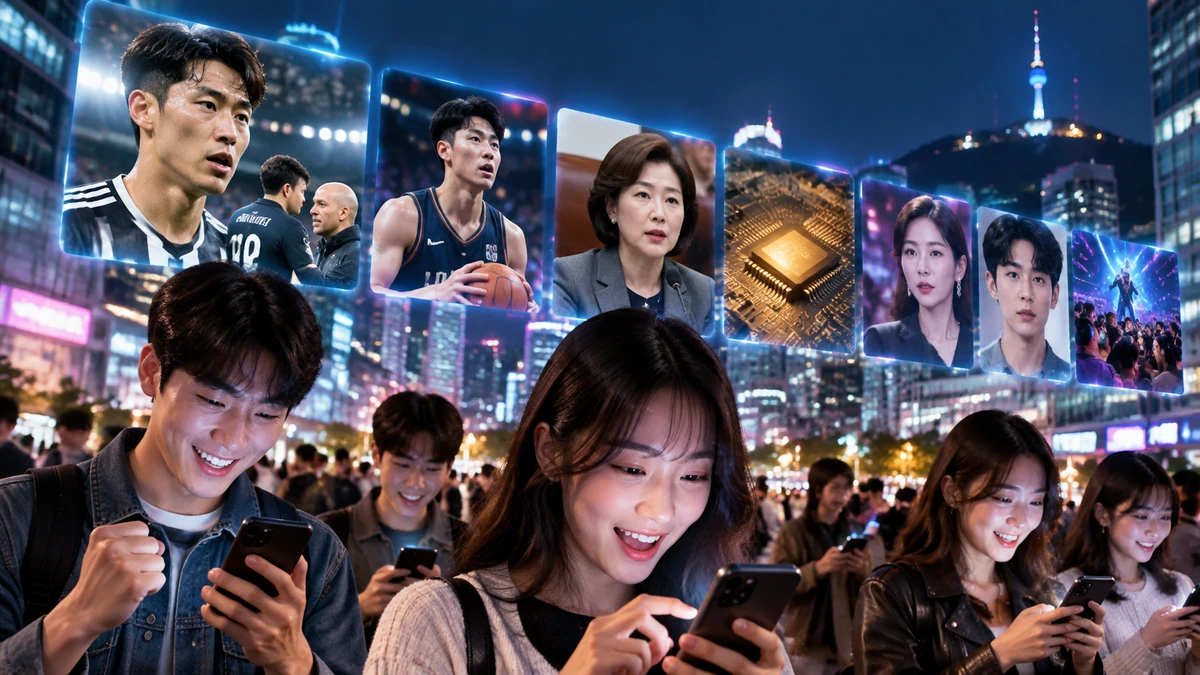
Image to help understand the article
South Korea’s Real-Time Search Culture Reveals What Captures Public Attention
South Korea’s Google trending searches on Sept. 18 offered a snapshot of a society where sports, politics, entertainment and technology news compete for public attention in real time. Unlike a traditional newspaper front page that reflects editorial choices, search trends show what millions of people are actively looking for at a particular moment. The rankings do not necessarily represent public opinion or importance, but they provide a window into the topics generating curiosity and discussion.
The top search term in South Korea that day was Oh Hyeon-gyu, a national team soccer forward playing for Turkish club Besiktas. He was followed by Lee Hyeon-jung, a Korean basketball player whose performance helped the country reach the Asian Games men’s basketball final. Other popular searches included political disputes, disaster relief news, a major Korean semiconductor company’s artificial intelligence investment plans, a blockbuster film, video game industry events and celebrity-related issues.
For American audiences, the mix may seem unusual at first. In the United States, trending topics often separate into distinct categories: sports on ESPN, politics on cable news, entertainment on streaming platforms and business news on financial networks. In South Korea, these subjects frequently appear together in the same online conversation, reflecting a highly connected digital culture where a soccer match, a parliamentary hearing and a technology announcement can all become major public discussions within hours.
Soccer Star Oh Hyeon-gyu Draws Attention After European Competition
Oh Hyeon-gyu became the most searched person in South Korea after appearing as a substitute in Besiktas’ UEFA Europa League match against Marseille. The Istanbul-based club defeated Marseille 4-1, earning its first victory in the competition’s league phase. Oh entered the game late in the second half and played about 13 minutes, including stoppage time.
The moment that attracted additional attention was not a goal or an assist, but a conversation after the final whistle. Cameras captured Besiktas manager Vincenzo Italiano approaching Oh on the field and speaking with him while making gestures toward different areas of the pitch. Korean fans closely analyzed the exchange, with many wondering whether the coach was offering tactical advice or encouragement.
For Korean soccer supporters, overseas performances by national team players carry particular significance. South Korea has a long tradition of following athletes who compete abroad, from European soccer leagues to Major League Baseball in the United States. Players such as Son Heung-min of Tottenham Hotspur have become international symbols of Korean sports success, and younger players are often closely watched as potential future stars.
Oh’s situation reflects a broader trend in Korean sports: fans increasingly follow not only official statistics but also behind-the-scenes moments, including conversations with coaches, training footage and social media updates. Digital platforms have transformed sports coverage from a once-a-week newspaper report into a continuous global conversation.
Basketball Performance Brings Lee Hyeon-jung Into the Spotlight
The second-most searched term was Lee Hyeon-jung, who played a leading role in South Korea’s Asian Games basketball campaign. In the semifinal against Iran, South Korea won 77-51, securing a place in the final and guaranteeing at least a silver medal. Lee recorded 26 points, 14 rebounds and four assists, including seven three-point shots.
Basketball has a strong following in South Korea, particularly among younger generations. While soccer and baseball traditionally dominate the country’s sports culture, basketball has maintained a significant fan base through professional leagues, school competitions and international tournaments.
Lee’s performance also attracted attention because Korean athletes competing internationally often become symbols of national pride during major sporting events. The Asian Games, like the Olympics, are viewed in South Korea as opportunities for athletes to demonstrate the country’s competitiveness on a global stage.
For American readers, the closest comparison may be the attention given to U.S. athletes during the Olympics or major international competitions. A standout performance can quickly move an athlete from a specialized sports audience into mainstream public awareness.
Politics Remains a Major Driver of Online Conversation
Politics was another major category among South Korea’s trending searches. Kim Min-jeon, a lawmaker from the conservative People Power Party, became a widely searched figure after raising questions during a parliamentary hearing concerning a candidate for a special inspector position.
Kim questioned issues related to information disclosure surrounding a presidential office staff member and raised questions about financial matters involving President Lee Jae-myung’s family. During the hearing, the nominee responded that the staff member mentioned was not directly subject to inspection under current law.
For Americans unfamiliar with South Korea’s political system, the National Assembly plays a central role in public hearings and government oversight. Similar to congressional hearings in Washington, lawmakers use these sessions to question nominees and government officials. However, Korean hearings often receive intense online attention, with short video clips from exchanges quickly spreading across social media and news platforms.
The popularity of political search terms does not necessarily indicate agreement or disagreement with a politician’s position. Instead, it reflects public interest in ongoing political debates, especially when they involve high-level officials or controversies involving government transparency.
What South Korea’s Search Trends Mean for the United States
South Korea’s digital trends are increasingly relevant to American audiences because the two countries are deeply connected through technology, entertainment, sports and business. A search list that combines soccer players, AI investment, movies and gaming illustrates how Korean industries operate in global markets rather than within a purely domestic environment.
The technology sector provides one clear example. SK hynix, one of the world’s major memory semiconductor manufacturers, saw attention after announcing the launch of SK hynix Ventures in Silicon Valley. The company said the initiative would expand investment in artificial intelligence computing, data centers and related infrastructure.
This development connects directly with the United States because Silicon Valley remains a global center for AI startups and computing innovation. American technology companies depend heavily on advanced semiconductor supply chains, and Korean chipmakers have become important partners in the global AI expansion. Developments involving Korean semiconductor companies can influence discussions among U.S. technology firms, investors and policymakers.
The entertainment sector also highlights the growing connection between the two countries. The film “The Odyssey” reached 11 million viewers in South Korea, placing it among the country’s most successful foreign films. The result reflects South Korea’s importance as a major entertainment market, where Hollywood releases, Korean productions and global streaming content compete for audiences.
For American companies in entertainment and gaming, South Korea remains a key market and a source of innovation. Korean game developers including Smilegate, NCSoft and Netmarble were featured at Tokyo Game Show, one of Asia’s largest gaming industry events. Their presence reflects the global expansion of Korean gaming companies and the increasing overlap between Korean entertainment culture and international audiences.
A Broader Trend: Korea’s Digital Public Sphere Moves at Global Speed
The Sept. 18 search rankings demonstrate how quickly Korean public attention moves across different industries. A single day’s trends included European soccer, Asian basketball, government oversight, semiconductor investment, disaster assistance, cinema, gaming and celebrity news.
This fast-moving environment is shaped by South Korea’s high level of internet connectivity and widespread use of digital platforms. News stories are often discussed immediately through online communities, social media platforms and search engines. A small moment, such as a coach speaking with a substitute player after a match, can become a national conversation within hours.
The same pattern is visible in Korean entertainment culture, where actors, musicians and creators often maintain close relationships with audiences through online channels. Celebrity-related searches, including reports involving actor Lee Dong-wook and warnings about impersonation scams, show both the influence of celebrity culture and the risks created by digital communication.
For global companies and media organizations, understanding these trends is increasingly important. Korea’s online conversations frequently provide early signals about consumer interests, entertainment demand and emerging technology discussions that may later spread internationally.
Looking Ahead: Watching the Intersection of Sports, Technology and Culture
South Korea’s trending searches are not simply a list of popular names. They reveal how modern Korean society connects national identity, global competition and digital participation. Athletes competing overseas, companies investing in artificial intelligence, filmmakers reaching millions of viewers and lawmakers debating public issues all become part of the same online ecosystem.
For the United States, the lesson is that Korea’s influence extends beyond the better-known areas of K-pop and television dramas. Korean sports figures, technology companies and entertainment industries are increasingly integrated into global markets. As AI development, gaming, streaming entertainment and international sports continue to expand, the topics attracting attention in South Korea may increasingly matter to American audiences as well.
Daily search rankings are only one measurement of public interest, and they should not be interpreted as a complete picture of Korean society. However, they provide a useful look at the subjects capturing attention at a specific moment — and they highlight the increasingly connected relationship between South Korea and the wider world.
Comments
Post a Comment