Image to help understand the article
A Search Snapshot of a Country Managing Change
South Korea’s most rapidly rising Google searches on Sept. 7, 2026, formed an unusually revealing portrait of the country’s public attention. A rare wild-ginseng discovery in the mountains led the list, followed by news involving the globally popular video game PUBG: Battlegrounds. Political leadership changes, the nominee to head a new investigative agency, soaring apartment prices, a high-stakes divorce case and a semiconductor stock rally also drove Koreans to their keyboards.
Taken together, the searches were less a coherent national agenda than a digital front page assembled by millions of individual impulses. They showed how quickly Korean audiences move between traditional symbols of good fortune, political controversy, personal wealth, housing anxiety, technology and entertainment. The mix would be recognizable to Americans accustomed to seeing election news, Powerball jackpots, celebrity disputes and major sports stories compete on the same trending page.
The figures associated with the list were approximate search-volume indicators supplied by Google, not verified counts of individual users. They are best understood as measures of momentum at a particular moment. A phrase can surge because people have never heard it before, because a headline is spreading across multiple outlets or because readers want details that are missing from an initial report. Trending data captures curiosity, not necessarily approval, concern or lasting importance.
The day’s No. 1 search was “sansam,” the Korean word for wild ginseng, with a volume indicator of more than 2,000. PUBG ranked second with more than 200, while the Basic Income Party and attorney Kim Ji-yong each registered more than 1,000. Other prominent searches included Kim Yong-hyun, Seoul’s suburban Bundang district, Smilegate founder Kwon Hyuk-bin, chipmaker SK Hynix, the Korea Land and Housing Corp. and baseball figure Park Byung-ho.
The apparent mismatch between rank and displayed volume is another reason not to treat the list like an election tally or television rating. Google’s labels are estimates attached to rapidly changing queries. The more meaningful question is why each topic suddenly attracted attention — and what the combination says about South Korea’s economy, institutions and popular culture.
Why Wild Ginseng Can Become National News
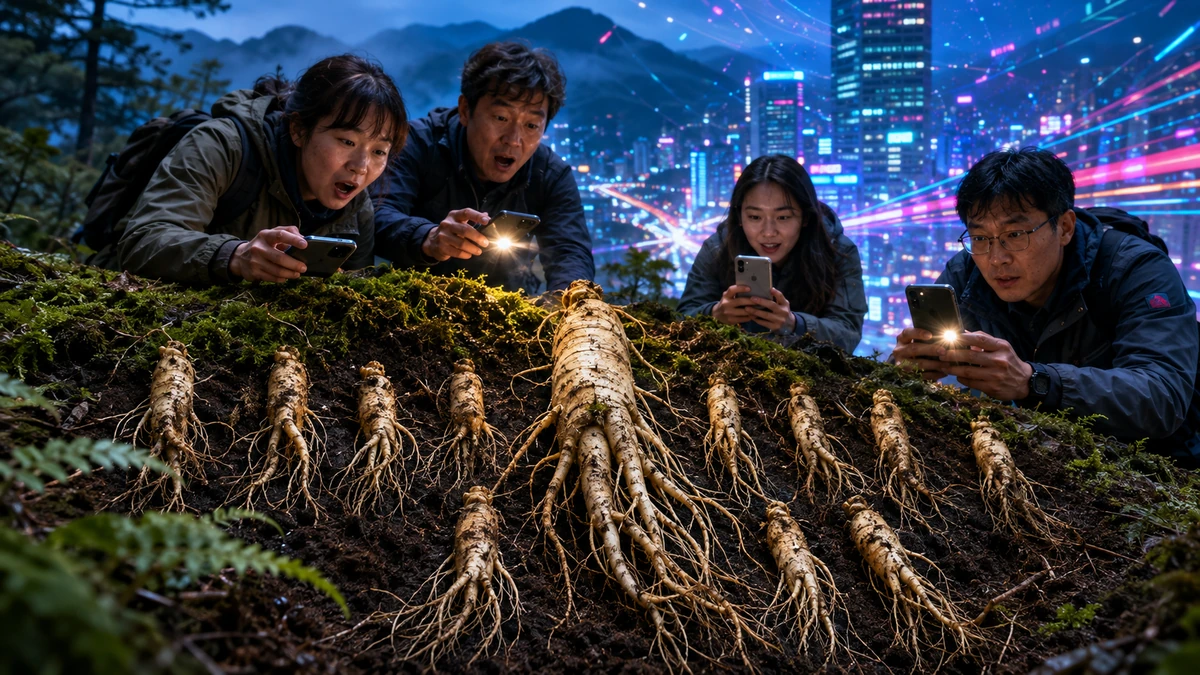
The leading story concerned the reported discovery of 11 wild ginseng roots in Jirisan, a mountainous area in southern South Korea. News headlines described the find as including naturally occurring ginseng said to be about 100 years old. Reports grouped the roots into five generations of a plant family and cited an appraisal of 120 million won.
For readers in the United States, the closest comparison may be the discovery of an exceptionally rare truffle, a valuable mineral specimen or a long-lost historical artifact. Yet wild ginseng carries a distinctive cultural charge in Korea. Ginseng has been used for centuries in traditional medicine and is commonly associated with stamina, recovery and longevity. It appears in health products, teas, tonics and gifts, especially for older relatives or during important holidays.
Wild ginseng is different from the cultivated roots sold in supermarkets and pharmacies. Its appeal comes from scarcity, age and the belief that a plant surviving for decades in the mountains has unusual value. Korean reports often emphasize the root’s shape, estimated age and the environment in which it grew. An appraised price can turn a botanical discovery into a story about sudden fortune.
Headlines also invoked the expression “sim bwatda,” commonly rendered as “I found it.” The phrase is traditionally associated with ginseng hunters announcing a discovery in the mountains. To Korean ears, it carries some of the drama that “Eureka!” has in English, though it is tied specifically to the lore of searching for precious roots.
The Jirisan report had nearly every ingredient needed for a viral search: a century-old object, a large monetary valuation, striking photographs and a familiar folk narrative about luck arriving in nature. It also offered a brief escape from more divisive stories. In an online news environment dominated by politics and financial pressure, a rare plant found on a mountain can function as both spectacle and modern-day treasure tale.
Global Fandom Pushes PUBG Back Into the Conversation
PUBG: Battlegrounds rose to second place after an official announcement promoted a collaboration with “Jujutsu Kaisen,” the Japanese manga and anime franchise. The supplied headline did not specify what content would be included, when it would become available or how players could participate. The available information therefore supports only a limited conclusion: The crossover announcement appears to have prompted the search spike, but it does not reveal which possible feature generated the strongest reaction.
Even with those limits, the pairing illustrates how the Asian entertainment market increasingly operates across national and media boundaries. PUBG is closely associated with South Korea’s game industry, while “Jujutsu Kaisen” comes from Japan’s manga and anime ecosystem. Their collaboration joins an established global strategy in which games become platforms for rotating entertainment franchises rather than products experienced in isolation.
American players are familiar with the model through crossovers in titles such as Fortnite and Call of Duty, where character skins, themed events and limited-time modes can turn an update into a pop-culture event. The commercial logic is straightforward: A game gains attention from an outside fandom, while an anime, movie or music property gains access to an active online community.
South Korea is particularly important to this convergence because gaming is deeply embedded in its modern popular culture. Competitive online play, livestreaming and PC gaming have long occupied a more visible place in Korean youth culture than they did in the United States before esports and streaming became mainstream. A game-related search can therefore reflect several overlapping audiences: active players, anime fans, esports followers and consumers curious about a new collaboration.
The PUBG surge also demonstrates why Korean cultural influence should not be measured only through K-pop groups or television dramas. Games are a major channel through which global audiences encounter Korean creative and technology companies, often without thinking of the experience as part of the Korean Wave. A collaboration with a Japanese franchise further complicates the old habit of sorting entertainment into neat national categories. For many fans, especially younger ones, the relevant identity is the franchise or online community rather than the country printed on a corporate registration.
New Political Figures Drive Search Curiosity
Several of the day’s fastest-rising searches involved people or institutions entering a new phase of public scrutiny. The Basic Income Party ranked third after choosing Oh Jun-ho as its new leader and electing Park Ki-hong, the spouse of lawmaker Yong Hye-in, to a senior party position. Headlines focused both on the leadership change and controversy surrounding the spouse’s election. Park was quoted as saying the allegations would be addressed individually.
The Basic Income Party’s name requires some context for American readers. As its name suggests, the party is associated with the idea of guaranteeing people a baseline income. Universal basic income has also circulated in U.S. politics and policy debates, including proposals for direct cash payments and local guaranteed-income experiments. In South Korea, however, the party operates within a multiparty parliamentary system in which even a small party can gain visibility through legislative representation, alliances and participation in broader political coalitions.
The search interest appears to have centered not only on policy but also on questions of party governance and family connections. American audiences would recognize the dynamic from scrutiny of political spouses, campaign appointments and allegations of insider influence. The Korean context differs institutionally, but the public question is familiar: When relatives or spouses hold positions in the same political organization, voters want to know how selections were made and whether personal relationships affected the process.
Attorney Kim Ji-yong ranked fourth after being selected as the final nominee to become the first head of the Major Crimes Investigation Office. Reports said presidential appointment would follow if he cleared a confirmation hearing. The interior minister emphasized building an agency that would place human rights protections at the center of its work.
Searches for Kim were likely driven by the symbolic importance of a first leader. In the United States, nominees to lead a newly created federal law-enforcement or oversight body would face questions about independence, civil liberties, political pressure and relationships with existing agencies. The same broad tensions surround the Korean nomination. The hearing process gives lawmakers and the public an opportunity to examine the nominee’s record while debating what kind of institution the new office will become.
The crucial point is that the day’s political searches were person-driven. Many users were not searching for abstract institutional design; they were searching names. That pattern is common when a figure suddenly moves from relative obscurity into a consequential public role. Search engines become a rapid background-check tool for citizens trying to understand who has acquired power and why.
Housing, Corporate Wealth and the Pressure of Big Numbers
South Korea’s economic anxieties appeared most clearly in searches for Bundang, Kwon Hyuk-bin and SK Hynix. Each involved a large number capable of stopping a reader mid-scroll: a 29.5% housing increase, a divorce dispute involving assets described in headlines as worth 8 trillion won and an 8% range jump in the shares of a major chipmaker.
Bundang, part of Seongnam in Gyeonggi province, is a major planned district in the Seoul metropolitan area. It was developed as one of the satellite communities intended to accommodate growth beyond the capital’s traditional core. Reports said apartment prices there had risen 29.5% over the preceding year, the highest increase in the country.
For Americans, Bundang can be understood partly through the experience of high-demand suburbs near major employment centers — places where transit, schools, redevelopment expectations and access to a dominant city can drive prices sharply upward. But housing carries exceptional political and emotional weight in South Korea. Apartments are not merely places to live; for many households, they are the central store of family wealth and a major factor in marriage, retirement and social mobility.
A dramatic rise can produce opposite reactions. Owners may see their balance sheets improve, while renters and would-be buyers feel that stability is moving farther out of reach. That divide helps explain why the name of a district can trend nationally. Users may be checking prices, comparing neighborhoods, evaluating government policy or simply wondering whether the headline’s increase is real.
Kwon Hyuk-bin drew attention ahead of an expected first ruling in a divorce case that reports said involved assets valued at approximately 8 trillion won. Coverage also raised the possibility of consequences for the governance of Smilegate, the game company associated with his business empire. The supplied headlines did not include the ruling itself, making it inappropriate to speculate about the outcome.
The American parallel is a divorce involving a technology founder whose personal holdings are intertwined with voting power and corporate control. Cases involving wealthy U.S. executives often draw interest not because the public knows the spouses personally, but because division of marital assets could affect ownership, succession or strategic decision-making. In South Korea, where founder influence can be central to corporate structures, those questions can extend well beyond celebrity curiosity.
What the Trends Mean for the United States
For American audiences and companies, the most consequential item on the Korean list may be SK Hynix. Searches increased as reports linked optimism surrounding OpenAI to a broader rally in Korean semiconductor shares. Headlines said SK Hynix rose in the 8% range, Samsung Electronics climbed more than 5%, expectations for third-quarter performance improved and South Korea’s benchmark Kospi opened more than 3% higher.
The immediate market claims should be read as a snapshot rather than proof of a lasting rally. Still, the connection between an American artificial intelligence company and Korean chip stocks illustrates how tightly the two economies are linked. The generative AI boom depends on an international hardware chain. U.S. software companies and cloud providers need advanced processors, memory and manufacturing capacity, while Korean technology companies are exposed to shifts in American investment, product demand and regulation.
For U.S. investors, Korean semiconductor movements can serve as a signal of expectations elsewhere in the AI supply chain. Enthusiasm in Silicon Valley does not remain confined to California or to shares listed on American exchanges. It can quickly affect valuations in Seoul, capital-spending plans across Asia and forecasts for electronics demand worldwide. The reverse is also true: Production constraints or weaker earnings at major Asian suppliers can reshape expectations for American technology businesses.
The gaming trend carries a separate lesson for U.S. entertainment companies. American studios increasingly compete in a market where Korean games, Japanese animation and global online communities overlap. A PUBG collaboration can reach U.S. consumers without a traditional Hollywood distributor or television network. Intellectual property now travels through downloadable content, streaming clips, influencers and fan communities that operate simultaneously across languages.
That creates partnership opportunities but also raises the competitive stakes. U.S. companies seeking younger audiences must understand release schedules, fandom etiquette and platform behavior across Asia. Simply licensing a recognizable character is not enough; collaborations are judged by whether they feel authentic to both communities. Korean companies, meanwhile, can use established games and digital platforms to expand their position in the American market without relying on the promotional pathways that introduced earlier waves of Korean music and drama.
The political and legal searches matter to the bilateral relationship in a less immediate but still important way. The United States and South Korea are treaty allies with extensive economic and security ties. Changes in Korean investigative institutions, political leadership and debates over national security can affect the environment in which diplomatic and commercial decisions are made. Americans should resist interpreting every domestic controversy primarily through Washington’s interests, but understanding Korea’s internal debates is essential to understanding a partnership that extends beyond military cooperation.
The search involving Kim Yong-hyun underscores that point. Headlines focused on arguments over a drone operation and an appeals proceeding involving former President Yoon, with prosecutors and defense attorneys disputing legal intent. The provided material does not establish the court’s ultimate findings, and claims by either side should not be treated as proven facts. For U.S. readers, the broader significance lies in seeing South Korea as a democracy conducting contentious legal and political arguments in public, not simply as a strategic ally represented by summit meetings and defense statistics.
Public Institutions and Everyday Acts Also Break Through
Not every trending topic involved vast wealth or national politics. The Korea Land and Housing Corp., widely known in South Korea by the initials LH, drew searches after reports that it was expanding the range of bid-rigging misconduct eligible for whistleblower reports. The program was described as offering rewards of up to 3 billion won and possible reductions in administrative penalties or punishment for voluntary disclosures.
LH plays a major role in public housing and land development, areas that directly affect affordability and confidence in government. A whistleblower policy may sound procedural, but procurement integrity matters when public agencies award large construction and development contracts. American readers can compare the issue to anti-fraud programs involving federal contractors, public infrastructure projects or housing authorities. Large rewards are intended to overcome the professional and personal risks faced by insiders who report misconduct.
The final search on the list offered a softer form of public interest. Park Byung-ho attracted attention after reports said he sent a coffee truck to former Samsung teammates before a developmental-league game between Samsung and Kiwoom, even though he was now coaching for the opposing organization.
“Coffee trucks” are a familiar feature of Korean entertainment and sports culture. They are mobile beverage stations sent to a filming location, practice site or workplace as a gesture of encouragement. K-pop fans send them to performers; actors send them to colleagues on drama sets; friends and former teammates use them to show support. The American equivalent might be arranging a catered food truck for a production crew or sending a large spread to a team clubhouse, but in Korea the coffee truck has become a particularly visible and photograph-friendly sign of loyalty.
The story resonated because it framed professional competition through enduring personal relationships. Sports coverage often relies on conflict, trades and rivalry. A gift to former teammates provides an alternative narrative: People can change uniforms without abandoning old bonds. Its presence beside investigations, real estate and billion-dollar fortunes is a reminder that trending lists reward emotional accessibility as much as conventional importance.
What to Watch Beyond a Single Day
The Sept. 7 search list reveals several trends worth following. First, large numerical claims remain powerful attention engines. A 100-year-old root, a 29.5% housing increase, an 8 trillion-won fortune and an 8% stock surge all package complicated stories into instantly understandable stakes. Those numbers encourage clicks, but they also require scrutiny. Appraisals are not sale prices, paper wealth is not cash, a one-year housing increase does not predict the next year and a one-day stock move does not establish a long-term trend.
Second, South Korean attention is increasingly international even when a story appears domestic. PUBG’s collaboration ties Korean gaming to Japanese anime and global players. SK Hynix’s rally connects Seoul’s stock market to an American AI company. Political and legal developments unfold within a country whose security and economy are closely linked to the United States.
Third, search behavior shows the importance of unfamiliar names at moments of institutional change. A new party leader or first nominee to head an agency can generate more immediate curiosity than a long-running policy debate. The next stage is whether that curiosity develops into sustained attention during hearings, court proceedings, leadership decisions or policy implementation.
Finally, the list demonstrates that the Korean Wave is only one part of how South Korea reaches the world. Music, television and beauty products remain highly visible, but the country’s global footprint also runs through games, semiconductors, financial markets and digital culture. American consumers may encounter Korea through a PUBG event, while American investors encounter it through memory chips and American policymakers through alliance management and institutional change.
No single day of Google searches can define public opinion. Trending terms are volatile, and their approximate volumes should not be confused with representative polling. But they can show where information gaps suddenly open — where thousands of people decide they need to know what a plant is worth, who a nominee is, why a stock jumped or what a former player sent his old teammates. On this day, South Korea’s digital curiosity stretched from a mountain in Jirisan to global game servers and the AI economy, capturing a country negotiating tradition, institutional change and an increasingly interconnected future.
Comments
Post a Comment