With Approval at 40%, South Korea’s Lee Jae Myung Turns to Labor and Civil Society — and Faces a Test of Results
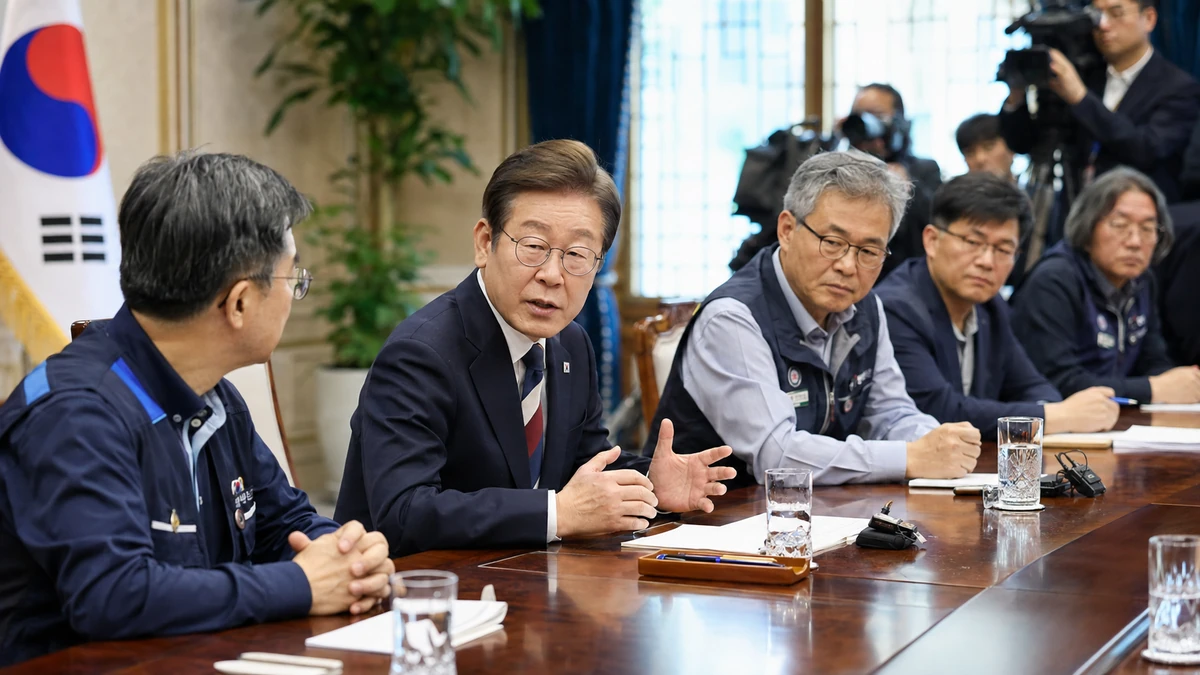
Image to help understand the article
A president looks back to his political base
South Korean President Lee Jae Myung is responding to the lowest approval rating of his presidency by renewing ties with the constituencies that have traditionally supplied the country’s progressive movement with votes, ideas and organizational muscle. In meetings at the presidential office, Lee has emphasized the role of civic organizations in pursuing broad social reforms and held talks with the leaders of South Korea’s two major labor federations. Taken together with recent personnel choices, the outreach suggests a deliberate effort to reinforce his political foundation before attempting a wider recovery in public support.
A Gallup Korea survey released on the 4th put Lee’s job approval rating at 40%, down 2 percentage points from the previous poll and the lowest level recorded since he took office. The survey was based on telephone interviews conducted from the 1st through the 3rd with 1,001 adults selected through randomly generated mobile phone numbers. It had a margin of sampling error of plus or minus 3.1 percentage points at the 95% confidence level. Gallup Korea reported a contact rate of 47.4% and a response rate of 10.9%.
One poll does not establish a lasting political trajectory, particularly when a 2-point movement falls within the survey’s margin of error. Still, presidential offices rarely ignore a new low. Approval ratings affect more than political optics in South Korea, where presidents serve a single five-year term and cannot seek reelection. A president who loses public confidence can find it harder to control the policy agenda, maintain discipline within the governing party and persuade lawmakers or interest groups to accept difficult compromises.
Lee’s response so far resembles a familiar form of coalition management in democratic politics: Secure the base before reaching for the middle. American presidents have often followed a similar playbook by returning to organized labor, civil rights groups, environmental organizations, religious conservatives or business associations when their broader standing weakens. But whether such outreach produces a recovery depends on what follows. Meetings can reassure supporters; durable gains usually require visible policy results.
Why civic groups carry unusual weight in South Korea
Lee met representatives of progressive civic organizations, including the Korea Civil Society Organizations Network and the Korean Progressive Alliance, and told them that civil society would have a major role in the country’s next phase of social reform. For American readers, the term civil society may sound like a broad label for nonprofit organizations. In South Korea, it also evokes a politically consequential tradition rooted in democratization, street mobilization, public-interest advocacy and campaigns against government or corporate abuses.
South Korea was governed by authoritarian leaders for much of the period after the Korean War. Its transition to democracy, especially the mass movement of 1987, was driven not only by opposition politicians but also by students, religious leaders, workers, lawyers and citizen organizations. That history gives civic groups a public standing that does not map neatly onto the role of Washington think tanks or conventional U.S. advocacy organizations. Some Korean groups conduct policy research or lobby lawmakers, but others have deep experience organizing demonstrations and building nationwide campaigns.
More recently, civic activism was central to the massive candlelight demonstrations that preceded the removal of President Park Geun-hye in 2017. Candlelight rallies have become an important symbol of peaceful popular mobilization in South Korea, combining the scale of an American national protest march with the sustained pressure of a long-running civic campaign. They are not the exclusive property of one political camp, but the progressive movement has historically maintained especially close links with labor organizers and reform-oriented civic networks.
By publicly inviting such groups into a discussion of what he described as major social reform, Lee is doing more than arranging a listening session. He is acknowledging that political legitimacy and implementation capacity can come from outside the government and the National Assembly. The message to progressive supporters is that their organizations remain partners rather than spectators. The risk is that language about sweeping reform can raise expectations faster than the administration can meet them.
Labor talks put economic choices at the center
Lee’s meeting a day earlier with Kim Dong-myung, chairman of the Federation of Korean Trade Unions, and Yang Kyung-soo, chairman of the Korean Confederation of Trade Unions, carried similar political significance. The FKTU and KCTU are South Korea’s two dominant labor federations. An imperfect American comparison would be the influence of the AFL-CIO and other major union coalitions, although Korea’s labor movement has its own ideological divisions, history of militant organizing and complicated relationship with progressive governments.
The FKTU has generally been regarded as the more moderate and institutionally oriented of the two federations. The KCTU emerged from the country’s independent labor movement and has often taken a more confrontational approach, including strikes and large public demonstrations. A president meeting both leaders together signals an effort to engage organized labor across its main institutional divide, not merely to consult a friendly group.
The discussion included Lee’s three large-scale national projects and the question of extending the retirement age. The available account does not specify the details of the three projects, making it premature to judge their economic effect or the unions’ likely response. The retirement-age debate, however, points to a larger challenge shared by South Korea, the United States and other advanced economies: how to adapt employment systems to longer life expectancy, population aging and financial insecurity among older workers.
In South Korea, the issue is especially sensitive because formal retirement from a long-term job does not always mean the end of working life. Older Koreans may leave career positions and then take lower-paid or less secure work. Any plan to extend mandatory retirement can affect wages, promotion opportunities for younger employees, corporate labor costs and the design of pension systems. That makes it a negotiation among generations as well as between employers and unions.
For Lee, labor engagement can serve both a substantive and political purpose. Organized labor can help build support for workplace reforms and large government initiatives, but unions can also become powerful critics if they believe a progressive administration has ignored them. The meetings therefore offer Lee a chance to demonstrate that labor policy is central to governing, not simply a symbolic reward for supporters. They also create a measurable test: whether dialogue leads to negotiated standards, timelines and compromises rather than another cycle of consultation followed by confrontation.
Appointments reinforce the progressive signal
Lee’s recent personnel decisions add to the impression of a coordinated effort to reconnect with the left. He nominated Yong Hye-in to lead the ministry responsible for gender equality and family policy and selected former lawmaker Lee Hae-min of the Rebuilding Korea Party as a senior presidential secretary focused on artificial intelligence and future planning. He also reportedly told the Democratic Party’s new leadership, including party leader Kim Min-seok, that the progressive camp had not received enough attention.
Personnel choices in South Korea are closely read for ideological balance, regional representation and relationships among party factions. Cabinet nominations can become major political contests, particularly when lawmakers question a nominee’s qualifications, finances or past statements. Appointing figures identified with smaller progressive parties or causes can broaden representation within the governing coalition, but it can also invite criticism that the president is prioritizing factional reassurance over administrative experience.
The inclusion of an artificial intelligence policy role is notable because it connects coalition politics to an area of direct economic competition. South Korea is a major technology and semiconductor producer, and decisions involving AI, data, energy and industrial policy have consequences well beyond domestic politics. A politically meaningful appointment will ultimately be judged by whether the official can coordinate policy across government and communicate with companies, researchers and international partners.
That distinction — between the signal sent by an appointment and the performance of the appointee — is central to Lee’s current challenge. Supporters may welcome evidence that the administration recognizes progressive priorities. Voters outside the president’s core coalition are more likely to ask whether the choices improve public services, strengthen economic security or resolve disputes. Political symbolism can stabilize a base, but competence determines whether the coalition expands.
Why a base-first strategy may not lift approval
There is a clear logic to Lee’s strategy. Core supporters act as a political defense line when public sentiment turns unfavorable. They volunteer, shape online debate, influence party lawmakers and help sustain attention to long-term reforms. Labor federations and civic organizations also provide expertise and networks that a government may need to turn legislation into practice. Reengaging them tells the progressive camp that Lee has not abandoned the priorities or alliances that helped bring him to power.
But the latest poll also illustrates the limits of coalition signaling. Lee’s approval rating declined despite his recent appointments and messages to progressive organizations. That does not prove the strategy failed; public opinion often responds slowly, and many issues can shape a president’s rating at once. It does show that voters distinguish between outreach and outcomes. A cabinet reshuffle or high-profile meeting may dominate political coverage without changing how families assess wages, housing, employment, education or the general direction of government.
The broader problem is one of scale. Reuniting a political base can stop further erosion, but a president cannot govern successfully with only one faction of the electorate. The stronger Lee’s appeals to the progressive camp become, the more clearly his administration must explain how its agenda benefits people who do not identify with that camp. Labor negotiations, for example, must address the concerns of union members while also accounting for younger job seekers, small businesses, nonunion workers and taxpayers.
This dynamic has a recognizable American parallel. Democratic administrations can gain energy by emphasizing organized labor, abortion rights or climate policy, while Republican administrations may rally supporters through immigration, gun rights or religious liberty. Those appeals can be politically effective, but they do not automatically persuade swing voters. In both countries, the challenge is to translate an identity-based coalition message into a broadly understood account of economic or social benefit.
What this means for the United States
Lee’s domestic standing matters in Washington because South Korea is not simply another foreign democracy experiencing routine polling turbulence. It is a treaty ally that hosts U.S. forces, plays a central role in deterring North Korea and supplies products and industrial capacity important to the American economy. South Korean companies are deeply connected to U.S. markets in semiconductors, automobiles, electric-vehicle batteries, consumer electronics and other advanced manufacturing sectors.
A president’s approval rating does not automatically change the alliance, and the 40% figure should not be treated as a crisis. Yet political capital can affect how confidently a South Korean government negotiates difficult issues with Washington or explains those decisions at home. Defense coordination, trade rules, technology controls and industrial subsidies can all produce domestic winners and losers. An administration focused on repairing its base may face additional pressure to show that cooperation with the United States protects Korean jobs and strategic autonomy.
American companies should pay particular attention to how Lee’s labor outreach develops. Changes involving retirement, employment protections or national development projects could affect the business environment, workforce planning and industrial partnerships, although the current account does not provide enough detail to forecast specific regulatory changes. The relevant question is whether talks with unions produce stable, transparent rules or prolonged political conflict. Predictability matters to U.S. companies investing in Korean operations and to Korean companies expanding factories in the United States.
American policymakers also have an interest in the role of Korean civil society. Public opinion in South Korea can shape debates over military cooperation, relations with Japan, policy toward North Korea and the balance between alliance commitments and independent decision-making. Civic organizations and unions may influence those debates through campaigns and demonstrations as well as formal consultation. Washington’s most durable approach is therefore not to view Korean politics only through presidential offices, but to understand the broader democratic institutions and movements that shape what any president can deliver.
For Americans who know South Korea mainly through K-pop, television dramas or consumer brands, this episode is a reminder that the Korean Wave exists alongside an intensely participatory political culture. The same society that built global entertainment companies and advanced manufacturing networks also has a modern history of mass protest, contentious labor relations and rapid democratic change. Those forces can influence policies that eventually reach American consumers, workers and investors.
From meetings to measurable policy
The next phase will be less about whom Lee meets than what those meetings produce. If civic groups are expected to participate in major reforms, the administration will need to identify the issues, decision-making process and limits of that participation. If the labor federations are being asked to support national projects or negotiate changes to retirement rules, the government will need a framework for resolving conflicts among workers, employers and generations.
The same standard applies to Lee’s appointments. A nominee’s political identity may reassure one constituency, but performance will be measured through policy coordination, management and public accountability. This is especially true for positions involving gender policy and artificial intelligence, two areas where social disputes, economic interests and technological change collide.
Polling will provide one measure of whether Lee’s strategy is working, but analysts should avoid overreading weekly changes. The Gallup Korea result carries a margin of error of 3.1 percentage points, and its 10.9% response rate is another reason to examine patterns across multiple surveys rather than treating a single figure as definitive. The more significant fact is that the poll represents a presidency facing enough erosion to prompt a visible political reset.
Lee has chosen to begin that reset with progressive civic groups, organized labor and personnel associated with his broader ideological camp. That may help rebuild trust among supporters who felt neglected. It may also sharpen expectations for reforms that are difficult to design and even harder to implement. The political payoff will depend on whether the administration can move from symbolic inclusion to negotiated policy — and then explain why those policies serve the country beyond the president’s base.
For South Korea’s partners, including the United States, the key issue is not whether Lee moves left or right in the language of a single week. It is whether he can preserve enough public confidence to manage economic change, sustain alliance commitments and negotiate with powerful domestic constituencies. At 40% approval, his presidency retains a substantial base but faces a clear warning. The coming test is whether renewed dialogue becomes a platform for governing or remains an exercise in political consolidation.
Comments
Post a Comment