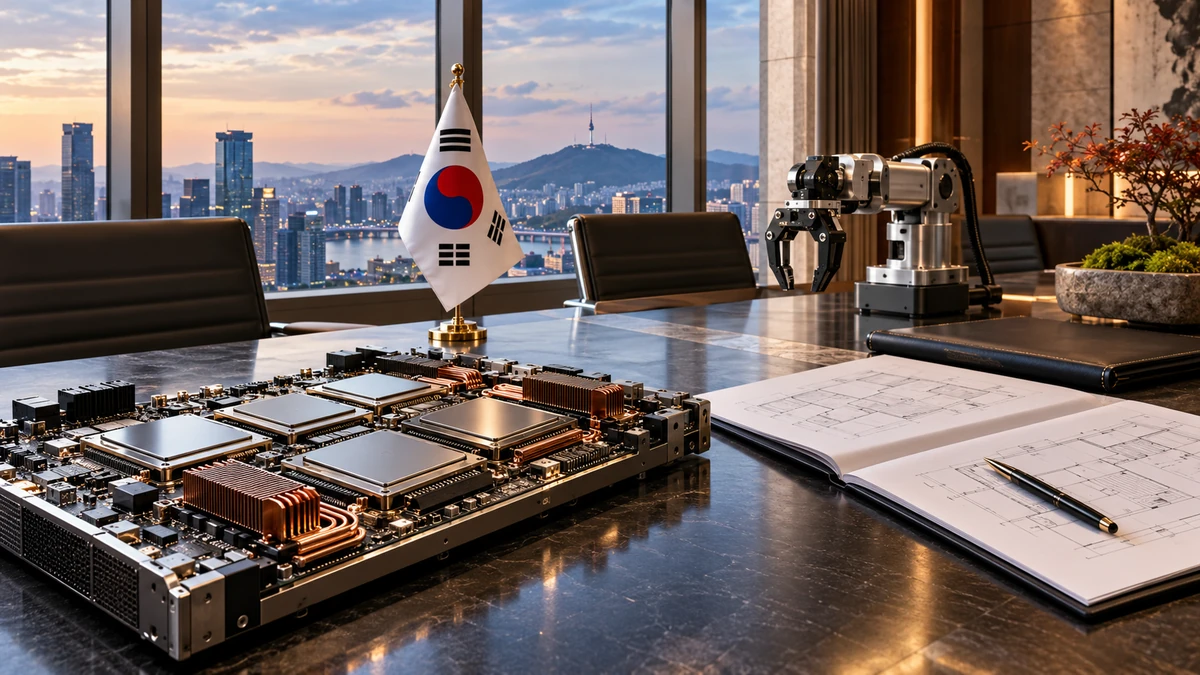
Image to help understand the article
AMD and South Korea Target Opening This Year
AMD Chair Lisa Su met with South Korea’s second vice minister of science and technology, Ryu Je-myung, in Seoul on the 7th to review plans for an artificial intelligence research center that the company and the government aim to open by year’s end.
The planned AMD AI Center of Excellence would be the U.S. chipmaker’s first research hub of its kind in Asia. The meeting at the Four Seasons Hotel Seoul followed an agreement signed in September and focused on the center’s development and operating plans. Su’s visit came seven months after her previous trip to South Korea in March.
South Korea’s Ministry of Science and ICT said the center would work with universities and major research institutions on projects including drug development, climate forecasting, energy transition, manufacturing and robotics. AMD would provide the high-performance computing hardware.
Su said AMD plans to recruit and retain hundreds of researchers and engineers in South Korea over several years to strengthen the country’s AI research and development ecosystem. The center’s location and details of its operations and partnerships are expected to be announced after a joint government-AMD steering committee meeting in November.
An Open AI Computing Ecosystem
A central goal of the center is to build an open technology ecosystem combining South Korean neural processing units, or NPUs, with AMD graphics processors, central processors and NPUs. The partners plan to test that mix of chips as part of a broader effort to develop a full-stack AI platform that is not dependent on a single foreign technology company.
After the meeting, representatives from 13 South Korean AI semiconductor and software companies joined a roundtable discussion. Their requests included greater participation in AMD’s ROCm software ecosystem, help with software optimization, shared research facilities and support for entering global markets.
Ryu said competition in AI infrastructure is shifting away from the performance of individual chips and toward complete systems and platforms as demand for AI inference grows. He pledged government support to help partnerships between global companies and South Korean technology businesses produce commercial results.
South Korea’s AI Megaprojects
Ryu proposed cooperation on three government priorities: semiconductors, physical AI systems that interact with the real world, and AI data centers. Su described the direction as ambitious and indicated that AMD was willing to participate.
Beginning in 2027, the South Korean government plans to pursue a large-scale national AI infrastructure project combining locally developed NPUs with foreign GPUs and CPUs, Compute Express Link technology and an independent software platform. Multiple companies are expected to form consortiums for each project to test the technology and demonstrate commercial uses.
AMD’s Ties to Korea’s Chip Industry
During her visit, Su also met with Samsung Electronics Vice Chairman Jun Young-hyun and SK Hynix Chief Executive Kwak Noh-jung. She said AMD relies heavily on South Korea’s supply chain and called Samsung and SK Hynix essential partners for the company’s data center ambitions.
At an AMD Gamer Day event in Seoul, Su said the company had begun shipping its MI455 and Helios systems, both of which use HBM4, a new generation of high-bandwidth memory. She said AMD was satisfied with the technology and was increasing production.
Su described AMD’s high-bandwidth memory cooperation with Samsung and SK Hynix as a multigenerational partnership. She added that AMD continues to explore opportunities with Samsung across both memory and contract chip manufacturing.
Su said the company and its partners must plan three to five years ahead rather than focusing on the next year or two. AMD, she said, expects to invest tens of billions of dollars across its global supply chain.
Comments
Post a Comment