Image to help understand the article
A family adrift after war
Yu Hyun-mok’s stark black-and-white drama “An Aimless Bullet” opened in South Korea on April 13, 1961, after its release had been delayed. Completed in 1960, the film was adapted from Lee Beom-seon’s novel of the same Korean title, “Obaltan,” a word that can also mean a stray or misfired bullet.
Produced by Daehan Film Co. and shot on 35mm film, the drama is listed by the Korean Film Council, or KOFIC, at 107 minutes, though TMDb gives a running time of 108 minutes. Its English-language titles have included “An Aimless Bullet,” “Aimless Bullet,” “Stray Bullet” and the transliterated “Obaltan.” Na So-un and Lee Jong-gi wrote the screenplay.
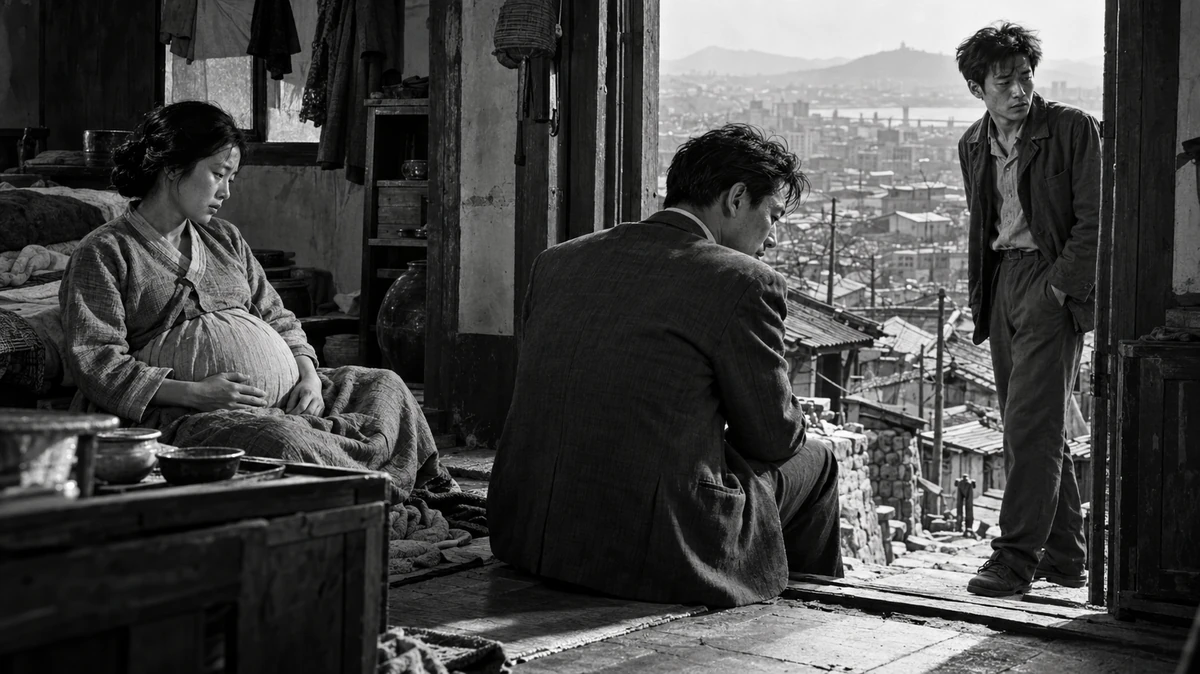
Kim Jin-kyu stars as Cheol-ho, a poorly paid accountant struggling to support an extended family in South Korea after the Korean War. Choi Moo-ryong plays his unemployed younger brother, Yeong-ho, while Moon Jeong-suk plays Cheol-ho’s pregnant wife. The cast also includes Seo Ae-ja as his sister Myeong-suk, Kim Hye-jeong as Miri, Noh Jae-shin as the family’s mother, Yoon Il-bong as Gyeong-sik and Moon Hye-ran as Seol-hui.
Poverty expressed through physical pain
Cheol-ho suffers from two painful wisdom teeth but cannot bring himself to spend money on treatment. Even after receiving his salary, he passes up the dentist and reluctantly puts down a pair of shoes he had considered buying for his young daughter.
At home, his mother has developed a mental illness and repeatedly cries, “Let’s go! Let’s go!” His wife is near childbirth and suffering from malnutrition. Yeong-ho, unable to find work after leaving the military, repeatedly lands in trouble. Cheol-ho must also provide for a younger brother and his daughter.
His sister Myeong-suk loves Gyeong-sik, a wounded veteran, but he withdraws because he does not want his injured leg to make him a burden. She eventually enters sex work catering to foreigners, one of the grim choices the film presents as a consequence of postwar poverty.
Yeong-ho’s desperate turn
Yeong-ho is offered a movie role by Miri, a coffeehouse hostess and actress. He walks away after learning that filmmakers are interested in him because of a scar from a wartime gunshot wound. He later wonders whether he too easily discarded a rare chance to make money.
He reunites with Seol-hui, a nurse who cared for him at a field hospital during the war, and the two acknowledge their feelings for each other. But Seol-hui is killed by a neighboring young man who had become obsessed with her.
Yeong-ho secretly takes a loaded pistol from her room and decides to rob a bank. The former sergeant recruited as his driver flees after hearing gunfire, and Yeong-ho is captured while trying to escape with the money. He hands the cash and gun to police and breaks down crying. In jail, he asks Cheol-ho to take his niece Hye-ok on an outing and to be a good father to the child his wife is about to deliver.
A taxi with nowhere to go
After leaving the police station, Cheol-ho learns that his wife is in danger during childbirth. He races to the hospital, but she has already died. The baby survives.
Reeling from the loss, Cheol-ho goes to a dentist and has one wisdom tooth removed. He asks the dentist to pull the other, but the doctor refuses because the bleeding makes another extraction dangerous. According to TMDb’s synopsis, Cheol-ho then finds another dentist willing to remove the remaining tooth.
He enters a taxi and initially heads toward the home where his mother is waiting, then changes the destination to the police station. Even after arriving, he tells the driver to keep going and repeats his mother’s cry: “Let’s go!” Another account has him answer the driver’s request for a destination by saying, “Go wherever you want.” The taxi continues without direction, leaving Cheol-ho’s future unresolved.
From government ban to San Francisco
South Korean authorities banned the film because they believed its relentlessly bleak portrait of life after the Korean War reflected badly on the country. An American adviser working with the government-run National Film Production Center saw the movie and persuaded officials to allow a Seoul release so it could qualify for submission to the San Francisco International Film Festival.
Yu attended the film’s first San Francisco screening in November 1963. A Variety review dated Nov. 13, 1963, called it “a remarkable film” and praised its “excellent, detailed photography” for combining deep compassion with rich characterization. The mother’s repeated command, “Let’s go! Let’s go!” became the line most often cited in that review and in later writing about Korean cinema.
The San Francisco appearance gave the film an early connection to American audiences, decades before South Korean movies became widely available in the United States. Cinema Epoch, founded by Gregory Hatanaka, later released a Region 1 DVD for the North American market on March 13, 2008. An earlier South Korean DVD with English subtitles, released in December 2002, had gone out of print by November 2007.
A visual landmark
“An Aimless Bullet” is frequently ranked among South Korea’s greatest films. Its reputation rests in part on Yu’s emphasis on visual storytelling rather than dialogue. The film uses layered montage to place different moments and spaces within the same frame, asking viewers to dwell on images and atmosphere instead of relying only on plot exposition.
In 2019, marking 100 years of Korean cinema, public broadcaster KBS and the Korean Film Archive selected 12 representative works for a retrospective titled “100 Years of Korean Cinema: The Classics.” “An Aimless Bullet” was the second film in the series and aired Oct. 18, 2019.
Comments
Post a Comment