Image to help understand the article
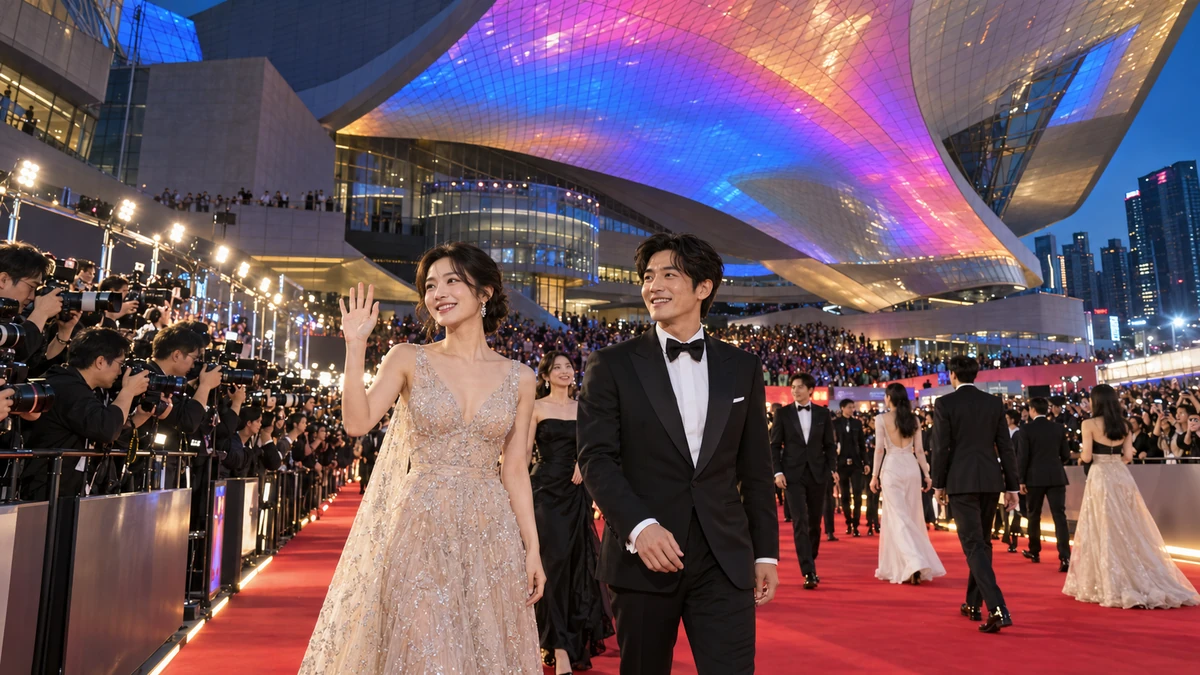
BUSAN, South Korea — The 31st Busan International Film Festival opened Tuesday at the Busan Cinema Center, beginning a 10-day run that brings 316 films to eight theaters across this southern port city.
Widely regarded as South Korea’s leading film festival and one of Asia’s largest, BIFF will continue through the 15th. Its official selection includes 247 films from 59 countries, including 93 world premieres. The overall screening slate, spread across 31 screens, is the festival’s largest since 2019.
Organizers moved the opening from the festival’s traditional Wednesday start to Tuesday in an effort to give audiences more opportunities to attend. From Thursday through Sunday, participating theaters will hold five screenings a day, up from four.
A Growing International Profile
The festival arrives with enhanced standing in the global film industry. In March, the International Federation of Film Producers Associations placed Busan among 17 festivals worldwide on its revised “A-list.” In June, it was also named one of six festivals whose top prize can provide a pathway to eligibility for the Academy Awards’ international feature film category.
That designation places Busan alongside Cannes, Venice, Berlin, Toronto and Sundance, and makes it the only Asian festival in that group. Beginning this year, the winner of the top Busan Award in the festival’s competition section will be eligible for consideration in the international feature race at the Oscars.
The competition, introduced last year, features 13 films in its second edition. The lineup includes work by directors from South Korea, Iran, Japan and Taiwan. Chinese filmmaker Zhang Yimou is leading the jury, which will present Busan Awards in five categories.
Opening Film and Honors
The festival opened with director Kim Jong-kwan’s “The Day and Night Belong to Each Other,” an anthology set in a cafe and built around conversations between four couples. The film explores meetings, breakups and less visible connections among its characters. Its cast includes Minha Kim, Shim Eun-kyung, Lee Hee-joon, Han Sun-hwa, Joo Jong-hyuk, Chang Ryul, Jeon So-young and Kim Dong-hwi.
Minha Kim also co-hosted the opening ceremony. At a press event beforehand, Kim Jong-kwan, who directed the 2017 film “The Table,” said he wanted to focus on the beauty found in small and seemingly ordinary things.
Michelle Yeoh received the Asian Filmmaker of the Year Award, which honors contributions to Asian cinema and culture. Yeoh, the first Asian performer to win the Academy Award for best actress, returned to the Busan festival for the first time in 15 years.
Reflecting on her career, Yeoh said the journey was never one she traveled alone. She said familiar faces in the audience reminded her of stories they had shared, while new faces made her look forward to stories still to be discovered.
Kim Dong-ho, the festival’s founding chairman, received the Korean Cinema Award for helping introduce Korean film abroad. Hong Kong New Wave director Ann Hui received the Camellia Award, recognizing filmmakers who have advanced the standing of women in the industry.
International Guests and Special Programs
The festival’s Icons section includes 35 films, among them “Fjord” by Cristian Mungiu, identified by organizers as a Cannes Palme d’Or winner. A 13-film special program, including shorts, examines animation’s growing prominence through a focus on Japanese works.
South Korean stars including Kim Hye-ja, Hyun Bin, Jung Woo-sung, Son Suk-ku, Jeon Do-yeon, Hwang Jung-min, Zo In-sung, Seol Kyung-gu and Cho Yeo-jeong appeared on the opening red carpet. International guests included Fan Bingbing, Shunsuke Michieda, Charlotte Gainsbourg, Eita Nagayama and Ryusei Yokohama.
Filmmakers in attendance included Lee Chang-dong, Na Hong-jin, Hirokazu Kore-eda, Zhang Yimou, Alfonso Cuarón and Jonás Cuarón. Alfonso Cuarón, the two-time Academy Award-winning director of “Gravity” and “Roma,” is making his first visit to South Korea and will participate in a master class. Actor and director Maggie Gyllenhaal is attending with her film “Flesh Impact.”
Events Canceled Amid Historical Dispute
A controversy over alleged historical distortion in the film “Assassin(s)” also affected the opening. Actors Yoo Hae-jin and Lee Min-ho did not attend after political figures raised concerns about the movie.
An outdoor stage appearance scheduled for Wednesday and an “Actors House” talk featuring Lee were canceled. The festival said the cancellations came at the request of production company Hive Media Corp. and that it respected the company’s decision in light of guest and audience safety and the orderly operation of the events.
The dispute surfaced during the opening film’s news conference when Kim Jong-kwan was asked for his view as an independent South Korean filmmaker. Before he answered, festival programmer Jung Ji-hye asked reporters to keep the discussion focused on the opening film. She said the festival’s previously issued notice represented its position. BIFF has relayed statements from the production company and performers’ agencies but has not released a separate position on the dispute.
Yoo will also skip the Buil Film Awards ceremony, where he is nominated for best actor for “The Man Who Lives With the King.” His agency said he decided not to attend after careful consideration.
Comments
Post a Comment