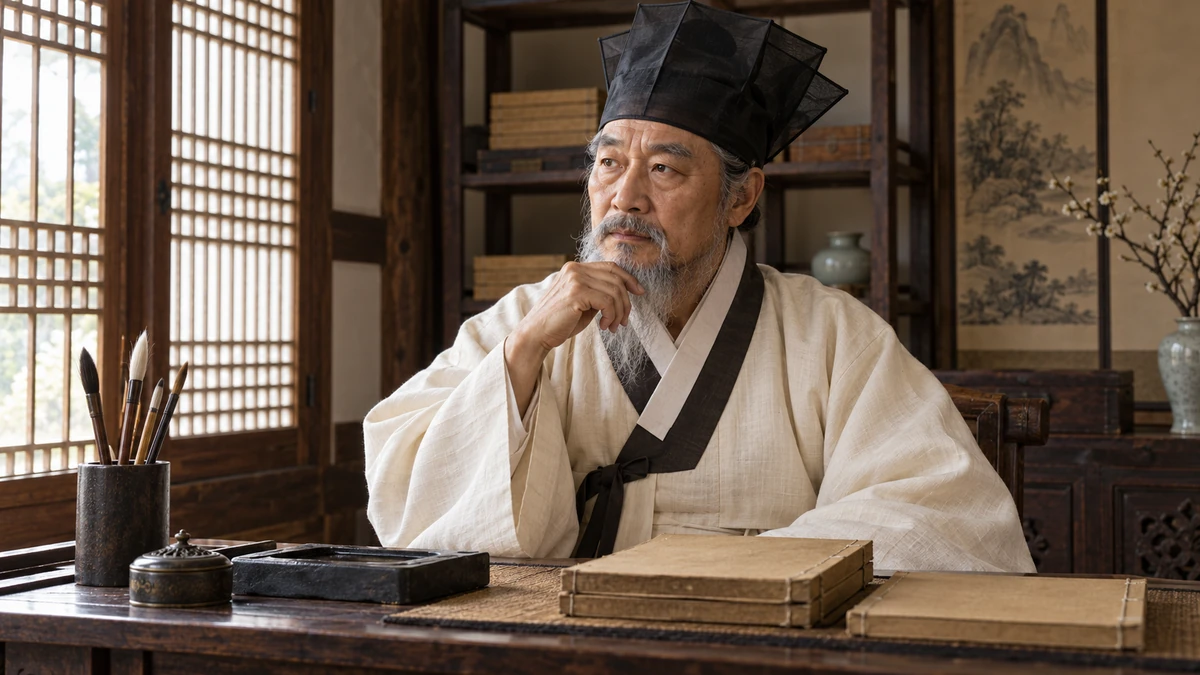
Image to help understand the article
Choe Han-gi, a 19th-century Korean philosopher, geographer and prolific writer, spent his life pursuing books rather than government office. At a time when orthodox Neo-Confucianism dominated intellectual life in Korea’s Joseon dynasty, Choe argued that knowledge should be tested through experience and used to improve everyday life.
Born Oct. 26, 1803, in Kaesong, in what is now North Korea, Choe studied Chinese classics and Neo-Confucian philosophy under family members and prominent scholars. He also drew inspiration from Silhak, or “practical learning,” a Korean intellectual movement that emphasized evidence, economic development and useful knowledge.
A Life Devoted to Books
Choe passed two preliminary civil service examinations in 1825 but abandoned plans for an official career after becoming disillusioned with the state examination system. He criticized hiring based on personal connections and devoted himself instead to reading, writing and teaching.
His appetite for books was costly. Choe sought out new publications arriving in Seoul from China, sometimes buying them at high prices and reselling them cheaply after reading them. When relatives suggested that he move to the countryside and farm as his finances declined, he replied that although farming was desirable, obtaining books was an even greater ambition.
In 1841, Chief State Councilor Jo In-yeong repeatedly tried to recruit him into government service. Choe refused, saying he could not take office by borrowing prestige he had not earned. His eldest son, Choe Byeong-dae, followed a different path, passing the highest-level civil service examination in 1862 and later serving King Gojong.
Knowledge Rooted in Experience
At the center of Choe’s philosophy was the idea that human knowledge is not fully present at birth but develops through experience. He argued that people encounter the external world through the senses and that knowledge becomes more reliable when it is confirmed repeatedly through multiple forms of observation.
Choe described reasoning from experience and memory as “inference.” His methods included understanding other people by reflecting on oneself, inferring character from emotion and judging events through observable objects and actions. He set out these ideas in two works published in 1836, later combined under the title “Gicheuk Cheui.”
His system, known as gihak, centered on “gi,” a concept commonly rendered as material force or vital energy in East Asian philosophy. Choe considered gi more useful than abstract principle because its movement and effects could be observed. He used it to explain change in nature, the universe and human society.
That approach brought him into conflict with scholars who treated the teachings of the Chinese thinker Zhu Xi as unquestionable truth. Choe even challenged the traditional claim that fundamental virtues were innate, arguing instead that they were habits acquired through experience. “When learning is present in life, it becomes practical learning,” he wrote. “When it is absent from life, it becomes empty learning.”
From World Maps to Western Medicine
Choe worked closely with Kim Jeong-ho, the celebrated Korean cartographer best known for mapping the Korean Peninsula. The two carved a world map onto jujube-wood printing blocks, and Choe wrote an inscription for Kim’s “Cheonggudo” map after its completion in 1834.
In his 1857 geographical work “Jigu Jeonyo,” Choe compiled information about the geography, history, products and scholarship of countries around the world. Drawing on Chinese-language works, he introduced Western scientific ideas including a spherical Earth, its rotation and its orbit around the sun. Such claims were sometimes dismissed in Joseon Korea as absurd or deceptive, but Choe incorporated them into a broader system combining East Asian philosophy with Western science.
He used examples from Western physics to discuss sound as vibration, reflection and the refraction of light. He also assigned Korean-Chinese names to instruments such as the thermometer and hygrometer.
Choe’s 1867 work “Seonggi Unhwa” adapted a Chinese translation of writing by British astronomer William Herschel. A year earlier, he compiled “Singi Cheonheom” from medical books by British missionary physician Benjamin Hobson, offering Korean readers a broad introduction to Western medicine. Choe described the body in mechanical terms and concluded that Western medicine was more advanced than East Asian medicine in anatomy and pathology.
Education, Merit and an Open Korea
Choe argued that education should not remain the privilege of elite families or serve merely as a route to wealth and status. He supported education for commoners and women and called for instruction not only in Confucianism but also in mathematics, physics, astronomy, medicine, commerce and engineering. He encouraged students to learn practical skills in trade, health care and manufacturing rather than romanticizing poverty.
In his 1860 book “Injeong,” Choe advocated selecting officials according to ability instead of family background or academic pedigree. He also argued that people with disabilities should have opportunities to study and work.
After King Gojong took the throne, Choe called for trade and greater engagement with foreign countries. He believed Korea should interact with other nations on equal terms and selectively adopt Western science and technology. A small group of reform-minded intellectuals supported those views, but leading conservative scholars rejected them, and the powerful regent Heungseon Daewongun regarded them with displeasure.
Advice During an Early U.S.-Korea Clash
Choe’s knowledge of Western technology became especially relevant during the 1871 U.S. military expedition to Ganghwa Island, an early armed encounter between the United States and Korea. With the regent’s permission, military official Jeong Gi-won sought Choe’s advice.
Choe warned that Western troops used firearms smaller and sturdier than cannons and matchlock guns and said Korean forces should prepare for the possibility of a larger deployment. He recommended remaining in Seoul, where he could consult books and review battlefield reports, rather than traveling to the military camp on Ganghwa Island.
A Reputation Revived After His Death
From his 1830 agricultural compendium “Nongjeong Hoeyo” to his later works on astronomy, geography, medicine, philosophy, mathematics and public administration, Choe produced an extraordinary body of writing. Historical records credit him with more than 1,000 volumes, though only part of that output survives.
In old age, he pawned books and sold writings, calligraphy and artwork to support himself, then spent much of the income on more books. He received honorary government rank in 1872 because of his son’s royal service and was appointed to government posts in 1875, but resigned on grounds of illness.
Choe’s final years also reflected the tensions of an era divided over foreign influence. Although he had advocated opening Korea to international exchange, he supported his son’s anti-foreign memorial to the throne in 1876 and praised him after he was exiled for it.
Choe died June 21, 1879. The royal government posthumously honored him in 1892, but his ideas had drawn controversy during his lifetime. His books circulated in China, and scholarly interest in his work grew after the end of the Joseon dynasty. Korean researchers began sustained studies of his philosophy in the early 1960s, and South Korea’s National Institute of Korean History began translating major works into modern Korean in 1979.
Choe is now remembered as a bridge between Silhak and the reformist thinking that accompanied Korea’s opening to the outside world. His effort to reconcile East Asian philosophy with empirical observation and Western science made him one of the most distinctive intellectual figures of late Joseon Korea.
Comments
Post a Comment