Image to help understand the article
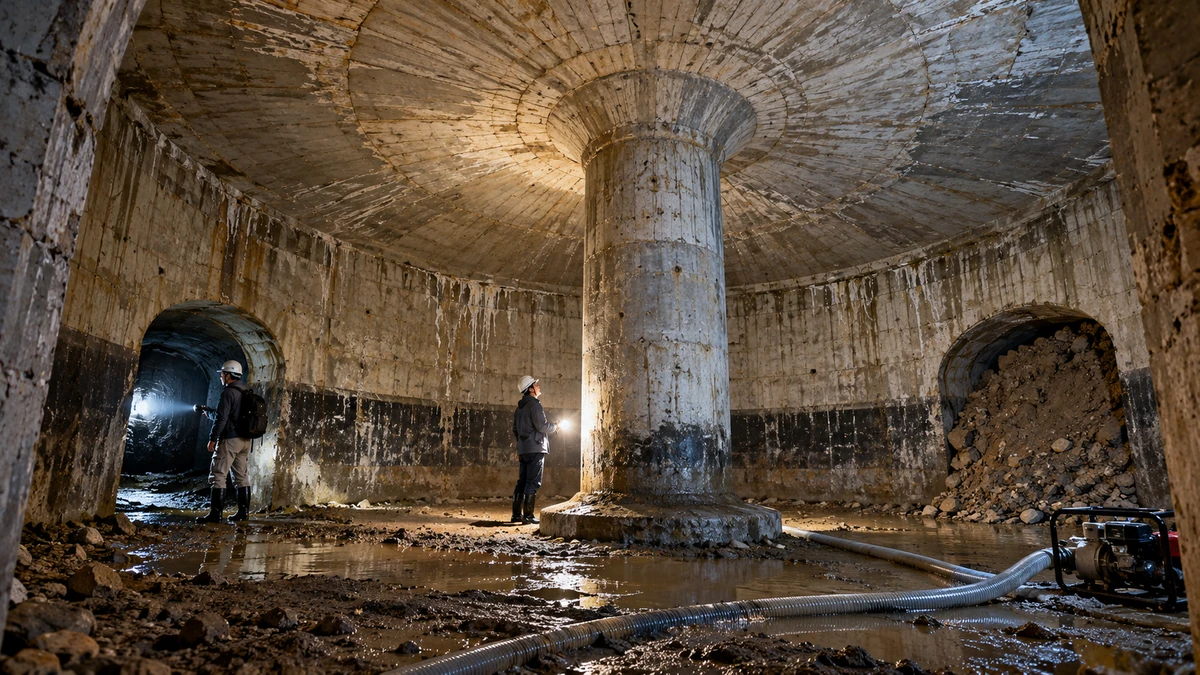
Photographs of underground military facilities built during Japan’s colonial rule over Korea have been publicly disclosed for the first time, revealing tunnels, caves and a distinctive dome-shaped chamber beneath Camp Market and nearby areas in Incheon.
Rep. Noh Jong-myeon of the opposition Democratic Party presented the images during a parliamentary audit of South Korea’s national heritage agency. Noh, whose district includes Bupyeong, said multiple Japanese-built structures had been identified beneath Camp Market, Buyoung Park and nearby Hambong Mountain.
The material presented to lawmakers indicated that the facilities were likely connected to an Imperial Japanese Army arsenal established at the site in 1939. Noh called for the dozens of military caves and other underground structures to be evaluated as modern cultural heritage.
A Rare Underground Dome
The most unusual discovery was a circular, domed structure in Camp Market’s Section D. A central pillar supports the chamber, which had to be drained with pumps before investigators could examine it. It has two entrances, one of which was buried in soil.
Cho Geon, a history education professor at Dongguk University, said investigators had found several types of underground structures, including tunnels and arched chambers, but that the dome was unique. He described the arsenal as an important historical site because of its role in Japan’s expansion of war onto the Korean Peninsula.
Jeong Hye-kyung, head of the Japanese War Network, said the domed chamber may have been used as a meeting place.
Tunnels May Extend Across Multiple Levels
Other discoveries include an underground tunnel about 300 meters, or nearly 1,000 feet, long near the boundary between Camp Market and Buyoung Park. Stairs leading farther underground suggest the complex may have been built on multiple levels.
Investigators also found an entrance fitted with a heavy iron door, caves cut directly into bedrock and concrete structures. According to Noh, the deepest facility lies about 200 meters, or 650 feet, underground.
Calls for a New Investigation
The structures were documented during an Incheon city investigation conducted from May 2022 to May 2024, but the findings were not made public, Noh said. The city also apparently did not provide detailed results to South Korea’s Defense Ministry or national heritage agency, sharing only some photographs with the heritage authority. No additional investigation followed.
Jeong urged authorities to determine the purpose and historical significance of the full underground complex. She said a new inquiry should begin quickly given the lack of follow-up since the research project ended.
From Japanese Arsenal to US Military Base
Camp Market, in Incheon’s Bupyeong district west of Seoul, was built on the site of the Japanese army arsenal. After Japan’s surrender in August 1945, the area served as part of a broader U.S. military complex in South Korea until June 1973.
The property was formally returned to South Korea on Dec. 11, 2019, and is now owned and managed by the Bupyeong district government. Plans call for the former base to be redeveloped.
Noh argued that the underground structures should be assessed together as a heritage district rather than as isolated sites. He proposed connecting their preservation and tourism potential with the planned public park project at Camp Market.
Heo Min, head of the national heritage agency, said officials should consider a detailed investigation and discuss how to preserve the site as modern heritage. He also said modern historical properties can be adapted for cultural and commercial uses, including museums, libraries and cafes.
Comments
Post a Comment